Postpartum abdominal changes
often feel different from simply “gaining weight.”
Even with no change in body weight,
the belly may protrude forward,
wrinkles may form on thinned skin,
and deeper changes in the skin and muscle
are often directly felt.
Some women naturally return to their pre-pregnancy shape
through postpartum care.
But when rectus muscles are separated
or skin elasticity has dropped,
sagging becomes a real concern.
While a healthy diet and exercise
can support general body maintenance,
they often fall short in solving these issues.
When such structural concerns persist,
a surgical correction involving
skin, muscle, and abdominal wall
may be necessary through medical evaluation.
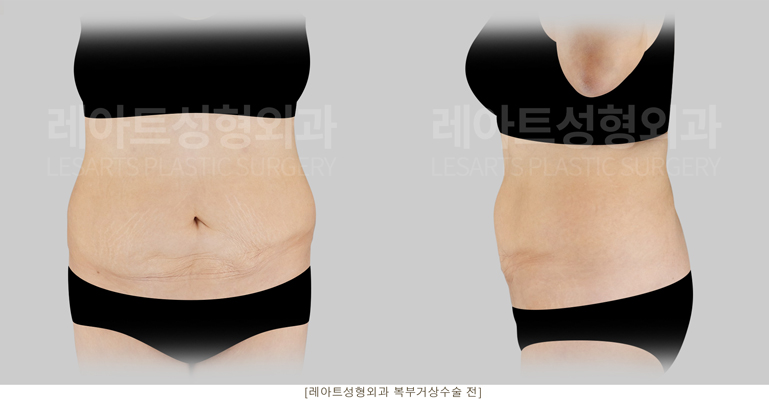
The patient featured today
is in her mid-40s and has had
two vaginal deliveries.
After childbirth,
she experienced increased wrinkling
and sagging in her lower abdomen
due to loss of skin elasticity.
She also reported fat accumulation
around the navel and central lower abdomen,
creating imbalance in her figure
and making her upper body look heavier—
a constant source of stress.
She concluded that diet and exercise
couldn’t solve this problem,
so she visited us to receive
a tummy tuck procedure.
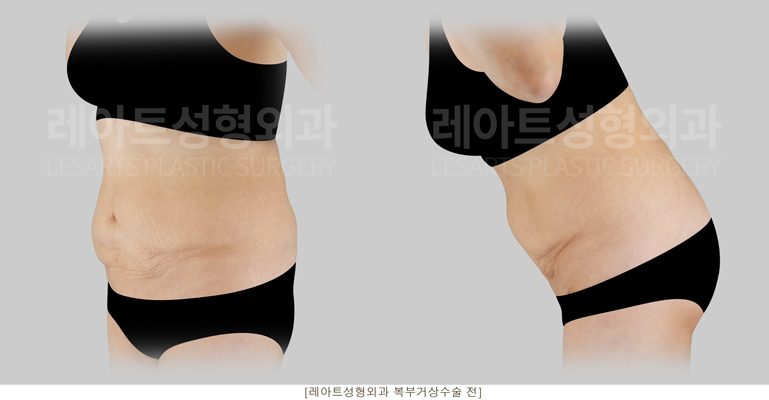
Consultation showed that the patient had
significantly reduced skin elasticity
across her upper and lower abdomen,
with notable sagging and deep wrinkles
centered in the lower belly.
Her skin was overall thin
and had lost resilience.
The lower abdomen wasn’t just wrinkled—
it showed visible folding with volume
shifting downward.
She also presented with rectus diastasis,
a separation of abdominal muscles,
causing the belly to bulge outward
and lose internal support,
especially around the upper navel.
This created uneven flow
throughout the abdomen,
with differences in tone and volume
that broke up the abdominal line.
In this case, both sagging skin
and muscle separation led to
decreased abdominal wall support,
requiring not just liposuction
but full structural correction.
1. M-type tummy tuck
To lift sagging skin
from upper to lower abdomen
and strengthen weakened rectus muscles,
we planned an M-type abdominoplasty
to restore central core support.
The navel was reconstructed in a vertical shape
to blend naturally with the new abdominal contour.
2. Abdominal liposuction
To refine subcutaneous fat
accumulated across the abdomen,
liposuction was added
to enhance contouring results.
3. Hip dip fat grafting
Because there was a lack of volume
around the waist-to-hip transition,
we planned to graft some fat
harvested from the abdomen
to the hip dip area,
creating a smoother lower body curve.
Let’s now review the changes
and recovery progress at 4 months post-op.
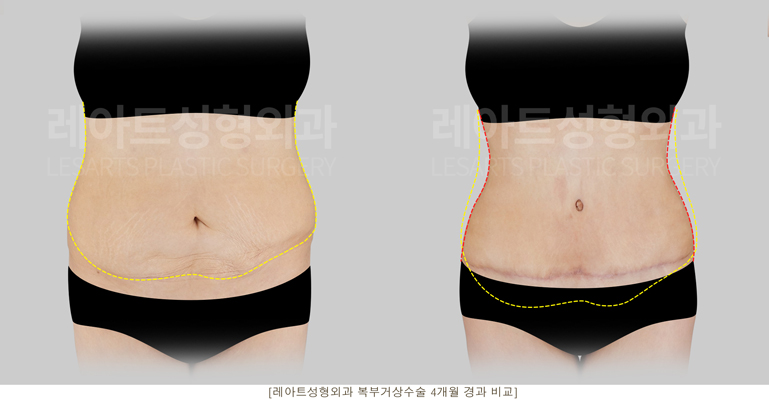
Before surgery,
the abdominal center had severely weakened tone,
with loose lower belly skin
folding downward and creating deep wrinkles
below the navel.
Due to rectus diastasis,
the abdominal core pushed forward,
making the belly protrude unnaturally.
Fat buildup and flat hips
created an awkward connection
between waist and pelvis,
blurring the transition from upper to lower body.
But after tummy tuck, liposuction,
and hip fat grafting,
we see a smooth, flat abdominal plane
with lifted skin and restored muscle tone.
The curve extending below the waist
has also become more natural and firm,
resulting in a neat and defined waistline.
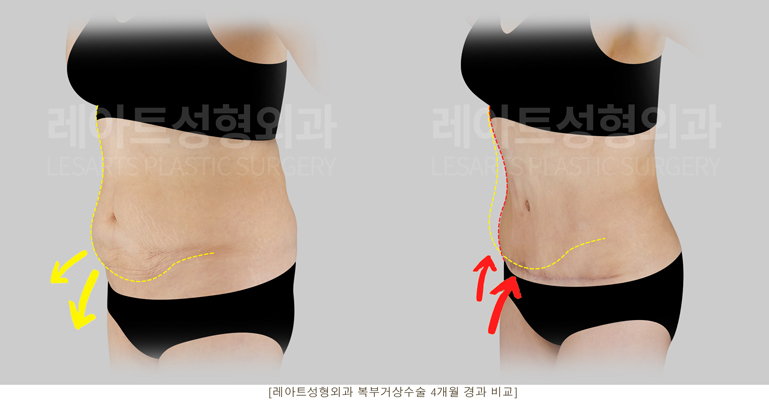
From a semi-profile view,
sagging skin and fat previously pulled downward,
creating a drooping and heavy look.
But post-surgery, the lifted lower abdomen
gave rise to a clear waistline
and smoother body curvature.
Even when bending forward,
we see a dramatic difference.
Before surgery,
skin loosened and folded visibly
during forward motion,
creating heavy wrinkles and bulging.
After the tummy tuck and rectus repair,
the skin stayed taut,
and the abdominal wall remained firm
with no bulging or sagging folds,
even in a bent position.

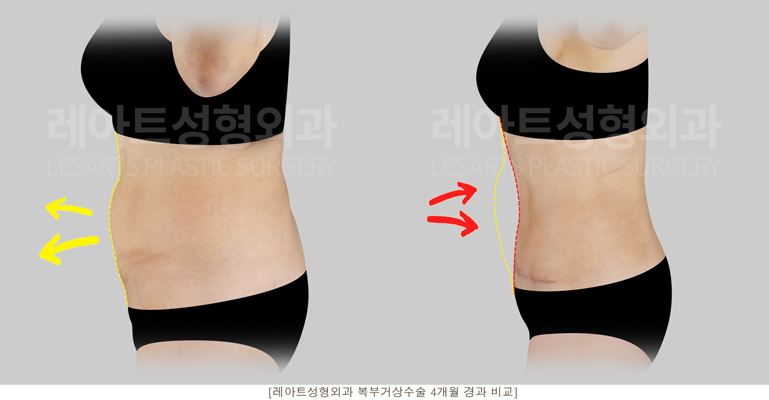
From the side,
we can clearly see the elimination
of abdominal wall protrusion.
Before surgery,
bulging and sagging were visible
both above and below the navel,
causing an uneven, heavy appearance.
After surgery,
the skin tightened and the abdomen
was flattened, presenting a slimmer
and more stable side profile.
In this patient’s case,
the main causes of abdominal bulge
weren’t just fat accumulation,
but muscle laxity and skin sagging.
Therefore, we didn’t stop
at removing fat or lifting skin.
We included muscle repair,
liposuction, and fat grafting
to correct functional issues
and achieve a balanced transformation.
The patient remained diligent
throughout the recovery process
and continues self-care at home
to maintain stable results post-op.
With continued scar and elasticity care,
she is likely to preserve
this smooth abdominal contour
for the long term.












