




Online Consultation
Please accurately enter the information below.
Quick Cost Consultation
Quick Consultation & Reservation
Cases finding
similar to my profile






Cases finding
similar to my profile
Customer Diagnostics
Gynecomastia correction with gland removal and liposuction → improved chest contour
2025-04-03

This patient is a man in his early 30s,
who has experienced gynecomastia symptoms since his teenage years.
The symptoms persisted throughout his 20s,
and even after losing about 20 kg during military service,
there was no change in the size or shape of his chest.
Moreover, as he recently gained weight,
the chest protrusion became more pronounced,
which increased his daily discomfort.
He was stressed because he couldn’t wear
tight-fitting clothes or even loose outfits
that revealed the chest silhouette clearly.
This made him constantly worry about his work attire,
and even casual outings caused significant stress.
In the end, he realized that exercise and dieting
could not fundamentally solve his gynecomastia,
so he came to our clinic for help.

The patient’s chest protrusion was clearly visible to the naked eye,
and the size and shape appeared large and rounded.
For a more accurate diagnosis,
an ultrasound examination was performed,
which confirmed excessive glandular tissue growth in both breasts.
The condition was diagnosed as true gynecomastia, Simon Grade 2A.
Based on this, our clinic planned and explained the following surgical approach:
Glandular tissue excision to precisely remove the glandular tissue —
the root cause of the chest protrusion.
Liposuction to remove fat accumulated in the lower chest and side areas,
which contributed to the chest size and bulging shape.
To prevent tissue adhesion and nipple inversion,
an adhesion prevention procedure and tissue repositioning surgery were performed.
Below, we will review the before-and-after photos
taken pre-surgery and 2 months post-surgery
to see how the chest line changed over time.
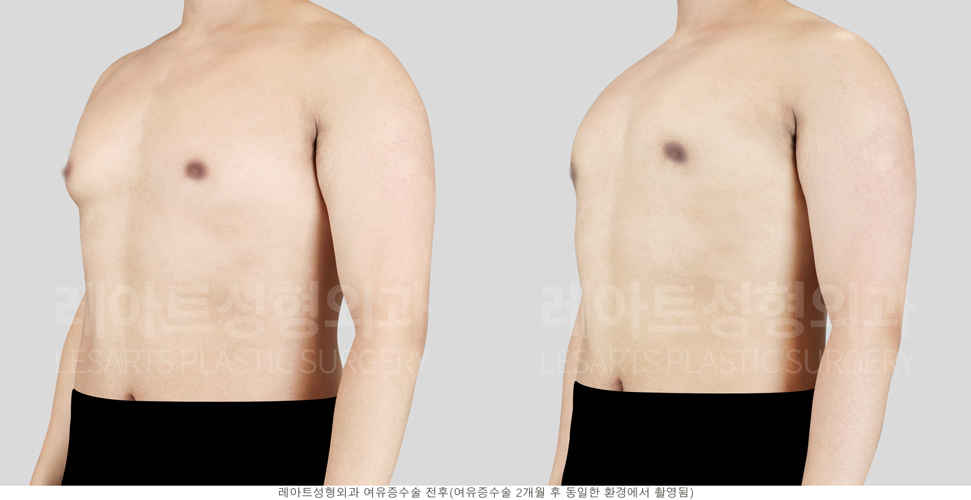
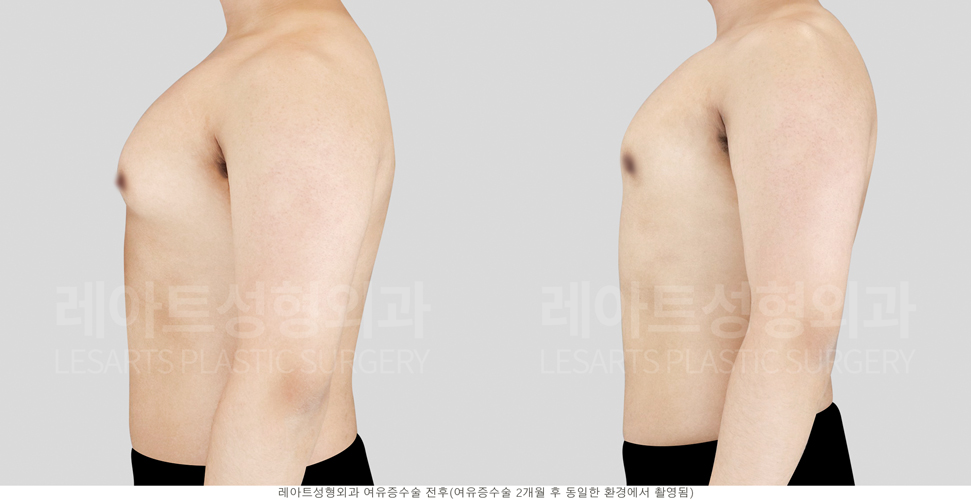
Looking at the pre-surgery photos,
both sides of the chest showed significantly enlarged glandular tissue,
resulting in a noticeably protruding chest shape.
This was especially prominent from the side view,
where the lower part of the chest also bulged outward.
However, 2 months after the gynecomastia surgery,
with the removal of glandular tissue and liposuction of the side chest fat,
the volume disappeared,
and the chest transformed into a flat, smooth, and masculine contour.
From the side view after surgery,
the previously protruding chest line now appears firm and
the chest contour looks natural and well-defined.
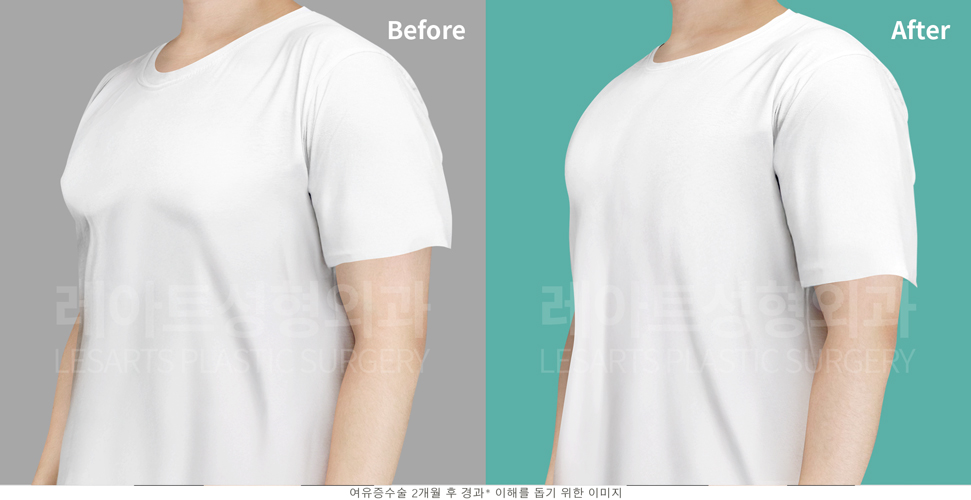
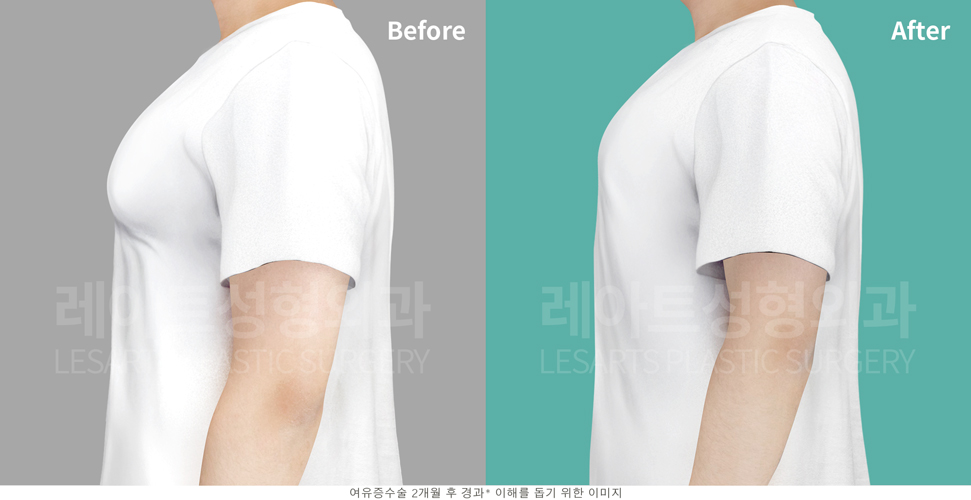
Clear changes are visible in the before & after photos wearing a white T-shirt.
Before surgery,
the chest volume was prominent,
which caused discomfort.
But after 2 months,
this issue was completely resolved.
Now, even wearing just a thin T-shirt,
the fit looks clean and natural.
Especially,
fat that had spread to the outer chest area was reduced,
making the overall chest line slimmer and more balanced.
With these changes,
the patient’s confidence noticeably increased.
However,
since the patient had gynecomastia symptoms for a long time,
continuous follow-up after surgery is necessary.
We made sure the patient fully understood this,
and advised regular visits for check-ups
to maintain the good results.
#Male body contouring
#Gynecomastia
#Grade2-A #true gynecomastia #Side chest liposuction


Cases finding
similar to my profile
Customer Diagnostics


Select the surgery and
area you are interestedto see real
before andafter changes.


we
make you,
the art
Clinic hours
MON - FRI
10 am – 7pm
SAT
10 am – 4pm
Holiday
SUN, HOLIDAY
Location
Lesarts Moon Clinic Tower 4-5F, 40, Nonhyeon-ro 168-gil,
Gangnam-gu, Seoul, Republic of Korea

Medical institution name Lesarts Plastic Surgery
Address Lesarts Moon Clinic Tower 4-5F, 40, Nonhyeon-ro 168-gil, Gangnam-gu, Seoul, Republic of Korea
Representative Moon sung jun
