




Online Consultation
Please accurately enter the information below.
Quick Cost Consultation
Quick Consultation & Reservation
Cases finding
similar to my profile






Cases finding
similar to my profile
Customer Diagnostics
Sagging Lower Belly After C-Section (Abdominoplasty | Tummy Tuck | C-Section Belly | Lower Belly Sagging | Diastasis Recti Repair | M-Type Tummy Tuck | Belly Button Reconstruction | Abdominal Liposuction | 3-Month Results | Seoul Gangnam Clinic)
2026-01-19
Today’s case features a patient whose abdominal shape
did not return to its pre-pregnancy condition—
even after plenty of time had passed since childbirth.
She maintained a stable weight after her C-section,
but her lower abdomen remained loose and creased,
prompting her to consider abdominoplasty (tummy tuck).

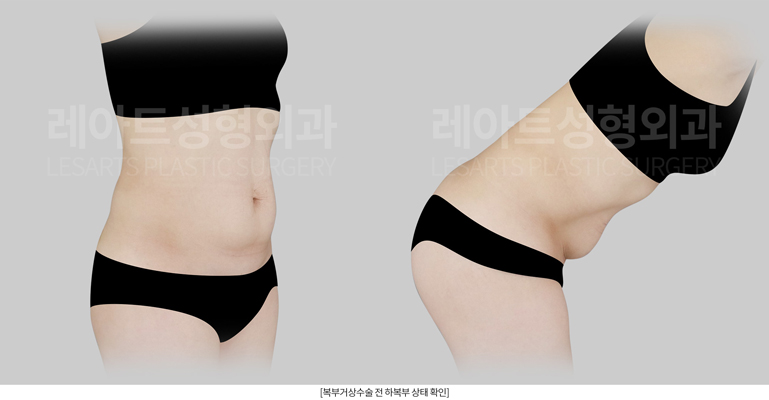
Preoperative Assessment
Before surgery, the patient showed several concerns:
-Significant wrinkling above the belly button
-Lower abdominal skin folding whenever she moved
-Reduced skin elasticity despite weight stability
-No structural improvement even after multiple fat-dissolving injections
She also mentioned that core tightening or exercise
did not help create abdominal tone.
Clinically, even when she tensed her abdomen,
the shape did not hold—indicating that the issue
went beyond simple fat accumulation.
A summary of her abdominal findings:
- Shape does not improve even with muscle engagement
- Wrinkles above the belly button
- Lower abdomen folds with movement
- Decreased elasticity after childbirth
- Structural changes involving skin, fascia, and abdominal wall
In short, this was not a “fat issue” alone.
It was a combined problem of stretched skin, weakened fascia,
and abdominal wall laxity, meaning exercise or injections
could not fundamentally correct it.
Surgical Plan
To correct the structural issues,
the following surgical plan was designed:
1. M-Type Abdominoplasty
-Removal of the previous C-section scar
-Tightening loose skin of both upper and lower abdomen
-Smoothing deep folds and wrinkles
2. Rectus Muscle Repair (Triple-Lock Repair)
-Reinforcement of the weakened abdominal wall
-Tightening of the central and bilateral rectus muscles
-Restoring stability lost after pregnancy
3. Belly Button Reconstruction
-Creating a natural, stable umbilical shape after excess skin removal
-Repositioning the navel to the proper anatomical location
4. Abdominal Liposuction
-Enhancing overall contour and waist definition
-Improving balance between the lifted skin and abdominal volume
Together, these procedures address both skin laxity and
internal structural weakness, which is crucial for long-lasting results.

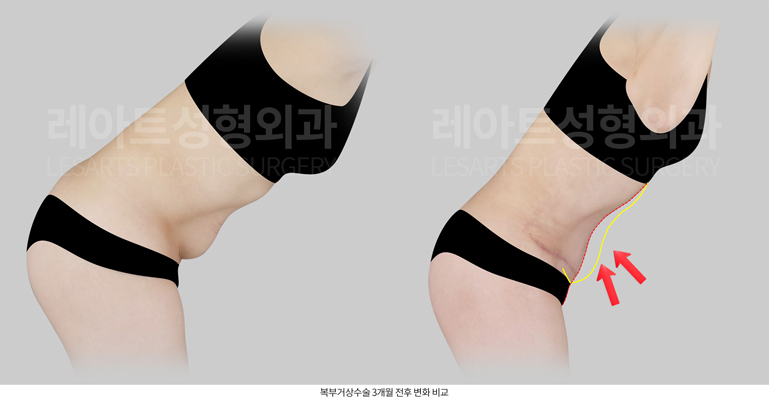
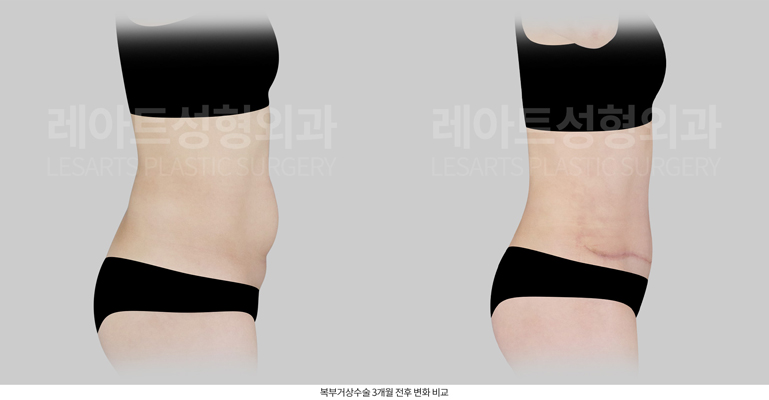
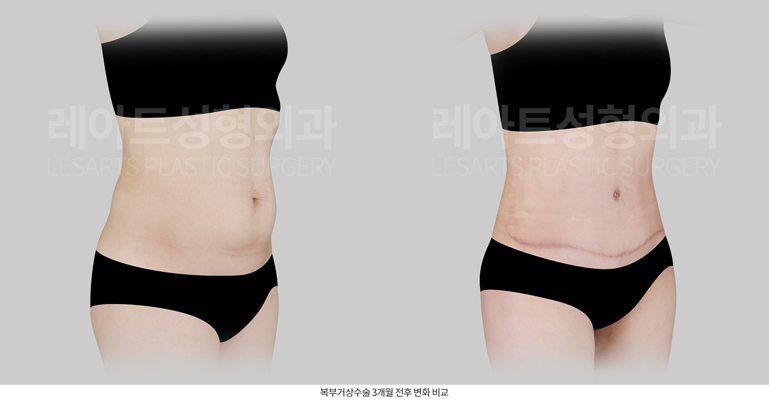
3-Month Before & After — Visible Improvement in Contour & Stability
Comparing the images taken before and 3 months after surgery:
- Upper belly wrinkles have disappeared
- The front abdomen appears firm and smooth
- Side-waist contour has tightened significantly
- The overall abdominal ratio looks more balanced
- The transition from waist to pelvis is now clean and defined
Before surgery, bending forward caused:
-Loose skin to fold heavily
-Weak abdominal wall support to “spill forward,”
creating a bulging appearance
At 3 months post-op, these issues have been fully corrected.
Patient Feedback
Before surgery, she felt discomfort whenever
she changed posture because
the lower abdominal skin folded easily.
After abdominoplasty, she reported that:
-The folding sensation disappeared
-Clothing fit became much more comfortable
-Daily movement no longer caused stress
She particularly noted that her abdomen now feels stable and firm,
which she had not experienced since childbirth.
#Abdominoplasty
#M-type
#Abdominal liposuction(M) #Hip Fat Transfer(M)


Cases finding
similar to my profile
Customer Diagnostics


Select the surgery and
area you are interestedto see real
before andafter changes.


we
make you,
the art
Clinic hours
MON - FRI
10 am – 7pm
SAT
10 am – 4pm
Holiday
SUN, HOLIDAY
Location
Lesarts Moon Clinic Tower 4-5F, 40, Nonhyeon-ro 168-gil,
Gangnam-gu, Seoul, Republic of Korea

Medical institution name Lesarts Plastic Surgery
Address Lesarts Moon Clinic Tower 4-5F, 40, Nonhyeon-ro 168-gil, Gangnam-gu, Seoul, Republic of Korea
Representative Moon sung jun
