




Online Consultation
Please accurately enter the information below.
Quick Cost Consultation
Quick Consultation & Reservation
Cases finding
similar to my profile






Cases finding
similar to my profile
Customer Diagnostics
Enlarged Areola & Pointed Nipples—Could It Be Gynecomastia? (Gynecomastia Surgery | Male Breast Reduction | Enlarged Areola | Puffy Nipple | Gland Overgrowth | Simon Grade 2A | Chest Liposuction | Ultrasound Diagnosis | Seoul Gangnam Clinic)
2026-01-15
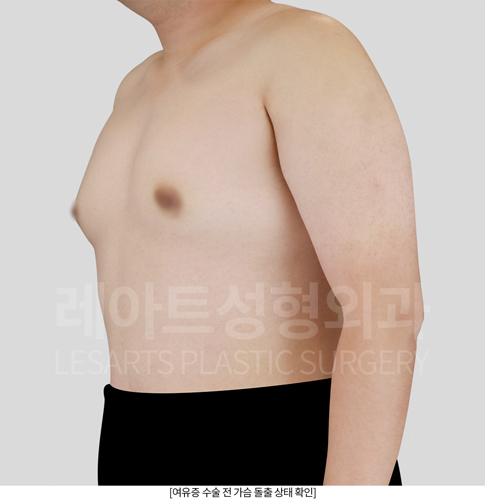
Many men experience unexpected changes in their chest over time—
especially after weight gain or lifestyle changes.
When the chest suddenly looks fuller or the nipple area
becomes more prominent, it’s natural to wonder:
“Is this gynecomastia?”
Some cases are simply pseudo-gynecomastia,
where chest fat increases temporarily and improves with dieting or exercise.
But true gynecomastia involves glandular overgrowth,
which does not shrink with weight loss.
That’s why chest enlargement cannot be diagnosed by weight or BMI alone.
If the appearance continues to cause stress,
a medical evaluation is recommended.
The patient in today’s case developed
gynecomastia symptoms in his teens.
Despite exercise and weight control,
his chest projection and nipple shape did not improve,
which led him to seek treatment.
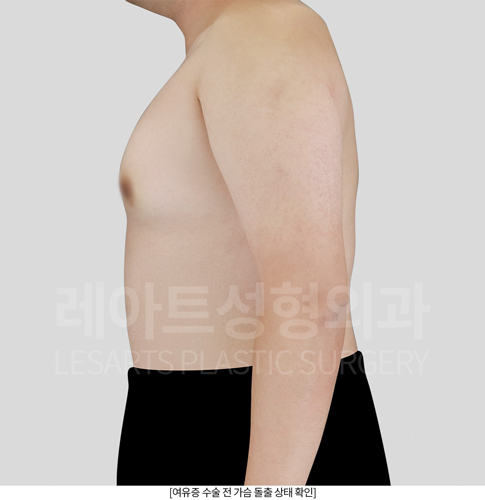
Pre-Surgery Evaluation
Patient Profile
-Age: Early 30s
-Height / Weight: 182 cm / 100 kg
-BMI: 30
-Diagnosis: Simon Grade 2A gynecomastia
During evaluation:
-A firm lump was felt beneath and around the areola
-Ultrasound imaging confirmed significant glandular tissue overgrowth
-The areola appeared enlarged and swollen due to the underlying gland
-No tenderness, nipple discharge, inverted nipple, or sagging was observed
Because the primary cause was gland enlargement
—not fat alone—exercise could not correct the condition.
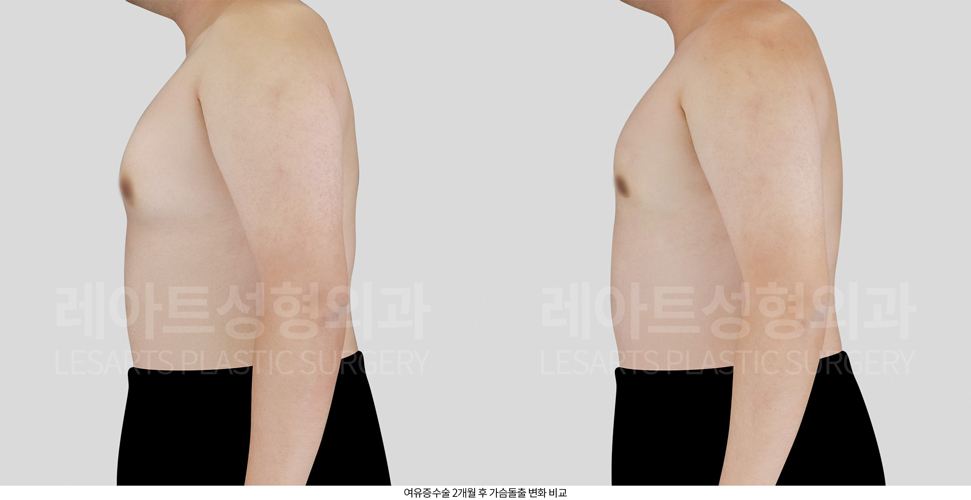
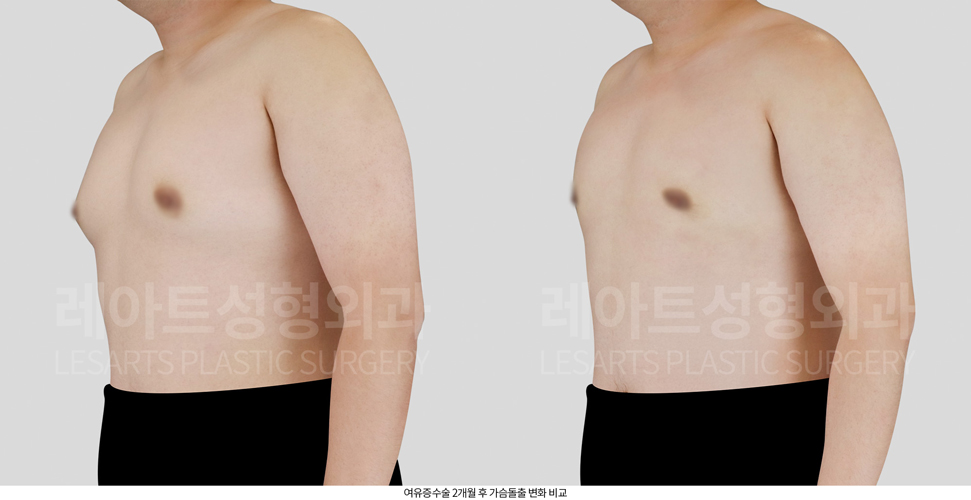
Before & After: 2-Month Chest Projection Improvement
Comparing photos before and after surgery:
- Chest projection has decreased noticeably
The pointed nipple shape and swollen areola
have settled into a flat, natural contour.
- Masculine chest lines are restored
Despite his tall height and strong build,
the chest projection had previously become the focal point.
Now, the contour from upper chest → upper abdomen appears clean and athletic
—similar to the results of consistent strength training.
- No dents or irregularities
Because lateral chest liposuction was performed together
with gland removal, the entire chest wall settled smoothly.
The improvement is especially significant since the patient
had maintained a large frame even at different body weights—
the chest fullness was due to gland tissue, not fat.
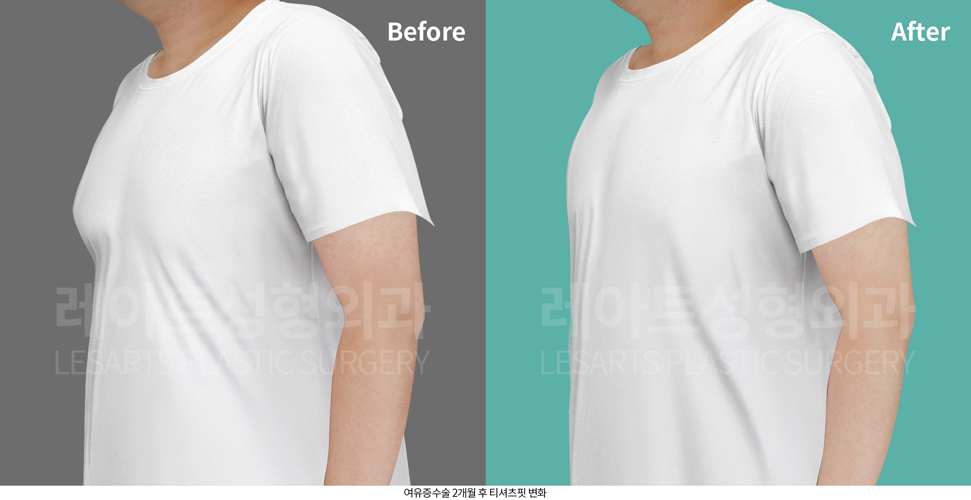
T-Shirt Fit After Surgery
Before surgery:
-The chest protruded noticeably under T-shirts
-The nipple–areola area drew unwanted attention
-He felt self-conscious every time he wore fitted or lightweight tops
After surgery:
-T-shirts now fit flat and naturally
-There is no visible projection of the nipple/areola
-He reported that the stress he felt when
dressing has completely disappeared
This kind of change is one of the main reasons men choose gynecomastia surgery
—because clothing fit has a major impact on daily confidence.
Why Ultrasound Is Important for Accurate Diagnosis
-Chest projection
-Puffy or enlarged areola
-Palpable lumps
-Nipple tenderness
-Nipple discharge
-Sagging or stretched chest skin
But only ultrasound can confirm whether the cause is:
- Fat (pseudo-gynecomastia)
or
- Glandular overgrowth (true gynecomastia)
Because treatment options differ between the two,
proper diagnosis ensures the most effective surgical plan.
Final Thoughts
For this patient, identifying the exact cause of chest enlargement
—and treating it through gland removal + lateral chest liposuction—resulted in:
-A natural, masculine chest
-Improved confidence
-Better clothing fit
-Resolution of long-term discomfort
His recovery has been stable, and the chest contour
will continue to refine over the coming months.
#Male body contouring
#Gynecomastia
#Grade2-A #true gynecomastia #Side chest liposuction


Cases finding
similar to my profile
Customer Diagnostics


Select the surgery and
area you are interestedto see real
before andafter changes.


we
make you,
the art
Clinic hours
MON - FRI
10 am – 7pm
SAT
10 am – 4pm
Holiday
SUN, HOLIDAY
Location
Lesarts Moon Clinic Tower 4-5F, 40, Nonhyeon-ro 168-gil,
Gangnam-gu, Seoul, Republic of Korea

Medical institution name Lesarts Plastic Surgery
Address Lesarts Moon Clinic Tower 4-5F, 40, Nonhyeon-ro 168-gil, Gangnam-gu, Seoul, Republic of Korea
Representative Moon sung jun
