




Online Consultation
Please accurately enter the information below.
Quick Cost Consultation
Quick Consultation & Reservation
Cases finding
similar to my profile






Cases finding
similar to my profile
Customer Diagnostics
Post-C-Section Belly Sagging (Tummy Tuck | Abdominoplasty | M-Type Tummy Tuck | C-Section Scar Revision | Diastasis Recti Repair | Lower Belly Sagging | Loose Abdominal Skin | Belly Button Reconstruction | Abdominal Liposuction | Hip-Dip Fat Grafting | Se
2026-01-27
Many women experience lasting abdominal changes after childbirth
—especially after multiple C-sections.
The patient in this case had two C-section deliveries,
and even after years had passed,
her abdomen did not return to its pre-pregnancy shape.
She struggled with:
-Lower belly sagging
-Overall loss of abdominal firmness
-Deepened skin folds
-A stretched abdominal wall
Despite trying weight control and various treatments
such as fat-dissolving injections,
she saw minimal improvement.
This led her to consider a more fundamental solution:
abdominoplasty (tummy tuck).
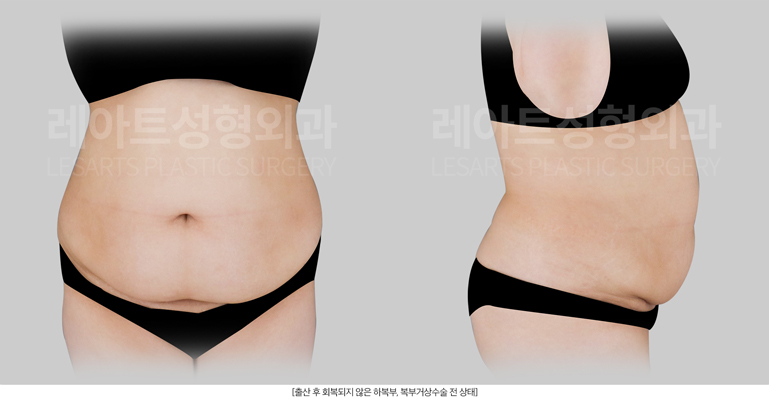
Preoperative Assessment
During consultation, the following abdominal
characteristics were confirmed:
-Significant skin looseness across both upper and lower abdomen
-Fat accumulation throughout the abdominal area
-Skin folding and heaviness in the lower abdomen
-Reduced elasticity, making it difficult for the abdominal shape to hold
-Diastasis recti causing poor abdominal wall support
This was not simply a “fat” issue.
The main problem was structural—a combination of:
-Stretched, sagging skin
-Weakened abdominal wall
-Loss of skin elasticity
-Post-pregnancy deformation
Because of this, dieting, exercise,
or injections alone could not achieve meaningful correction.
A comprehensive surgical approach was required.
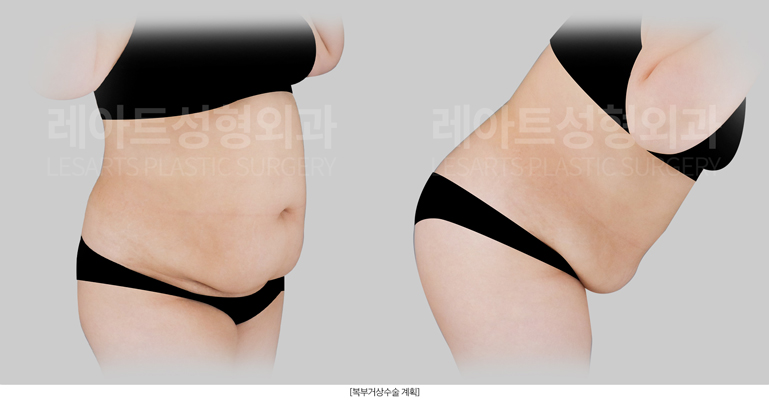
Surgical Plan
M-Type Tummy Tuck + Diastasis Repair + Belly Button Correction + Liposuction + Hip-Dip Fat Grafting
1. M-Type Abdominoplasty
-Removes loose skin from the entire abdomen
-Smooths upper–lower abdomen continuity
-Eliminates the old C-section scar
2. Rectus Muscle Repair (Diastasis Recti Correction)
-Repositions separated muscles
-Restores abdominal wall strength
-Prevents forward bulging when standing or bending
3. Belly Button Reconstruction
-Necessary due to skin removal
-Creates a natural, stable placement of the umbilicus
4. Abdominal Liposuction
-Enhances overall contour
-Helps achieve a smoother silhouette
around waist and upper abdomen
5. Hip-Dip Fat Grafting
-Restores body-line balance after abdominal improvement
-Fills naturally depressed areas around the pelvis
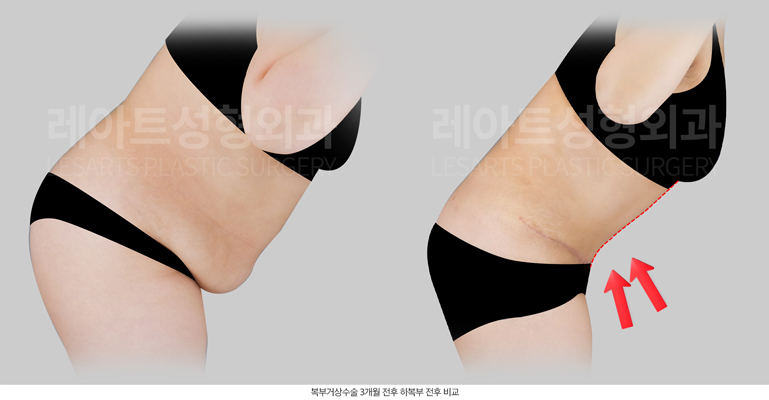


3-Month Before & After (Lower Abdomen Comparison)
After surgery, the following improvements were seen:
-Loose skin from the upper abdomen was tightened
-The heavy, folded lower belly became smooth
-The previously protruding abdominal wall became stable after muscle repair
-The waist-to-hip line appeared cleaner and more connected
From the side view,
the abdomen no longer bulged outward.
Instead, the line from the waist to the pelvis flowed
naturally and looked much lighter.
Because the patient originally had both fat and
severe skin laxity, the tummy tuck significantly reduced
the heaviness of the lower abdomen.
The disappearance of skin overhang created
a visibly more refined, balanced appearance.
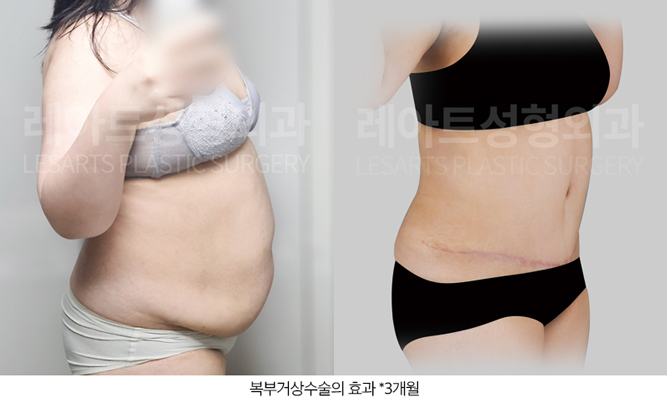
45-Degree Angle Comparison
Structural Improvement After Tummy Tuck
Viewed at 45 degrees:
-The entire abdominal shape looks stabilized
-Skin folds and weight at the lower abdomen have resolved
-Core support improved thanks to rectus muscle repair
-The abdomen maintains its shape during movement
This case is especially meaningful because the issues were structural—
sagging skin + weakened abdominal wall + C-section scar indentation—
all of which were successfully corrected through comprehensive abdominoplasty.
Final Notes
Since the patient had a wide area of lower-belly sagging,
continued improvement is expected as scar maturation
and tissue settling progress.
This case demonstrates how postpartum abdominal deformation,
especially after C-sections, often requires a structural correction
rather than simple fat reduction.
Through M-type abdominoplasty,
muscle repair, and contour refinement,
the overall abdominal balance was restored effectively.
#Abdominoplasty
#M-type
#Abdominal liposuction(M) #Hip Fat Transfer(M)


Cases finding
similar to my profile
Customer Diagnostics


Select the surgery and
area you are interestedto see real
before andafter changes.


we
make you,
the art
Clinic hours
MON - FRI
10 am – 7pm
SAT
10 am – 4pm
Holiday
SUN, HOLIDAY
Location
Lesarts Moon Clinic Tower 4-5F, 40, Nonhyeon-ro 168-gil,
Gangnam-gu, Seoul, Republic of Korea

Medical institution name Lesarts Plastic Surgery
Address Lesarts Moon Clinic Tower 4-5F, 40, Nonhyeon-ro 168-gil, Gangnam-gu, Seoul, Republic of Korea
Representative Moon sung jun
