




Online Consultation
Please accurately enter the information below.
Quick Cost Consultation
Quick Consultation & Reservation
Cases finding
similar to my profile






Doctor's Note
Medical columns by our surgeons
Gynecomastia Surgery: The Golden Ratio of Liposuction and Glandular Resection, and Precise Sculpting [Doctor's Note by Dr. Jihoon Moon]
2026-08-25
Gynecomastia Surgery: The Golden Ratio of Liposuction and Glandular Resection, and Precise Sculpting [Doctor's Note by Dr. Jihoon Moon]
Is glandular resection alone sufficient for gynecomastia surgery?
No. Excising glandular tissue in isolation can lead to saucer-deformity depressions or visible demarcation against surrounding fat.
Therefore, performing glandular excision concurrently with liposuction to uniformly level overall chest thickness
and sculpt a natural, masculine chest line is essential.
[Lesarts Male Gynecomastia Surgery Guide]
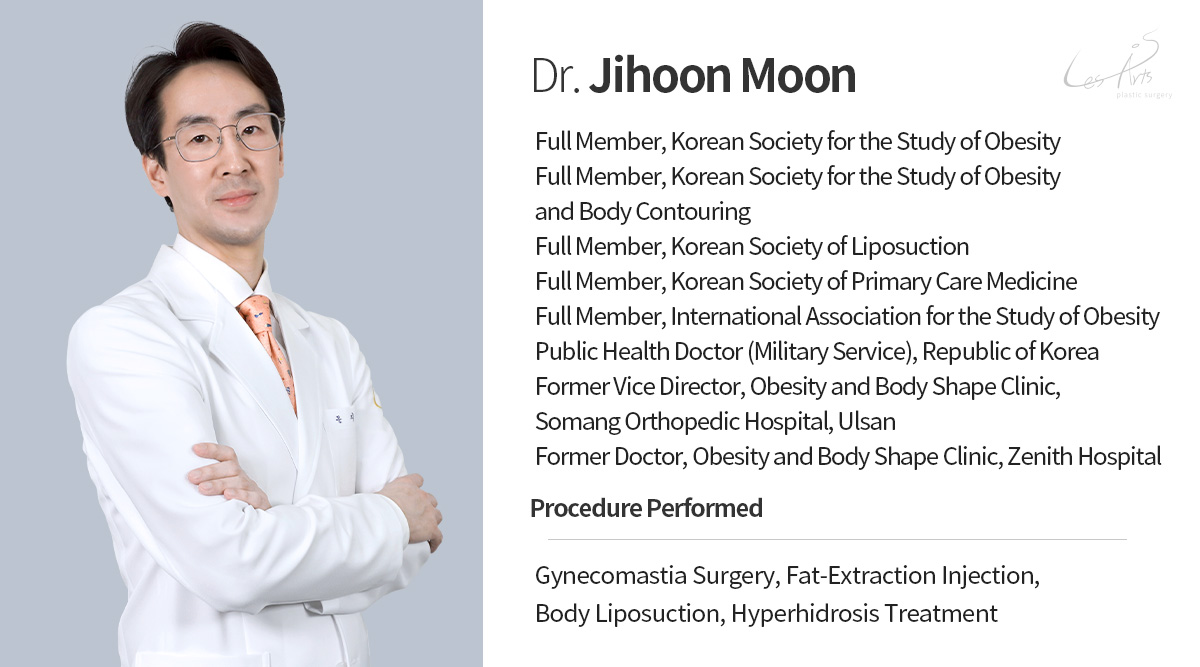
Hello, I am Dr. Jihoon Moon, Board-Certified Plastic Surgeon at Lesarts Plastic Surgery.
When explaining to patients consulting for gynecomastia surgery that
"Gynecomastia is a condition characterized by excessive proliferation of mammary glandular tissue,"
a common question frequently arises:
"In that case, isn't simply removing the gland sufficient?"
However, gynecomastia surgery does not conclude merely with the excision of developed tissue.
To sculpt a flat, firm, and masculine chest contour,
it must be approached from the perspective of body sculpting.
Today, let us examine the relationship between glandular resection and liposuction,
which determines surgical outcomes, along with quadrant-by-quadrant precision sculpting
for a refined chest silhouette.
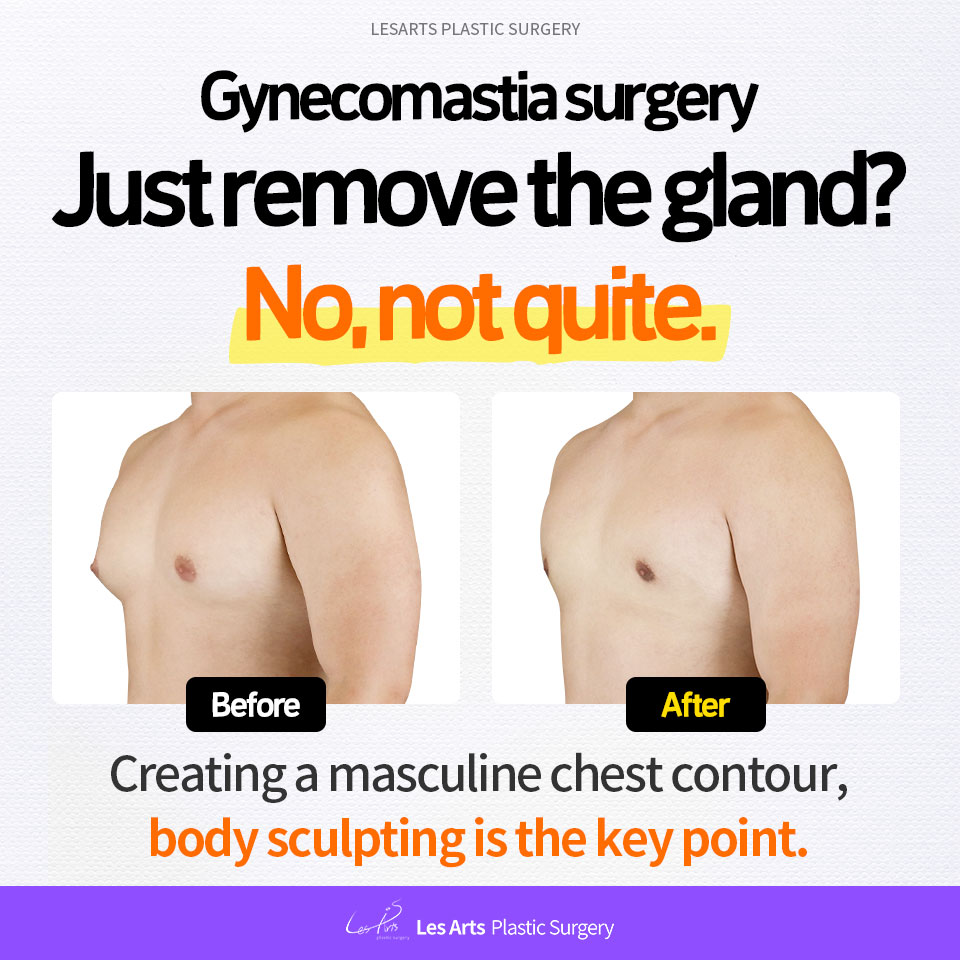
[Gynecomastia Surgical Approach - Dr. Jihoon Moon, Lesarts Plastic Surgery]
1. Why Liposuction Is Performed Concurrently in Gynecomastia Surgery
Gynecomastia can be categorized into true gynecomastia (predominantly glandular development),
pseudogynecomastia (predominantly adipose tissue),
and mixed-type gynecomastia, where both tissues are concurrently developed.
Among these, the most frequently observed presentation is the mixed type,
where glandular hyperplasia is surrounded by accumulated adipose tissue.
What happens if only the firm, palpable glandular tissue is excised in such cases?
A hollowed indentation (saucer deformity) can occur where the gland once sat,
or sharp demarcation against residual peripheral fat can develop,
causing the chest contour to appear unnatural and irregular.
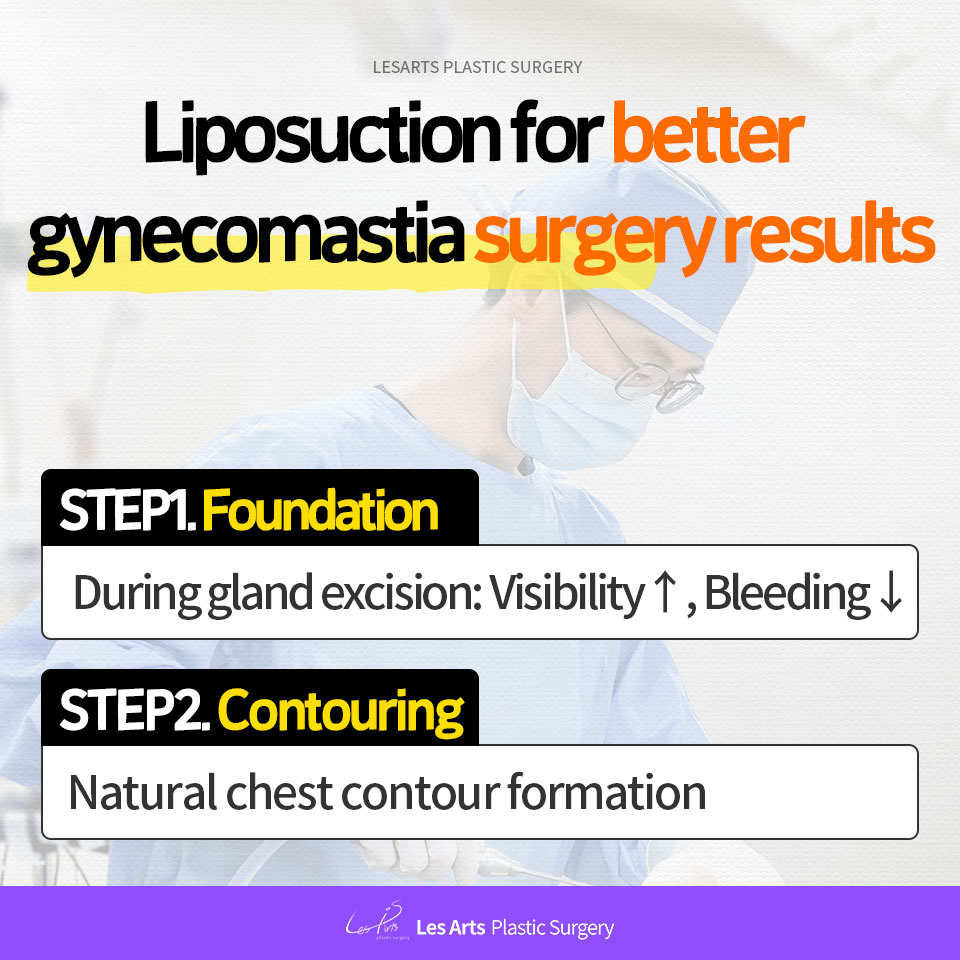
[Significance of Liposuction in Gynecomastia Surgery - Lesarts Plastic Surgery]
There are two primary clinical objectives for performing liposuction in gynecomastia surgery.
First, thinning the adipose layer surrounding the glandular tissue
secures direct visual access and reduces intraoperative bleeding during glandular resection.
Second, uniformly reducing overall chest thickness creates
a smooth gradation connecting the resection site seamlessly to surrounding tissue.
In other words, while primary liposuction serves as the foundational preparation for a flat chest,
secondary superficial liposuction following gland removal
acts as the refining step that feather-blends the overall pectoral contour.
2. Surgical Strategies According to Simon Grade
The Simon classification system used to grade gynecomastia severity
serves as an important benchmark determining the procedural balance between liposuction and glandular excision.
Grade II, which encompasses a large portion of patients,
is subdivided based on the presence of skin laxity,
requiring differentiated surgical approaches accordingly.
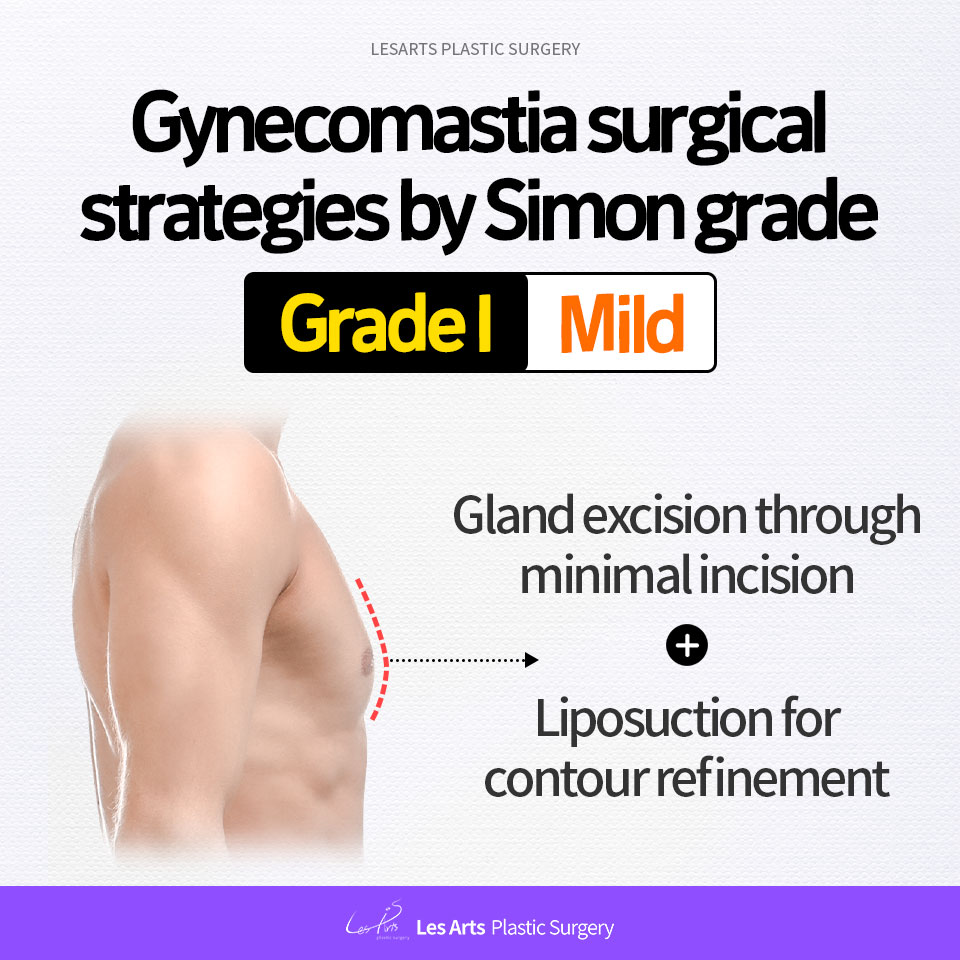
[Simon Grade I Gynecomastia Surgery - Dr. Jihoon Moon, Lesarts]
Grade I (Mild) presents with minor breast enlargement without skin laxity.
The core focus is minimal-incision resection of the glandular tissue localized beneath the areola,
accompanied by light peripheral liposuction as needed.
Grade II (Moderate) presents with more pronounced breast volume,
and is subdivided into Grade IIa and IIb based on skin laxity.
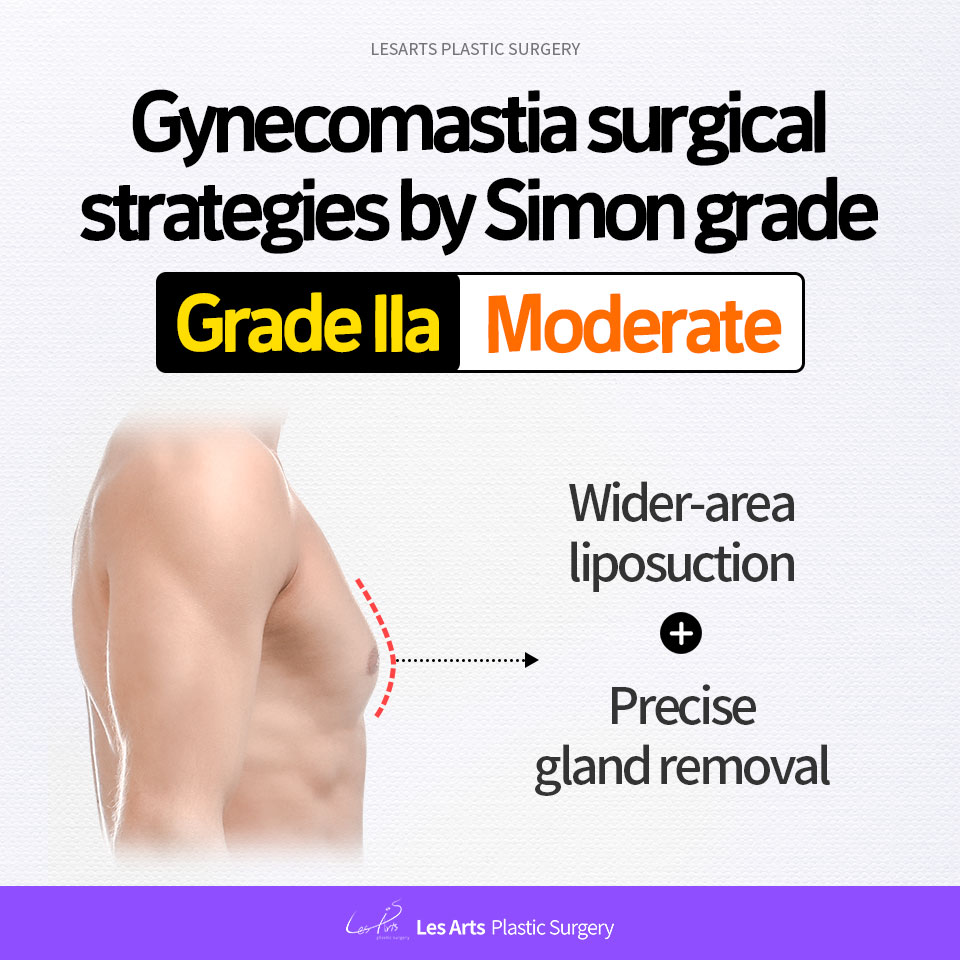
[Simon Grade II Gynecomastia Surgery - Dr. Jihoon Moon, Lesarts]
① Grade IIa: Breast volume is visibly enlarged,
yet without accompanying skin ptosis.
In this presentation, extensive liposuction is first performed
to debulk the protruding breast volume across the field.
Remaining glandular tissue is then meticulously excised,
allowing the skin to adhere smoothly over the pectoralis muscle bed
to sculpt a flat, masculine chest line.
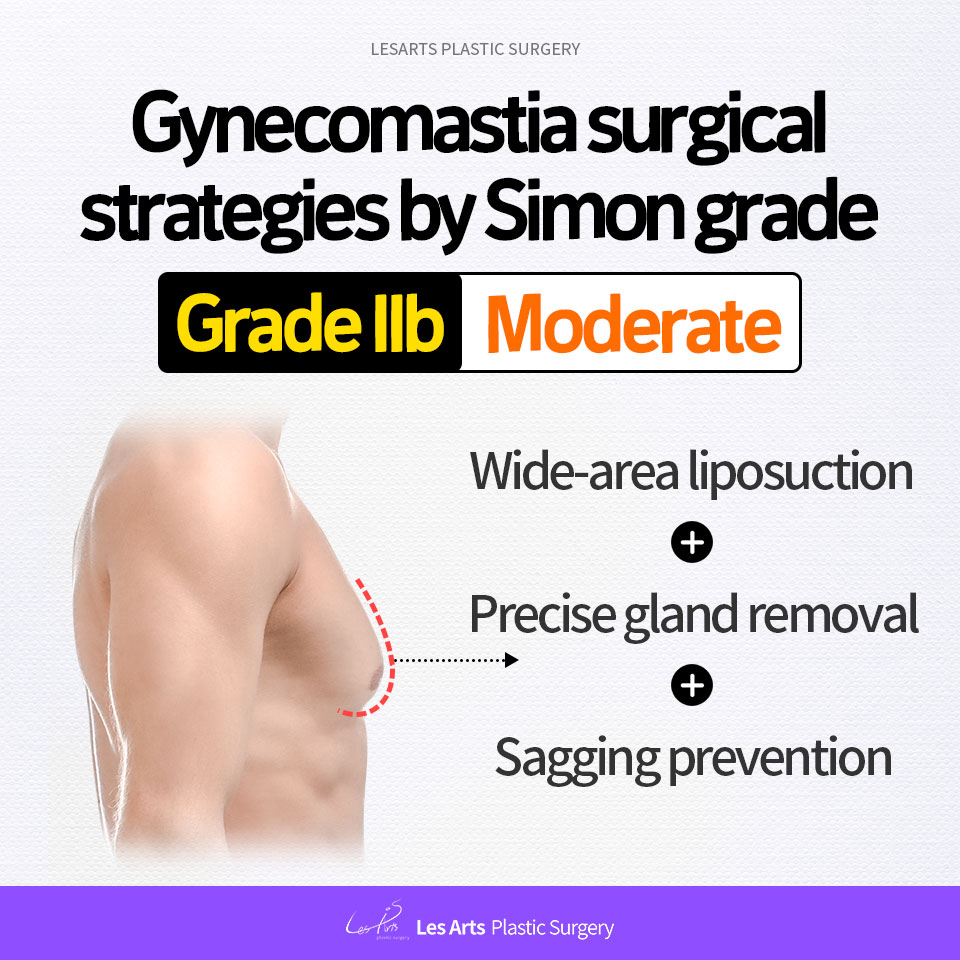
[Surgical Approach for Gynecomastia with Skin Ptosis - Dr. Jihoon Moon, Lesarts]
② Grade IIb: Breast volume is enlarged
and accompanied by mild skin ptosis.
Beyond excising glandular tissue and debulking fat,
guiding residual skin to retract naturally without drooping is critical.
Consequently, supportive postoperative aftercare, such as compressive taping,
may be required during recovery to assist skin redraping.
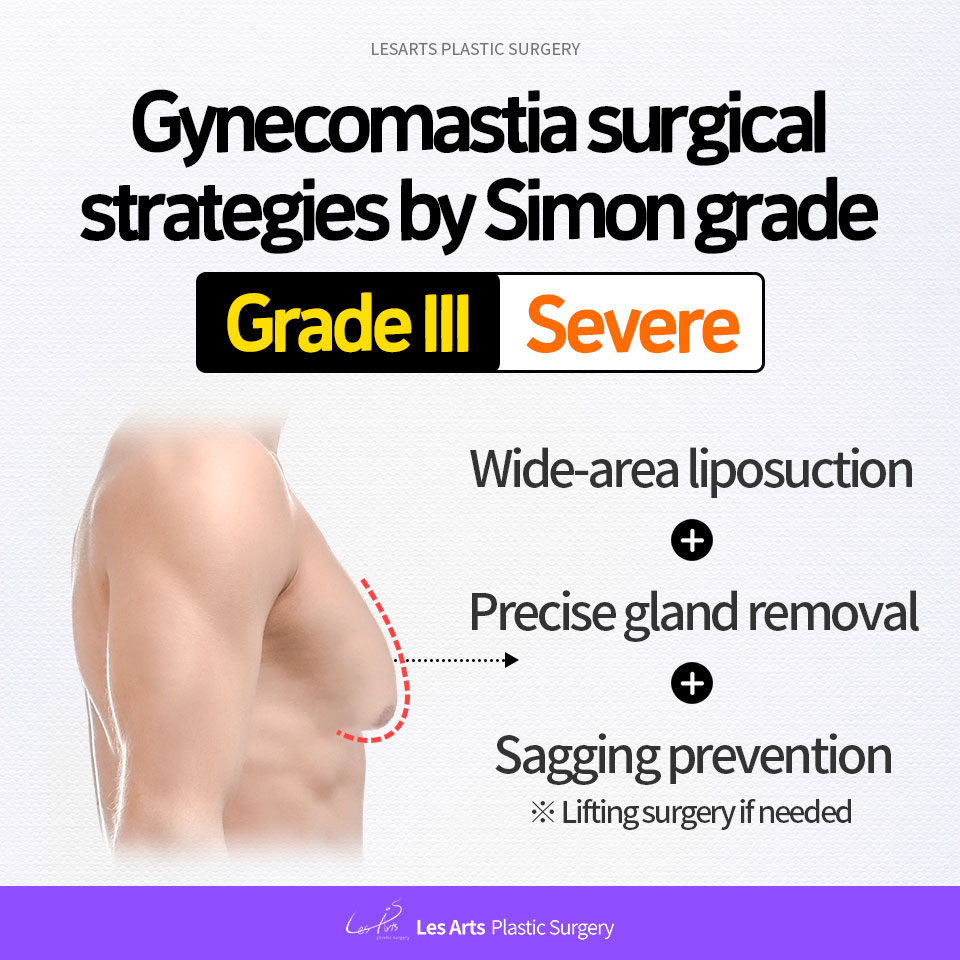
[Simon Grade III Gynecomastia Surgical Approach - Lesarts Plastic Surgery]
Grade III (Severe) presents with marked breast enlargement and pronounced skin ptosis.
Broad-area liposuction and thorough glandular resection are conducted, and skin excision (mastopexy) may be combined as indicated to reshape the overall chest envelope.
Regardless of the clinical grade, the fundamental principle remains:
"Completely excise glandular tissue while delicately contouring surrounding fat."
3. Four-Zone Precision Anatomical Sculpting
Rather than treating the chest as a single flat plane,
the surgical plan must address distinct anatomical zones individually.
By dividing the anterior chest into four specific zones,
surgery moves beyond simple flattening to achieve
a three-dimensional, athletic chest line that naturally reveals pectoral muscle contours.
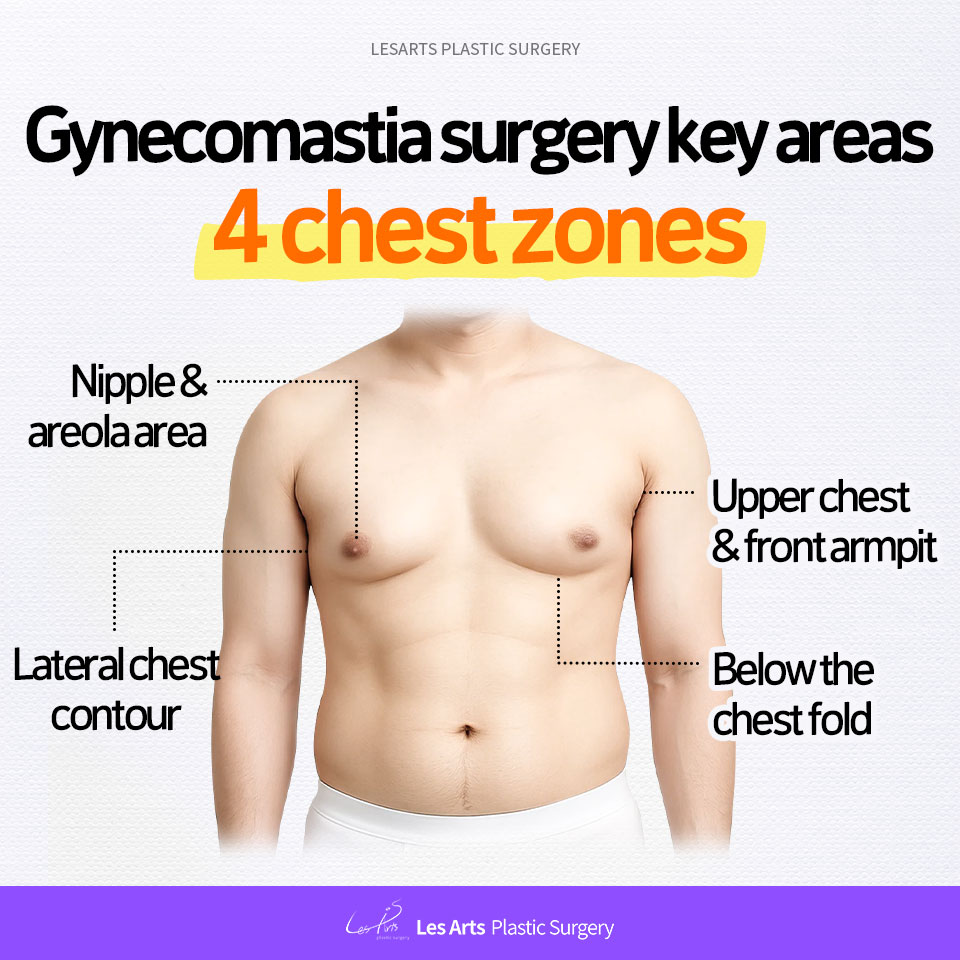
[Key Anatomical Zones in Gynecomastia Surgery - Lesarts Plastic Surgery]
Zone 1: Periareolar and Subareolar Area
This is where glandular tissue is predominantly concentrated.
To prevent subareolar depression or saucer deformities,
a delicate, uniform subdermal fat layer is preserved
while hypertrophied glandular tissue is completely excised.
Zone 2: Lateral Pectoral Border
This corresponds to the lateral margin of the pectoralis major muscle.
Residual fat here causes the chest to appear wide and heavy from the frontal view.
Contouring this area smoothly toward the axilla
highlights a tapered, masculine pectoral silhouette.
Zone 3: Superior Chest and Anterior Axillary Line
This is the junction where the upper chest meets the axilla.
Debulking adipose tissue that resembles pseudomammae
ensures the upper chest lies flat without bulging under fitted shirts,
supporting a firm, continuous pectoral plane.
Zone 4: Inframammary Fold Region
This area defines the lower boundary
that can impart a feminine, rounded lower breast crease.
Delicately aspirating inferior fat softens the prominence of the inframammary fold,
allowing the chest to transition naturally into the abdominal wall.
4. Summary
Gynecomastia surgery is not merely an ablative procedure to resect tissue;
it is a restorative, sculpting procedure that reconstructs a masculine chest frame.
While thorough glandular excision provides the clinical baseline,
delicately feathering surrounding fat to highlight pectoral muscle definition
determines the ultimate refinement of the chest line.
When considering gynecomastia surgery, rather than focusing solely on "tissue removal,"
planning through thorough consultation on how to sculpt a balanced masculine line tailored to your anatomy is essential.
[View Real Clinical Cases of Male Gynecomastia at Lesarts]
FAQ
Q1. Is glandular excision alone sufficient for gynecomastia surgery?
Excising only the gland can cause central depression or noticeable demarcation against surrounding fat.
Combining glandular resection with liposuction is essential to create a smooth, natural transition across the entire chest.
Q2. Why is liposuction necessary in gynecomastia surgery?
Liposuction levels the surrounding adipose layer, creates uniform chest thickness, and feather-blends the resection site smoothly into peripheral tissue planes.
Q3. Does the surgical approach vary according to Simon grade?
Yes. Grade I involves mild glandular prominence, whereas Grade II accounts for breast volume and skin laxity.
In Grade III with pronounced ptosis, concurrent skin excision may be evaluated as indicated.
Q4. Why is the chest divided into four zones during surgery?
The periareolar zone, lateral border, superior axillary junction, and inframammary fold each feature distinct fat and glandular distribution.
Addressing each zone individually ensures seamless transitions with adjacent anatomical landmarks.
Q5. What is the key to achieving natural-looking gynecomastia surgery outcomes?
Beyond completely removing glandular tissue, delicately contouring surrounding adipose layers is essential.
The overall masculine chest contour must be designed taking individual chest anatomy and skin elasticity into account.
Dr. Jihoon Moon


Cases finding
similar to my profile
Customer Diagnostics


Select the surgery and
area you are interestedto see real
before andafter changes.


we
make you,
the art
Clinic hours
MON - FRI
10 am – 7pm
SAT
10 am – 4pm
Holiday
SUN, HOLIDAY
Location
Lesarts Moon Clinic Tower 4-5F, 40, Nonhyeon-ro 168-gil,
Gangnam-gu, Seoul, Republic of Korea

Medical institution name Lesarts Plastic Surgery
Address Lesarts Moon Clinic Tower 4-5F, 40, Nonhyeon-ro 168-gil, Gangnam-gu, Seoul, Republic of Korea
Representative Moon sung jun
