




Online Consultation
Please accurately enter the information below.
Quick Cost Consultation
Quick Consultation & Reservation
Cases finding
similar to my profile






Doctor's Note
Medical columns by our surgeons
Abdominoplasty | Correcting Post-Cesarean Scar Sagging and Tissue Step-Offs
2026-08-25
Abdominoplasty | Correcting Post-Cesarean Scar Sagging and Tissue Step-Offs [Doctor's Note by Dr. Kukhan Lee]
If skin sags above a Cesarean section scar and the lower belly protrudes, can it be improved through abdominoplasty?
When redundant skin laxity and diastasis recti coexist, both the stretched skin envelope and the abdominal muscular wall can be corrected concurrently through abdominoplasty.
Depending on the anatomical extent of laxity and the baseline location of the prior scar, a mini-abdominoplasty or a full abdominoplasty is planned.
[Lesarts Abdominoplasty Guide]
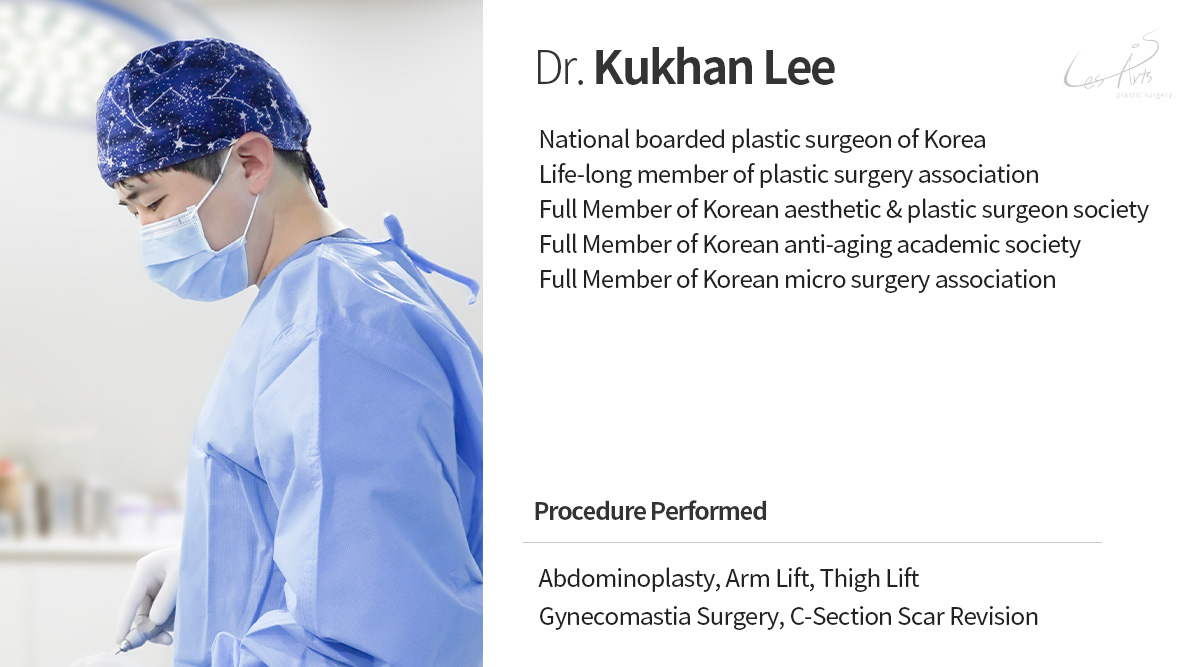
Hello, I am Dr. Kukhan Lee, Board-Certified Plastic Surgeon.
Through pregnancy and childbirth, a woman's body undergoes numerous structural and physiological changes.
In particular, following Cesarean deliveries, many women experience not only the surgical scar itself,
but also redundant skin sagging or folding directly above the scar line,
making the lower abdomen project forward even more noticeably.
Even when post-partum body weight returns close to pre-pregnancy levels,
the overstretched skin and attenuated abdominal wall
may struggle to retract completely back to their original state.
When redundant, loose skin or forward muscular bulging persists
despite consistent physical workouts and disciplined dietary habits,
surgical correction is often considered.
Today, let us examine a clinical case of a patient
who visited our clinic to resolve persistent skin redundancy above a C-section scar
and refine her overall abdominal silhouette.
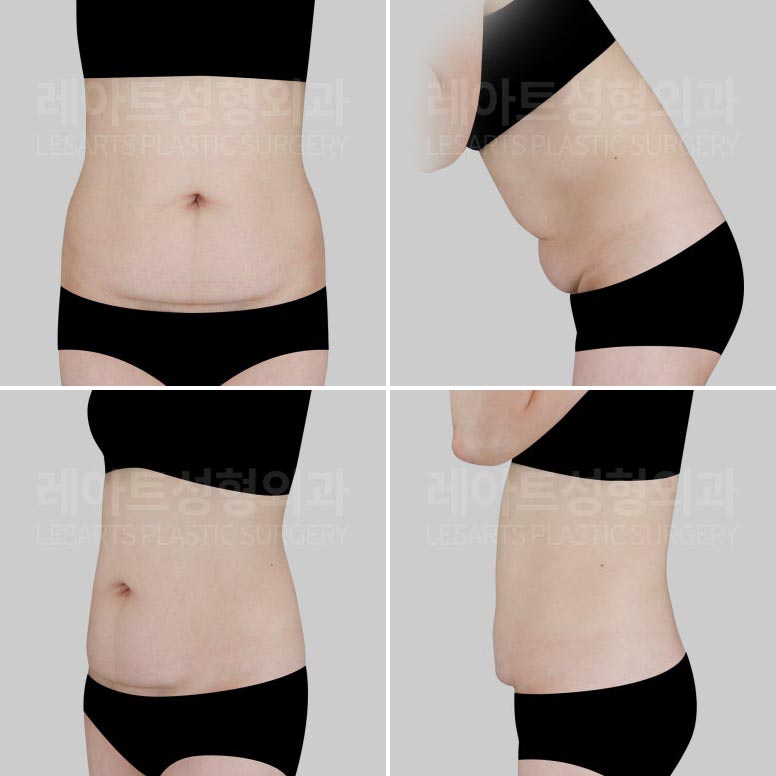
The patient was a female in her 40s measuring 154 cm and 45 kg,
who had delivered two children via Cesarean section.
She experienced approximately 16 kg of weight gain during pregnancy,
yet maintained her current weight stably through consistent post-partum management.
Nevertheless, her primary aesthetic concern was
the redundant, sagging lower abdominal skin drooping over her Cesarean scar.
Even after slimming down, an apron-like tissue fold persisted over the lower belly,
and she desired to correct the forward abdominal projection and disrupted body contours concurrently.
Physical examination revealed that the C-section scar was situated in a relatively high position,
though without evidence of hypertrophic scarring or keloids.
However, the lower abdominal skin hung broadly over the scar line,
and overall cutaneous elasticity was diminished from the periumbilical region into the upper abdomen.
Furthermore, across both the upper and lower abdomen,
diastasis recti and fascial attenuation were palpably confirmed.
While her overall frame was categorized as slender,
abdominal subcutaneous fat accumulation appeared relatively accentuated compared to the rest of her body.
When establishing the scope of abdominoplasty,
one must not merely measure the volume of loose skin,
but evaluate how far cephalad the laxity extends.
Along with this, the plan must carefully account for
an acceptable surgical incision length and location tailored to the patient's preferences.
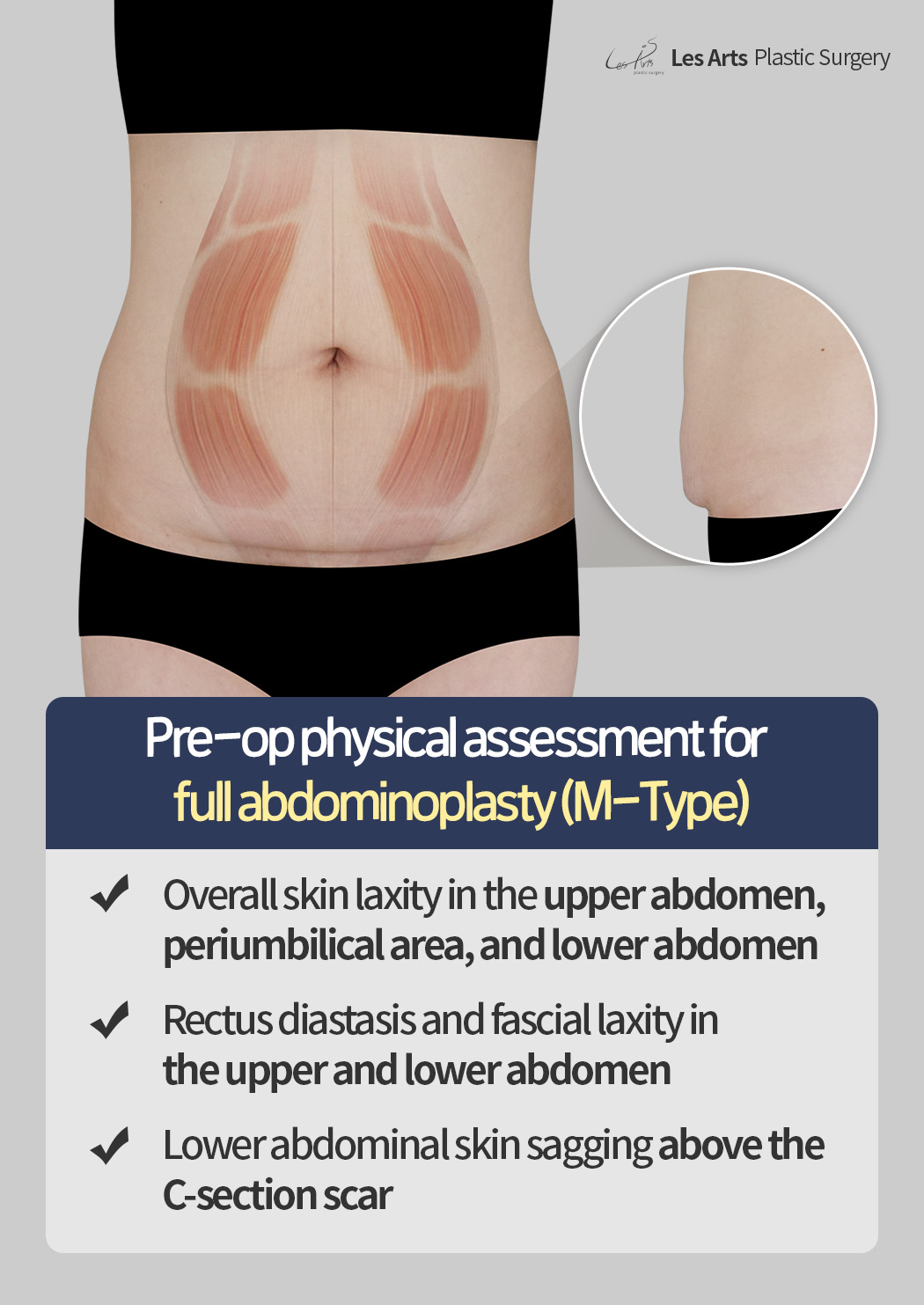
[Pre-Operative Assessment for Full Abdominoplasty - Lesarts Plastic Surgery]
In this patient, skin laxity was not confined solely to the infraumbilical abdomen,
but extended broadly into the upper abdomen as well.
Additionally, because diastasis recti was present along the entire rectus sheath,
an M-type full abdominoplasty was deemed clinically more appropriate
than an S-type mini-abdominoplasty.
Initially, the patient's primary focus was resolving the lower belly bulge,
leading her to favor an S-type mini-abdominoplasty during her first visit.
However, we explained that even with a mini-abdominoplasty,
the incision length could not be significantly shortened as hoped,
while the anatomical correction would remain limited strictly to the lower abdomen.
Consequently, given a comparable incision footprint,
we determined that a comprehensive correction addressing both upper and lower abdominal zones was the superior choice.
Ultimately, the surgical plan combined an M-type full abdominoplasty
with targeted abdominal liposuction.
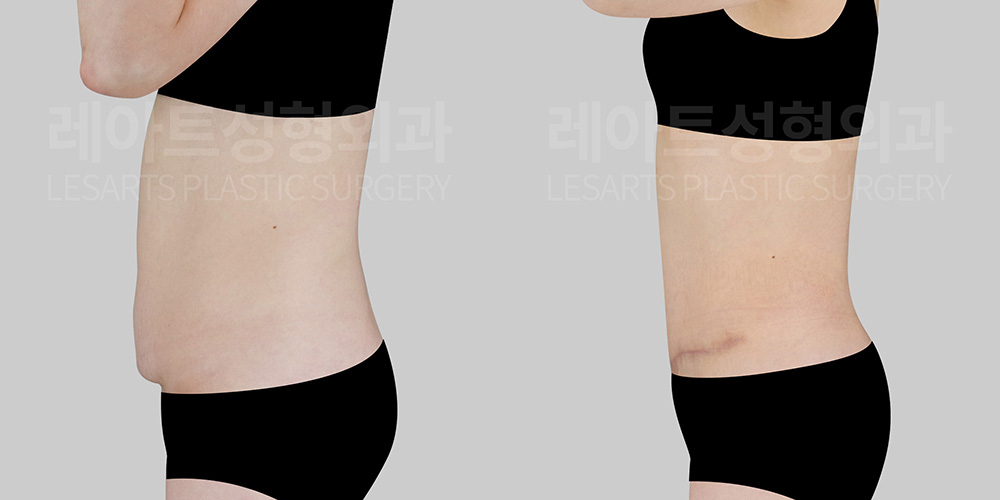
[C-Section Scar Step-Off Improvement via Abdominoplasty - Dr. Kukhan Lee, Lesarts]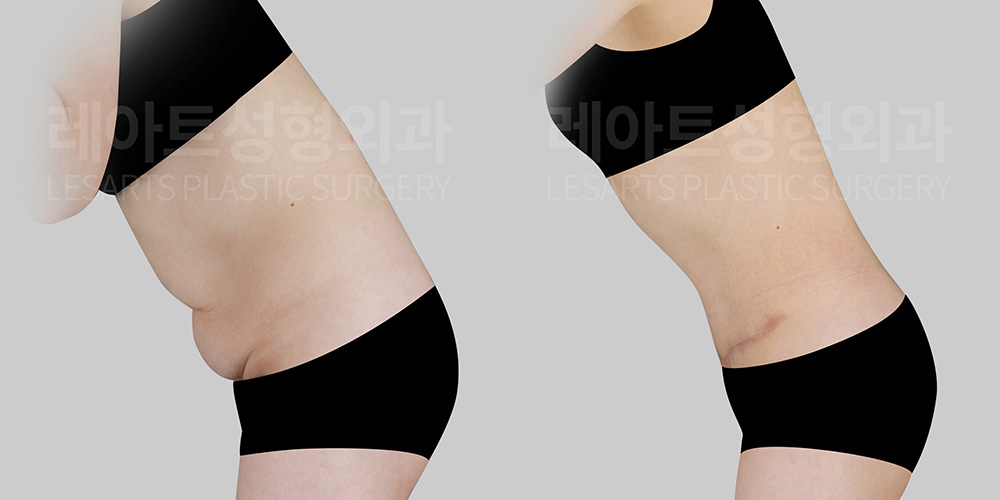
[Restoration of Abdominal Skin Tone via Body Contouring - Lesarts Plastic Surgery]
Here is the appearance at 5 months following abdominoplasty.
The redundant skin fold above the C-section scar that had caused the patient the greatest distress
has been eliminated, leaving the lower abdomen significantly flatter and smoother.
During initial planning, we considered the possibility that a portion
of the high-riding C-section scar might not be fully excised.
Intraoperatively, however, the pre-existing C-section scar was completely resected along with the redundant tissue flap,
eliminating the step-off deformity
and creating a natural, continuous contour across the lower abdomen.
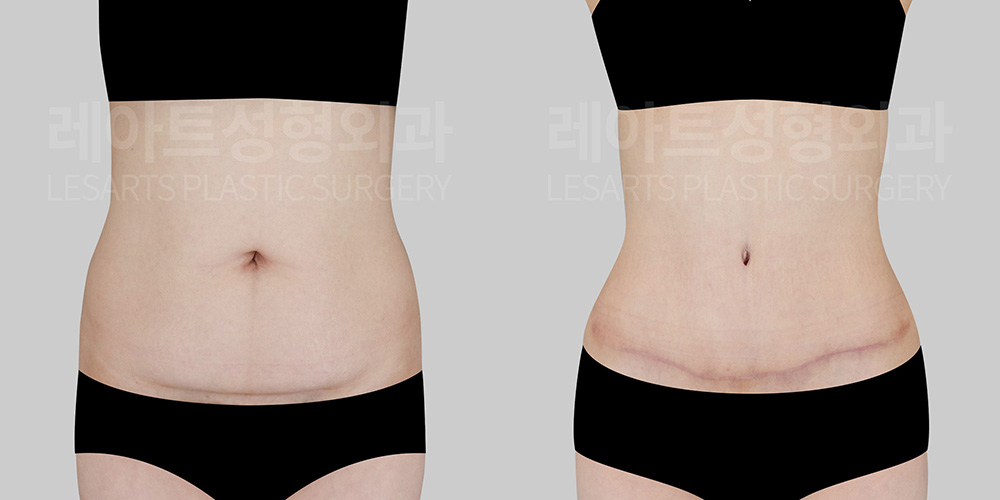
[Lifting Redundant Skin Above a C-Section Scar - Dr. Kukhan Lee, Lesarts]
With concurrent plication of diastasis recti,
the anterior abdominal wall that previously projected forward
has transformed into a firmer, flatter plane.
The umbilicus was reshaped into an elongated vertical oval,
and its positioning and proportional balance
integrate naturally within the newly sculpted abdominal contour.
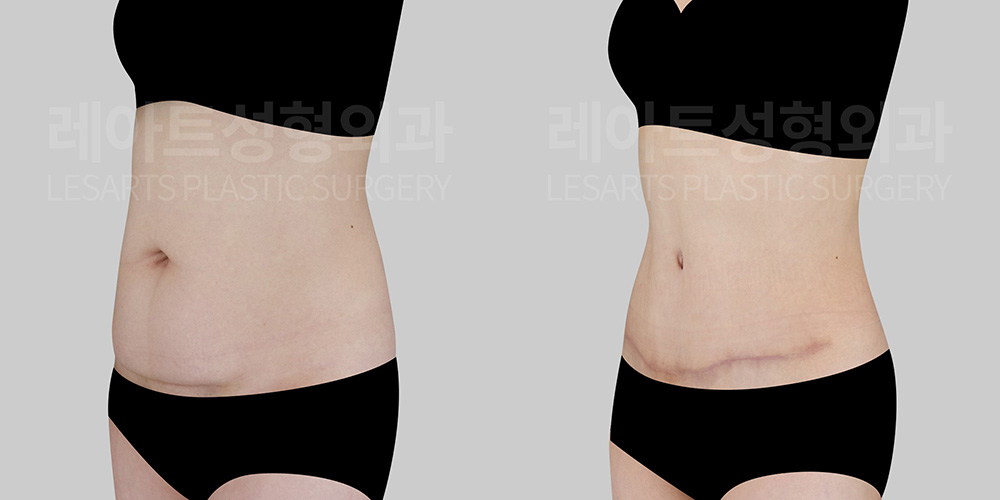
[C-Section Scar Resection, Abdominoplasty Before & After - Dr. Kukhan Lee, Lesarts]
Through abdominal liposuction performed in conjunction with abdominoplasty,
residual subcutaneous fat was debulked,
refining the lateral waist and flank transitions smoothly.
This harmonized the full torso silhouette,
contributing significantly to higher overall patient satisfaction.
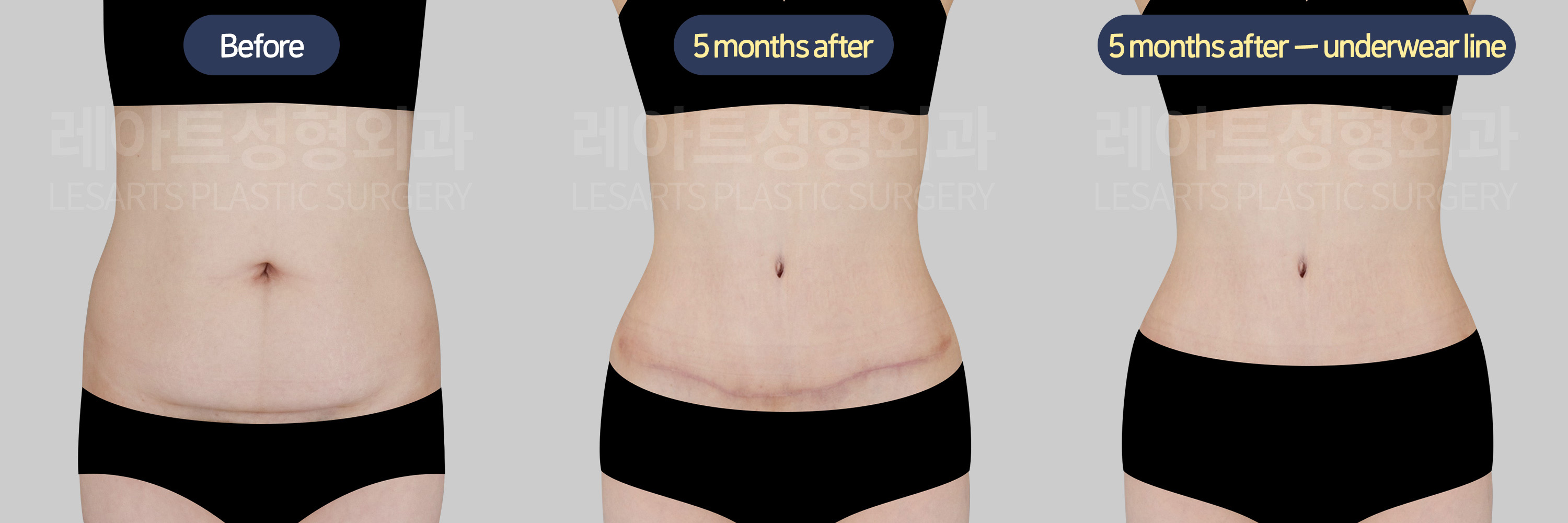
[Abdominoplasty Incision Placement and Scar Maturation - Lesarts Plastic Surgery]
At 5 months post-op, the surgical incision line remains somewhat visible.
However, abdominoplasty scars undergo a prolonged maturation process
where erythema fades and tissue softens progressively over time,
allowing us to monitor continued refinement.
Because the patient had consistently maintained disciplined weight management
and healthy habits prior to surgery,
her post-operative recovery and contour stabilization have progressed smoothly.
Maintaining these healthy habits
will ensure the surgical outcome continues to settle
into an even more natural result over time.
Abdominal changes following childbirth and Cesarean deliveries
do not arise purely from simple weight gain.
Stretched skin and weakened abdominal musculature frequently persist,
which explains why loose skin or a rounded lower belly
often remains even after returning to a target weight.
When personal exercise and diet reach their limits,
surgical abdominoplasty tailored to individual tissue laxity
can provide definitive structural improvement.
What is essential is not solely focusing on tissue resection,
but harmonizing individual frame proportions, the anatomical scope of laxity,
and the location of baseline scars to achieve overall balance.
[View More Real Clinical Cases of Abdominoplasty at Lesarts]
FAQ
Q1. Can skin sagging over a Cesarean scar be corrected through abdominoplasty?
Yes. If redundant skin folds broadly over a C-section scar,
abdominoplasty can excise the redundant skin fold and restore a flat lower abdominal wall.
Q2. Is lower abdominal bulging after childbirth caused solely by fat?
Not necessarily. Beyond fat accumulation, overstretched skin, diastasis recti (separation of abdominal muscles),
and fascial attenuation are major structural contributors.
Q3. How is the choice made between mini-abdominoplasty and full abdominoplasty?
If laxity is confined strictly to the infraumbilical region, a mini-abdominoplasty may be considered;
however, if skin laxity and diastasis recti extend into the supraumbilical abdomen, a full abdominoplasty is indicated.
Q4. Can a prior C-section scar be excised during abdominoplasty?
Depending on the resection boundary and the baseline position of the scar,
the prior C-section scar can frequently be excised concurrently within the redundant skin flap.
Q5. Does an abdominoplasty scar fade completely by 5 months post-op?
At 5 months post-op, the scar is still undergoing active remodeling and remains visible.
It will gradually fade, soften, and mature over the course of 1 to 2 years.
Dr. Kukhan Lee


Cases finding
similar to my profile
Customer Diagnostics


Select the surgery and
area you are interestedto see real
before andafter changes.


we
make you,
the art
Clinic hours
MON - FRI
10 am – 7pm
SAT
10 am – 4pm
Holiday
SUN, HOLIDAY
Location
Lesarts Moon Clinic Tower 4-5F, 40, Nonhyeon-ro 168-gil,
Gangnam-gu, Seoul, Republic of Korea

Medical institution name Lesarts Plastic Surgery
Address Lesarts Moon Clinic Tower 4-5F, 40, Nonhyeon-ro 168-gil, Gangnam-gu, Seoul, Republic of Korea
Representative Moon sung jun
