




Online Consultation
Please accurately enter the information below.
Quick Cost Consultation
Quick Consultation & Reservation
Cases finding
similar to my profile






Doctor's Note
Medical columns by our surgeons
Male Gynecomastia Surgery | When Can You Resume Exercise? Timeline for Weight Training & Chest Workouts
2026-08-26
Male Gynecomastia Surgery | When Can You Resume Exercise? Timeline for Weight Training & Chest Workouts [Doctor's Note by Dr. Jihoon Moon]
Will taking a month off from exercise after gynecomastia surgery lead to significant muscle loss?
For those who exercise regularly,
taking time off from workouts after surgery
can understandably feel concerning.
However, excessive exertion during the early recovery phase
can cause hematoma, seroma, or excessive tissue irritation,
which may actually prolong recovery.
It is generally advised to avoid heavy weight training for about 4 weeks,
and to reintroduce chest workouts gradually
starting after 6 weeks.
▶ View Lesarts Male Gynecomastia Surgery Cases
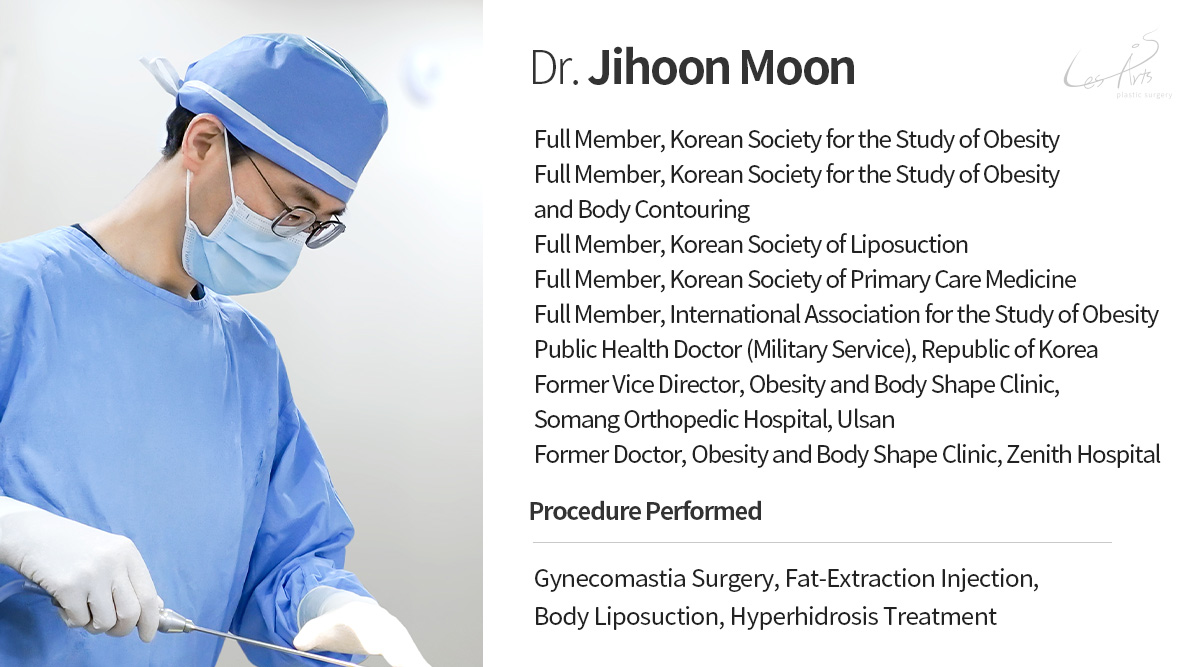
Hello, I am Dr. Jihoon Moon of Lesarts Plastic Surgery.
For those who work out consistently or pursue weight training
as a serious routine, the recommendation to rest from exercise
for a while can feel quite daunting.
In fact, even when experiencing discomfort from gynecomastia,
“If I can’t work out for a month after surgery,
won’t I lose all the muscle I’ve built up so far?”
some patients hesitate and delay their procedure due to this concern.

Exercise After Gynecomastia Surgery - Dr. Jihoon Moon, Lesarts Plastic Surgery
However, taking a temporary break from workouts
for proper healing does not necessarily mean
you are simply losing muscle.
Rushing back into intense exercise before the surgical site has sufficiently stabilized
can actually hinder recovery;
therefore, resting for the required duration and progressively
increasing exercise intensity is essential.

Rest Period from Workouts (Weights) After Gynecomastia Surgery - Dr. Jihoon Moon, Lesarts
1. Medical Misconceptions About Muscle Atrophy and the Science of ‘Muscle Memory’
After taking about 4 weeks off from heavy weight training following surgery,
it may feel as though your physique has become smaller than usual.
This occurs because the reduced activity level leads to a decrease
in water and glycogen stored within the muscle tissues.
Medically speaking, this temporary change differs from
the outright loss or disappearance of muscle cells themselves.
However, if the period of inactivity extends significantly longer,
actual reductions in muscle fiber diameter and muscle mass
may begin to occur.
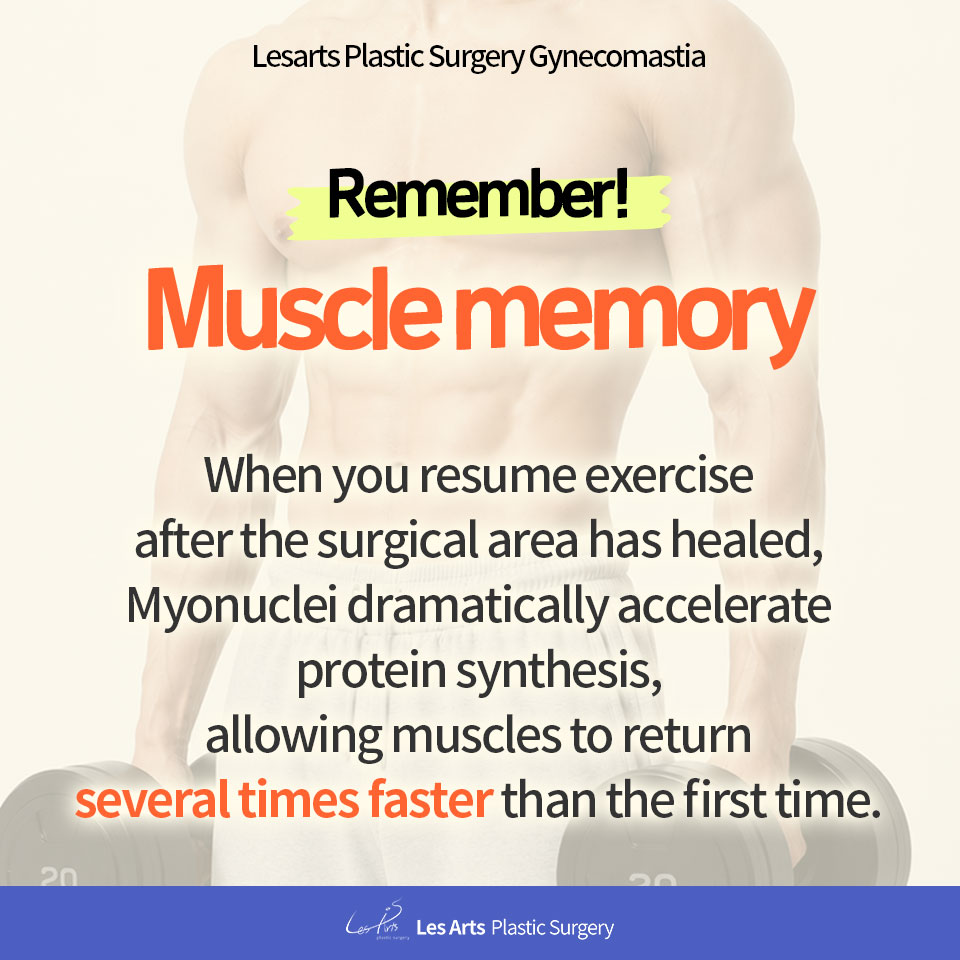
Muscle Loss, Muscle Atrophy, Muscle Memory - Lesarts Plastic Surgery
Those who have trained for a long time
have likely heard of the term ‘Muscle Memory’.
The myonuclei developed through past training
do not simply disappear during a brief period of rest,
and once exercise is resumed,
the rate of regaining previous muscle conditioning
is often noticeably faster than building it for the first time.
Therefore, rather than viewing a temporary break from heavy lifting
as losing all previous fitness progress,
it is better regarded as an essential recovery period that allows
the surgical area to stabilize fully before safely returning to training.
2. Why Exercise Should Not Be Rushed Immediately After Surgery
Immediately following gynecomastia surgery, the tissue repair process begins
in the area where glandular tissue and fat were removed.
At this stage, exercises that strongly contract the pectoral muscles
or significantly raise blood pressure can transmit repeated stress
and irritation to the surgical site.
In particular, two clinical points require close attention:
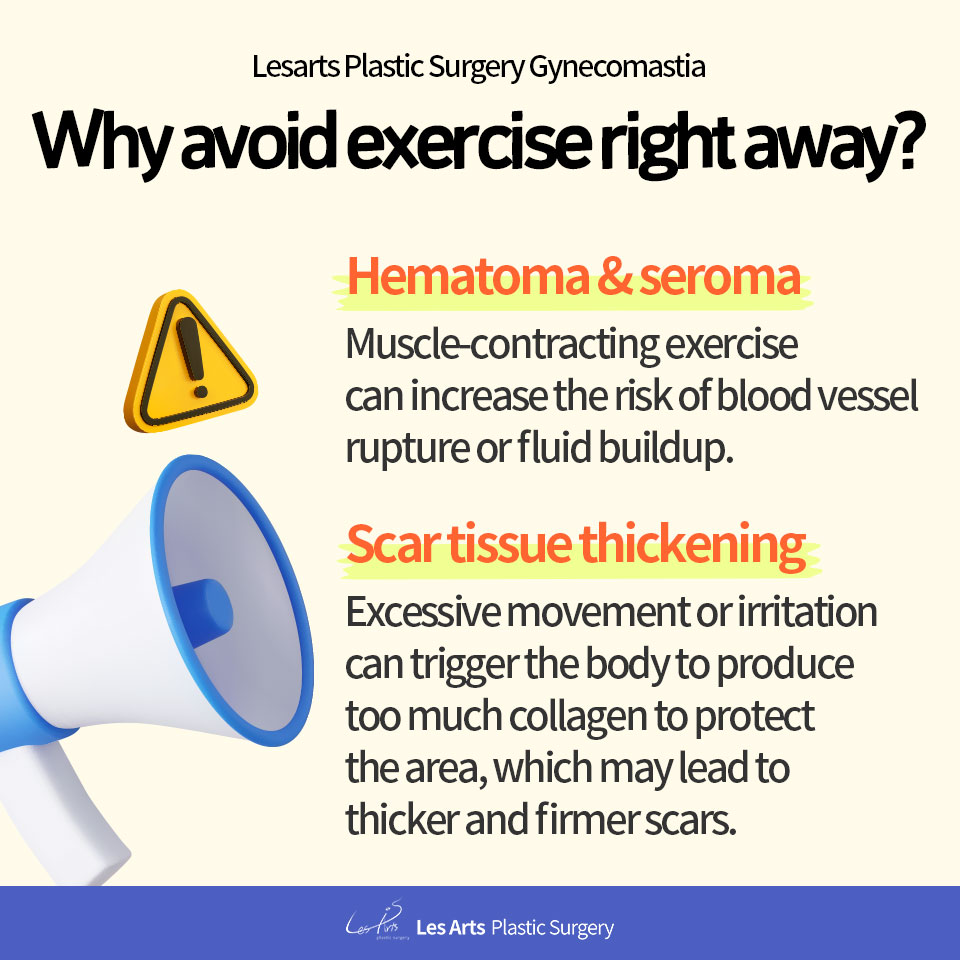
[Why Rest from Exercise Is Necessary After Gynecomastia Surgery - Lesarts Plastic Surgery]
1. Hematoma and Seroma
A potential dead space remains immediately after the excision of glandular tissue.
Forcefully contracting the chest muscles or overexerting during this window
increases the possibility of bleeding from microvessels or fluid accumulation,
which may lead to hematoma or seroma formation.
In more pronounced cases, accumulated blood or fluid
may require medical drainage, making it crucial to keep
the surgical area stable and protected in the early stage.
2. Risk of Excessive Internal Scar Tissue Firmness (Induration)
Scarring after gynecomastia surgery is not limited
to visible skin incisions.
Internal tissues also heal, remodel, and settle into place.
If subjected to excessive movement and repeated mechanical strain early on,
the internal scar tissue can heal in a denser,
firmer state.
This can cause lingering stiffness or foreign-body sensation during workouts,
and may affect the natural flexibility and motion of the pectoral muscles.
Allowing sufficient time for internal tissues to heal smoothly
is vital for preserving well-defined chest contours
and ultimately supports a safer, more sustainable
return to exercise.
▶ View More Lesarts Male Gynecomastia Surgery Cases
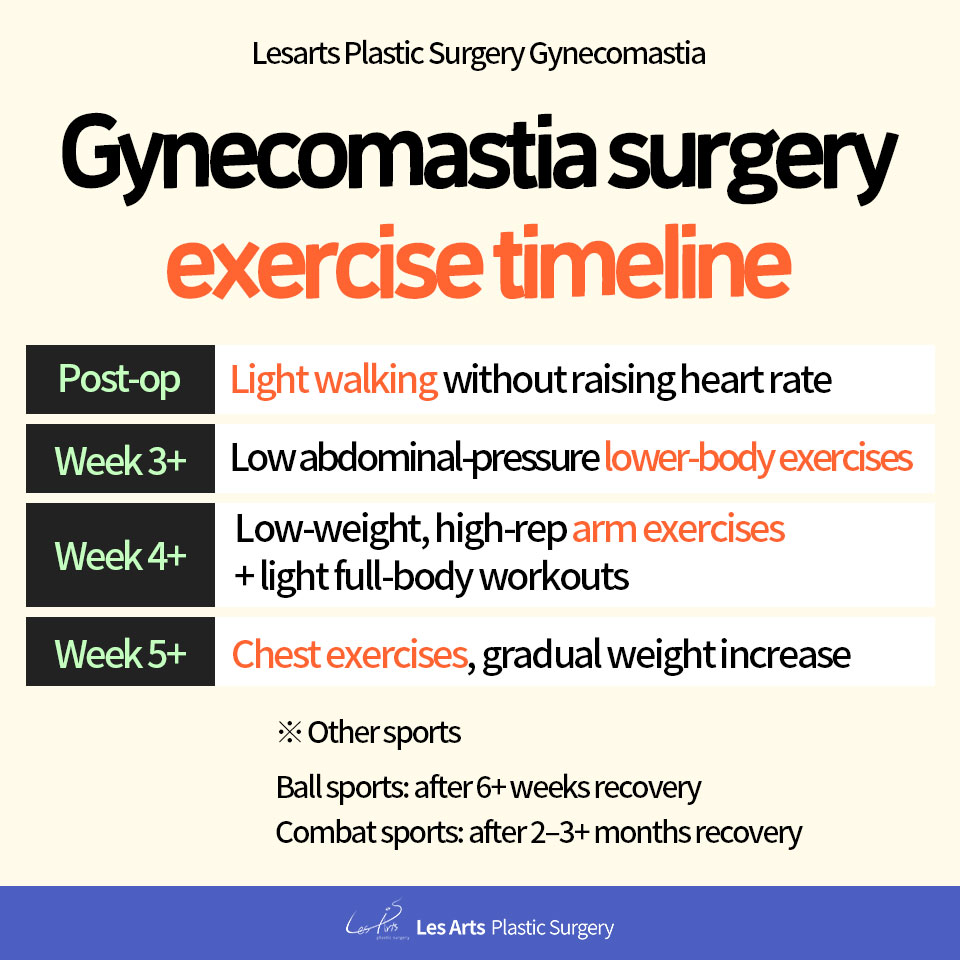
[Timeline for Chest Workouts After Gynecomastia Surgery - Dr. Jihoon Moon, Lesarts]
3. Phased Timeline for Returning to Weight Training
Complete inactivity is not required throughout recovery.
Instead, activities can be reintroduced gradually according to the healing phase.
From Day 1 Post-Op: Light Walking
The earliest recommended physical activity is light walking.
Taking comfortable strolls starting the day after surgery
helps lower-body circulation and promotes recovery
far better than staying strictly bedridden.
However, high-intensity aerobic exercise that causes
heavy breathing or excessive sweating must be avoided.
It is generally advised to refrain from vigorous cardiovascular workouts
for at least 2 weeks.
Week 3: Lower-Body Focused Workouts
Around the 3-week mark, lower-body exercises
with minimal upper-body engagement can begin.
Isolated machine movements such as leg extensions or leg curls,
which do not exert force through the torso, serve as good examples.
Conversely, compound movements like squats and deadlifts require caution,
as they significantly elevate intra-abdominal pressure
and engage upper-body and thoracic musculature.
Week 4: Gradual Reintroduction of Back & Arm Exercises
By week 4, full-body workout elements can be slowly integrated.
This includes back movements like lat pulldowns and rows,
as well as bicep and tricep exercises performed
with light resistance and higher repetitions.
During this phase, movements that excessively stretch the chest tissue
or involve aggressive stretching should still be avoided.
Week 6 and Beyond: Chest Workouts
Dedicated chest exercises such as bench presses and dips
are typically recommended only after 6 weeks.
Rather than jumping straight to pre-surgery working weights,
start with very light resistance to verify
there is no localized pain, strain, or pulling sensation.
From there, monitoring your physical feedback while progressing
weights incrementally by about 5% to 10% each week is recommended.
4. When Can You Resume Soccer, Basketball, Golf, and Swimming?
For sports beyond weightlifting,
return timelines should be evaluated according to the demands of each discipline.
Sports like soccer and basketball involve running and risk of collision,
which can deliver direct impact or trauma to the chest.
A stabilization period of at least 6 weeks
is generally recommended.
While tennis or golf may not seem to stress the chest directly,
large rotational torso swings can apply significant shearing
and pulling forces across the healing area.
Swimming follows the same principle.
Repetitive broad arm strokes repeatedly stretch the pectorals
and surrounding tissues, which can cause excessive strain
if attempted too early.
Contact combat sports such as Brazilian Jiu-Jitsu, where close physical pressure
and direct chest compression frequently occur,
should ideally be resumed after 2 to 3 months,
once structural healing is much firmer.
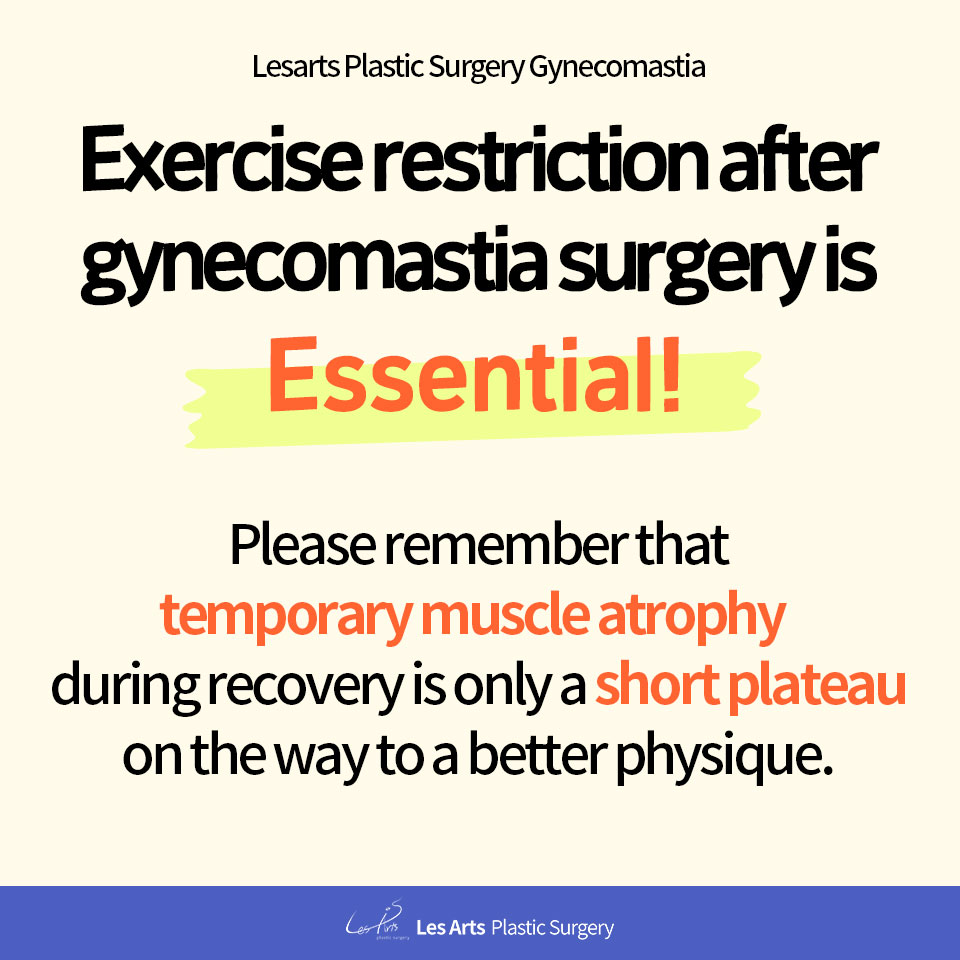
[Gynecomastia Surgery Recovery - Lesarts Plastic Surgery]
The objective of gynecomastia surgery is not solely
the excision of fat and glandular tissue.
It encompasses how the remaining tissues naturally adapt and settle
into a balanced, masculine chest contour throughout recovery.
For fitness enthusiasts,
a resting window of 4 to 6 weeks may feel long.
However, pushing into vigorous training too early out of impatience
risks hematoma, seroma, or dense internal scar formation,
which can ultimately delay your return to regular training even further.
Conversely, honoring the necessary recovery timeline and stepping up intensity gradually
allows you to safely rebuild and restore
your muscular condition.
Rather than feeling anxious about pausing workouts right after surgery,
it is crucial to distinguish which physical activities are safe
at your current stage and which should still be avoided.
When restarting chest workouts in particular,
rather than lifting previous working weights right away, start at a low resistance,
monitor for any pain or pulling sensations, and build volume gradually.
If you have a high training frequency or if fitness
is a major part of your lifestyle
and you are contemplating gynecomastia surgery,
share your sports routines and athletic schedules with your surgical team beforehand
so you can establish a well-guided recovery timeline
and a customized return-to-exercise plan.
Post-Gynecomastia Surgery Exercise FAQ
1. Can I walk starting the day after gynecomastia surgery?
Gentle walking and light strolls within a comfortable range are recommended starting the day after surgery.
However, strenuous workouts that lead to heavy breathing
or excessive perspiration should be avoided at this stage.
2. When can I return to gym workouts after gynecomastia surgery?
This depends on the target muscle group. Recommended guidelines suggest
lower-body training with minimal upper-body strain from week 3,
light-resistance back and arm workouts from week 4, and
a gradual reintroduction of chest exercises starting after week 6.
3. Will I lose all my muscle if I take a month off?
A short pause in training causes glycogen and water depletion,
which is distinct from the total loss
of muscle cells themselves.
Once training is resumed safely,
you can expect to rebuild previous conditioning effectively.
4. When can I perform bench presses again?
Chest exercises are generally advised starting after 6 weeks.
Avoid jumping directly back to previous heavy weights;
start with light loads to ensure there is no pain or pulling,
and increase resistance progressively.
5. Are soccer or jiu-jitsu also allowed after 6 weeks?
Sports with risk of collision like soccer or basketball
generally require a stabilization window of at least 6 weeks,
while martial arts involving direct chest pressure like jiu-jitsu
are recommended after 2 to 3 months.
The exact timing may vary depending on individual recovery progress.
Dr. Jihoon Moon


Cases finding
similar to my profile
Customer Diagnostics


Select the surgery and
area you are interestedto see real
before andafter changes.


we
make you,
the art
Clinic hours
MON - FRI
10 am – 7pm
SAT
10 am – 4pm
Holiday
SUN, HOLIDAY
Location
Lesarts Moon Clinic Tower 4-5F, 40, Nonhyeon-ro 168-gil,
Gangnam-gu, Seoul, Republic of Korea

Medical institution name Lesarts Plastic Surgery
Address Lesarts Moon Clinic Tower 4-5F, 40, Nonhyeon-ro 168-gil, Gangnam-gu, Seoul, Republic of Korea
Representative Moon sung jun
