




Online Consultation
Please accurately enter the information below.
Quick Cost Consultation
Quick Consultation & Reservation
Cases finding
similar to my profile






Doctor's Note
Medical columns by our surgeons
Medical Treatment for Gynecomastia | If Surgery Feels Daunting, Is Tamoxifen Therapy an Option?
2026-08-31
Medical Treatment for Gynecomastia | If Surgery Feels Daunting, Is Tamoxifen Therapy an Option? [Doctor's Note by Dr. Jihoon Moon]
Is surgery always required for gynecomastia? Can it be treated with tamoxifen?
Pharmacotherapy may be considered for gynecomastia
depending on its stage and clinical subtype.
Particularly in early-stage true gynecomastia driven predominantly
by glandular tissue proliferation, medical management
utilizing tamoxifen can be evaluated.
In contrast, for pseudogynecomastia primarily composed of adipose tissue or long-standing cases
where glandular tissue has undergone fibrous consolidation, expected clinical improvement
may be limited, making an initial objective diagnostic assessment essential.
▶ View Lesarts Male Gynecomastia Cases
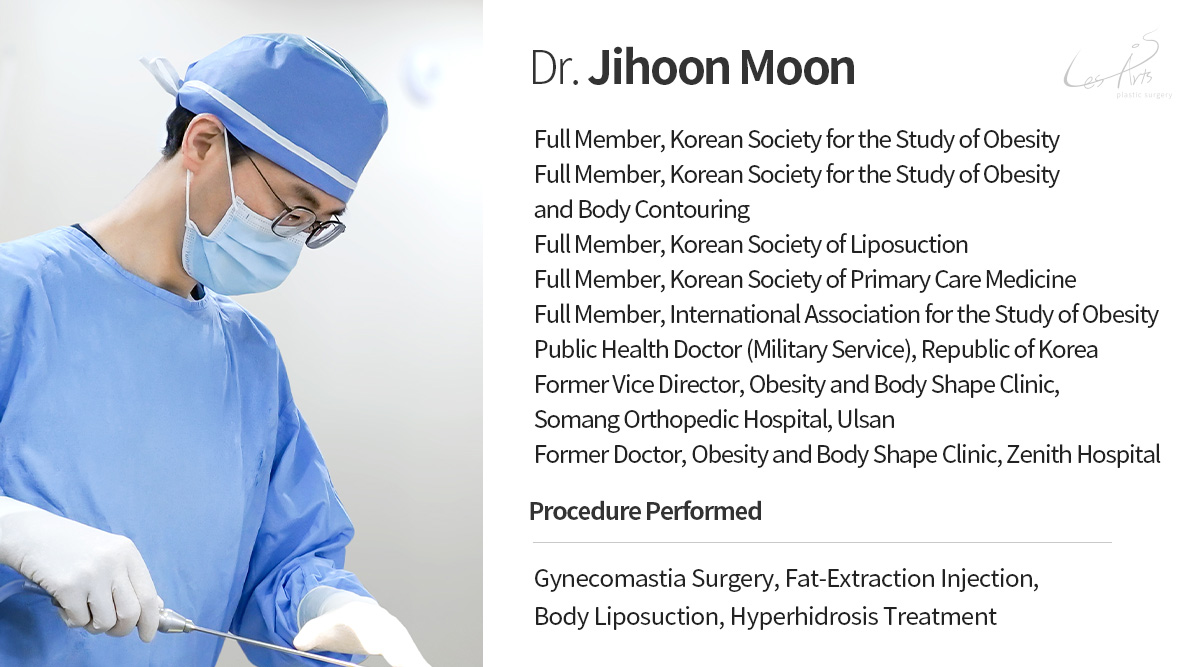
Hello, I am Dr. Jihoon Moon of Lesarts Plastic Surgery.
For men, gynecomastia—the development of prominent glandular tissue—
causes not only aesthetic concerns, but often leads
to psychological distress and self-consciousness in daily life.
While researching clinical care, some patients feel overwhelmed
by the prospect of undergoing a surgical procedure on the chest,
leading them to postpone evaluation altogether.
“Is surgery strictly necessary for gynecomastia? Can it be managed with oral medications?”
Many individuals present with this exact question.
Depending on clinical presentation, pharmacotherapy can be considered for gynecomastia,
and among the primary pharmacological agents utilized,
tamoxifen is widely documented.
In this article, for those who feel hesitant toward surgery
or are concerned about postoperative recovery windows, physical activity restrictions,
and wearing compression garments,
we will examine the pharmacological mechanism of tamoxifen
and explore which specific subtypes of gynecomastia
may respond favorably to medical therapy.

1. Pharmacotherapy for Gynecomastia: How Does Tamoxifen Work?
The pathogenesis of gynecomastia is often influenced by an altered relative balance
between circulating androgens and estrogens.
When estrogenic stimulation becomes relatively dominant,
dormant glandular tissue within the male breast
can be stimulated to proliferate and enlarge.
In such contexts, tamoxifen is employed for targeted medical therapy.
Tamoxifen is a selective estrogen receptor modulator
(SERM) class medication.
Widely recognized in clinical practice as an agent for breast cancer management,
its pharmacological mechanism functions by competitively blocking
estrogenic actions on target breast tissue.
Leveraging this pathway, it is applied in treating gynecomastia
characterized by active proliferation of male glandular tissue.
Inhibiting Estrogenic Action on Glandular Tissue
Tamoxifen binds competitively to estrogen receptors on mammary epithelial cells,
preventing circulating estrogens from continuing to stimulate
glandular development.
In practical terms, it inhibits the proliferative signaling
transmitted by estrogen to the glandular tissue.
Once this proliferative stimulus is attenuated, proliferating glandular elements
can undergo regression and decrease in volumetric size.
Additionally, it can be clinically effective in alleviating localized mastalgia
and tenderness associated with palpable glandular buds in early-stage gynecomastia.
Beyond tamoxifen, aromatase inhibitors such as anastrozole—which inhibit the peripheral conversion of androgens to estrogens—
as well as androgenic formulations have also been utilized adjunctively in literature.
In clinical practice, tamoxifen is widely cited as the most commonly studied
and prescribed medical agent for this indication.
2. How Tamoxifen Efficacy Differs Across Gynecomastia Subtypes
Because tamoxifen acts selectively on glandular tissue and endocrine pathways,
uniform clinical outcomes cannot be expected across all anatomical variations of gynecomastia.
Therapeutic suitability varies significantly based on whether the prominent tissue is glandular or adipose,
as well as the chronological duration since onset.
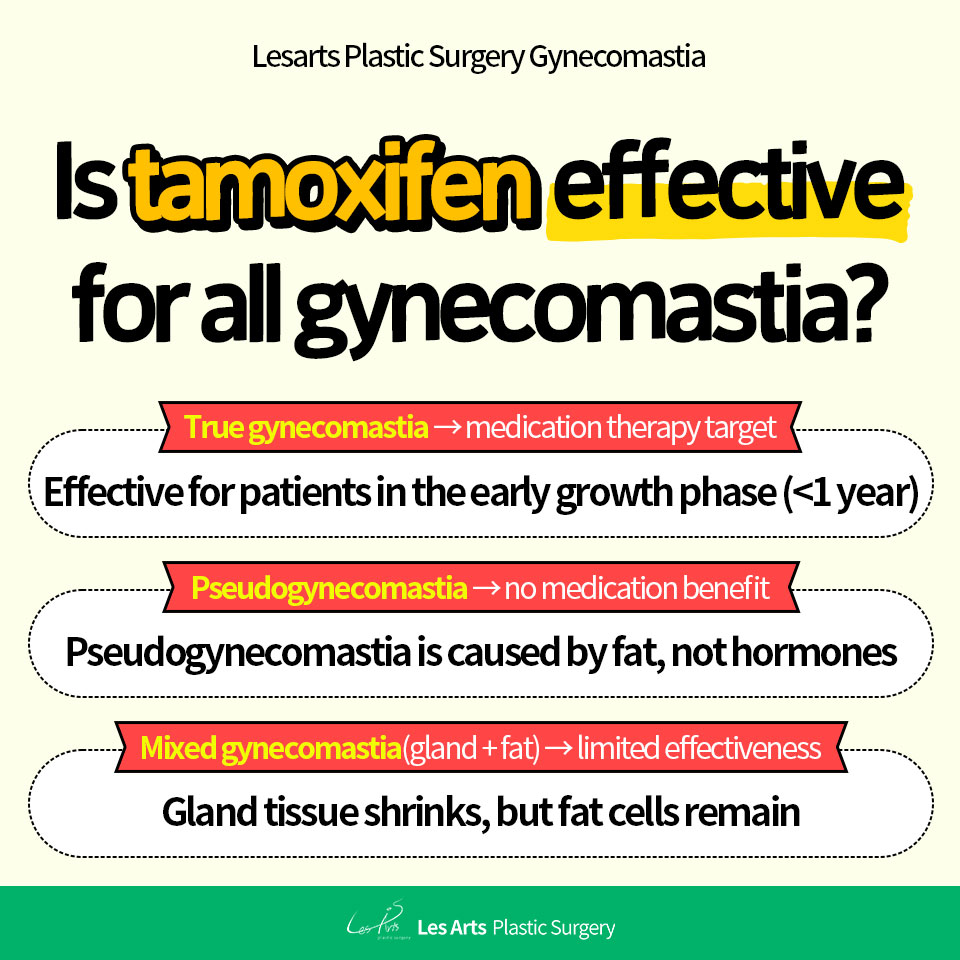
① True Gynecomastia — A Clinical Subtype Eligible for Medical Therapy
True gynecomastia is defined primarily by glandular hyperplasia
rather than excess adipose accumulation.
On physical palpation, a firm retroareolar mass is typically felt,
often accompanied by localized tenderness.
Because tamoxifen functions by suppressing hormonal stimulation of glandular tissue,
medical literature indicates that therapeutic response is most favorable in early proliferative true gynecomastia
presenting within approximately one year of onset.
Conversely, if an extended duration has elapsed and glandular architecture
has progressed into dense, irreversible stromal fibrosis,
pharmacotherapy alone is unlikely to regress the organized fibrotic tissue,
yielding limited clinical efficacy.
② Pseudogynecomastia — Subtype Where Tamoxifen Efficacy Is Not Expected
Pseudogynecomastia involves localized adipose deposition across the pectoral region
without true glandular hyperplasia, creating the visual impression of breast enlargement.
This presentation typically correlates with systemic adiposity or rapid weight changes.
Because the underlying tissue is exclusively adipose rather than glandular epithelial cells,
taking tamoxifen does not reduce localized pectoral adipose tissue.
Accordingly, lifestyle weight management, physical conditioning, or targeted liposuction
represent the appropriate clinical modalities in such presentations.
③ Mixed-Type Gynecomastia — Glandular Response with Inherent Aesthetic Limitations
Mixed-type gynecomastia is characterized by concurrent glandular proliferation
and substantial surrounding adipose accumulation.
It is among the most frequently diagnosed presentations in adult men.
While tamoxifen administration may reduce glandular nodularity and tenderness,
it does not metabolize or eliminate the coexisting adipose volume.
Consequently, meaningful visible reduction in overall chest prominence or contour definition
when wearing fitted clothing remains structurally limited.

3. Key Clinical Considerations Prior to Tamoxifen Therapy
While pharmacotherapy provides an option for patients seeking to avoid surgery,
establishing a sound treatment plan requires understanding
both the clinical timeline and procedural limitations.
① Therapeutic response requires a structured duration
While surgical excision directly removes glandular tissue,
tamoxifen operates by modulating receptor stimulation,
requiring physiological time for gradual tissue involution.
Immediate post-administration changes in exterior contour
should therefore not be anticipated.
Clinical studies typically describe a regimen requiring consistent daily administration
for a minimum of 3 to 6 months or longer.
② Risk of recurrence following cessation of pharmacotherapy
Tamoxifen does not permanently remove
the anatomical glandular bed.
Therefore, even if regression is achieved during therapy,
subsequent endocrine fluctuations following medication withdrawal
can allow remaining glandular cells to proliferate again.
Medical literature observes that the incidence of recurrence following cessation is comparatively higher
than with definitive surgical excision.
③ Monitoring for potential side effects during extended use
Because long-term administration of tamoxifen interacts with systemic endocrine pathways,
potential adverse events must be routinely monitored.
Reported side effects include occasional decreased libido, erectile changes, fatigue,
and gastrointestinal discomfort.
Periodic hepatic function monitoring may also be warranted; thus, maintaining regular physician oversight
and indicated laboratory evaluations throughout therapy
is essential.

4. Selecting Between Medical Therapy and Surgery
Pharmacotherapy and surgical intervention cannot be categorized
as universally superior to one another in all clinical presentations.
The optimal approach depends on the gynecomastia subtype, chronological duration, glandular-to-adipose ratio,
and the specific anatomical expectations of the patient.
In cases of recent onset where clinical examination confirms
predominantly glandular tissue in early-stage true gynecomastia,
a trial of medical therapy with tamoxifen may be considered prior to surgical decisions.
Conversely, when tissue is long-standing and characterized by dense fibrous consolidation,
or in mixed-type presentations with significant adipose accumulation,
medication alone is unlikely to achieve the desired contour correction.
Particularly when flattening the anterior projection visible under lightweight clothing is the primary objective,
surgical intervention combining direct glandular excision with targeted liposuction represents the definitive anatomical modality.
The vital priority is neither to delay care indefinitely out of surgical hesitation,
nor to assume surgery is the sole immediate option for every presentation.
An initial high-resolution ultrasound examination accurately determines the distribution of glandular tissue and adipose layers,
allowing an evidence-based distinction between candidates for medical management and those requiring surgical correction.
If reluctance toward surgery has caused hesitation, exploring pharmacotherapy
serves as a valid clinical discussion point.
However, tamoxifen is not a universal solution
for all variations of gynecomastia without surgery.
Whether the presentation represents true, pseudo-, or mixed-type gynecomastia
dictates expected therapeutic efficacy, with chronological duration further guiding clinical feasibility.
While medical therapy may be evaluated in early proliferative stages,
its efficacy remains constrained in chronic fibrotic or adiposity-predominant presentations.
Rather than committing prematurely to a single treatment path,
establishing the precise anatomical subtype and glandular status through proper clinical diagnostics
is the critical first step toward effective, personalized care.
▶ View Lesarts Gynecomastia Clinical Cases
Q1. Can gynecomastia be treated medically with pharmaceuticals instead of surgery?
Medical management using tamoxifen may be considered depending on the subtype and developmental stage of gynecomastia.
Particularly in early-stage true gynecomastia characterized by glandular proliferation,
it can help suppress glandular stimulation and alleviate nodular tenderness.
Q2. Which clinical presentations of gynecomastia respond best to tamoxifen?
Tamoxifen selectively targets glandular tissue rather than adipose stores.
Accordingly, favorable response is primarily observed in early true gynecomastia of less than one year's duration
during the active proliferative phase.
Conversely, when long-standing tissue has consolidated into dense fibrosis, clinical efficacy is significantly limited.
Q3. Does tamoxifen reduce breast fullness caused primarily by excess fat?
In pseudogynecomastia driven predominantly by adipose accumulation,
tamoxifen does not reduce adipose tissue volume.
In mixed-type presentations combining both elements, glandular nodularity and tenderness may decrease,
but coexisting adipose volume limits visible aesthetic contour change.
Q4. What is the typical treatment duration for tamoxifen therapy?
Because pharmacological tissue regression occurs progressively,
immediate morphological changes should not be expected.
A consistent therapeutic course of at least 3 to 6 months is typically required,
accompanied by routine clinical monitoring for therapeutic response and tolerability.
Q5. How should a patient decide between pharmacotherapy and surgical excision?
In early true gynecomastia of recent onset where glandular tissue predominates,
medical therapy can be evaluated as an initial approach.
Conversely, when glandular tissue is chronically fibrotic or substantial adipose volume coexists,
medication alone has clear limitations in delivering noticeable contour correction.
Therefore, objective ultrasound diagnostics to determine the exact tissue composition
should precede the selection of the most effective management strategy.
Dr. Jihoon Moon


Cases finding
similar to my profile
Customer Diagnostics


Select the surgery and
area you are interestedto see real
before andafter changes.


we
make you,
the art
Clinic hours
MON - FRI
10 am – 7pm
SAT
10 am – 4pm
Holiday
SUN, HOLIDAY
Location
Lesarts Moon Clinic Tower 4-5F, 40, Nonhyeon-ro 168-gil,
Gangnam-gu, Seoul, Republic of Korea

Medical institution name Lesarts Plastic Surgery
Address Lesarts Moon Clinic Tower 4-5F, 40, Nonhyeon-ro 168-gil, Gangnam-gu, Seoul, Republic of Korea
Representative Moon sung jun
