




Online Consultation
Please accurately enter the information below.
Quick Cost Consultation
Quick Consultation & Reservation
Cases finding
similar to my profile






Doctor's Note
Medical columns by our surgeons
Abdominoplasty | Postpartum Abdominal Laxity & Periumbilical Creases: 7-Month Progress After M-Type Full Abdominoplasty
2026-09-02
Abdominoplasty | Postpartum Abdominal Laxity & Periumbilical Creases: 7-Month Progress After M-Type Full Abdominoplasty
How can postpartum abdominal skin laxity and protrusion that resist diet be addressed?
When cutaneous redundancy, rectus diastasis, and forward abdominal projection coexist after childbirth,
there are clear anatomical limitations to what exercise or weight loss alone can improve.
Depending on the specific anatomical presentation, concurrent rectus plication and abdominoplasty can be considered.
[Lesarts Abdominoplasty Guide]
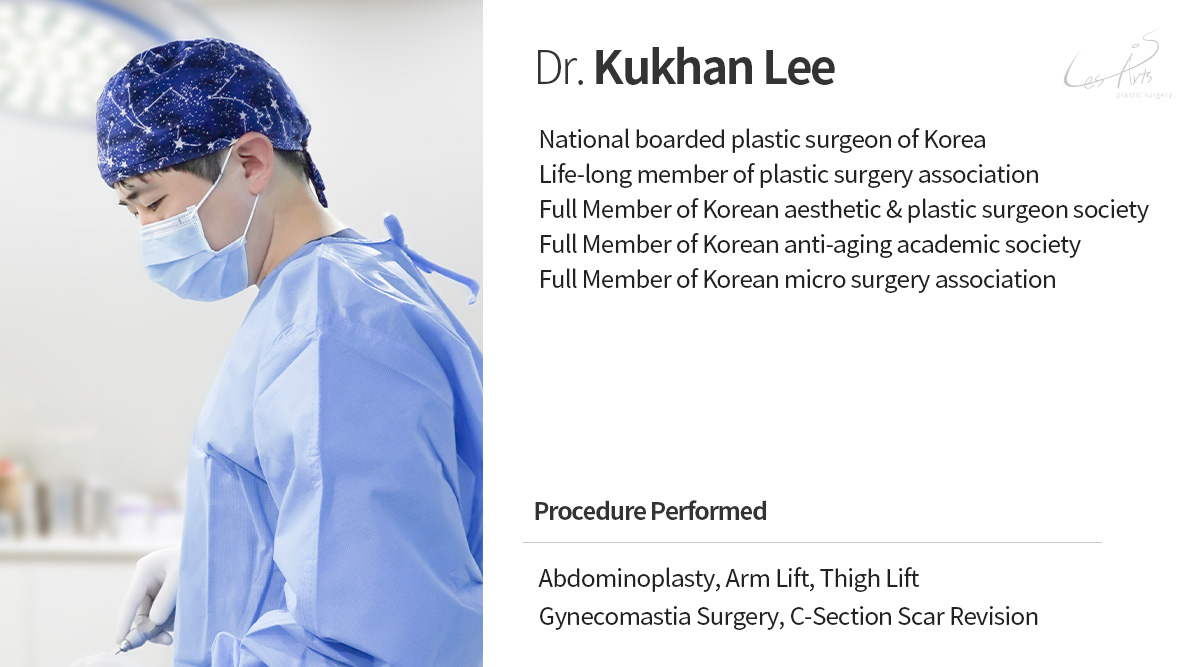
Hello, I am Board-Certified Plastic Surgeon Dr. Kukhan Lee of Lesarts Plastic Surgery.
While childbirth is a deeply meaningful life journey,
the anatomical alterations that occur throughout pregnancy and delivery often do not resolve spontaneously, presenting a prolonged aesthetic and functional concern.
In particular, even after returning to pre-pregnancy weight, if the abdomen continues to protrude forward,
or if overstretched skin, wrinkling, and rectus diastasis persist, it is often difficult to achieve desired contour improvements through exercise and dietary discipline alone.
The patient presented here had also consistently managed her weight and undergone multiple non-surgical procedures,
yet sought surgical correction because post-pregnancy abdominal changes did not sufficiently resolve.
This case provides helpful insight for individuals troubled by persistent postpartum skin laxity, protrusion, and periumbilical creasing.
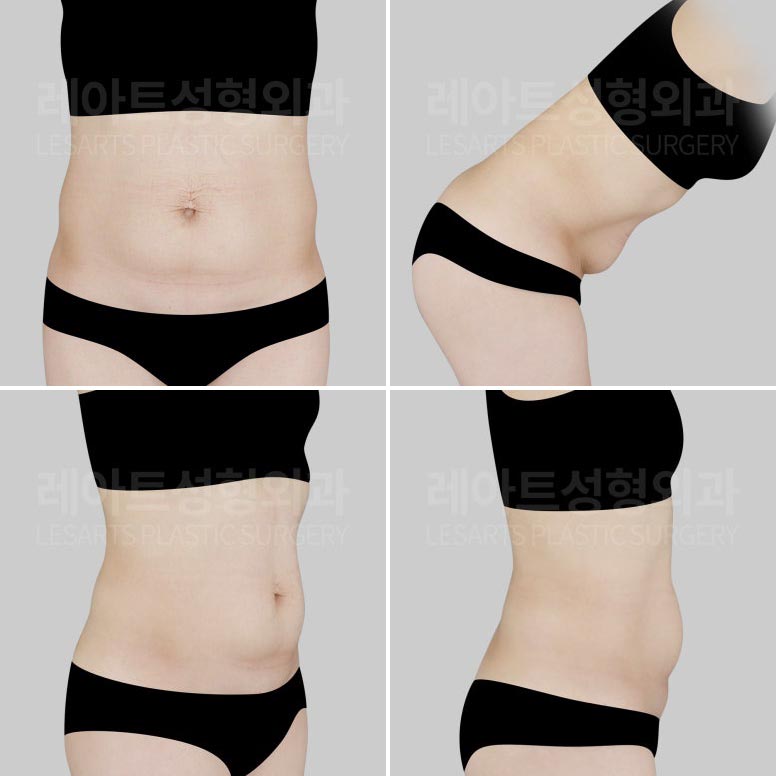
[Preoperative Assessment: Abdominoplasty]
The patient was a woman in her 30s measuring 160 cm and 52 kg, with a history of two Cesarean deliveries.
During pregnancy, her weight increased up to approximately 65 kg, and she noted that her abdomen expanded disproportionately compared to other regions.
Following childbirth, she consistently exercised and managed her diet in an effort to restore her body frame,
yet her abdominal profile did not improve as anticipated.
She had also undergone approximately 6 sessions of abdominal lipolytic injections without satisfactory improvement,
prompting her to visit our clinic to explore a definitive structural solution for her abdomen.
During consultation, her primary aesthetic concerns were
the prominently protruding lower abdomen, persistent wrinkles around the umbilicus, and post-pregnancy umbilical distortion.
Along with these, she desired a smoother refinement of her overall abdominal contour, including the waistline.
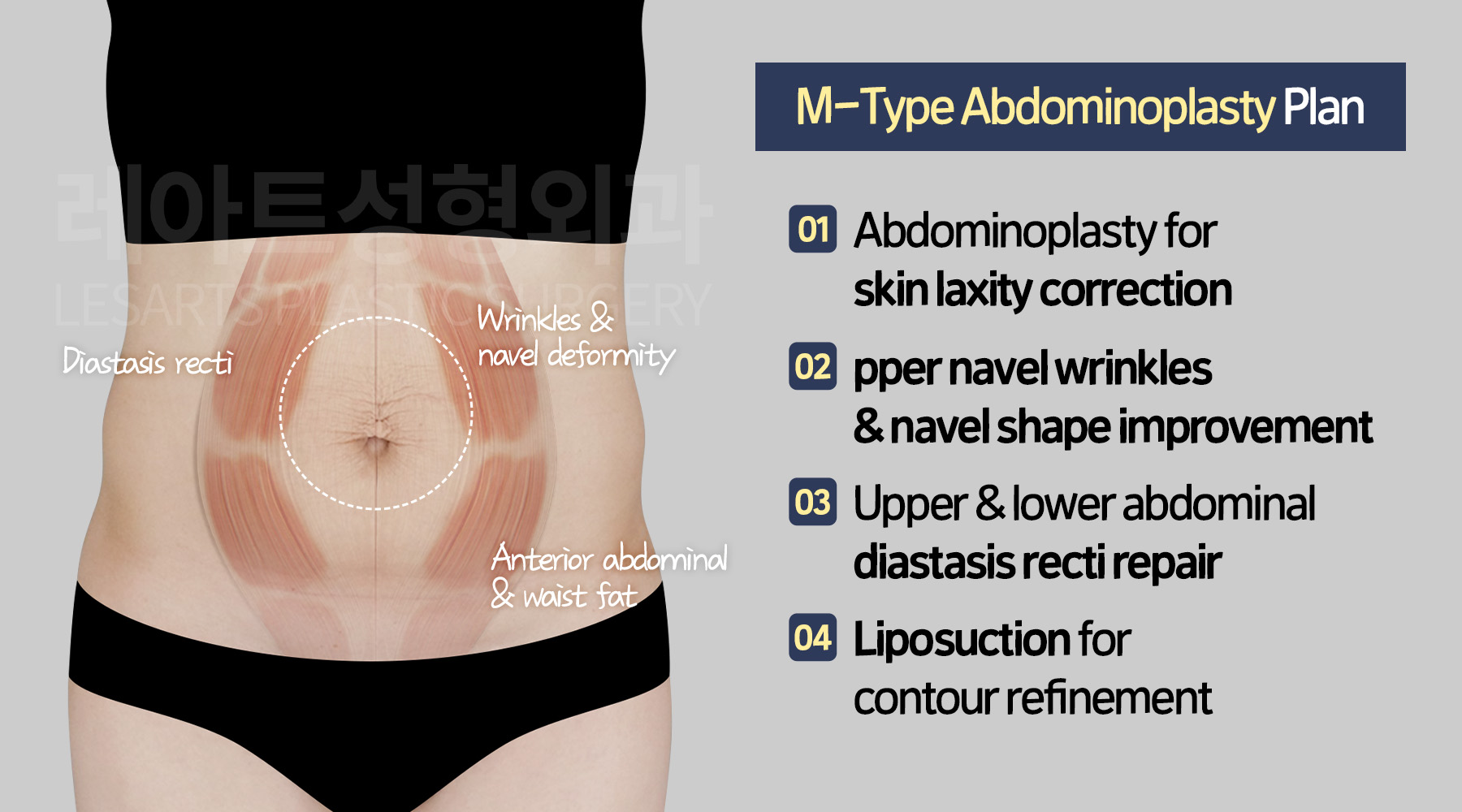
[Surgical Plan for M-Type Full Abdominoplasty]
Physical examination revealed rectus diastasis extending throughout the abdominal wall,
with fascial separation particularly pronounced in the supraumbilical zone.
This finding clearly reflected significant mechanical stretching of the musculoaponeurotic layer during pregnancy.
The abdominal skin envelope was diffusely thinned,
presenting with gestational striae alongside multiple fine creases concentrated over the upper abdomen.
These wrinkles were not simply loose skin folds,
but rather the result of diminished dermal elasticity combined with underlying structural fascial attenuation.
Due to rectus separation, the umbilicus appeared shallower than normal,
with noticeable morphological distortion of its perimeter.
Although cutaneous creasing was marked across the upper abdomen,
the actual redundant skin available for inferior advancement was limited, requiring careful technical calibration during surgical planning.
Furthermore, a pre-existing piercing scar was present superior to the navel,
and her prior Cesarean section scar was positioned somewhat lower than standard transverse landmarks.
Fortunately, the previous C-section scar was well-matured and stable.
While her overall adipose volume was modest,
a localized layer of subcutaneous fat requiring refinement remained around the umbilicus and anterior abdominal wall.
Given her relatively broad iliac bony framework, significant dramatic waist indention through liposuction alone was anatomically limited.
However, selectively contouring the residual fat deposits across the abdomen and flanks
was evaluated to be beneficial in refining the overall torso transition.
Synthesizing these clinical findings,
an M-type full abdominoplasty was determined to be the most appropriate approach to correct supraumbilical creasing and reconstruct umbilical architecture.
However, the volume of supraumbilical skin that could be advanced was limited,
and excising the supraumbilical piercing mark risked further reducing tissue laxity reserves.
Additionally, because the native C-section scar was set quite low,
we thoroughly counseled her preoperatively that the newly formed transverse incision scar would sit slightly higher than conventional placement.
The procedure was planned to incorporate concurrent liposuction to debulk upper abdominal and flank fat,
alongside rectus muscle repair utilizing a triple-lock plication technique.
Through this, the operative strategy was established to optimize abdominal core stability while enhancing waistline contours.
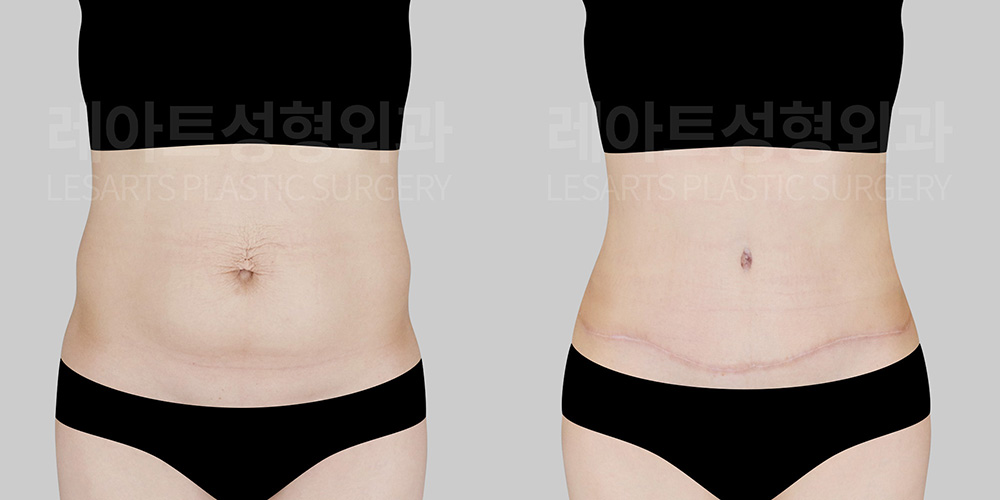
[Waistline Changes After Abdominoplasty - Dr. Kukhan Lee, Lesarts Plastic Surgery]
7 Months Postoperative Progress
Reviewing frontal photographs at 7 months postoperatively,
the most apparent change is that the fine wrinkles and skin laxity previously clustered around the umbilicus and upper abdomen have smoothed cleanly.
Plicating the separated rectus abdominis muscles has corrected anterior protrusion, transforming the anterior abdominal wall into a flatter, more supported contour,
with an overall more balanced waistline transition.
Preoperatively, rectus diastasis caused the umbilicus to appear shallow and structurally distorted.
Following concurrent fascial plication and umbilicoplasty,
the umbilicus has regained a natural vertical depth and aesthetic three-dimensional shape.
However, despite utilizing triple-lock plication,
her underlying skeletal proportions naturally imposed anatomical limits on creating an exaggerated waist inward curve.
These structural limits were clearly outlined during preoperative discussions,
and the result represents a favorable, balanced outcome achieved within realistic anatomical expectations.

[Anterior View Comparison Before & After Full Abdominoplasty - Dr. Kukhan Lee, Lesarts]
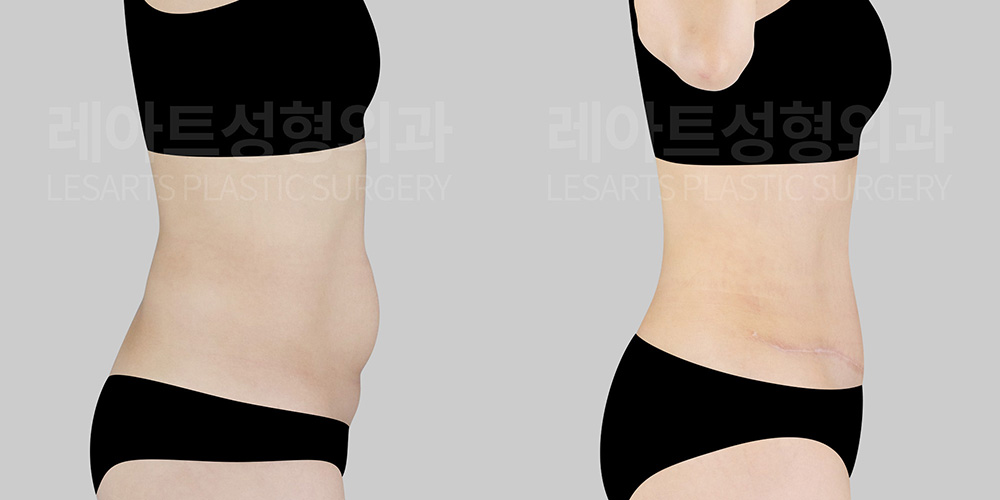
[Abdominoplasty and Liposuction at 7 Months - Dr. Kukhan Lee, Lesarts]
Examining oblique and lateral photographic views highlights the surgical transition with greater clarity.
Prior to surgery, the anterior abdominal wall bulged outward globally,
whereas abdominoplasty has flattened this protrusion into a firm abdominal contour.
Moreover, muscular plication has reinforced the midline core,
establishing a smooth, natural lateral profile with improved structural tone.
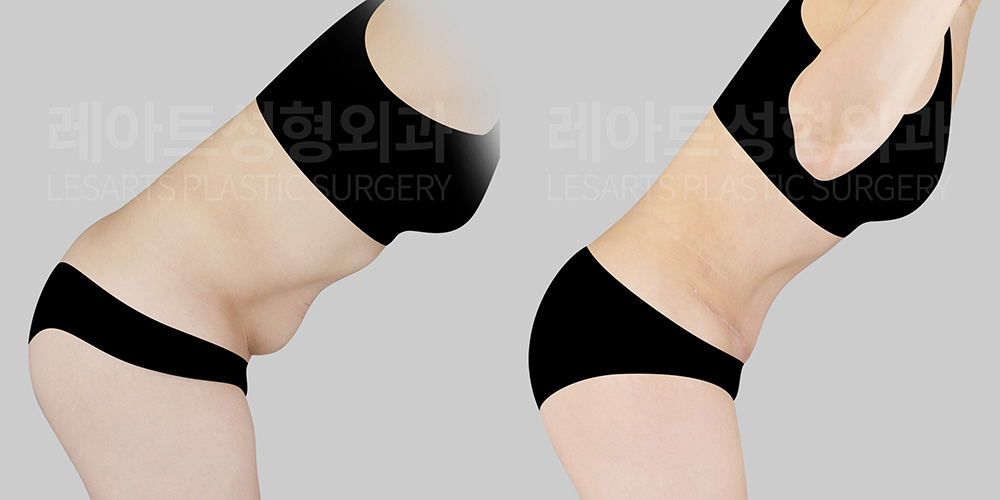
[Lesarts Plastic Surgery Abdominoplasty: Skin Laxity During Postural Flexion]
Even when flexing the torso forward,
the excess skin folding and bunched redundancy observed preoperatively have visibly diminished.
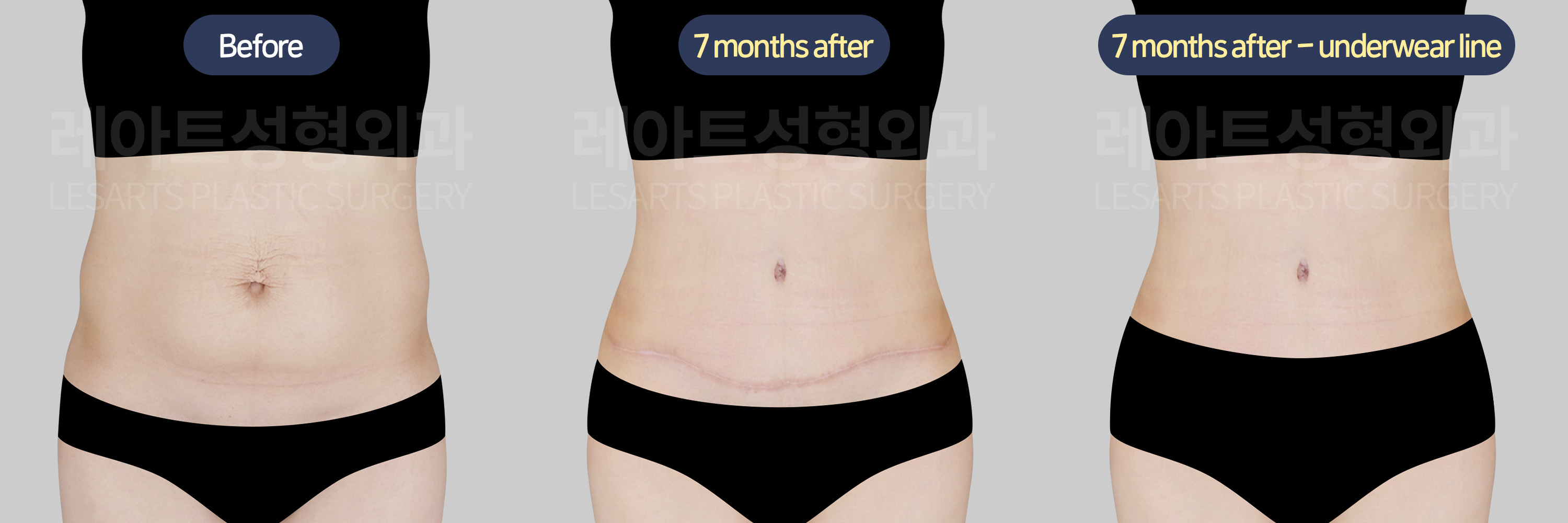
[Incision Location in Full Abdominoplasty - Lesarts Plastic Surgery]
In this clinical case, a key surgical consideration during planning was the final vertical level of the transverse scar.
Although supraumbilical wrinkling was extensive, the quantity of movable skin that could be advanced inferiorly was limited,
raising the possibility that the incision line would rest higher than average.
As anticipated, the postoperative scar settled somewhat higher than standard M-type placement.
However, it remains well within the coverage boundary of standard undergarments and swimwear,
representing a favorable outcome given the challenging baseline anatomy.
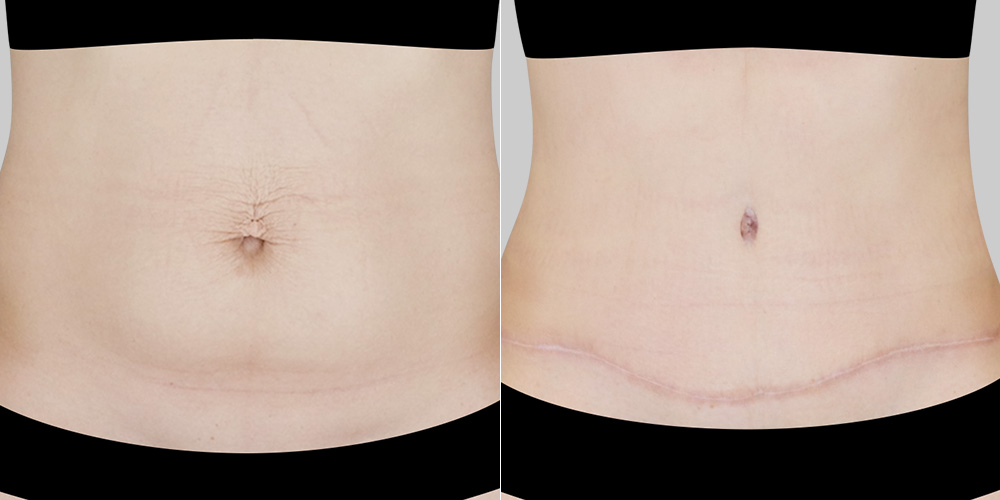
[Correction of Umbilicus and Creasing via Abdominoplasty - Dr. Kukhan Lee, Lesarts]
The pre-existing piercing scar above the umbilicus was successfully excised during the procedure,
and the surgical incision line is currently demonstrating stable maturation.
While minor transient hyperpigmentation persists in select segments,
ongoing scar therapy and topical maintenance regimens will support continued lightening.
At approximately 7 months following abdominoplasty, internal cicatricial healing tissues and induration (bio-band) have largely resolved.
Sensory hypoesthesia across the lower abdominal wall, common in early recovery, also steadily normalizes over time.
As deep remodeling progresses, firm internal planes soften into natural pliability,
and the external incision line continues its long-term maturation process.
However, undergoing surgery does not conclude the journey on its own.
To sustain sculpted abdominal contours over the long term,
consistent physical fitness and mindful weight maintenance must continue postoperatively.
Having chosen surgery and accepted an incision line to achieve definitive structural correction,
abdominoplasty should be viewed not as the final step in physique management, but as the foundation for renewed, healthy lifestyle care.
Postpartum abdominal changes affect not only exterior appearance, but can also
influence personal confidence and comfort in daily living.
When cutaneous laxity, rectus diastasis, and forward projection persist despite disciplined diet and training,
personal efforts alone may reach clear anatomical limits.
The most essential priority is to objectively assess cutaneous elasticity, fascial separation, and regional fat distribution,
and select a tailored clinical approach.
While abdominoplasty is not universally required for all postpartum patients,
when executed for appropriate anatomical indications, it delivers meaningful functional support and aesthetic balance.
If postpartum abdominal changes have caused ongoing concern,
we recommend undergoing detailed consultation to assess your anatomical status and determine the most suitable corrective plan.
[View More Real Cases of Abdominoplasty]
FAQ
Q1. Can loose abdominal skin following childbirth be resolved through exercise alone?
When postpartum changes involve structural cutaneous redundancy or rectus diastasis rather than simple adiposity,
there are clear clinical limits to what exercise and nutritional regimens can contract on their own.
Q2. Can rectus diastasis and forward abdominal bulging be corrected simultaneously?
Yes. Incorporating fascial plication of the separated rectus abdominis muscles during abdominoplasty
reinforces the midline abdominal wall,
effectively correcting outward projection and restoring a firmer profile.
Q3. Can abdominoplasty improve periumbilical wrinkles?
By excising redundant tissue and advancing the skin flap smoothly,
wrinkling clustered around the umbilicus and upper abdomen can be significantly smoothed.
Concurrent umbilicoplasty can also be performed to reshape the navel architecture as needed.
Q4. Can an abdominoplasty scar be concealed under standard undergarments?
The final scar level depends on individual tissue redundancy and pre-existing surgical scars.
In this patient, while positioned slightly higher than average due to anatomical tissue constraints,
it remained well within the wearable boundary of standard undergarments and swimwear.
Q5. Is recovery fully complete at 7 months post-abdominoplasty?
At 7 months, internal cicatricial adhesions and induration have substantially softened,
and sensory recovery and tissue suppleness continue to progress favorably.
The surgical scar and deep planes will continue their subtle maturation process beyond this milestone.
Dr. Kukhan Lee


Cases finding
similar to my profile
Customer Diagnostics


Select the surgery and
area you are interestedto see real
before andafter changes.


we
make you,
the art
Clinic hours
MON - FRI
10 am – 7pm
SAT
10 am – 4pm
Holiday
SUN, HOLIDAY
Location
Lesarts Moon Clinic Tower 4-5F, 40, Nonhyeon-ro 168-gil,
Gangnam-gu, Seoul, Republic of Korea

Medical institution name Lesarts Plastic Surgery
Address Lesarts Moon Clinic Tower 4-5F, 40, Nonhyeon-ro 168-gil, Gangnam-gu, Seoul, Republic of Korea
Representative Moon sung jun
