




Online Consultation
Please accurately enter the information below.
Quick Cost Consultation
Quick Consultation & Reservation
Cases finding
similar to my profile






Doctor's Note
Medical columns by our surgeons
Thigh Liposuction | Why Firm Thighs Aren't Just Muscle: How to Target Hidden Adipose Layers
2026-09-02
Thigh Liposuction | Why Firm Thighs Aren't Just Muscle: How to Target Hidden Adipose Layers
Can firm, muscular-type thighs become slimmer through liposuction?
When firmness in the thighs stems not only from muscle but also from fibrotic tissue and subcutaneous fat,
calibrated contouring of specific adipose layers can help refine overall thickness and leg lines.
However, establishing an accurate preoperative plan by evaluating the precise ratio between muscle and fat is essential.
[Learn More About Thigh Liposuction]
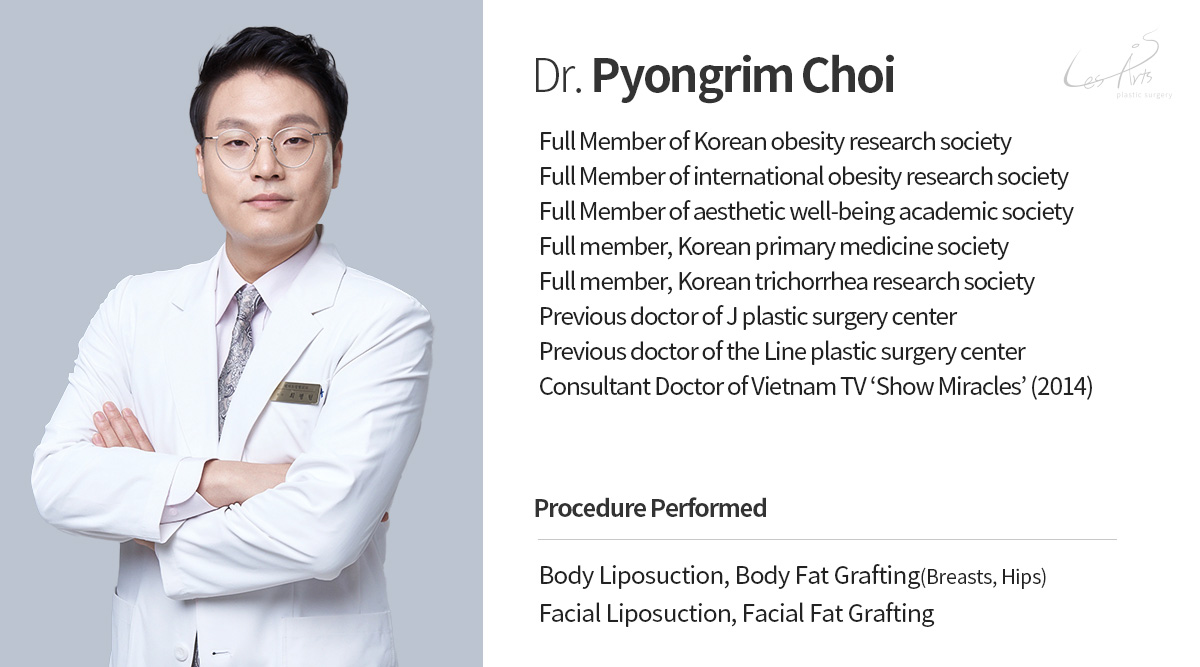
Hello, I am Dr. Pyongrim Choi of Lesarts Plastic Surgery.
“I don't think they get slimmer because it's muscle, not fat.”
This is one of the most common statements I hear during thigh consultations.
In particular, those whose thighs feel solid to the touch or who have consistently exercised
often assume that their thighs are purely muscular rather than composed of treatable adipose tissue.
However, when clinically evaluating the tissue,
cases where external firmness is composed solely of pure muscle are far less common than generally assumed.
The thigh is not composed merely of muscular structures;
it features a complex layered anatomy where subcutaneous fat and fibrotic adipose tissue sit directly over the muscular plane.
Therefore, it is premature to conclude that thighs cannot be refined through liposuction
simply because they feel dense or firm on manual palpation.
Today, through a clinical patient case,
we will examine the anatomical causes behind firm-feeling thighs,
and discuss how to evaluate and approach the targeted adipose layers treatable via liposuction.
Clinical Case
Female in her 20s / 162 cm / 56 kg / BMI 21.4
Aesthetic Goal: Refine dense-appearing thighs into a slimmer, well-proportioned contour
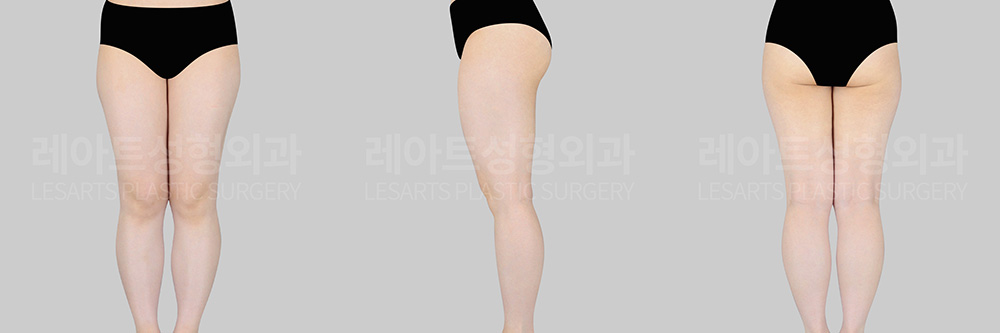
[Thigh Liposuction Consultation & Physical Assessment - Dr. Pyongrim Choi, Lesarts]
Although the patient maintained a relatively slender overall frame,
she noted that her thighs appeared disproportionately thick and dense compared to the rest of her body.
While she had assumed her thighs were simply muscular and resistant to change,
physical examination and tissue palpation revealed that muscular hypertrophy was not the sole factor:
- A thicker layer of subcutaneous fat over the muscular plane than anticipated
- Fibrotic adipose tissue densely anchored along the lateral and posterior aspects
- A softer distribution of subcutaneous fat along the inner thighs
Her presentation featured a compound anatomical profile combining underlying muscle with varying regional fat characteristics.
1. Why Thighs Can Feel Dense: The Role of Fibrotic Adipose Tissue
It is common to assume that firm thighs are entirely muscular,
yet physical firmness is often driven by non-muscular tissue architecture.
When dense fibrous septa develop within the adipose layer, the fat resists natural mobility
and feels firmly tethered against underlying structures.
This type of fibrous tissue exhibits high lipolytic resistance, often remaining unchanged despite consistent exercise,
and serves as a primary factor causing the lower extremities to appear broader and heavier.
2. Tailored Approach Based on Regional Adipose Characteristics
Rather than treating the thigh as a uniform plane,
it was necessary to differentiate the surgical approach according to tissue consistency and regional lines.
1) Medial Thigh (Inner Thigh)
The medial aspect presented softer subcutaneous fat compared to other zones.
This area responds with visible contour shifts following treatment,
playing a crucial role in establishing a natural medial space and clean inner silhouette.
2) Lateral Thigh (Trochanteric Saddlebag Line)
The lateral area presented dense fibrotic adipose tissue overlying lateral muscular contours,
serving as the main cause of outward leg widening.
Rather than over-resecting this region,
the objective was to smooth the outward projection into a balanced lateral contour.
3) Anterior Thigh
The anterior thigh presented firm quadriceps musculature alongside a distinct subcutaneous fat layer.
The surgical design focused on preventing excessive muscular demarcation
while evenly debulking the overlying subcutaneous adipose layer for a smooth transition.
3. Core Considerations in Thigh Liposuction
For this anatomical presentation, success relies not merely on total aspiration volume.
It depends on targeting the appropriate subcutaneous plane,
releasing and contouring dense fibrotic adipose deposits,
and selectively debulking excess fat without compromising native muscular balance.
Addressing these three factors simultaneously
is vital for shaping a natural, harmonious lower body silhouette.
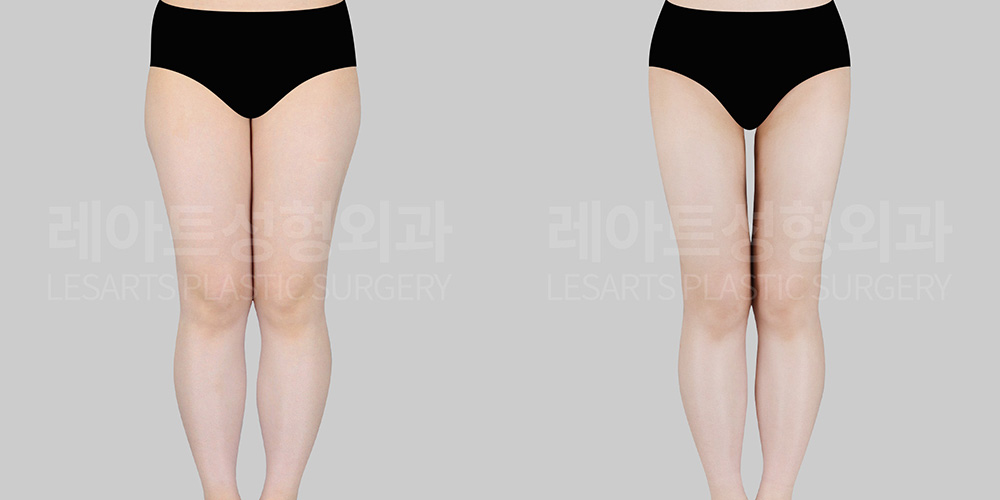
[Before & After Thigh Liposuction Comparison - Dr. Pyongrim Choi, Lesarts]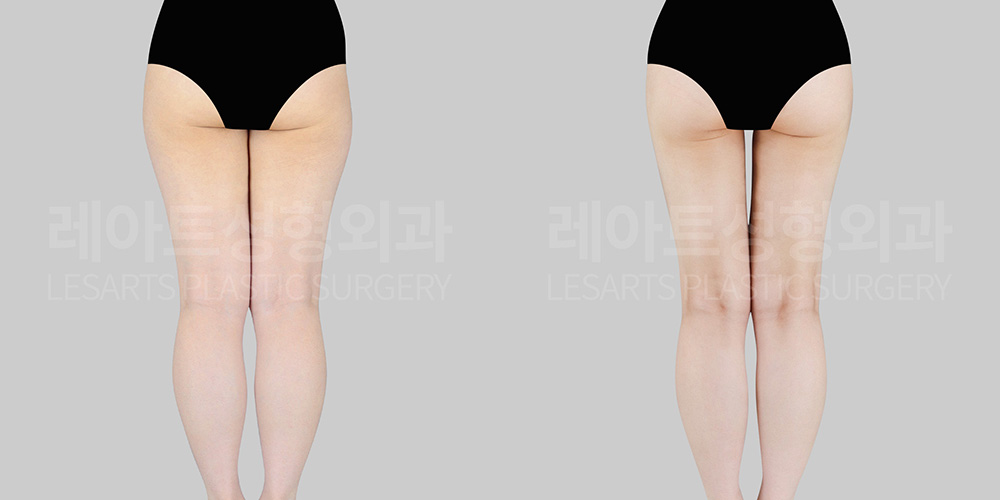
[Anterior Thigh Changes Before & After Liposuction - Dr. Pyongrim Choi, Lesarts]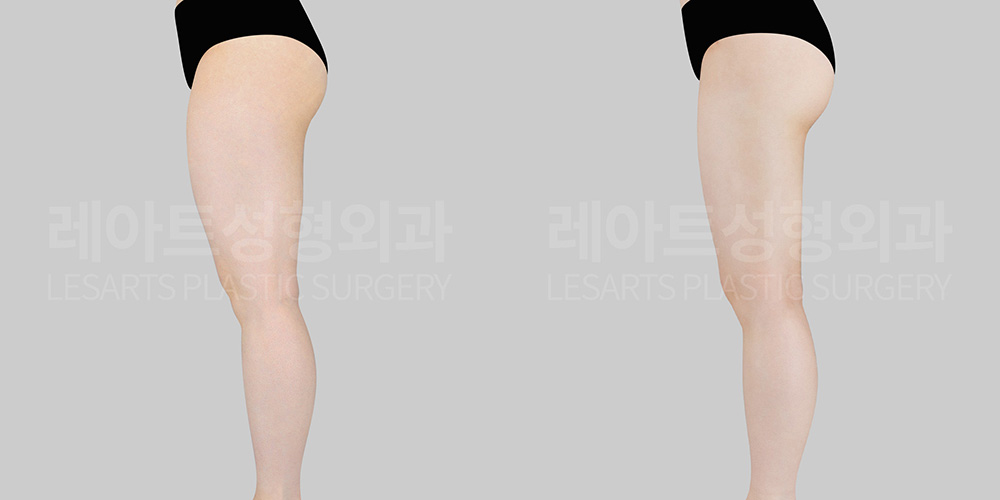
[Before & After Liposuction in Muscular-Type Thighs - Dr. Pyongrim Choi, Lesarts]
Reviewing outcomes at 3 months postoperatively,
lateral fullness has diminished,
and a clean, natural contour has formed along the inner thighs.
The dense fullness across the posterior aspect has also refined into a smooth transition.
With overall thigh circumference reduced,
the legs exhibit a visually leaner, elongated proportion,
lending the entire lower body silhouette a lighter and more refined profile.
It is true that muscular-type thighs present technical complexities
during liposuction compared to softer, fat-dominant cases.
However, concluding that “liposuction offers no benefit simply because muscle is developed” is clinically inaccurate.
When tissue firmness is partially driven by fibrotic adipose layers,
identifying regional tissue characteristics and contouring the targeted planes
can yield meaningful refinements in both thickness and overall lines.
If firm thighs have remained unchanged despite ongoing exercise,
it is worth evaluating whether the underlying cause involves treatable,
fibrotic adipose layers rather than isolated muscular development.
[View More Cases of Liposuction in Muscular-Type Thighs]
FAQ
Q1. Are all firm thighs strictly muscular in nature?
Not necessarily. When subcutaneous fat and dense fibrotic adipose tissue overlie the muscle,
thighs can feel firm to the touch, making objective clinical evaluation essential.
Q2. Can muscular-type thighs still benefit from liposuction?
If a sufficient layer of treatable subcutaneous or fibrotic adipose tissue exists over the muscle,
selectively debulking those layers can meaningfully refine leg thickness and contours.
Q3. Can dense, fibrotic adipose tissue be addressed with liposuction?
Yes. Even when dense fibrous septa make fat feel firm,
identifying tissue depth and structure allows targeted contouring within the appropriate subcutaneous plane.
Q4. Which areas are primarily targeted during thigh liposuction?
Because tissue characteristics differ across the medial thigh, lateral saddlebags, and anterior plane,
surgical planning is customized to regional anatomy rather than applying uniform extraction across all zones.
Q5. Can legs appear visually longer after thigh liposuction?
Streamlining lateral saddlebag bulges and refining medial and posterior fullness
narrows the leg profile, helping the lower body appear visually longer and more balanced.
Dr. Pyongrim Choi


Cases finding
similar to my profile
Customer Diagnostics


Select the surgery and
area you are interestedto see real
before andafter changes.


we
make you,
the art
Clinic hours
MON - FRI
10 am – 7pm
SAT
10 am – 4pm
Holiday
SUN, HOLIDAY
Location
Lesarts Moon Clinic Tower 4-5F, 40, Nonhyeon-ro 168-gil,
Gangnam-gu, Seoul, Republic of Korea

Medical institution name Lesarts Plastic Surgery
Address Lesarts Moon Clinic Tower 4-5F, 40, Nonhyeon-ro 168-gil, Gangnam-gu, Seoul, Republic of Korea
Representative Moon sung jun
