




Online Consultation
Please accurately enter the information below.
Quick Cost Consultation
Quick Consultation & Reservation
Cases finding
similar to my profile






Doctor's Note
Medical columns by our surgeons
Gynecomastia | 'Could My Chest Be Gynecomastia?' A Self-Assessment Guide for Concerned Men
2026-09-02
Gynecomastia | 'Could My Chest Be Gynecomastia?' A Self-Assessment Guide for Concerned Men
How can you tell whether your chest fullness is simple fat accumulation or true gynecomastia?
If your chest protrudes regardless of body weight, a firm mass is palpable beneath the nipple,
or fullness around the areola persists even after weight reduction, gynecomastia may be suspected.
For an accurate distinction, clinical high-resolution ultrasonography is essential to evaluate glandular tissue proliferation.
[Lesarts Gynecomastia Surgery Guide]
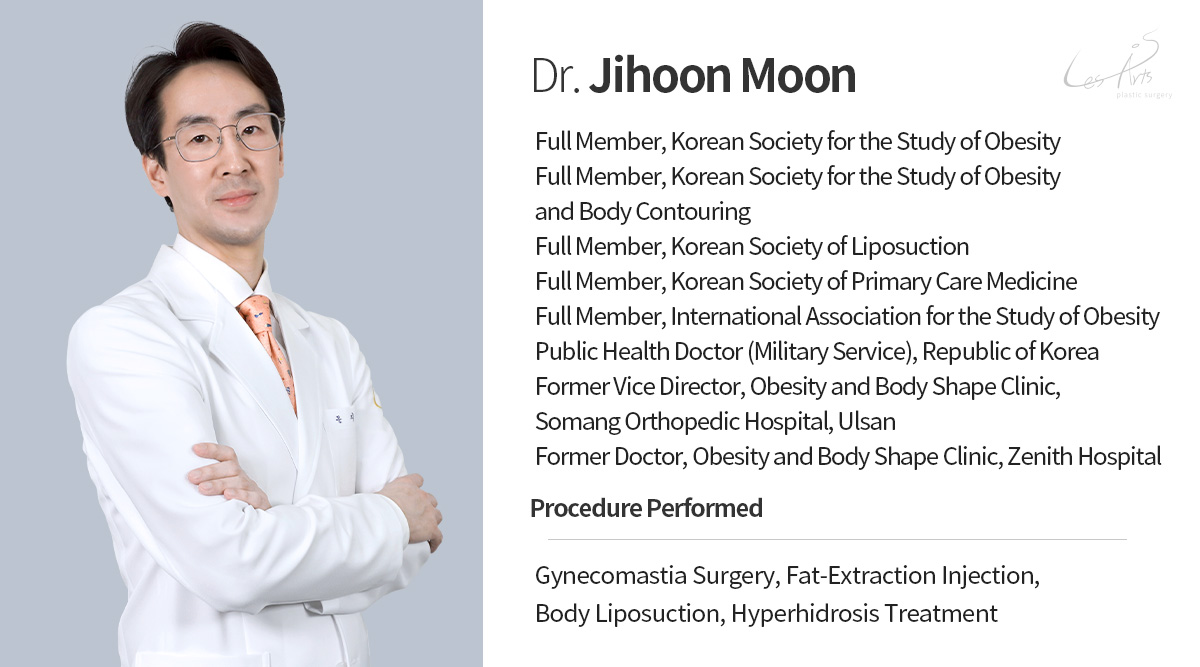
Hello, I am Dr. Jihoon Moon of Lesarts Plastic Surgery.
When consulting with various patients in the clinic,
I frequently observe a shared pattern behind their reasons for seeking clinical care.
Patients who present for gynecomastia consultations generally fall into two broad categories.

[Gynecomastia Consultation - Dr. Jihoon Moon, Lesarts Plastic Surgery]
The first group includes individuals who have endured persistent distress over their chest contour for years,
eventually deciding, ‘I want to resolve this definitively through surgery rather than continuing to worry.’
A substantial proportion of patients I meet in daily practice belong to this group.
While comfortable wearing shorts, they felt self-conscious wearing lightweight t-shirts,
and long avoided public baths, saunas, or swimming facilities where the upper body is exposed,
ultimately seeking consultation to find relief from these everyday constraints.
Conversely, the second group visits with a different concern.
“Doctor, is my chest truly gynecomastia? I want to know whether it's simple weight gain or true glandular tissue.”
Because they find it difficult to discern their condition independently,
they visit the clinic primarily to establish an accurate objective diagnosis.
Today, before scheduling a clinical visit,
to help you evaluate your chest presentation and daily habitual patterns independently,
we have outlined the <10-Point Self-Assessment Guide for Gynecomastia>.
Rather than focusing on complex endocrine pathophysiology,
this guide is divided into ‘5 Physical Indicators’ and ‘5 Psychological & Behavioral Signals’
drawn directly from the anatomical features and common patterns patients report during clinical consultations.
※ Review items ① through ⑩ and check each one that aligns with your current experience.
[Part 1] Visual & Palpatory Assessment: ‘5 Physical Indicators’
First, let us examine anatomical features and structural changes
that can be observed directly in front of a mirror or assessed via gentle manual palpation.
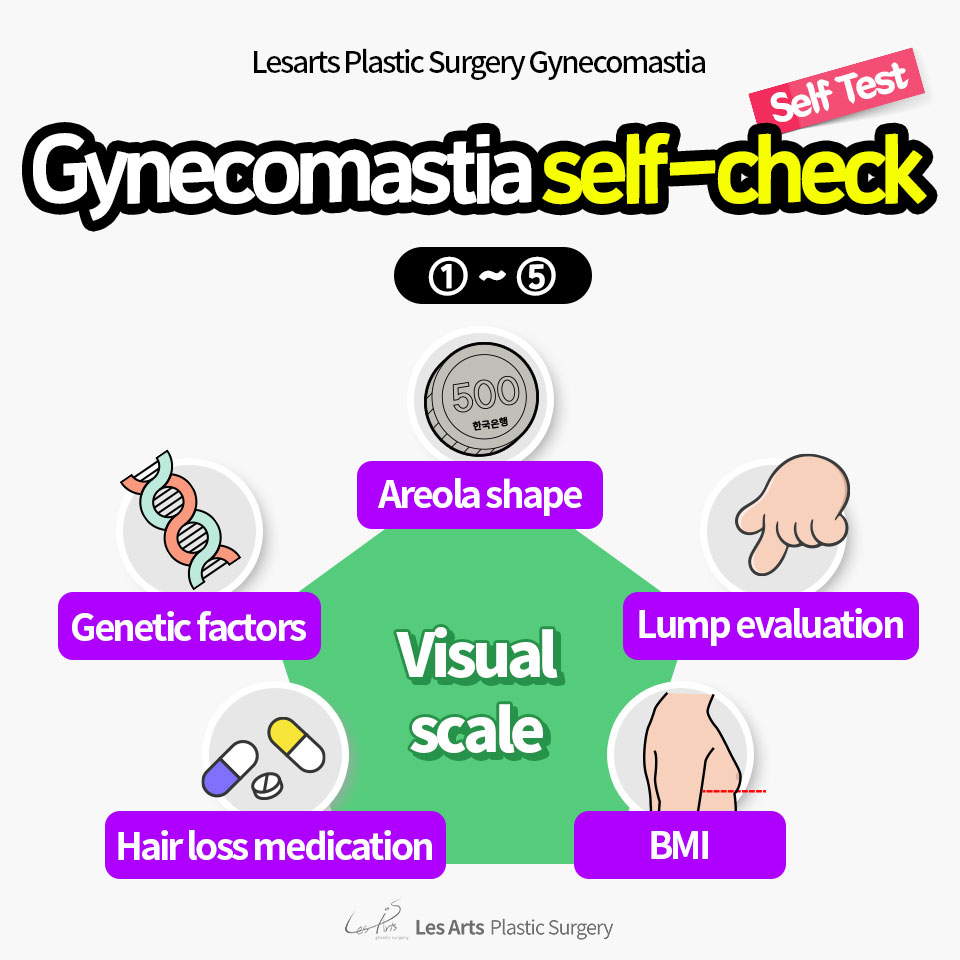
[Gynecomastia Self-Assessment - Dr. Jihoon Moon, Lesarts Plastic Surgery]
① The areolar diameter is larger than a standard coin (approx. 26 mm) and protrudes outward.
You can compare the size of your areola against a standard coin (approximately 26.5 mm in diameter).
If the areolar diameter is noticeably larger, or if the nipple-areolar complex
projects forward in a conical or rounded contour, underlying glandular proliferation may be suspected.
② A firm, defined nodular mass is palpable beneath the nipple.
While resting comfortably without flexing the pectoral muscles,
use your thumb and index finger to gently compress the tissue surrounding the areola toward the center.
In cases of simple adipose accumulation, the tissue feels soft and uniform throughout,
whereas if a rubbery, firm, disc-like mass is felt beneath the nipple,
it indicates a high likelihood of true glandular breast tissue rather than simple fat.
③ The chest remains prominently projected despite being at a standard body weight.
Even when body weight and BMI (Body Mass Index) reside within standard ranges,
the chest area alone may appear disproportionately projected.
Many question whether further caloric reduction or chest workouts are needed,
yet if localized projection around the areola persists after weight loss,
evaluating the presence of resistant glandular tissue rather than simple adiposity is clinically recommended.
④ Changes in chest contours followed the initiation of specific medications, such as hair loss therapy.
If changes in chest volume or sensation developed recently,
it is valuable to review your current pharmacological regimens.
Particularly following the use of 5-alpha reductase inhibitors such as finasteride or dutasteride,
if glandular fullness, hypersensitivity, or tingling discomfort develops,
altered peripheral hormone ratios stimulating glandular tissue may be considered.
⑤ Other male family members exhibit similar chest prominence.
When evaluating gynecomastia, familial patterns and body habitus can offer helpful context.
While weight gain correlates with increased chest tissue,
genetic variations in adipose distribution and glandular hormone sensitivity also run in families.
If close male relatives, such as a father or brother, present with pronounced chest fullness,
you may share a similar anatomical predisposition worth assessing.
[Part 2] Daily Habits & Psychological Cues: ‘5 Behavioral Signals’
When an individual feels self-conscious about a specific body area,
it frequently influences daily visual attention and behavioral habits.
Review whether any of the following patterns recur
in your daily thoughts and lifestyle routines.
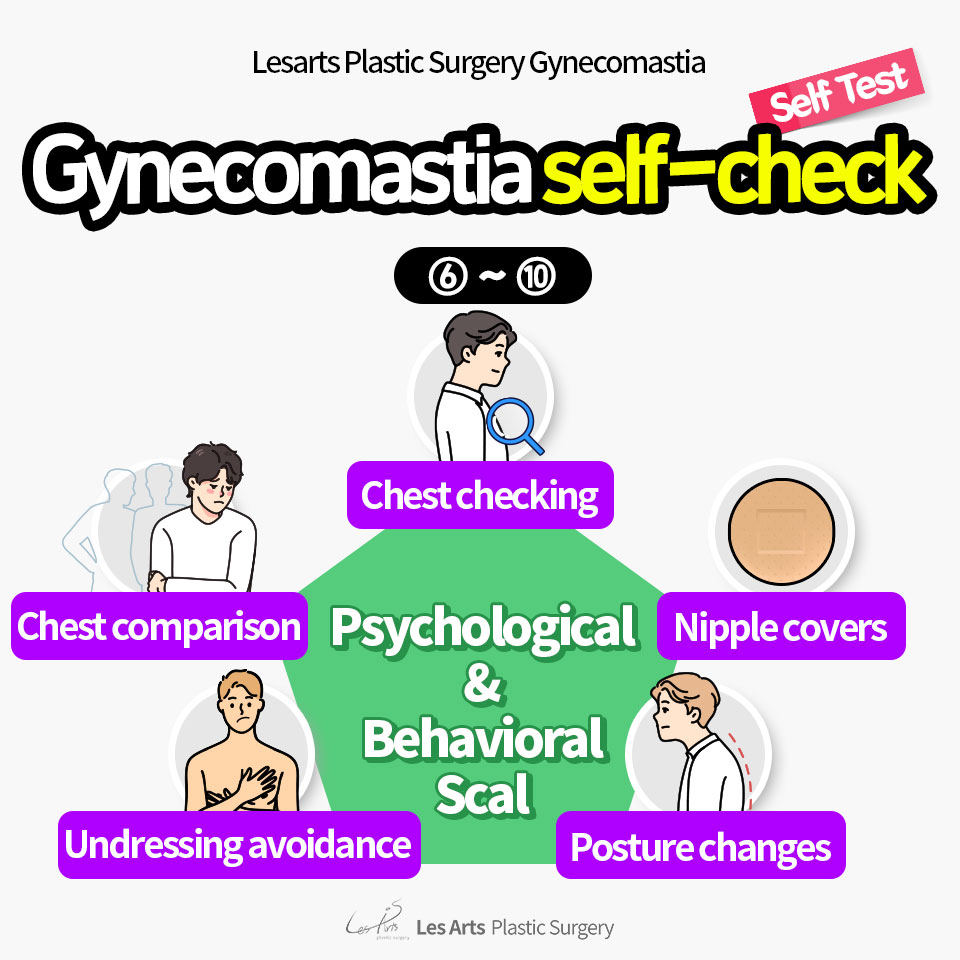
[Preoperative Diagnostic Evaluation - Lesarts Plastic Surgery]
⑥ Your gaze instinctively shifts to the chest when observing other men.
When encountering or passing other men in daily life,
your eyes instinctively check their chest silhouette first.
Noticing thoughts such as ‘his chest looks flat even in a light shirt’
or ‘he has a larger build, yet his chest does not protrude’
reflects unconscious comparison habits regarding your own chest contour.
⑦ You constantly compare chest contours in media or social networks.
When viewing shirtless male figures in online media, social networks, or video platforms,
your attention focuses on chest projection rather than overall muscle or physique.
Closely analyzing how flat or projected the areolar complex appears
and repeatedly comparing it against your own silhouette represents a common behavioral cue.
⑧ Going out in lightweight clothing feels uncomfortable without nipple covers.
When wearing light short-sleeve shirts during warmer seasons,
leaving the house without nipple concealers (patches) causes significant hesitation,
or you habitually select heavy, dense fabrics to mask projection.
Yet, because patches do not conceal underlying three-dimensional volume,
choosing outfits remains a recurring source of stress,
often limiting your wardrobe exclusively to dark or oversized garments.
⑨ You frequently hear remarks from others telling you to "straighten your shoulders."
In an attempt to conceal chest projection,
you may unconsciously round your shoulders forward or slouch your upper back.
Even if unintentional, if peers frequently tell you,
“Why are you slouching?” or “Keep your shoulders back,”
it is valuable to consider whether chest-related self-consciousness is impacting your habitual posture.
⑩ You avoid saunas, pools, or locker rooms even around unfamiliar strangers.
Beyond feeling hesitant in front of acquaintances,
you avoid removing your shirt even in settings where no one knows you.
During business trips, travel, or visits to public baths, spas,
pools, or water parks, concern over external perception prevents you from participating comfortably.
This indicates that being shirtless in communal settings has become
a notable psychological constraint.
[Scoring System] Gynecomastia Self-Assessment Scale
Among the 10 criteria reviewed above,
tally the total number of items that correspond to your physical findings and daily experiences,
and evaluate your score according to the clinical tiers below.
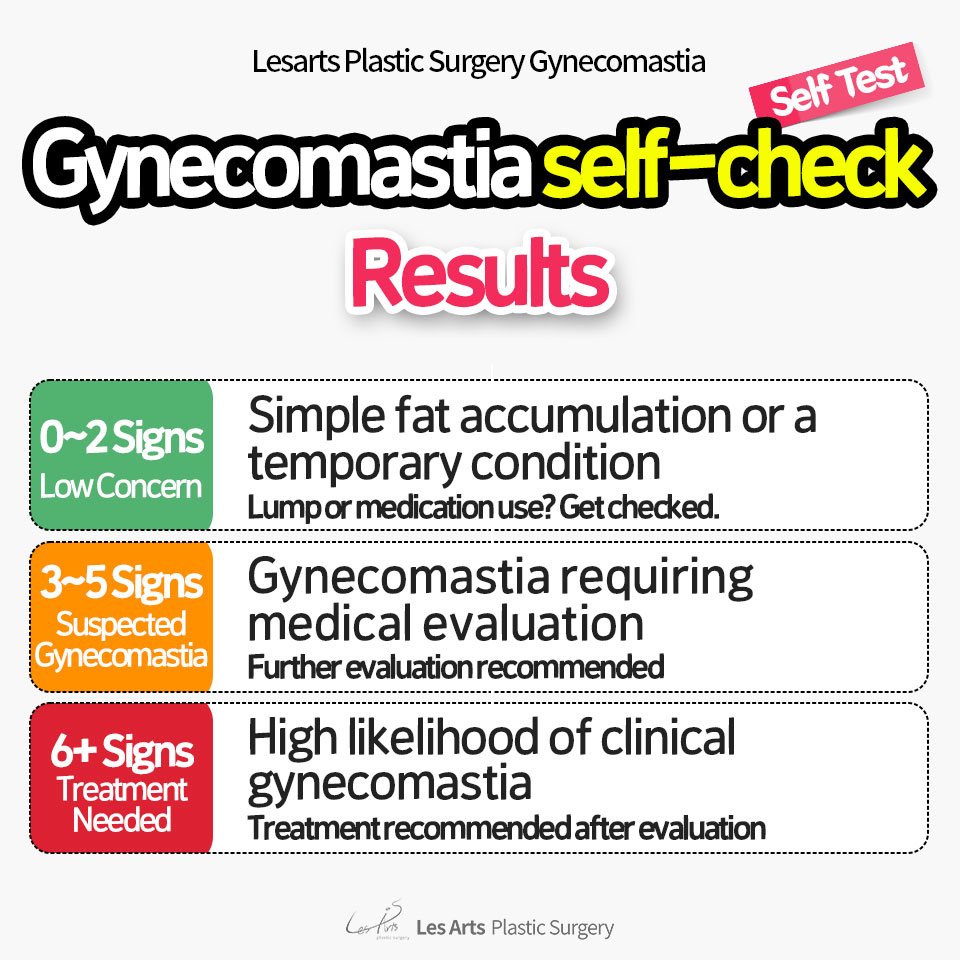
[Gynecomastia Self-Test - Dr. Jihoon Moon, Lesarts Plastic Surgery]
◈ 0 to 2 Items (Low Probability Tier) ◈
There is a comparatively high probability of pseudogynecomastia driven by simple adipose accumulation
or transient physiological changes.
However, even within a low score range, if a firm glandular mass is palpated beneath the areola
or if distinct tenderness developed following specific medication use,
clinical evaluation remains advisable to establish objective clarity.
◈ 3 to 5 Items (Moderate Suspicion Tier) ◈
This range warrants consideration of professional medical evaluation
to accurately confirm or rule out true gynecomastia.
If physical projection is accompanied by daily lifestyle hesitations or postural adjustments,
high-resolution breast ultrasonography is recommended to assess glandular development and measure tissue depth.
◈ 6 or More Items (High Suspicion & Evaluation Tier) ◈
There is a strong clinical indication to formally evaluate for gynecomastia,
suggesting that chest-related self-consciousness may be imposing meaningful daily and social constraints.
Rather than continuing to manage the concern in isolation, visiting a specialized clinic
to establish an objective anatomical diagnosis and explore targeted clinical options is recommended.
Conclusion
Reviewing these 10 criteria may have helped you realize
that persistent chest concerns are often attributable to anatomical glandular factors rather than simple changes in weight or fitness habits.
Nonetheless, a self-assessment guide serves solely as an initial screening reference,
and checked items alone cannot replace a formal medical diagnosis.
During an in-clinic consultation, high-resolution breast ultrasound imaging
precisely confirms whether retroareolar glandular tissue is pathologically developed,
measuring glandular thickness objectively down to the millimeter (mm).
Once your anatomical presentation is clearly characterized through diagnostic imaging,
the necessity of surgical excision or conservative observation can be evaluated with clinical precision.
We hope this 10-point gynecomastia guide offers helpful clarity
for those who have managed these concerns privately, serving as a reliable benchmark
toward obtaining a definitive clinical evaluation when needed.
[Explore More Male Gynecomastia Cases]
FAQ
Q1. How can one clinically distinguish between gynecomastia and simple chest fat accumulation?
If the chest protrudes at a normal body weight or a firm mass is palpable beneath the nipple,
gynecomastia should be evaluated.
A definitive distinction requires ultrasound evaluation to verify glandular tissue proliferation.
Q2. If chest projection persists despite dieting, could it indicate gynecomastia?
When rounded volume around the nipple-areolar complex remains unchanged following weight reduction,
it is valuable to evaluate whether underlying glandular tissue rather than simple adiposity is responsible.
Q3. If chest enlargement or tenderness follows hair loss medication use, is it gynecomastia?
Following the use of finasteride or dutasteride formulations,
if areolar fullness or mastalgia develops, evaluating medication-induced glandular stimulation is clinically indicated.
Q4. Can a self-assessment guide definitively confirm gynecomastia?
A self-assessment serves as an informative screening aid regarding physical features and behavioral cues.
To establish a definitive diagnosis, clinical examination and ultrasonography
are required to measure glandular proliferation and tissue depth.
Q5. What diagnostic testing is conducted when gynecomastia is suspected?
High-resolution breast ultrasound is performed to assess retroareolar glandular architecture,
measuring glandular thickness and internal tissue composition to determine whether surgical intervention is indicated.
Dr. Jihoon Moon


Cases finding
similar to my profile
Customer Diagnostics


Select the surgery and
area you are interestedto see real
before andafter changes.


we
make you,
the art
Clinic hours
MON - FRI
10 am – 7pm
SAT
10 am – 4pm
Holiday
SUN, HOLIDAY
Location
Lesarts Moon Clinic Tower 4-5F, 40, Nonhyeon-ro 168-gil,
Gangnam-gu, Seoul, Republic of Korea

Medical institution name Lesarts Plastic Surgery
Address Lesarts Moon Clinic Tower 4-5F, 40, Nonhyeon-ro 168-gil, Gangnam-gu, Seoul, Republic of Korea
Representative Moon sung jun
