




Online Consultation
Please accurately enter the information below.
Quick Cost Consultation
Quick Consultation & Reservation
Cases finding
similar to my profile






Doctor's Note
Medical columns by our surgeons
Sculpting a Sleek, Defined Shoulder Line with Arm & Accessory Breast Liposuction
2026-09-08
Sculpting a Sleek, Defined Shoulder Line with Arm & Accessory Breast Liposuction
What contour refinements can be anticipated when combining arm and accessory breast liposuction?
Contouring the posterior and lateral arm fullness alongside accessory breast deposits
reduces prominent outward bulges and smooths the transition where the arm meets the axilla,
helping establish a straighter, more slender arm silhouette.
[Lesarts Arm & Accessory Breast Liposuction Guide]
As warmer weather approaches and sleeveless or short-sleeved tops are brought out,
many people feel self-conscious about localized bulges that become visible when raising their arms.
In particular, stubborn posterior arm fullness and accessory breast tissue projecting outside clothing
frequently resist persistent exercise and dietary weight reduction.
For individuals genetically predisposed to storing adipose tissue in the upper extremities,
it is quite common to find that self-directed fitness routines alone
fail to achieve the desired contour refinements.
Similarly, accessory breast tissue adjacent to the axilla often contains glandular elements alongside adipose stores,
making it an anatomical zone that does not readily diminish through weight loss alone.
For these reasons, many consider combining arm and accessory breast liposuction
to reduce arm thickness and achieve a continuous, smooth contour.
However, because the arm houses multiple muscular structures including the deltoid, biceps, and triceps,
underlying muscular contours directly influence the overall exterior silhouette.
Consequently, simply extracting large volumes of fat
does not automatically result in a natural, slender arm line.
To reduce arm diameter while preserving soft, feminine transitions,
meticulous surgical design and controlled aspiration tailored to muscular anatomy and adipose distribution are essential.
Today, through a clinical case of a patient seeking correction for posterior arm volume and accessory breast protrusion,
we will examine the primary anatomical considerations involved in designing concurrent arm and accessory breast liposuction
in detail.
[Patient Profile]
Age: Late 20s
Height: 160 cm
Weight: 51.4 kg
BMI: 20.1 kg/m²
Body Fat Percentage: 26.8%
* Clinical outcomes may vary individually depending on personal anatomical conditions, even with similar measurements.
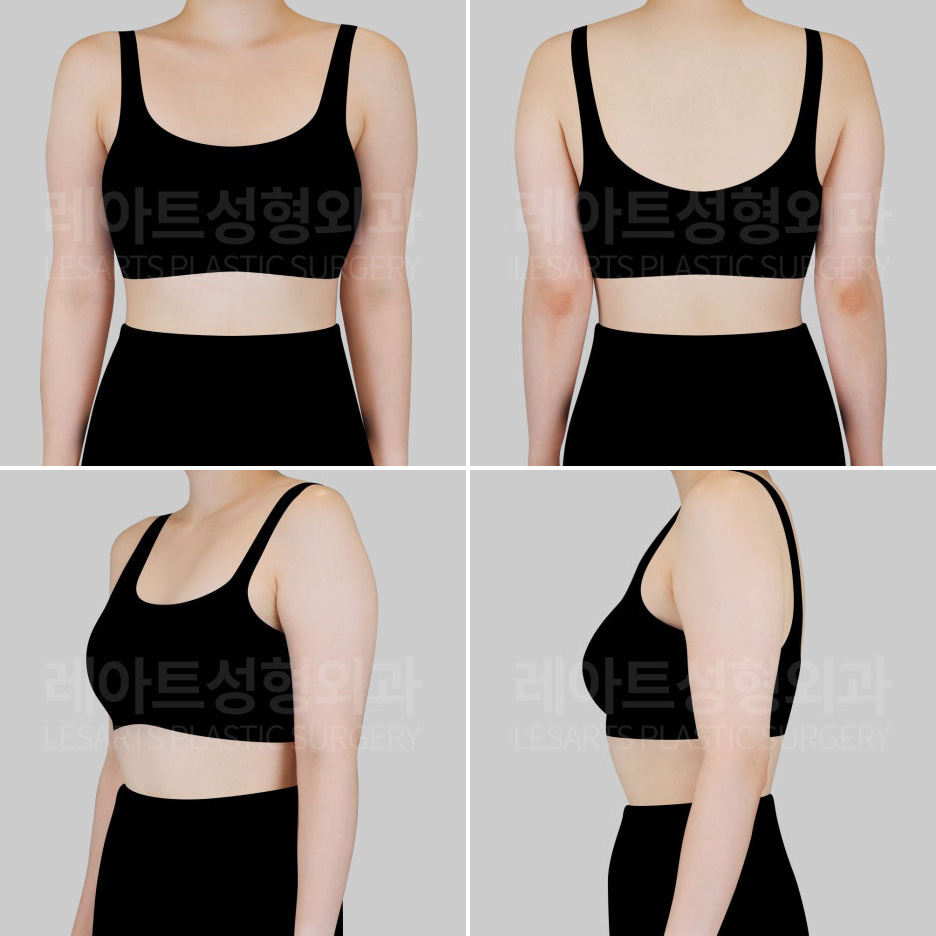
[Preoperative Assessment: Arm & Accessory Breast Liposuction]
[Preoperative Assessment: Arm & Accessory Breast Contours]
The patient maintained stable body weight over time,
had no underlying medical conditions or active medications,
and presented with an overall slender body frame.
However, her systemic body fat percentage was slightly elevated relative to weight,
with noticeable fullness concentrated along the posterior upper arm
and accessory breast deposits adjacent to the axilla.
On visual examination, even with arms resting naturally at her sides,
the posterior and lateral arm lines bulged outward,
while anterior projection of the accessory breast partially obscured the front arm line,
giving the upper frame a crowded, heavy appearance.
Ultrasound Measurements:
Posterior Arm: 14 / 13 mm
Anterior Arm: 8 / 9 mm
Deltoid Muscle Thickness: 20 / 15 mm
[Surgical Design for Arm & Accessory Breast Refinement]
Rather than aiming solely for maximum fat extraction,
arm liposuction requires preserving the native curvature of underlying muscles
while contouring the silhouette into a sleek, straight line.
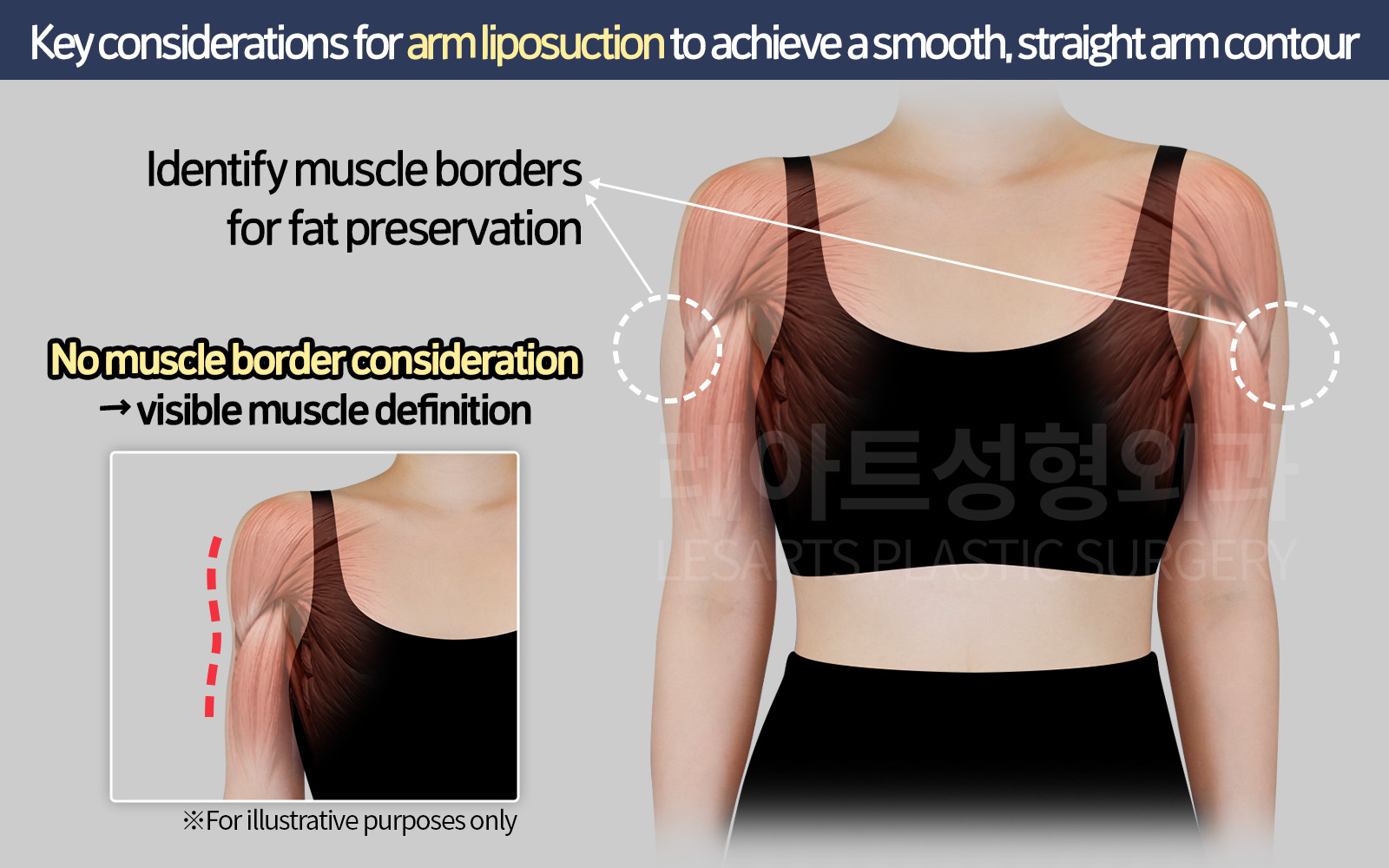
[Design Considerations for Arm Liposuction - Dr. Yongseung Seo, Lesarts]
To create a slender, soft line,
a controlled layer of adipose tissue must be preserved along the borders where the deltoid, biceps, and triceps meet
to prevent sharp muscular demarcation.
If fat is extracted too aggressively along muscular transitions,
underlying muscle lines become starkly delineated, projecting an athletic or muscular impression
that diverges from the soft, delicate contour desired by the patient.
Additionally, because ultrasound confirmed a 5 mm difference in deltoid thickness between sides,
we explained that subtle bilateral asymmetry in thickness or contour could remain postoperatively.
Because the human frame is rarely completely symmetrical,
it is important to understand that liposuction does not alter underlying skeletal or muscular structures,
but refines and balances the overlying adipose layer across the patient's native anatomy.
Regarding the accessory breast area, we counseled her that as tissues contract during healing,
new superficial skin creases can develop or pre-existing axillary folds may become slightly more defined.
Because this is an expected physiological response following volume reduction in the axillary region,
understanding this possibility beforehand is vital prior to surgery.
[Before & After Comparison: Arm, Scapular & Axillary Contouring]
(Photographed 1 month postoperatively under identical lighting and clinical conditions)
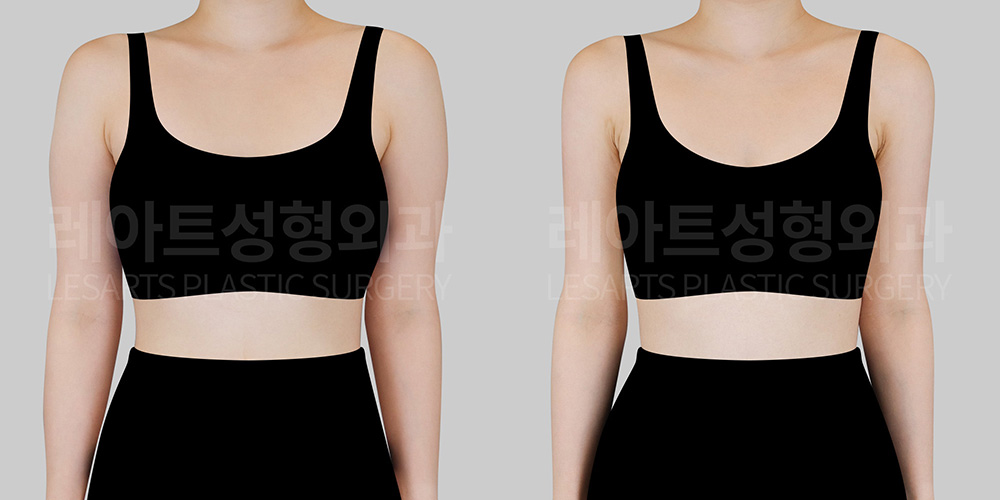

Prior to surgery, prominent posterior and lateral arm bulges
caused the upper body to appear comparatively heavy and broad.
Postoperatively, debulking the protruding zones smoothed the outer contour,
transitioning the arm into a straight silhouette
that appears noticeably more elongated and refined than baseline.
In the accessory breast area, as anticipated preoperatively,
the axillary crease settled slightly deeper,
yet reducing the bulky tissue that previously shadowed the anterior arm
established a significantly slimmer, cleaner upper body profile.
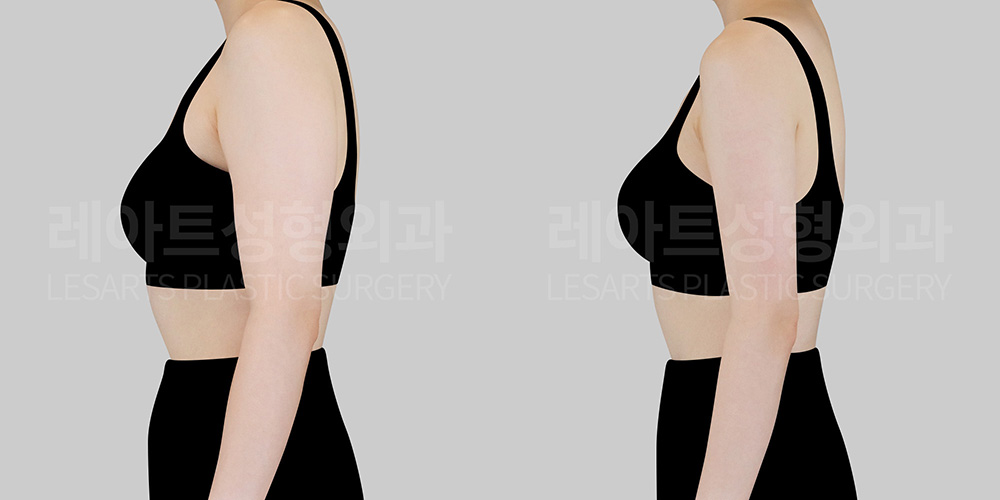
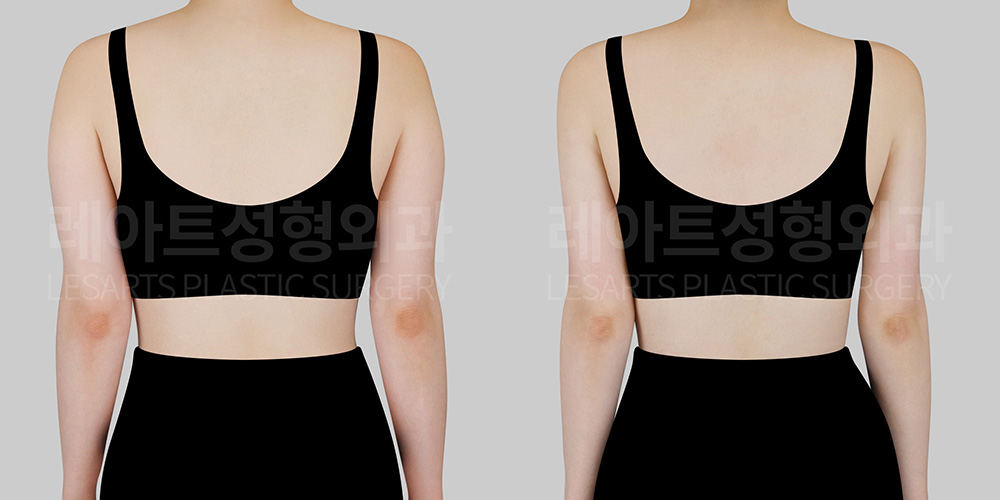
Following arm and accessory breast liposuction, peers noted that her upper frame appeared significantly lighter,
and the patient expressed high satisfaction with her reduced arm circumference and clean lines.
Because only one month had elapsed since the procedure,
we explained that as residual swelling subsides throughout recovery,
the arm contour will continue to settle into an even smoother, more defined line.
View Similar Arm Liposuction Cases
▽▽▽

Liposuction extends beyond simple adipose removal;
it is a refined body contouring procedure that harmonizes the overall silhouette
by respecting individual skeletal proportions, muscular structure, and fat distribution.
In particular, how muscular transitions are contoured and what depth of adipose buffer is retained in the arm
fundamentally dictates the final contour and aesthetic outcome.
Achieving the desired line requires
accurate preoperative assessment paired with tailored, meticulous operative design.
If persistent upper arm fat has resisted diet and exercise,
consulting with a specialist to evaluate your tissue anatomy
can help identify an approach suited to your body frame.
Rather than repeating cycles of extreme dieting,
selecting an evidence-based clinical method based on precise diagnostic findings
serves as a constructive way to achieve balanced, lasting contours.
Lesarts Plastic Surgery is dedicated to assisting you
in sculpting smooth, natural arm lines.
Doctor's Note by Dr. Yongseung Seo, Lesarts Plastic Surgery
This column is authored directly by our medical staff.
FAQ
Q1. Can upper arm fat and accessory breast tissue persist in a slender frame?
Yes. Even with a lean body mass, genetic variations in adipose distribution can cause
subcutaneous fat in the posterior arm, lateral arm, and accessory breast area to appear disproportionately prominent.
Q2. Is maximum fat extraction always the primary goal in arm liposuction?
Extracting as much fat as possible is not the objective.
It is essential to preserve an appropriate buffer layer along the borders of the deltoid, biceps, and triceps
to contour a smooth, feminine line without unnatural muscular demarcation.
Q3. Can bilateral asymmetry remain noticeable after arm liposuction?
If pre-existing differences exist in underlying skeletal framework or muscular volume,
subtle variations in arm thickness or contour transitions can remain noticeable postoperatively.
Q4. Can axillary skin creases change following accessory breast liposuction?
As tissue contracts during healing, minor superficial skin creasing can form,
or pre-existing axillary folds may become slightly deeper or longer.
Q5. Is the outcome at 1 month post-op the final contour?
At one month, active tissue healing and recovery are still underway.
As post-op swelling and induration continue to resolve over subsequent months, the arm line will settle into an even smoother, more refined contour.
Dr. Yongseung Seo


Cases finding
similar to my profile
Customer Diagnostics


Select the surgery and
area you are interestedto see real
before andafter changes.


we
make you,
the art
Clinic hours
MON - FRI
10 am – 7pm
SAT
10 am – 4pm
Holiday
SUN, HOLIDAY
Location
Lesarts Moon Clinic Tower 4-5F, 40, Nonhyeon-ro 168-gil,
Gangnam-gu, Seoul, Republic of Korea

Medical institution name Lesarts Plastic Surgery
Address Lesarts Moon Clinic Tower 4-5F, 40, Nonhyeon-ro 168-gil, Gangnam-gu, Seoul, Republic of Korea
Representative Moon sung jun
