




Online Consultation
Please accurately enter the information below.
Quick Cost Consultation
Quick Consultation & Reservation
Cases finding
similar to my profile






Doctor's Note
Medical columns by our surgeons
Full Abdominoplasty Before & After Comparison: Supraumbilical Creasing, Striae, Scar Maturation, and Dog-Ear Prevention
2026-09-10
Full Abdominoplasty Before & After Comparison: Supraumbilical Creasing, Striae, Scar Maturation, and Dog-Ear Prevention [Doctor's Note by Dr. Kukhan Lee]
Q. Why do lower belly protrusion and supraumbilical wrinkling persist even after losing postpartum weight, and how can they be corrected?
A. This presentation stems not merely from body weight, but from residual cutaneous redundancy and rectus diastasis (separation of the midline abdominal musculature) caused by gestational expansion.
Because these structural changes cannot be resolved through exercise alone, an M-type full abdominoplasty is performed to excise overstretched upper and lower abdominal skin and plicate the separated musculature,
restoring a firm, flat abdominal wall.
[ Learn More About Lesarts Abdominoplasty ]
Written by Dr. Kukhan Lee, Lesarts Plastic Surgery
This column was authored directly by our medical staff.
※ Unauthorized copying, editing, or redistribution is strictly prohibited. ※
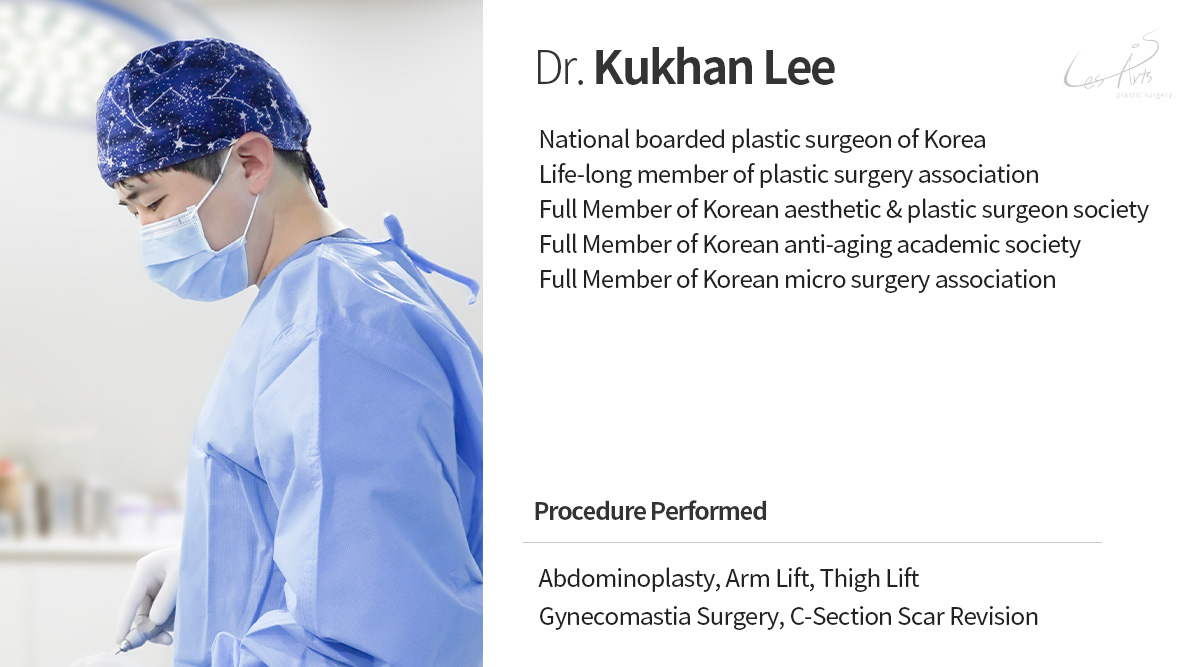
Hello, I am Board-Certified Plastic Surgeon Dr. Kukhan Lee of Lesarts Plastic Surgery.
Pregnancy and childbirth bring profound and multifaceted anatomical changes to a woman's physique.
While scale weight can often be returned to pre-pregnancy numbers through dedicated aerobic exercise and dietary control,
severely overstretched redundant skin, separated rectus abdominis muscles (rectus diastasis), and widespread gestational striae distensae rarely resolve through self-care efforts alone.
Even with body mass within standard reference ranges, a lower belly that protrudes forward
or skin that folds loosely and creases finely represents a widespread concern shared by many postpartum women.
As warmer weather approaches, lightweight attire, swimwear, and fitted garments often heighten self-consciousness regarding these persistent contours.
The clinical case presented today involves a patient who diligently sustained exercise and nutrition routines after delivery,
yet could not achieve desired contour improvements due to underlying structural abdominal changes.
Below, we review the 9-month postoperative progression following M-type full abdominoplasty.
The patient was a female in her 40s measuring 162 cm and 51 kg. Despite maintaining consistent fitness regimens and strict dietary discipline,
she visited our clinic troubled by stubborn, resistant lower abdominal bulging.
She had no prior history of abdominal surgical procedures and had delivered three children via spontaneous vaginal delivery.
Her weight had increased to approximately 70 kg during pregnancy, yet she had steadily maintained a slender baseline weight through ongoing postpartum care.
Nevertheless, the lower abdomen continued to project forward,
while loose cutaneous laxity and gestational striae persisted across the entire abdominal wall, causing considerable personal frustration with her body profile.

On physical examination, subcutaneous fat thickness was not excessive, yet both the supraumbilical and infraumbilical regions exhibited marked reduction in dermal elasticity and prominent laxity.
Striae distensae were widely distributed across the abdominal envelope, with multiple fine, shallow creases concentrated above the umbilicus.
These wrinkles were diagnosed as structural tissue remodeling resulting from extensive dermal expansion and loss of deep elastic fibers during gestation.
Even in a relaxed, standing posture, the entire abdominal wall projected outward in a rounded profile, with lower abdominal ptosis appearing particularly noticeable.
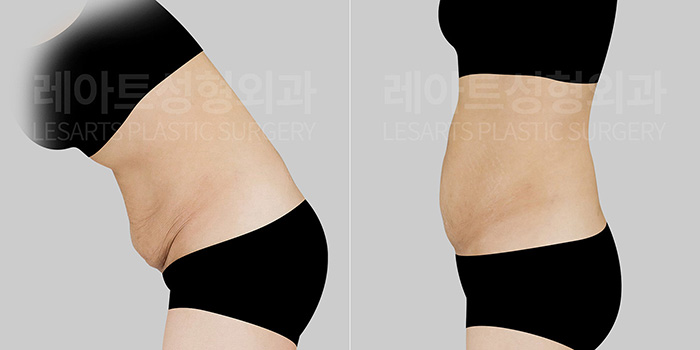
Widespread striae, supraumbilical creasing, and global rounded projection strongly indicated underlying rectus diastasis,
and targeted clinical palpation clearly confirmed substantial fascial separation extending from the upper to the lower abdomen.
Furthermore, upon forward trunk flexion, loose cutaneous redundancy and bunched wrinkling became significantly more pronounced, indicating substantial skin laxity.
Considering these clinical findings, an S-type mini abdominoplasty addressing only the infraumbilical area was insufficient.
Achieving the smooth, flat contour the patient desired required redraping the extensive supraumbilical laxity and creasing while plicating the separated rectus abdominis pillars continuously across the midline.
Following thorough consultation, we established a surgical plan combining M-type full abdominoplasty, rectus diastasis repair, and aesthetic vertical umbilicoplasty.
Additionally, concurrent targeted abdominal liposuction was incorporated to evenly contour residual subcutaneous fat and sculpt a natural waistline transition.

Clinical Assessment of Striae, Wrinkles, and Dog-Ears Post-Abdominoplasty
Below are clinical follow-up photographs recorded at 9 months post-M-type full abdominoplasty.
At 9 months postoperatively, the most apparent transformation is observed in the supraumbilical upper abdominal skin.
Prior to surgery, shallow creases and striae caused the skin to drape loosely downward;
through full abdominoplasty, redundant tissue from both the upper and lower abdomen was advanced and excised under calibrated tension, revealing a firm, smooth contour.
Both lateral endpoints along the bikini line incision have healed smoothly without dog-ear deformities or cutaneous puckering,
and having reached the 9-month maturation stage, erythema along the scar line has significantly lightened and stabilized.
She continues structured post-care scar management, and the incision is expected to blend further with surrounding skin tones over time.
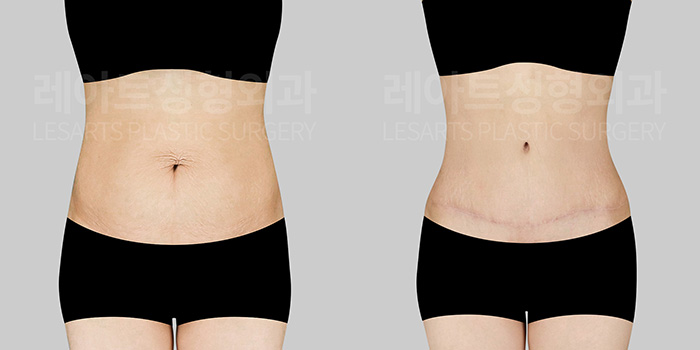
Lesarts Abdominoplasty Before & After Comparison
The global body silhouette achieved a natural, balanced transition.
Concurrent liposuction smoothed the flanks and waistline into continuous curves, establishing a slender torso,
while the umbilicus was reconstructed into a refined, vertical orientation that integrates naturally with the abdominal profile.
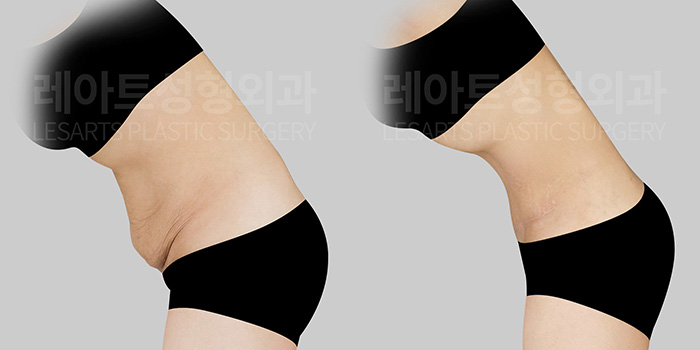
Lower Abdominal Skin Redundancy Correction via Abdominoplasty
Even during deep forward trunk flexion, the abdominal wall maintains firm structural tension without redundant skin folds or bunched creasing.
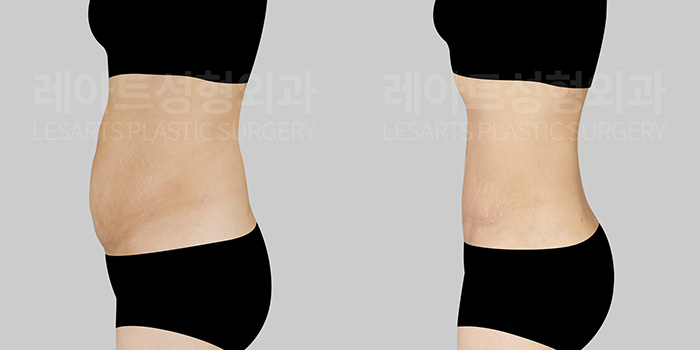
Clinical Review of Abdominoplasty, Rectus Repair, and Liposuction
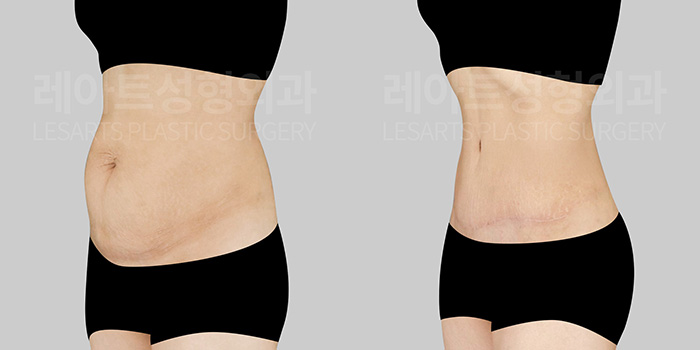
Improvement of Postpartum Protrusion, Laxity, Wrinkles, and Striae - Lesarts Abdominoplasty
Because the separated rectus abdominis muscles were securely reapproximated, the abdomen presents a flat, supported profile from anterior, lateral, and oblique views.
The rounded forward bulge that served as her primary concern resolved cleanly,
representing the core change the patient found most satisfying.
Overall, recovery and final contour harmony settled into a stable, favorable result.
Such clinical outcomes depend not only on surgical execution,
but also on the patient's dedicated compliance with scar care protocols, appropriate physical activity, and consistent nutritional habits.
As emphasized in consultation, abdominoplasty is not the end of physique care, but the start of healthy, sustainable maintenance.
Once anatomical challenges like cutaneous laxity and rectus diastasis are structurally corrected, sustaining a stable weight
supports long-term aesthetic stability and lasting patient satisfaction over the years.
Postpartum abdominal laxity, striae, and bulging often persist despite rigorous fitness routines,
as these reflect structural alterations involving overstretched skin and separated musculoaponeurotic layers that lifestyle modifications cannot reverse independently.
If abdominal protrusion or skin redundancy continues despite dedicated personal efforts, seeking an objective evaluation from a board-certified plastic surgeon is recommended to assess suitable clinical options.
Abdominoplasty FAQ
Q1. Why does the belly bulge in a rounded shape despite postpartum dieting?
A. This typically results from rectus diastasis, where midline abdominal muscles separate due to rapid gestational expansion.
When the musculoaponeurotic wall loses tension, intra-abdominal contents project forward under normal pressure, causing the abdomen to appear rounded regardless of weight loss.
Q2. What criteria determine the choice of a full abdominoplasty (M-type) over a mini abdominoplasty?
A. A full abdominoplasty is indicated when skin laxity, creasing, and striae extend broadly above the umbilicus into the upper abdomen.
Unlike a mini procedure that addresses only the lower abdomen, a full abdominoplasty redrapes upper and lower abdominal skin simultaneously while plicating the full length of the separated rectus musculature.
Q3. Does abdominoplasty improve umbilical shape and supraumbilical fine wrinkles?
A. Yes. Advancing redundant upper abdominal skin downward smooths superficial creasing,
while concurrent umbilicoplasty reconstructs a previously compressed, horizontal navel into a slender, natural vertical shape.
Q4. What causes 'dog-ear' deformities at the endpoints of an abdominoplasty scar?
A. Dog-ears occur when discrepancies in skin thickness or tissue fullness at the ends of an incision cause tissue to bunch or peak upward.
Carefully calibrating incision length to individual laxity and performing precise, step-free approximation prevents this irregularity.
Q5. When does an abdominoplasty scar typically mature and fade?
A. Erythema is expected during the first 3 to 6 months, after which the scar gradually lightens and flattens between 6 and 9 months.
With consistent topical scar management and laser therapies, the incision line settles into a discreet mark concealed within standard undergarment margins.
Dr. Kukhan Lee


Cases finding
similar to my profile
Customer Diagnostics


Select the surgery and
area you are interestedto see real
before andafter changes.


we
make you,
the art
Clinic hours
MON - FRI
10 am – 7pm
SAT
10 am – 4pm
Holiday
SUN, HOLIDAY
Location
Lesarts Moon Clinic Tower 4-5F, 40, Nonhyeon-ro 168-gil,
Gangnam-gu, Seoul, Republic of Korea

Medical institution name Lesarts Plastic Surgery
Address Lesarts Moon Clinic Tower 4-5F, 40, Nonhyeon-ro 168-gil, Gangnam-gu, Seoul, Republic of Korea
Representative Moon sung jun
