




Online Consultation
Please accurately enter the information below.
Quick Cost Consultation
Quick Consultation & Reservation
Cases finding
similar to my profile






Doctor's Note
Medical columns by our surgeons
Male Gynecomastia Surgery | White Cotton T-Shirt Fit & Simon Grade IIa True Gynecomastia: 7-Month Scar Progress
2026-09-11
Male Gynecomastia Surgery | White Cotton T-Shirt Fit & Simon Grade IIa True Gynecomastia: 7-Month Scar Progress [Doctor's Note by Dr. Kukhan Lee]
Q. If chest protrusion persists under lightweight t-shirts despite consistent workouts and weight reduction, could it be gynecomastia?
A. If forward projection centers around the areola despite minimal subcutaneous adipose tissue, the presence of glandular tissue proliferation should be evaluated.
Following clinical palpation and high-resolution ultrasonography to evaluate subcutaneous fat, pectoral muscle volume, and glandular tissue status, the definitive diagnosis of gynecomastia and appropriate clinical intervention are determined.
Written by Dr. Kukhan Lee, Lesarts Plastic Surgery
This column was authored directly by our medical staff.
※ Unauthorized copying, editing, or redistribution is strictly prohibited. ※
Hello, I am Board-Certified Plastic Surgeon Dr. Kukhan Lee of Lesarts Plastic Surgery.
During the sweltering summer months when thin clothing is worn more frequently,
consultations for male chest contour concerns noticeably increase.
Many men attempt to resolve anterior chest projection and areolar fullness through vigorous physical training or weight reduction, especially when wearing thin t-shirts.
Yet, despite disciplined self-care regimens, it is quite common to find that localized contours fail to diminish as anticipated.
This occurs because the presentation is not merely an issue of excess adiposity,
but involves underlying proliferated glandular tissue driving the forward protrusion.
In this clinical column, we review the 7-month postoperative progress of a patient with Simon grade IIa true gynecomastia who presented with persistent chest projection despite dedicated exercise and nutritional management.
We will examine how his contoured chest silhouette is maintained and assess the healing progression along the periareolar incision scar.
The patient was a male in his 30s measuring 170 cm and 66 kg. He maintained his physique conscientiously through regular workouts and structured dietary habits.
Nonetheless, persistent anterior chest projection remained visible, causing continuous discomfort when wearing lightweight attire or engaging in professional and social settings.
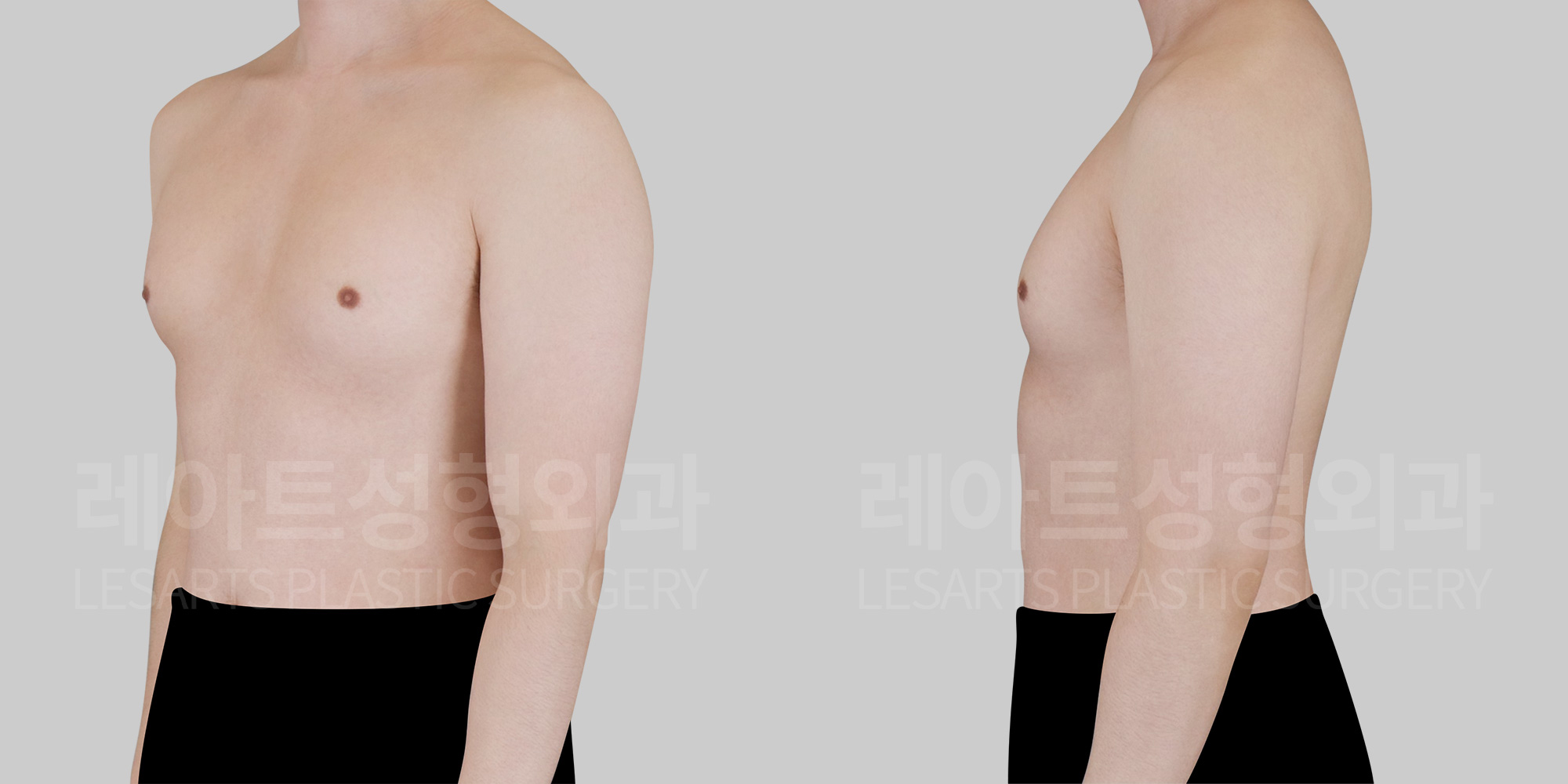
[Preoperative Physical Examination for Gynecomastia Surgery]
Physical examination revealed well-developed pectoralis major musculature and a thin subcutaneous adipose layer.
This clearly demonstrated his disciplined, long-term personal commitment to fitness.
Conversely, the inferior pole of the breast, centered around the areola, bulged distinctly outward.
On lateral and oblique profiles, the highest projection point of the anterior chest wall was situated directly beneath the periareolar complex.
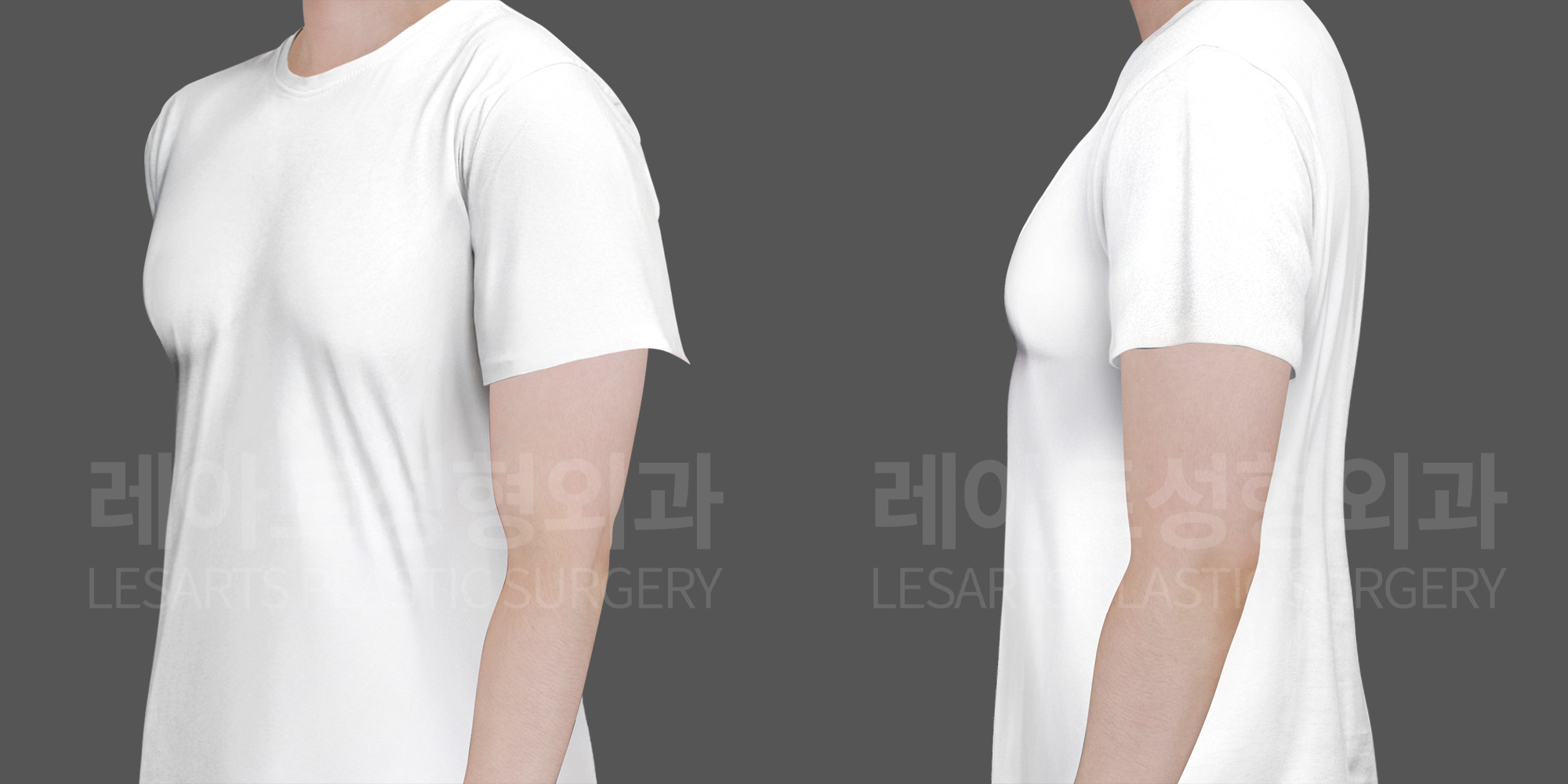
[Preoperative Lightweight T-Shirt Fit]
This conical projection becomes particularly apparent beneath thin summer shirts, serving as a major source of aesthetic self-consciousness for gynecomastia patients.
High-resolution ultrasound confirmed a thin subcutaneous fat layer across the upper chest alongside well-developed pectoralis major muscle fibers.
In contrast, substantial proliferation of dense glandular tissue was clearly identified around the areola rather than simple fat accumulation.
Synthesizing moderate breast enlargement on physical inspection and distinct glandular tissue hypertrophy on ultrasound,
the patient was definitively diagnosed with Simon grade IIa true gynecomastia.
The surgical approach combined subcutaneous glandular excision to evacuate the hypertrophic parenchymal mass with targeted liposuction to blend surrounding anatomical transitions smoothly.
[Postoperative Progress at 7 Months]
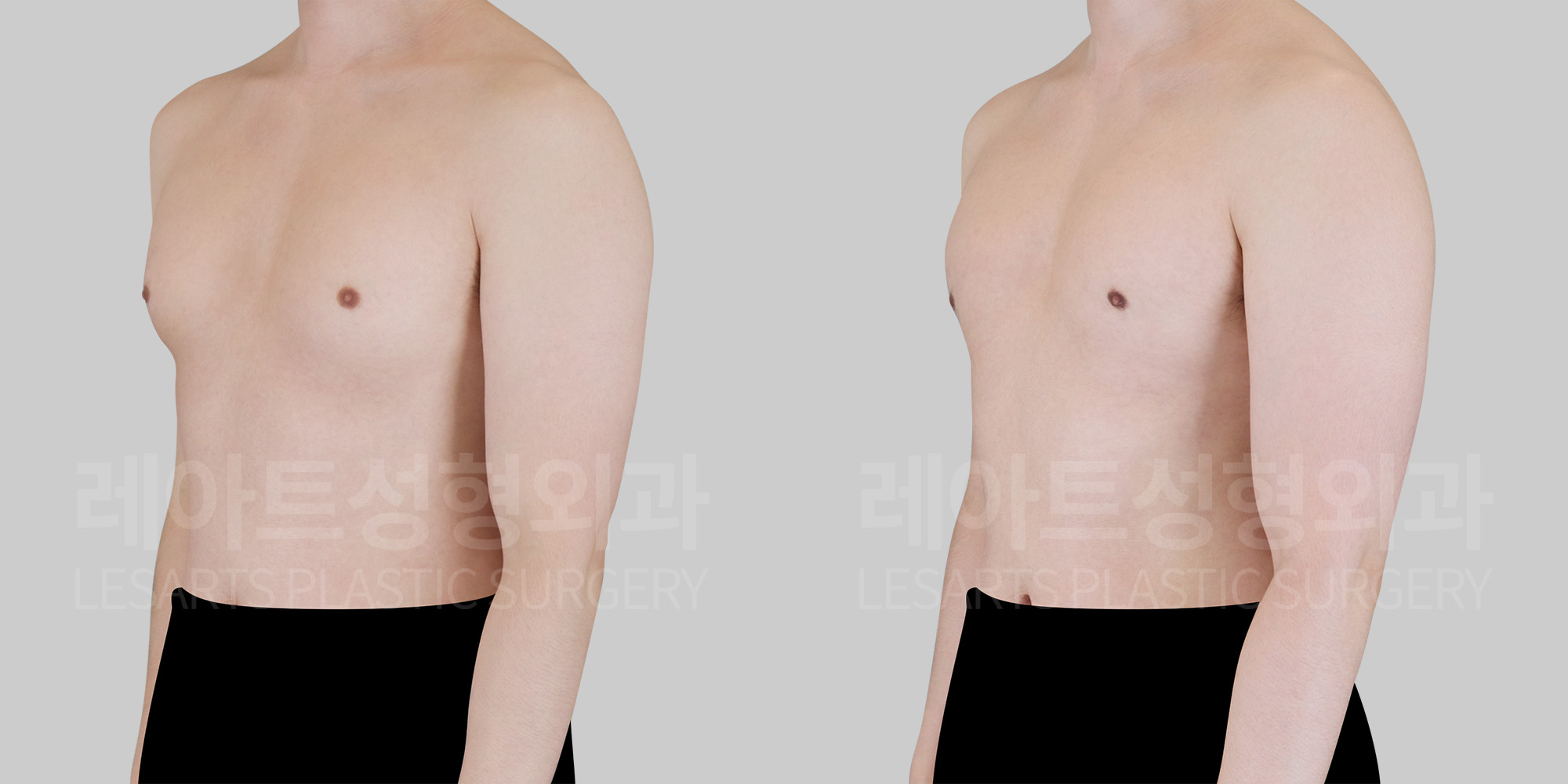
[Recovery Status at Half a Year Post-Op - Dr. Kukhan Lee, Lesarts Plastic Surgery]
A primary technical challenge in this case was the patient's relatively small areolar diameter. A smaller areola necessitates a concise incision length to ensure the resultant scar remains naturally concealed within the pigmented periareolar border.
Therefore, meticulously and completely excising the proliferated glandular tissue through a limited periareolar portal while protecting delicate cutaneous margins was vital to procedural success.
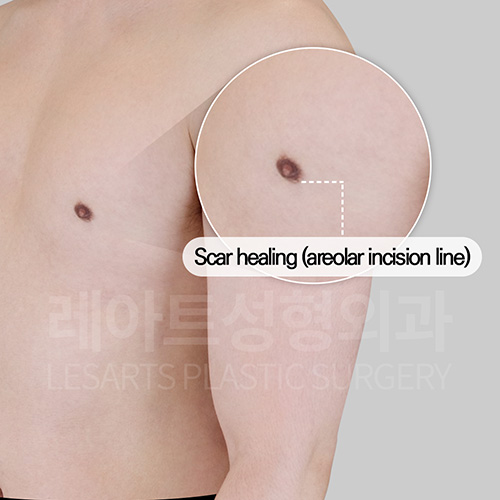
[Scar Maturation Status at 7 Months Post-Op - Lesarts Plastic Surgery]
At 7 months postoperatively, the periareolar incision scar is barely noticeable upon close inspection.
Because the incision was precisely placed along the natural junction between the areola and adjacent skin, it has matured into a discreet line that is inconspicuous at conversational distances.
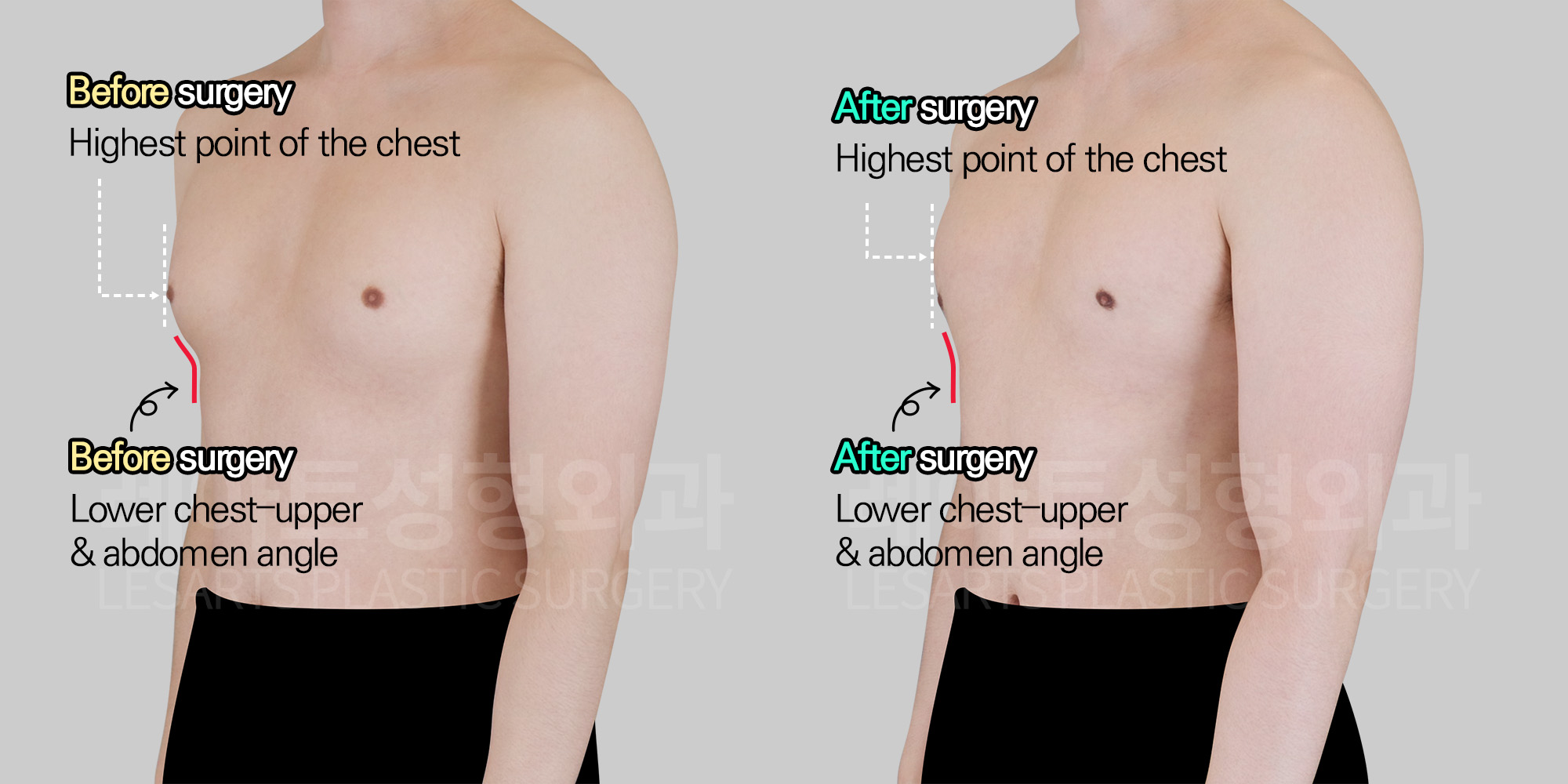
[Pre- and Postoperative Chest Projection Comparison - Dr. Kukhan Lee, Lesarts Plastic Surgery]
The most prominent transformation lies in the global chest contour.
Preoperatively, the periareolar region represented the highest apex of anterior chest projection.
By excising the hypertrophic glandular tissue and harmonizing adjacent adipose planes, areolar elevation dropped into a flatter plane and anterior projection resolved.
Consequently, the anatomical apex shifted superiorly toward the clavicular upper chest, creating a masculine, defined, and flat chest profile.
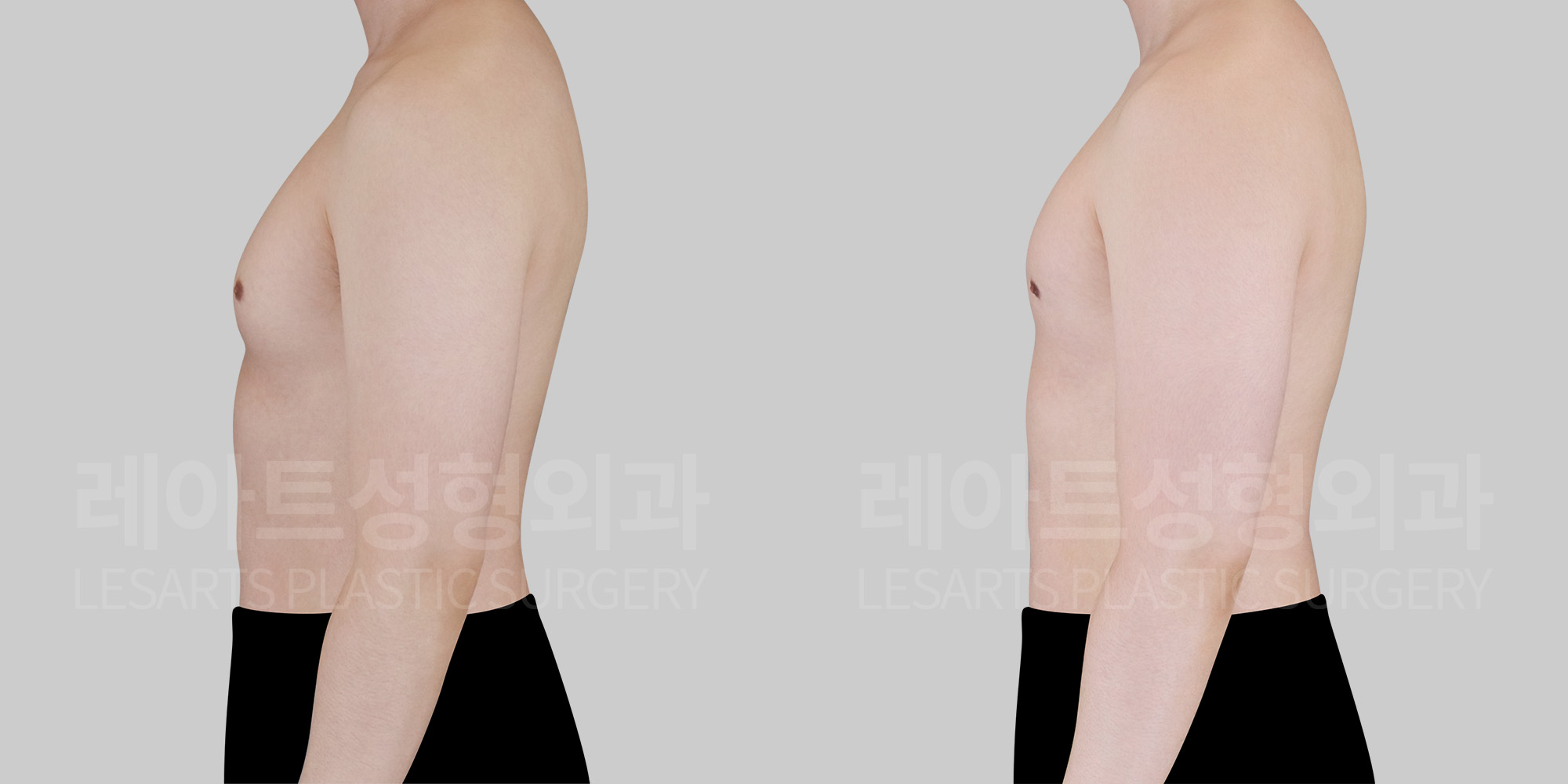
[Chest Projection Changes Post-Gynecomastia Surgery - Lesarts Plastic Surgery]
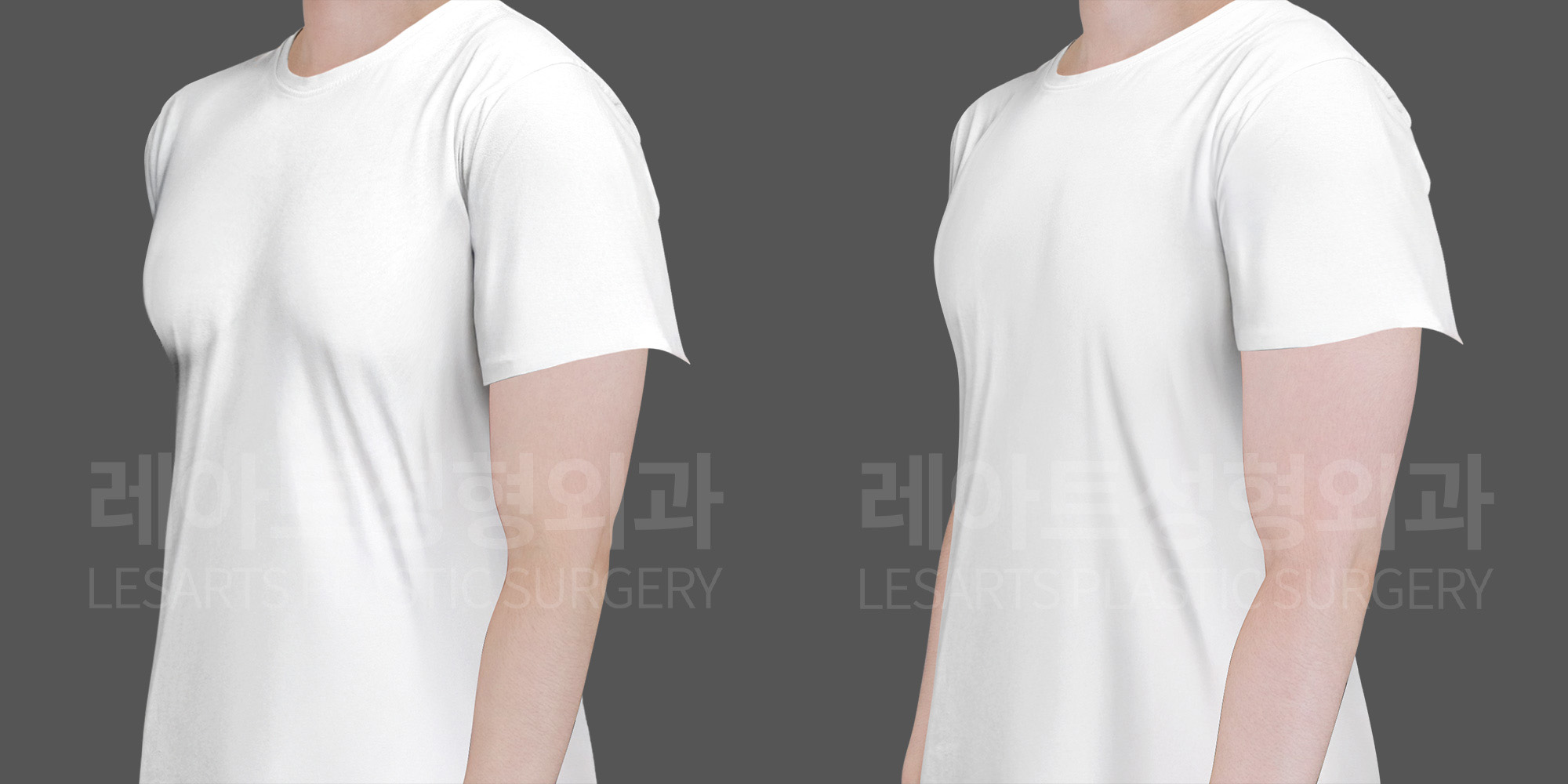
[7-Month Follow-Up After Gynecomastia Surgery - Lesarts Plastic Surgery]
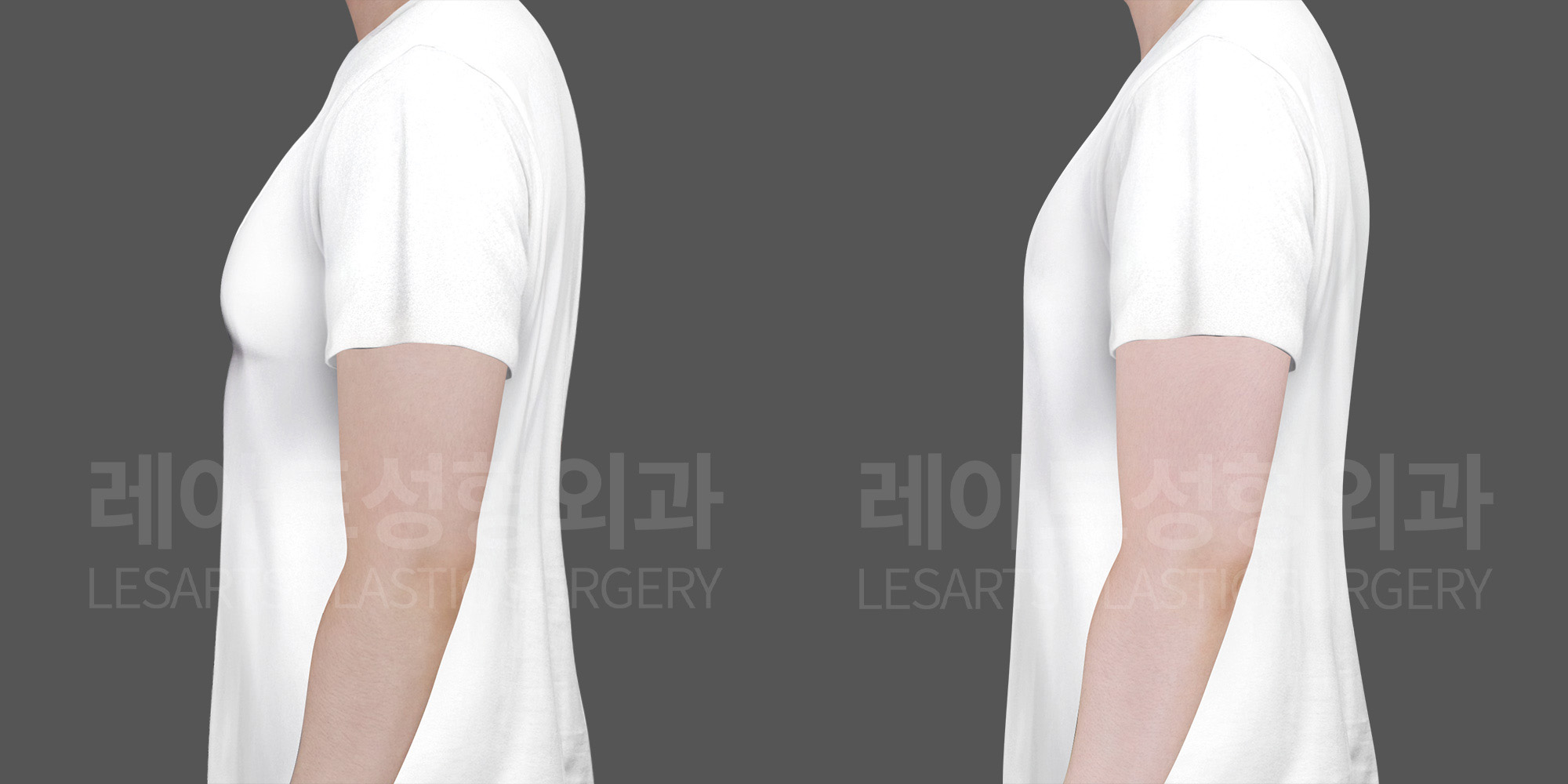 [T-Shirt Fit Comparison Before and After Surgery - Lesarts Plastic Surgery]
These structural improvements are apparent not only from the frontal view, but also on lateral and oblique profiles.
While anterior bulging previously projected through thin cotton t-shirts,
the debulked anterior chest volume postoperatively allows lightweight clothing to drape smoothly and cleanly over the pectoralis musculature.
At 7 months postoperatively, internal healing induration (bio-band) and cicatricial remodeling have resolved substantially, allowing tissue suppleness and natural chest contour to stabilize favorably.
As long-term tissue remodeling continues over time, subcutaneous soft tissues will soften further and the periareolar scar will fade into surrounding dermal tones.
Because true gynecomastia is driven by glandular hyperplasia rather than simple adiposity, workouts and caloric restriction face clear clinical limits in eliminating localized projection.
If similar self-consciousness recurs each summer when wearing lightweight shirts, rather than attributing it to insufficient training or body fat, evaluating for glandular gynecomastia is recommended.
Indeed, many post-surgical patients reflect:
“Had I understood that gynecomastia is a treatable medical condition earlier, I could have spared myself prolonged private distress.”
If chest projection causes ongoing concern when wearing clothing or shirtless, seeking an objective, accurate clinical evaluation provides clear guidance.
Through clinical palpation and high-resolution ultrasound, we characterize glandular distribution and chest wall anatomy to recommend an evidence-based treatment plan tailored to your profile.
[ View More Lesarts Gynecomastia Clinical Cases ]
Gynecomastia Surgery FAQ
Q1. Can the chest and periareolar area continue to protrude despite dedicated workouts?
Yes. If glandular proliferation is the primary driver of chest protrusion, periareolar fullness will persist despite ongoing exercise or weight loss. An accurate assessment differentiating subcutaneous fat, muscle, and glandular tissue via physical exam and ultrasound is necessary.
Q2. What defines Simon Grade IIa gynecomastia?
Simon Grade IIa represents moderate breast enlargement with glandular hyperplasia without redundant skin ptosis. The definitive surgical approach is determined after verifying glandular distribution and regional soft-tissue architecture.
Q3. Is the contour refinement visible beneath a white t-shirt following surgery?
Reducing areolar conical projection and flattening the anterior chest volume allows lightweight t-shirts to drape cleanly over the pectoralis musculature without focal bulging.
Q4. Does a smaller areola cause larger gynecomastia surgery scars?
A smaller areola restricts the permissible incision span along the pigmented margin, elevating surgical technical complexity to excise the glandular mass thoroughly through a confined portal while preserving discreet scar placement.
Q5. Is the incision scar still visible at 7 months post-op?
A subtle scar line remains visible under close inspection at 7 months, yet placing the incision along the natural periareolar border renders it inconspicuous at conversational distances as healing and remodeling continue.
Dr. Kukhan Lee


Cases finding
similar to my profile
Customer Diagnostics


Select the surgery and
area you are interestedto see real
before andafter changes.


we
make you,
the art
Clinic hours
MON - FRI
10 am – 7pm
SAT
10 am – 4pm
Holiday
SUN, HOLIDAY
Location
Lesarts Moon Clinic Tower 4-5F, 40, Nonhyeon-ro 168-gil,
Gangnam-gu, Seoul, Republic of Korea

Medical institution name Lesarts Plastic Surgery
Address Lesarts Moon Clinic Tower 4-5F, 40, Nonhyeon-ro 168-gil, Gangnam-gu, Seoul, Republic of Korea
Representative Moon sung jun
