




Online Consultation
Please accurately enter the information below.
Quick Cost Consultation
Quick Consultation & Reservation
Cases finding
similar to my profile






Doctor's Note
Medical columns by our surgeons
Thigh Liposuction | Thigh Gap, Saddlebags & Lower Body Proportions: 6-Month Progress
2026-09-11
Thigh Liposuction | Thigh Gap, Saddlebags & Lower Body Proportions: 6-Month Progress [Doctor's Note by Dr. Yongseung Seo]
Q. If inner thigh fullness and saddlebags persist after dieting, can liposuction create straight, streamlined leg lines?
A. If sufficient subcutaneous fat is distributed across the inner thighs and trochanteric saddlebag areas,
liposuction can effectively reduce diameter and smooth the outer contour lines.
However, rather than stripping all subcutaneous fat, it is essential to evaluate muscular architecture, skin elasticity,
and baseline bilateral discrepancies, preserving a delicate layer where needed
to establish balanced, continuous leg contours.
[ Learn More About Lesarts Plastic Surgery Thigh Liposuction Cases ]
Written by Dr. Yongseung Seo, Lesarts Plastic Surgery
This column was authored directly by our medical staff.
※ Unauthorized copying, editing, or redistribution is strictly prohibited. ※
Lower body adipose tissue is often among the most persistent areas of concern when dieting.
While the upper torso tends to lean down comparatively quickly, localized fat often lingers along the inner thighs,
lateral saddlebags, and subgluteal regions,
causing the lower extremities to appear comparatively heavy and short.
In particular, heavy adipose accumulation along the medial inner thighs causes friction and chafing
between the legs during ambulation,
leading to persistent discomfort when choosing or wearing clothing.
Aesthetically, when the inner thighs touch closely,
the absence of medial separation (a thigh gap)
further accentuates the visual thickness of the lower limbs.
Even when overall scale weight is reduced through workout and dietary regimens,
localized contour changes may not materialize as desired depending on individual adipose distribution.
In such cases, liposuction extends beyond simple circumferential debulking;
it represents a precise body sculpting procedure that evaluates native skeletal alignment and muscle contours,
distinguishing which adipose layers to aspirate and which to preserve to refine the leg silhouette.
Because extracting excessive fat can sharply demarcate muscular margins
or lead to surface wrinkling and skin laxity depending on dermal elasticity,
an operative design that considers the continuous silhouette is vital.
The patient presented today recently lost weight through dieting,
yet visited our clinic troubled by persistent fullness
concentrated along her inner thighs and saddlebag areas.
[Patient Profile]
Age: Late 20s
Height: 167 cm
Weight: 58 kg
BMI: 21 kg/㎡
Body Fat Percentage: 29.6%
* Clinical outcomes of liposuction may vary individually based on fat distribution, muscular anatomy,
and skin condition, even among individuals with similar physical measurements.
[Preoperative Assessment: Thigh Contours]
The patient typically maintained a baseline weight of around 55 kg,
with a previous peak reaching 63 kg.
She had recently lost approximately 5 kg through self-directed dieting,
had previously received localized fat-dissolving injections once,
and noted that she did not engage in regular exercise routines.
Although her body mass index was within standard ranges, her body fat percentage was relatively high
compared to her muscle mass, and the thighs presented with sufficient treatable subcutaneous fat,
indicating favorable potential for noticeable circumferential and contour refinement following liposuction.
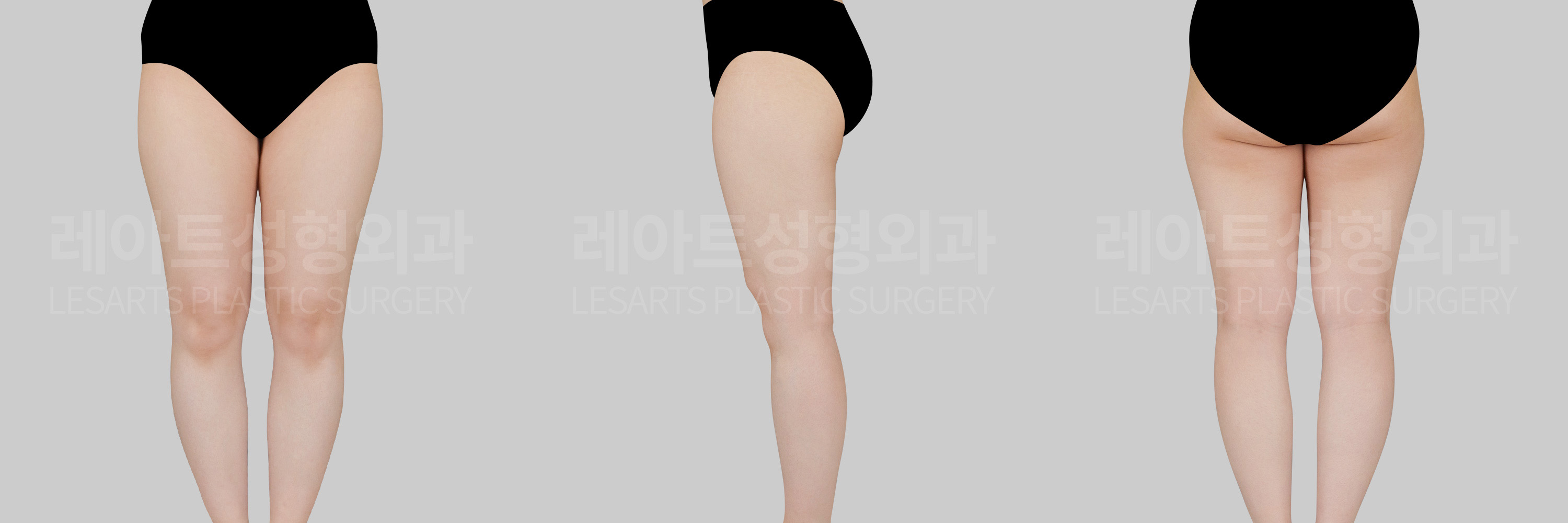
On visual inspection, lower body volume appeared disproportionately heavy
relative to her upper frame,
with touching medial inner thighs leaving virtually no clearance between the legs.
The patient identified the inner thigh line
as her foremost aesthetic concern.
Furthermore, lateral protrusion of the saddlebags broadened the horizontal span of the upper legs,
making the limbs appear shorter and accentuating lower body visual weight.
On lateral examination, forward projection of the anterior quadriceps combined with posterior fullness,
further adding to the perceived thickness of the thighs.
High-resolution ultrasound evaluation confirmed substantial subcutaneous fat layers
distributed throughout the thighs, as anticipated:
Consultation and Diagnostic Evaluation - Lesarts Plastic Surgery
Lateral: 39 / 26 mm
Medial: 24 / 23 mm
Anterior: 15 / 15 mm
Posterior: 13 / 14 mm
Knee: 17 / 15 mm
Subcutaneous fat was distributed extensively across the lateral saddlebags and medial inner thighs,
directly contributing to the broadened leg width
and thickness that troubled the patient.
[Lesarts Liposuction KakaoTalk Consultation]
[Customized Design for Thigh Line Refinement]
Because subcutaneous fat was distributed generously across all aspects of the thighs,
thorough debulking within safe physiological boundaries
formed the foundational surgical direction.
However, aggressively evacuating all adipose tissue without contour planning
can expose underlying muscular demarcations directly through the skin.
While this might reduce diameter numerically,
it can produce an athletic, muscular appearance that diverges from the smooth, straight aesthetic she desired.
Therefore, the operative design planned to preserve a measured buffer of subcutaneous fat along muscular margins
to maintain continuous, soft transitions.
A marked baseline difference in fat volume between the right and left saddlebags was identified preoperatively.
We explained that subtle structural asymmetry would likely persist postoperatively,
and noted that as surrounding volume thins,
underlying skeletal or muscular variances could become slightly more perceptible than before.
Surgically, priority was placed on debulking the inner thigh line,
which was the patient's primary concern.
Because the inner thigh is anatomically prone to skin laxity following volume reduction,
over-aspiration in this zone risks surface creasing or soft-tissue ptosis.
We thoroughly counseled her prior to surgery that depending on subsequent skin retraction,
adjunctive skin elasticity care could be beneficial if laxity developed.
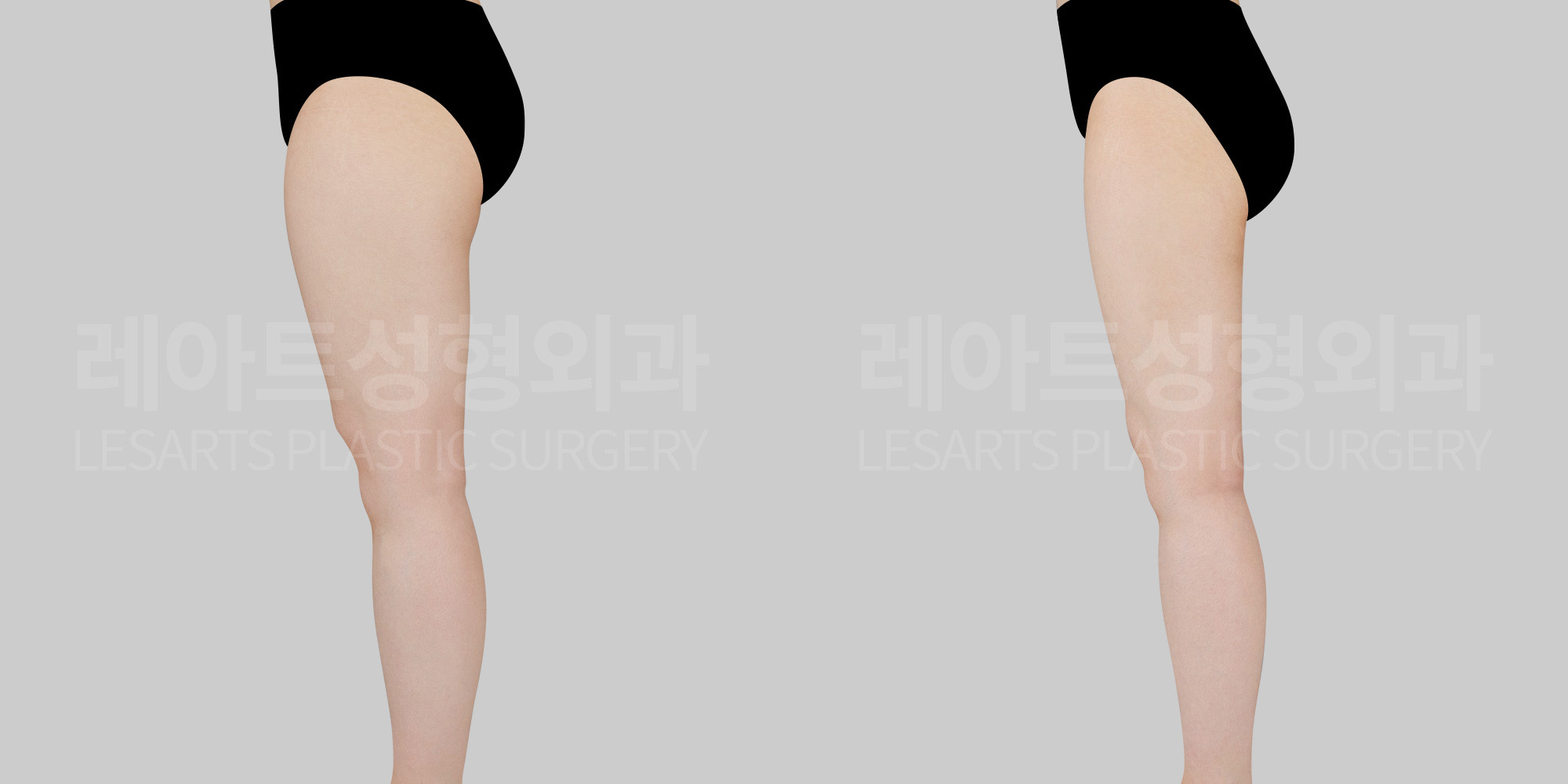
[Before & After Comparison: Thigh Liposuction]
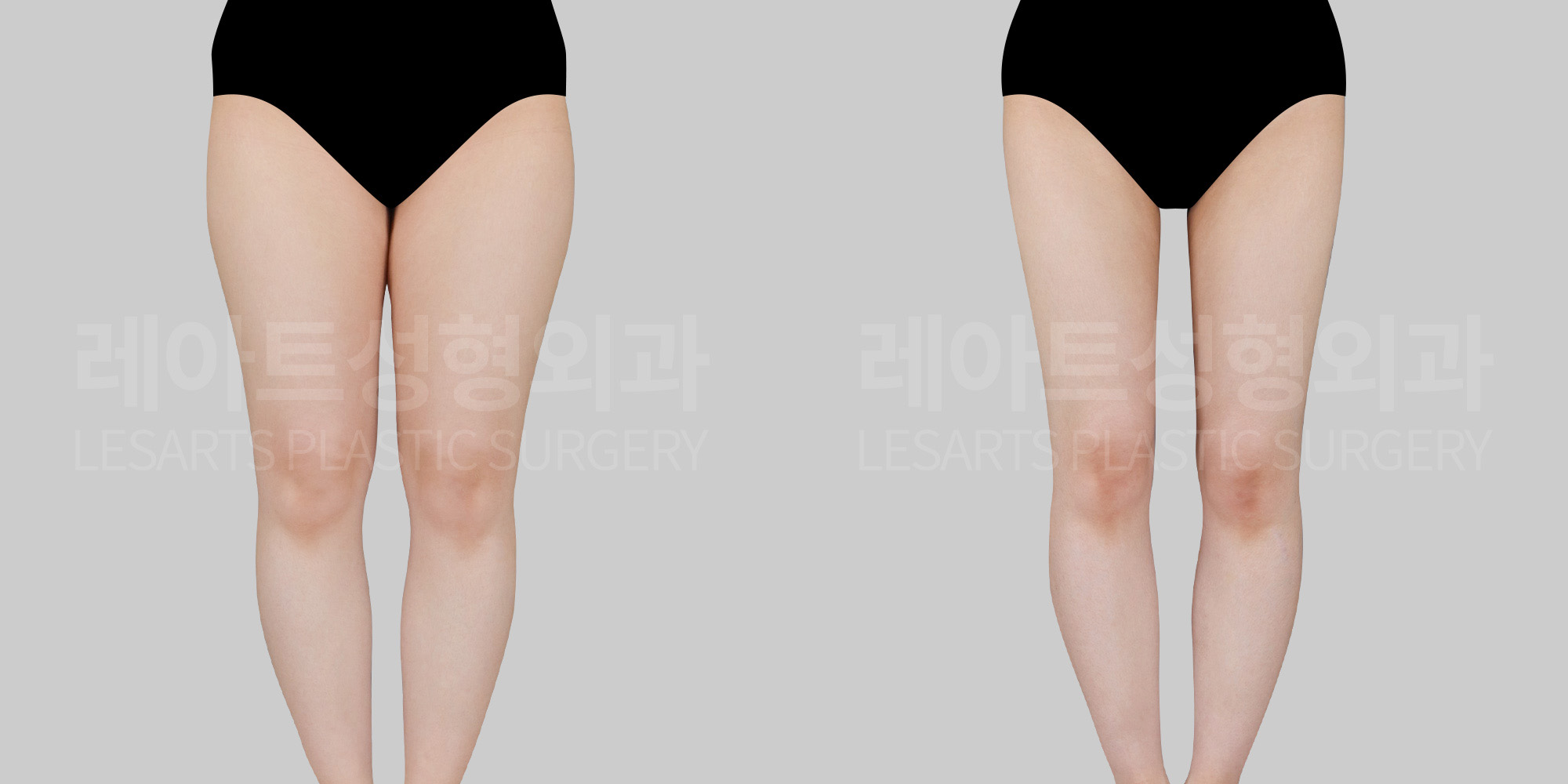
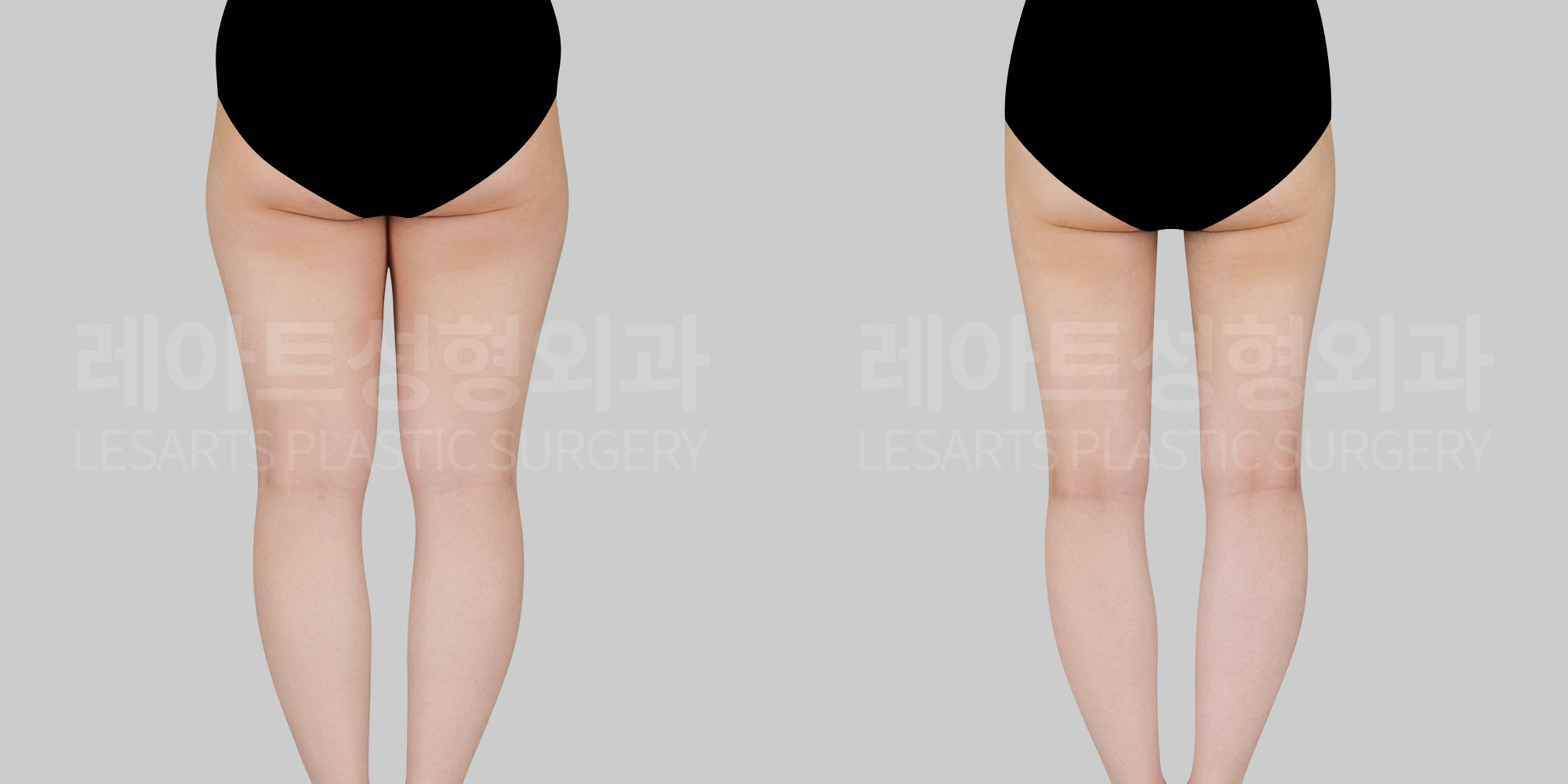
Lateral saddlebag projection also diminished substantially following surgery.
Streamlining the saddlebags narrowed the upper thigh span,
visually lengthening and thinning the overall appearance of the legs.
As explained prior to surgery, baseline bilateral differences in saddlebag anatomy remained subtly observable,
and as surrounding fat thinned, pre-existing skeletal variances became slightly more perceptible,
yet blended harmoniously with her new, balanced silhouette.
As demonstrated in this case, even after successful weight reduction,
stubborn adipose stores in the inner thighs and saddlebags
often persist until the very end,
causing persistent aesthetic concern.
When further weight loss alone fails to achieve desired lower body contours,
identifying localized adipose distribution and considering targeted liposuction
can provide a structured, predictable solution.
Particularly when inner thighs touch and a straight-line contour is desired,
how much inner fat is reduced and what buffer is preserved
fundamentally dictates the final visual proportions of the lower extremities.
In this patient's case, prioritizing medial debulking
established clear space between the legs,
while reducing saddlebag and anterior-posterior thickness
helped the entire lower body silhouette appear visually longer and thinner.
To maintain these refined contours over the long term,
continuing stable weight management and consistent lifestyle habits
following surgery remains an essential component.
If persistent inner thigh fat or trochanteric saddlebags remain bothersome after weight loss,
rather than focusing solely on removing as much fat as possible,
we recommend consulting to evaluate your adipose distribution, muscular contours, skin tone,
and baseline structural asymmetry
to establish a tailored liposuction scope and design suited to your frame.
Thigh Liposuction FAQ
Q1. Can inner thigh fat persist even after significant weight loss?
Even when body weight is reduced, depending on genetic adipose distribution,
localized thickness along the inner thighs and saddlebags can remain resistant.
When planning liposuction, actual subcutaneous fat depth and regional distribution are evaluated first.
Q2. Is maximum fat extraction always optimal in thigh liposuction?
No. If fat is debulked too aggressively,
underlying muscular margins become sharply demarcated, which can prevent a smooth contour.
Preserving a measured buffer layer across targeted zones is essential to achieve a natural, feminine line.
Q3. Can inner thigh liposuction create a thigh gap and a straight-line contour?
If sufficient subcutaneous adipose tissue is present along the medial thigh,
reducing this volume can create clearance between the legs and establish a straight medial contour line.
The degree of clearance achievable depends on underlying skeletal alignment, muscle curvature, and baseline fat volume.
Q4. Can bilateral saddlebag asymmetry be completely corrected through liposuction?
Differences driven by adipose volume can be balanced by adjusting aspiration quantities between sides,
yet native skeletal or muscular variances will remain to some degree.
As overlying volume diminishes, pre-existing structural asymmetry can occasionally appear slightly more noticeable.
Q5. Can aggressive inner thigh fat removal cause skin laxity?
The inner thigh is anatomically susceptible to skin laxity following volume evacuation.
Baseline dermal elasticity must be evaluated when determining extraction volume, and if postoperative wrinkling develops,
adjunctive skin tightening or post-care therapies may be recommended.
Dr. Yongseung Seo


Cases finding
similar to my profile
Customer Diagnostics


Select the surgery and
area you are interestedto see real
before andafter changes.


we
make you,
the art
Clinic hours
MON - FRI
10 am – 7pm
SAT
10 am – 4pm
Holiday
SUN, HOLIDAY
Location
Lesarts Moon Clinic Tower 4-5F, 40, Nonhyeon-ro 168-gil,
Gangnam-gu, Seoul, Republic of Korea

Medical institution name Lesarts Plastic Surgery
Address Lesarts Moon Clinic Tower 4-5F, 40, Nonhyeon-ro 168-gil, Gangnam-gu, Seoul, Republic of Korea
Representative Moon sung jun
