




Online Consultation
Please accurately enter the information below.
Quick Cost Consultation
Quick Consultation & Reservation
Cases finding
similar to my profile






Doctor's Note
Medical columns by our surgeons
Is Abdominoplasty Safe in Your Late 50s? Full Abdominoplasty & Abdominal Liposuction 3-Month Progress
2026-09-15
Is Abdominoplasty Safe in Your Late 50s? Full Abdominoplasty & Abdominal Liposuction 3-Month Progress
Written by Dr. Kukhan Lee, Lesarts Plastic Surgery
This column was authored directly by our medical staff.
※ Unauthorized copying, editing, or redistribution is strictly prohibited. ※
Can someone in their late 50s undergo abdominoplasty?
Surgical candidacy for abdominoplasty is not determined solely by chronological age.
It is essential to comprehensively evaluate baseline systemic health, underlying medical conditions, cardiopulmonary capacity, and anesthetic suitability.
[Lesarts Abdominoplasty Guide]
With every seasonal shift, the desire to wear desired clothing comfortably and with confidence is natural for everyone.
However, undergoing pregnancy, childbirth, and the physiological aging process can fundamentally alter one's body shape.
These physical changes often diminish personal self-esteem in front of the mirror, leading to ongoing stress when choosing preferred attire.
In particular, women aged 50 and older who have spent decades prioritizing childcare, family, and home life
frequently visit our clinic seeking consultation for altered body contours only after regaining personal time and breathing room in their daily lives.
Consultations with patients in this demographic frequently involve several recurring questions:
“Do many women in their 50s undergo abdominoplasty?”
“Up to what age is abdominoplasty feasible?”
“Does older age carry greater surgical risks?”
While patients in their 30s and 40s primarily focus on the degree of aesthetic refinement and expected contour changes,
patients in their 50s and beyond tend to prioritize procedural safety and the physical burden of surgery before discussing aesthetic outcomes.
To clarify this directly: candidacy for abdominoplasty and liposuction is never decided by chronological age alone.
What truly dictates surgical feasibility is not numeric age, but the patient's current systemic health status.
In the absence of unmanaged underlying conditions and with healthy systemic function, abdominoplasty can be safely considered regardless of age.
Indeed, patients in their 60s and older regularly visit our clinic seeking abdominoplasty.
However, because general physiological resilience can gradually decrease after age 65 even without overt pathologies,
we perform standard preoperative diagnostics alongside thorough assessments of cardiopulmonary function and anesthetic suitability.
Once comprehensive preoperative examinations verify that systemic health is stable and secure,
chronological age itself is never an absolute limiting contraindication for abdominoplasty.
Today, we introduce a case of a female patient in her late 50s who visited Lesarts Plastic Surgery
seeking to correct postpartum abdominal changes and achieve a firmer, more contoured silhouette.
The patient was a female in her late 50s, measuring 164 cm and 56 kg.
Her obstetric history included two deliveries via Cesarean section,
with no other prior abdominal surgical procedures.

[Preoperative Abdominoplasty Consultation (Lower Abdomen Concerns) - Dr. Kukhan Lee, Lesarts Plastic Surgery]
Her primary concern was lower abdominal protrusion that bulged noticeably beneath clothing.
She desired to debulk overall abdominal volume while resolving uneven, sagging contours
to establish a smooth, continuous silhouette.

[Preoperative Physical Examination for Abdominoplasty in Late 50s]
Preoperative physical examination revealed significant subcutaneous adipose accumulation distributed broadly across the abdomen.
Because localized fullness extended from the anterior wall across the flanks, love handles, and posterior waist,
the anatomical area requiring procedural contouring was relatively extensive.
Regarding her structural proportions, her ribcage was comparatively wide,
yet her waist circumference was relatively narrow in contrast.
This anatomical trait offers distinct aesthetic advantages while requiring careful planning.
By debulking redundant waistline deposits via liposuction and accentuating the waist indentation,
the structural contrast between the ribcage and waist becomes more defined,
helping sculpt a feminine, classic silhouette.
Conversely, because the ribcage is an unalterable osseous framework, its skeletal diameter cannot be reduced.
Consequently, as abdominal volume decreases, the upper ribcage may visually appear slightly more prominent in proportion,
a factor carefully incorporated into our preoperative surgical planning.
Cutaneous laxity was not confined to the lower abdomen, but extended into the upper abdomen as well.
In particular, as supraumbilical skin sagged downward,
the navel had deformed into a hooded, inverted 'V' configuration.
When dermal laxity extends broadly into the epigastrium,
an M-type full abdominoplasty capable of advancing and resecting both upper and lower abdominal skin
is clinically indicated.
Additionally, the umbilicus was positioned slightly off-center toward the right.
In reality, perfect midline placement of the umbilicus is relatively uncommon.
In this case, we determined that during rectus diastasis repair,
re-centering the new umbilical site as close to the true anatomical midline as possible
was essential to creating a balanced, natural contour.
Synthesizing these clinical findings,
we established a surgical plan combining 360-degree abdominal liposuction with M-type full abdominoplasty,
incorporating midline rectus diastasis repair and aesthetic umbilicoplasty.
Although the patient was in her late 50s, she had no underlying medical conditions
and her systemic physiological health was excellent, presenting no clinical contraindications to surgery.
Because she experienced considerable procedural anxiety beforehand,
we provided thorough explanations of the operative steps, recovery timelines,
and clinic safety protocols before proceeding.
[Postoperative Progress at 3 Months: Abdominoplasty & Liposuction]

[Pre- and Postoperative T-Shirt Fit: Abdominoplasty & Liposuction - Dr. Kukhan Lee]
At 3 months postoperatively, tissue recovery is actively underway,
making it an interim evaluation stage rather than the definitive final endpoint.
Residual edema continues to resolve and the surgical scar remains in an active remodeling phase.
Nevertheless, even during this intermediate stage,
the transformation in abdominal contours and clothing fit is distinct and visible
compared to her preoperative baseline.
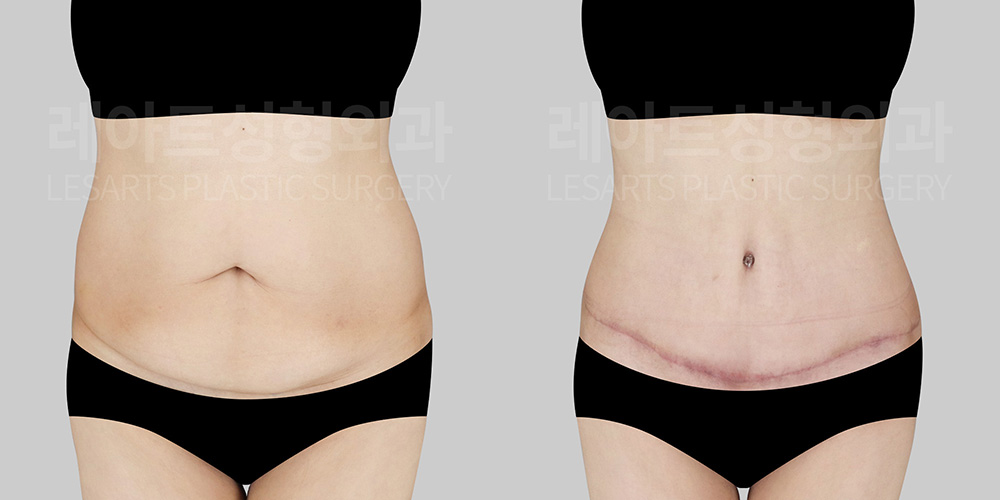
[Clinical Case: Abdominoplasty in Late 50s - Lesarts Plastic Surgery]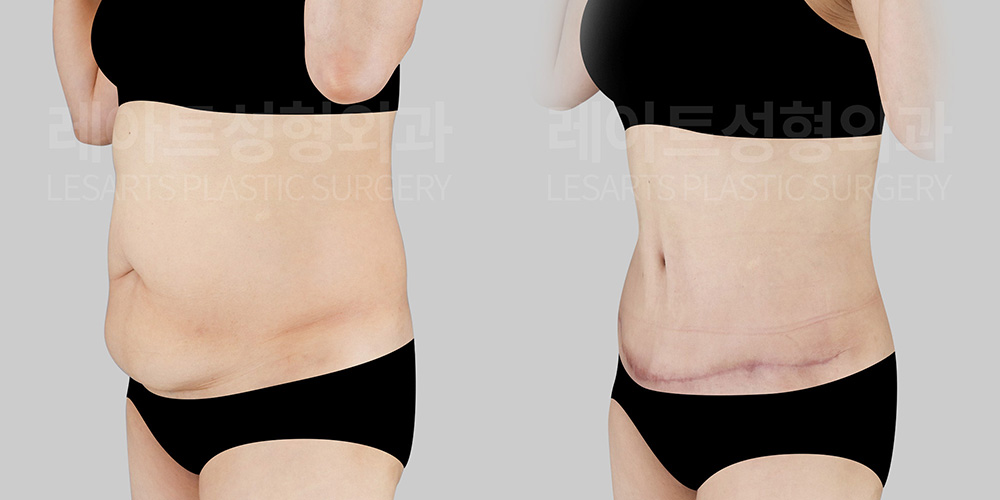
[Abdominoplasty & Liposuction Outcomes in 50s - Dr. Kukhan Lee, Lesarts Plastic Surgery]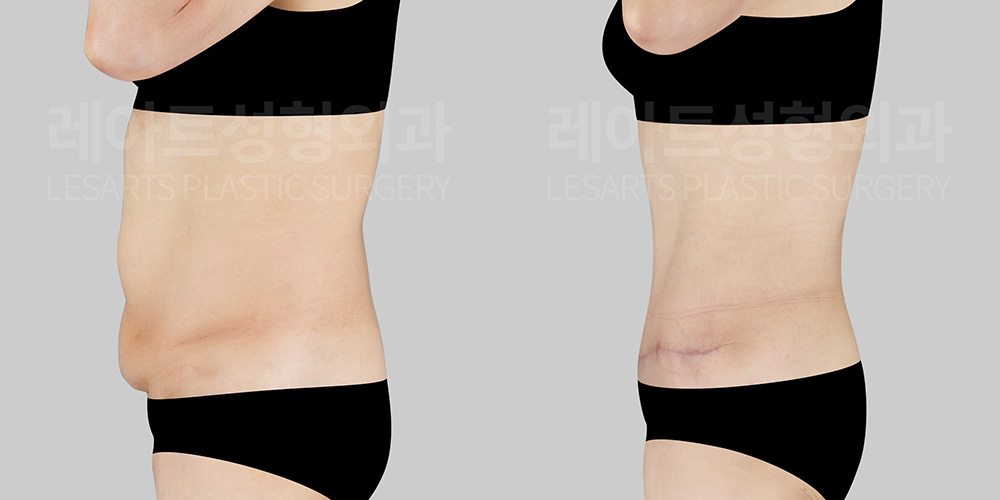
[Lower Abdominal Laxity Correction via Abdominoplasty in 50s - Lesarts Plastic Surgery]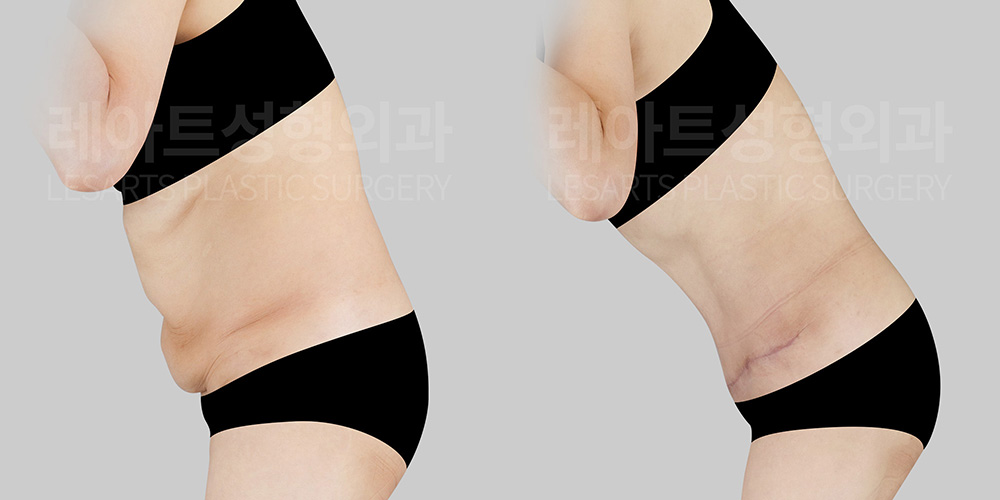
[Pre- and Postoperative Abdominoplasty Comparison - Dr. Kukhan Lee, Lesarts Plastic Surgery]
First, 360-degree abdominal liposuction
debulked circumferential volume from the anterior wall across the flanks and posterior waist,
establishing a smooth, cohesive torso transition.
While abdominal volume previously appeared disproportionately heavy relative to her limbs,
postoperative debulking established
a noticeably more balanced, harmonious full-body proportion.
Through M-type full abdominoplasty,
redundant skin across both the upper and lower abdomen was advanced and excised,
restoring a firm, taut cutaneous surface.
Separated rectus abdominis muscles were securely plicated and a new umbilicus was sculpted,
correcting the previous lateral deviation toward the true midline.
This restored structural central symmetry
while establishing a continuous, natural abdominal profile.
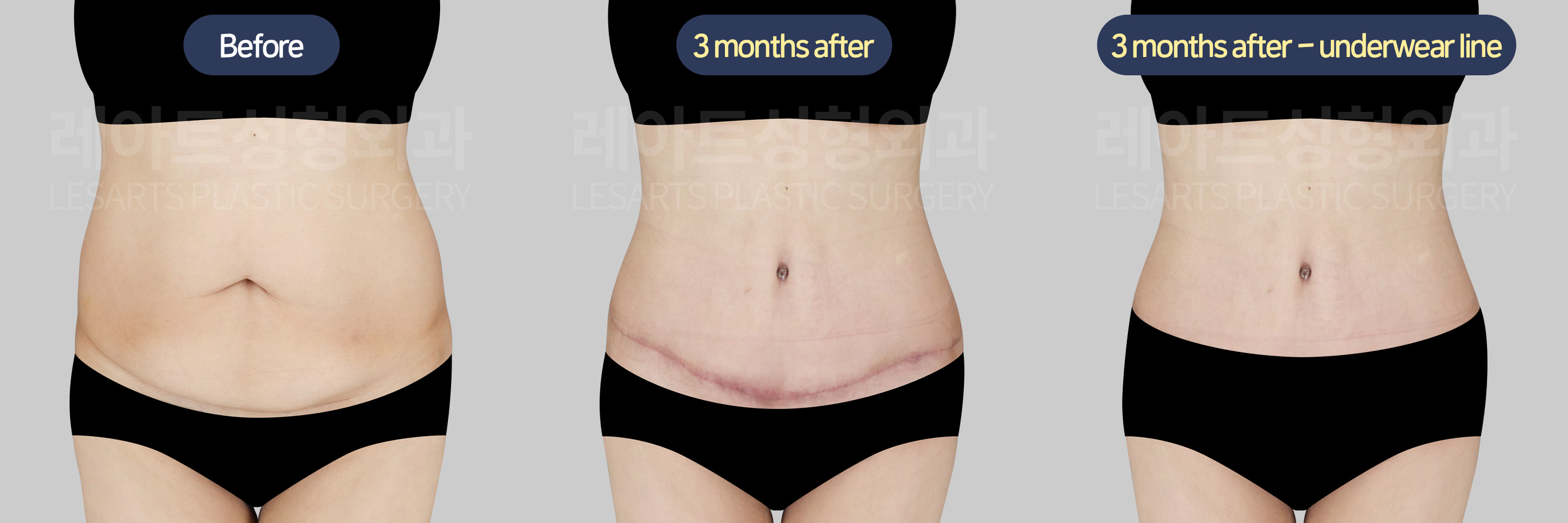
[Recovery Progression at 3 Months Post-Abdominoplasty in Late 50s - Lesarts Plastic Surgery]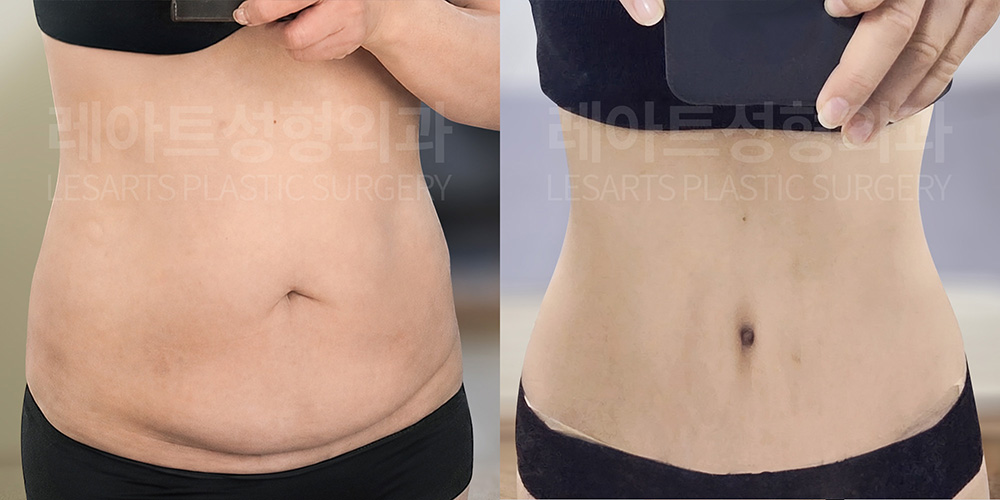
[3-Month Clinical Follow-Up for Abdominoplasty in 50s - Lesarts Plastic Surgery]
At 3 months post-op,
erythema and temporary post-inflammatory hyperpigmentation remain along the incision line.
However, there is no hypertrophic widening
or broadening of the scar margins.
With ongoing scar maintenance regimens and clinical laser therapies,
residual pigmentation will progressively fade,
allowing the scar to mature and blend smoothly into surrounding skin tones over time.
View More Abdominoplasty Clinical Cases
▼▼▼

After dedicating years to family and childcare,
many women unexpectedly confront altered body contours later in life.
If these changes cause diminished confidence or everyday discomfort,
one does not need to rule out surgical correction simply due to age.
In abdominoplasty, current physiological health and precise clinical diagnostics are far more critical than chronological age.
With thorough preoperative screening and rigorous anesthetic monitoring protocols,
a customized surgical plan tailored to individual health and abdominal morphology can be established safely.
Once procedural readiness is verified through these standards,
numeric age is never an absolute barrier to undergoing abdominoplasty.
If persistent skin laxity or postpartum contour changes are causing concern,
we encourage you to consult with a board-certified plastic surgeon
to accurately evaluate your current anatomy and explore tailored clinical solutions.
FAQ
Q1. What is the upper age limit for abdominoplasty?
There is no predetermined chronological cutoff.
Surgical suitability is determined by assessing systemic physiological health, cardiopulmonary reserve, and underlying medical conditions rather than numeric age.
Q2. Is abdominoplasty more hazardous for patients in their 50s and 60s?
Older age alone does not preclude surgery.
However, preoperative diagnostics—including cardiopulmonary evaluations and anesthetic risk stratification—must be conducted thoroughly with age and health status in mind.
Q3. What procedure is indicated if both the upper and lower abdomen exhibit postpartum laxity?
When cutaneous redundancy affects both the epigastrium and lower abdomen,
a full abdominoplasty capable of advancing and resecting redundant skin across both planes is indicated.
Q4. Can abdominoplasty be performed concurrently with abdominal liposuction?
If generalized adipose accumulation accompanies cutaneous laxity,
combining abdominoplasty with liposuction addresses both redundant skin and excess adipose volume concurrently.
Q5. What is the expected scar healing status at 3 months post-abdominoplasty?
At 3 months, erythema and temporary hyperpigmentation are standard physiological findings.
With structured scar management and clinical laser therapies, the incision line progressively softens, flattens, and fades over subsequent months.
Dr. Kukhan Lee


Cases finding
similar to my profile
Customer Diagnostics


Select the surgery and
area you are interestedto see real
before andafter changes.


we
make you,
the art
Clinic hours
MON - FRI
10 am – 7pm
SAT
10 am – 4pm
Holiday
SUN, HOLIDAY
Location
Lesarts Moon Clinic Tower 4-5F, 40, Nonhyeon-ro 168-gil,
Gangnam-gu, Seoul, Republic of Korea

Medical institution name Lesarts Plastic Surgery
Address Lesarts Moon Clinic Tower 4-5F, 40, Nonhyeon-ro 168-gil, Gangnam-gu, Seoul, Republic of Korea
Representative Moon sung jun
