




Online Consultation
Please accurately enter the information below.
Quick Cost Consultation
Quick Consultation & Reservation
Cases finding
similar to my profile






Doctor's Note
Medical columns by our surgeons
Achieving a Sculpted Three-Dimensional S-Line: Abdominal Liposuction & Hip Fat Grafting
2026-09-15
Achieving a Sculpted Three-Dimensional S-Line: Abdominal Liposuction & Hip Fat Grafting
Written by Dr. Yongseung Seo, Lesarts Plastic Surgery
This column was authored directly by our medical staff.
※ Unauthorized copying, editing, restructuring, or redistribution is strictly prohibited. ※
What aesthetic improvements can be achieved by combining abdominal liposuction with hip fat grafting?
Debulking excess abdominal adipose tissue refines and tapers the waistline,
while grafting the harvested fat into the pelvis and hips
helps sculpt a three-dimensional S-line silhouette.
[Lesarts Trochanteric Fat Grafting Guide]
Beyond simply being slender, many people aspire to a defined, tapered waistline
paired with natural volumetric curvature along the pelvis and hips.
However, selectively reducing localized fat or adding volume exclusively to desired zones through diet or workout regimens alone
is challenging due to individual anatomical framework limitations.
Even after reaching a target body weight, persistent anterior abdominal fullness often lingers,
or deficient hip projection can leave the overall body silhouette appearing flat and boxy.
To harmoniously refine such anatomical concerns,
it is essential to design tailored liposuction and fat grafting that considers native skeletal alignment, adipose distribution, and full-body proportions.
Debulking redundant abdominal fat accentuates the waistline curve,
and precisely grafting the harvested autologous fat into volume-deficient hip zones
improves the entire body contour flowing from the waist through the pelvis into the hips.
Rather than focusing solely on removing fat,
the priority lies in harmonizing regional balance by evaluating where to reduce volume and where to augment projection.
The patient presented today visited Lesarts Plastic Surgery with two primary goals:
‘smoothing and flattening the abdominal contours’ and
‘sculpting a rounded, three-dimensional hip profile.’
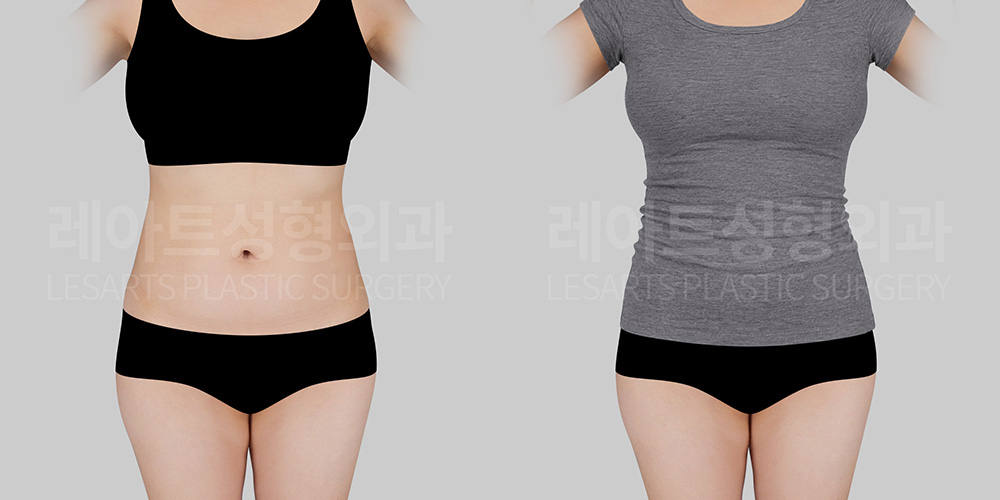
[Preoperative Flank and Pelvic Contour Assessment - Dr. Yongseung Seo, Lesarts Plastic Surgery]
[Patient Profile]
Age: Late 30s
Height: 165 cm
Weight: 66.3 kg
BMI: 24.4 kg/m²
Body Fat Percentage: 24.2%
* Clinical outcomes may vary individually depending on personal anatomical conditions, even with similar measurements.
[Preoperative Assessment: Abdominal Liposuction & Hip Fat Grafting]
The patient underwent arm and thigh liposuction at our clinic earlier this year,
and satisfied with her surgical outcomes, she returned to refine her abdominal silhouette
and restore volumetric projection to her hips.
She had a surgical history of laparoscopic uterine fibroid resection,
yet physical evaluation showed no significant dermal adhesions or surface irregularities.
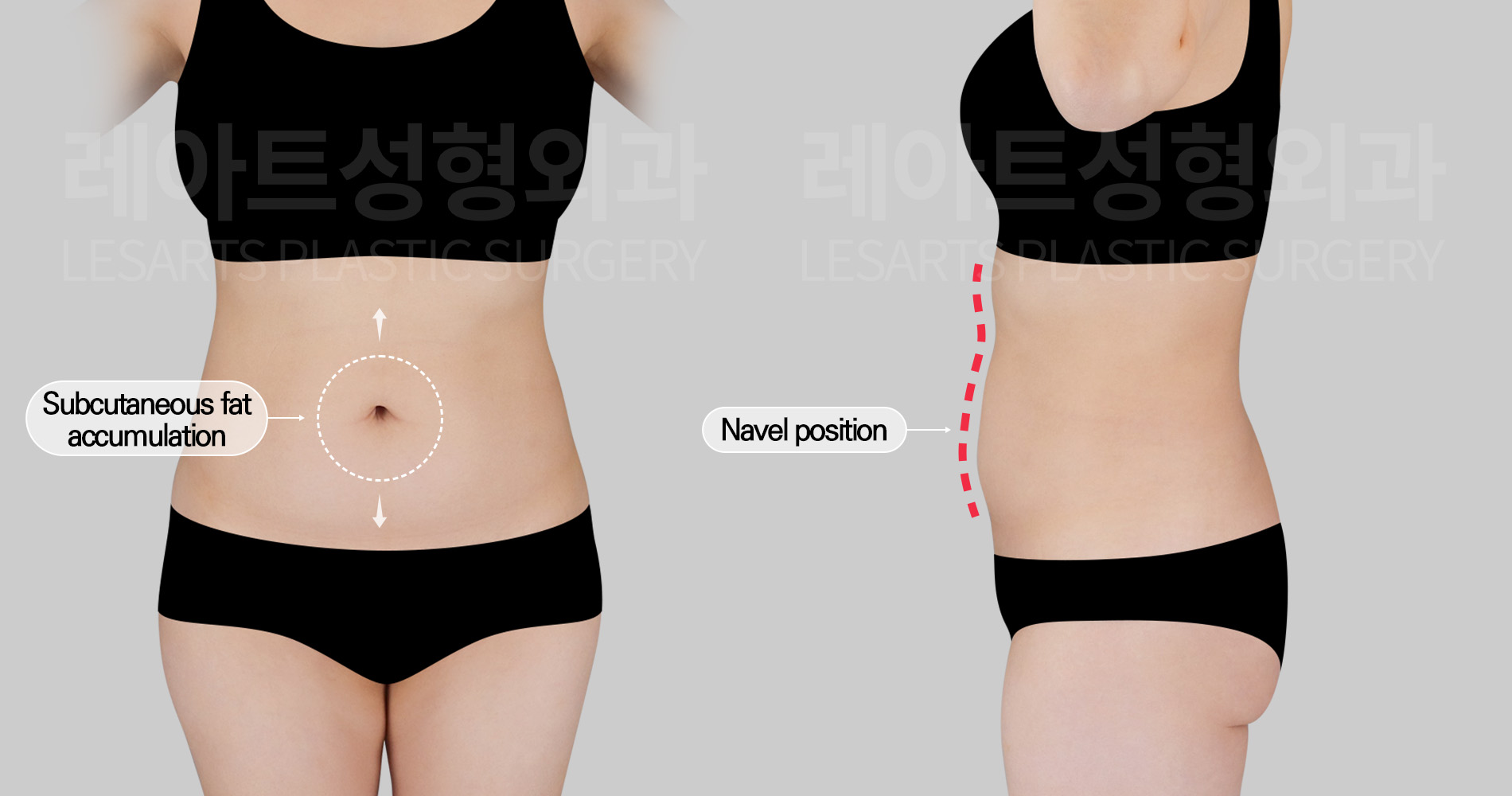
[Diagnostic Assessment of Abdominal Morphology and Adipose Distribution - Dr. Yongseung Seo]
Visual inspection preoperatively revealed
a horizontal crease centered around the umbilicus,
with substantial subcutaneous fat accumulation above and below this fold.
Consequently, the abdomen projected forward on frontal view,
while lateral examination displayed an interrupted, undulating contour
resembling the number ‘3’.
Pre-existing transverse creases across the anterior abdominal wall can deepen postoperatively
if repetitive trunk flexion causes skin folds to bunch during recovery and edema resolution.
To prevent this, we counseled her prior to surgery to avoid slumped posturing
and ensure tight clothing or compression garments do not crease across the abdominal fold for approximately one month post-op.
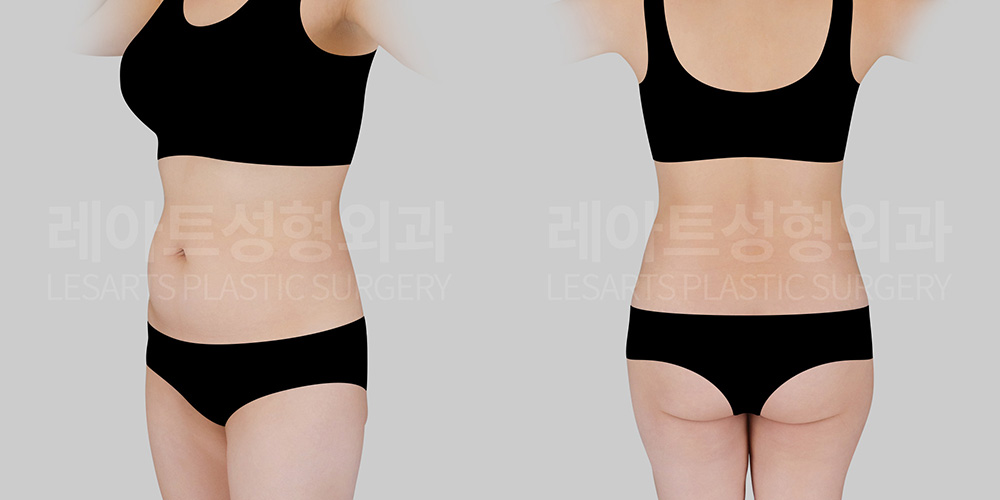
[Preoperative Baseline: Abdominal Liposuction & Hip Fat Grafting - Dr. Yongseung Seo]
Evaluating her torso proportions, her ribcage was slightly broad,
yet the relative ratio between her ribcage and pelvis was well-balanced.
Nonetheless, redundant fullness around the waist obscured natural curvature,
leaving the waistline appearing wide and flat.
Her hip region displayed generalized volumetric deficiency.
Although adjacent transitions had been contoured during prior thigh liposuction,
her lateral profile remained flat and lacked three-dimensional projection.
The hip silhouette presented as elongated and lean rather than rounded.
Therefore, achieving the rounded, projected hip contours she envisioned
required harvesting an adequate yield of injectable autologous fat.
High-resolution ultrasound recorded subcutaneous fat thickness at:
Upper and Lower Abdomen: 17 / 22 mm
Flanks: 10 / 12 mm
Love Handles: 17 / 15 mm
confirming ample treatable subcutaneous adipose layers across the abdomen.
Body composition analysis recorded a visceral fat level of 7.
We explained that visceral adiposity contributes to abdominal wall projection
alongside subcutaneous adipose deposits.
We counseled her that even after debulking subcutaneous fat via liposuction,
achieving a truly flat, defined waistline requires
sustained nutritional management to reduce visceral fat stores.
[Customized Design for Abdominal Refinement & Rounded Hip Augmentation]
The surgical plan focused on debulking circumferential abdominal volume to redefine the waistline,
while grafting harvested fat into the flat hip region
to establish a rounded, three-dimensional profile.
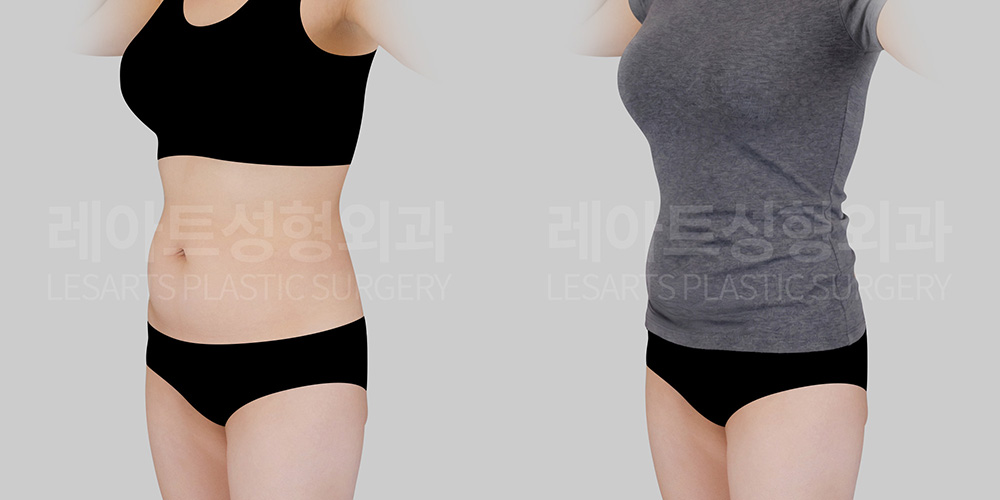
[Abdominal Wall Expansion from Visceral Fat - Lesarts Plastic Surgery]
Because anterior abdominal undulation was pronounced preoperatively,
subcutaneous fat across the costal margins, epigastrium, and infraumbilical wall
was planned for maximal extraction within safe physiological limits.
Because a transverse periumbilical crease was pre-existing,
aspiration depth was calibrated to blend smoothly with contiguous planes,
sculpting a flat, continuous abdominal surface.
As subcutaneous fat thins and skin retracts postoperatively,
pre-existing transverse creases can potentially appear more demarcated.
To minimize this risk, she was advised to avoid slumped posturing for one month,
and instructed to ensure garments and compression wear do not fold or pinch
directly over the pre-existing fold.
Because body composition analysis confirmed a visceral fat level of 7,
we noted that dietary management to lower visceral adiposity alongside surgery
is vital to achieving a slender, flat abdomen.
Regarding the flanks, her ribcage-to-pelvis ratio indicated favorable skeletal balance,
leading us to anticipate significant waistline tapering once excess fat was debulked.
Prior to surgery, overlying subcutaneous fat masked native skeletal asymmetry.
We explained in advance that once adipose volume was evacuated,
subtle baseline asymmetry along the waistline could become slightly more perceptible.
Hip fat grafting was designed to produce
a rounded, volumized hip profile.
Rather than merely filling localized depressions,
fat was layered across the pelvic-trochanteric junction to create distinct projection and curvature.
Achieving this required adequate donor fat volume.
While abdominal liposuction yielded sufficient fat to smooth depressions and refine contours,
we explained that donor volume limits may constrain maximal projection.
Because donor sites were insufficient for a secondary touch-up session,
strict compliance with postoperative graft survival protocols
was emphasized to optimize retention rates.
[Before & After Comparison: Abdominal Liposuction & Hip Fat Grafting]
(Photographed 2 months postoperatively under identical lighting and clinical conditions)
Preoperatively, heavy abdominal subcutaneous fat obscured waistline curvature,
causing the torso to appear wide and flat.
Deficient hip volume left the lower body profile lacking projection and dimension.

[Before & After Abdominal Liposuction & Hip Fat Grafting - Dr. Yongseung Seo, Lesarts Plastic Surgery]
Surgical execution contoured circumferential abdominal fullness to create a slender, continuous silhouette.
To integrate with the tapered waistline,
harvested fat was grafted into the hips to replenish flat contours,
sculpting a rounded, feminine lateral profile.
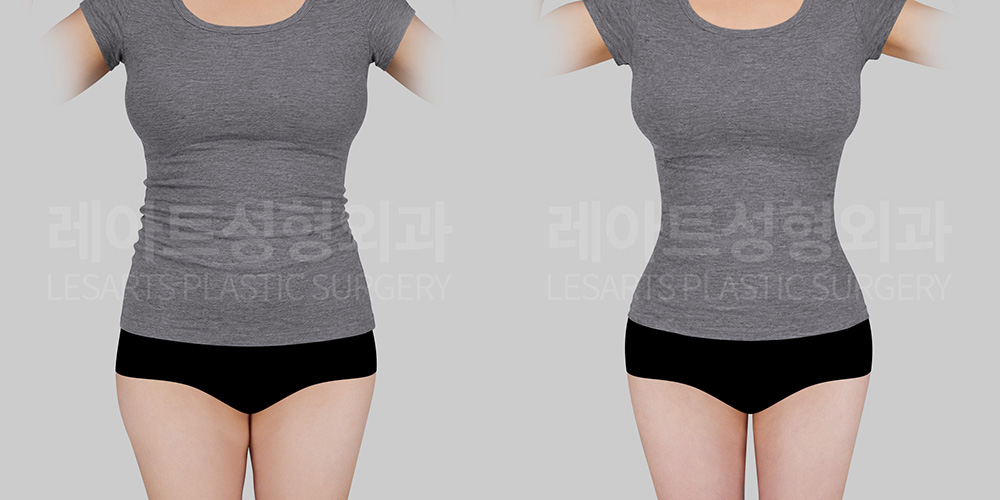
[Before & After Abdominal (Anterior, Flanks, Love Handles) Liposuction - Dr. Yongseung Seo]
On anterior view,
debulking flank fullness sculpted a noticeably tapered waistline,
revealing a defined S-curve flowing into the pelvis.
Subtle baseline bilateral asymmetry was observable as anticipated,
yet remained harmonious without disrupting overall bodily balance.
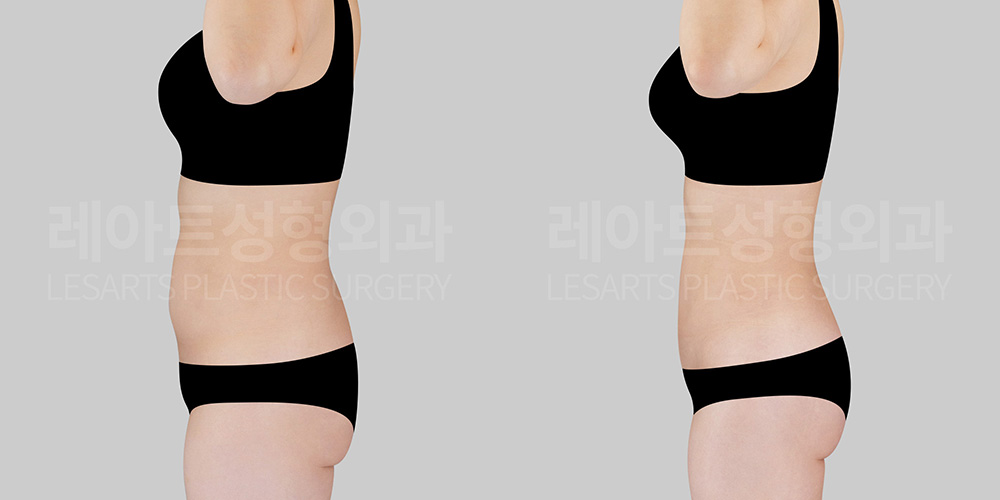
[Visceral Fat Management Post-Abdominal Liposuction - Dr. Yongseung Seo]
On lateral examination,
the undulating ‘3’-shaped abdominal profile flattened into a continuous plane.
Because the patient diligently followed posture and garment guidelines,
the pre-existing transverse crease did not deepen, integrating smoothly into the abdominal wall.
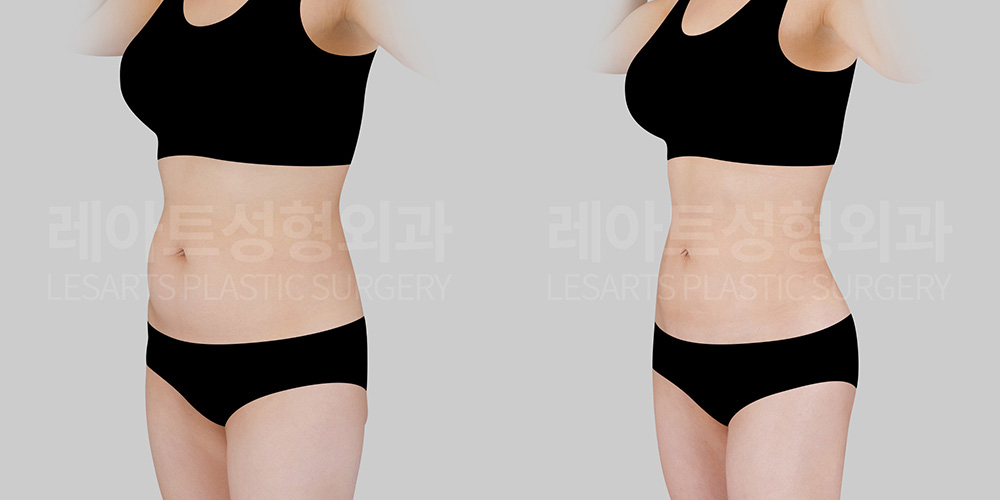
[Abdominal & Buttock Contouring at 2 Months - Lesarts Plastic Surgery]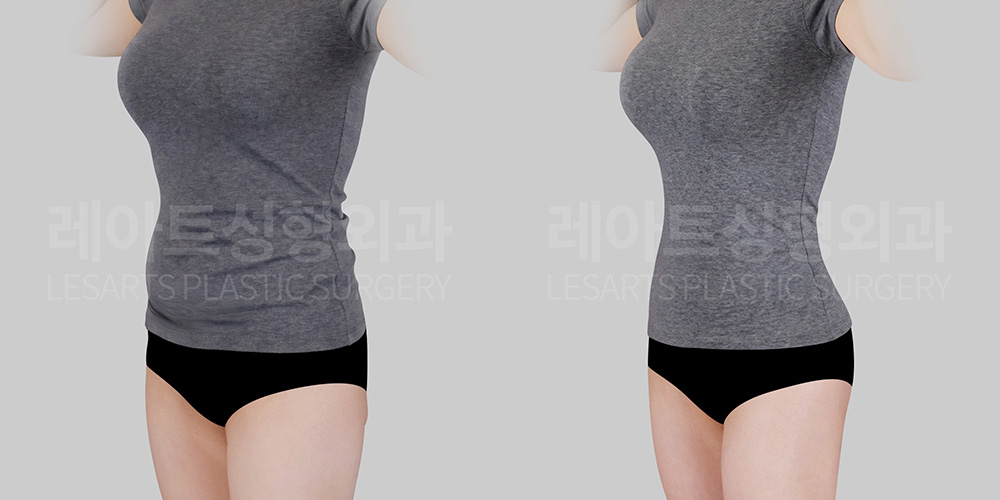
[2-Month Outcomes of Abdominal Liposuction & Buttock Fat Grafting - Dr. Yongseung Seo]
Even with thorough subcutaneous fat removal,
elevated visceral fat can limit how flat the abdominal profile becomes.
Her smooth contour reflects surgical execution combined with
her dedicated compliance with postoperative weight and visceral fat control.
We encouraged her to maintain these lifestyle habits to preserve long-term contour stability.
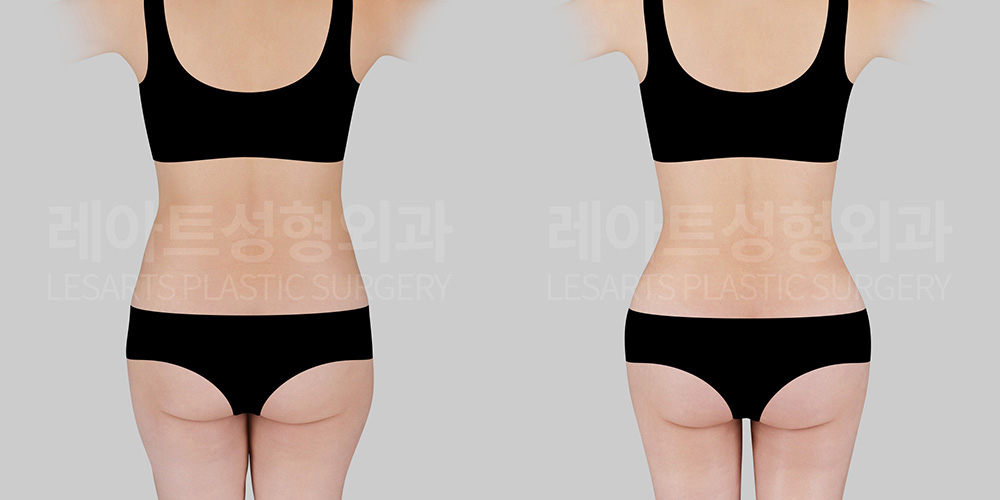
[Pelvic and Hip Contour Changes Post-Fat Grafting - Dr. Yongseung Seo]
Following fat grafting, the pelvic-to-hip transition settled into a rounded curve.
Debulking the waist highlighted the waistline indentation,
while hip projection balanced upper-to-lower body proportions.
Because available donor fat yield was limited,
maximal posterior projection was bounded by graft volume.
This case illustrates debulking redundant volume in the abdomen and flanks via liposuction
while grafting harvested autologous fat into the pelvis and hips
to achieve overall bodily harmony.
We advised her that balanced nutrition and stable weight maintenance are essential to sustaining graft retention and smooth lines.
View Similar Abdominal Liposuction + Hip Fat Grafting Cases
↓ ↓ ↓

Liposuction and fat grafting provide an effective modality to resolve stubborn, resistant areas.
Sculpting an aesthetic silhouette centers on overall proportions and three-dimensional balance.
By debulking redundant fat and replenishing deficient areas through tailored body contouring,
patients can achieve silhouettes difficult to attain through diet alone.
Accurate diagnosis and meticulous design highlight natural proportions and enhance innate physical strengths.
A flat abdominal profile paired with rounded hip volume enhances wardrobe fit and elevates daily self-confidence.
Through precise surgical planning and structured post-care protocols, we support your aesthetic goals.
Experience balanced body contouring at Lesarts Plastic Surgery.
FAQ
Q1. Can a tapered waist and volumized hips be sculpted simultaneously?
Contouring abdominal and flank fat while grafting harvested fat into the hips
sculpts a narrow waist and three-dimensional hip profile concurrently.
Q2. Is lifestyle dieting necessary after abdominal liposuction?
When visceral adiposity is elevated, liposuction alone cannot create a completely flat profile,
making ongoing dietary and weight management vital postoperatively.
Q3. Can liposuction be performed if pre-existing transverse abdominal creases are present?
Yes, but skin retraction following fat removal can potentially deepen pre-existing folds,
requiring diligent attention to posture and garments during initial recovery.
Q4. Can hip fat grafting achieve unlimited volume augmentation?
Augmentation capacity depends on available donor fat harvest yields;
if harvest yield is limited, achievable volumetric projection will have natural anatomical boundaries.
Q5. How do body proportions transform following abdominal liposuction and hip fat grafting?
Debulking the waist accentuates waistline curvature,
while augmenting the pelvic-hip line adds volume, enhancing overall full-body proportions.
Dr. Yongseung Seo


Cases finding
similar to my profile
Customer Diagnostics


Select the surgery and
area you are interestedto see real
before andafter changes.


we
make you,
the art
Clinic hours
MON - FRI
10 am – 7pm
SAT
10 am – 4pm
Holiday
SUN, HOLIDAY
Location
Lesarts Moon Clinic Tower 4-5F, 40, Nonhyeon-ro 168-gil,
Gangnam-gu, Seoul, Republic of Korea

Medical institution name Lesarts Plastic Surgery
Address Lesarts Moon Clinic Tower 4-5F, 40, Nonhyeon-ro 168-gil, Gangnam-gu, Seoul, Republic of Korea
Representative Moon sung jun
