




Online Consultation
Please accurately enter the information below.
Quick Cost Consultation
Quick Consultation & Reservation
Cases finding
similar to my profile






Doctor's Note
Medical columns by our surgeons
Thigh Revision Liposuction | Asymmetry & Saddlebags: 2-Month Contour Changes [Doctor's Note by Dr. Yongseung Seo]
2026-09-21
Thigh Revision Liposuction | Asymmetry & Saddlebags: 2-Month Contour Changes [Doctor's Note by Dr. Yongseung Seo]
Liposuction Is the Beginning, Not the End, of Body Contouring: Clinical Analysis of Thigh Revision Liposuction
Q. If asymmetry or stubborn fat pockets become bothersome again after thigh liposuction, is revision surgery possible?
A. Revision surgery can be considered after thoroughly evaluating residual adipose distribution and internal tissue conditions following previous liposuction.
Because visible bilateral discrepancies do not always correlate directly with actual differences in fat volume,
it is essential to determine whether to prioritize asymmetry correction or overall circumferential reduction through comprehensive consultation.
[ Learn More About Lesarts Plastic Surgery Thigh Revision Liposuction Cases ]
Written by Dr. Yongseung Seo, Lesarts Plastic Surgery
This column was authored directly by our medical staff.
※ Unauthorized copying, editing, or redistribution is strictly prohibited. ※
Following prior liposuction or body contouring procedures,
many consider revision surgery due to bilateral asymmetry, uneven surface undulations,
or contour alterations resulting from subsequent weight regain over time.
Anatomical zones that have previously undergone liposuction
often exhibit internal fibrosis and tissue firmness,
and the distribution of residual fat layers differs fundamentally
from untouched, virgin tissue planes.
Furthermore, if body weight increases postoperatively, remaining adipocytes hypertrophy,
disrupting previously sculpted bodily balance
and causing contour lines to appear irregular once again.
Consequently, patients who have already experienced liposuction
naturally approach revision surgery with greater caution.
“Having already had surgery, will a revision truly make a noticeable difference?”
“I was left with regrets after my primary surgery; can a revision fix this?”
“Doesn't revision surgery carry a higher burden of scarring and complications than the first procedure?”
Revision liposuction should never be approached simply as an uncalibrated attempt
to extract remaining fat deposits.
It is crucial to analyze what adipose layers remain, whether visible asymmetry stems from fat differences
or underlying structural factors, and to formulate a re-design plan accordingly.
The patient presented today visited our clinic with these exact concerns.
Although she had undergone thigh liposuction at another clinic two years prior,
she sought revision consultation due to recurrent stubborn fat deposits
and visible asymmetry along her inner thighs.
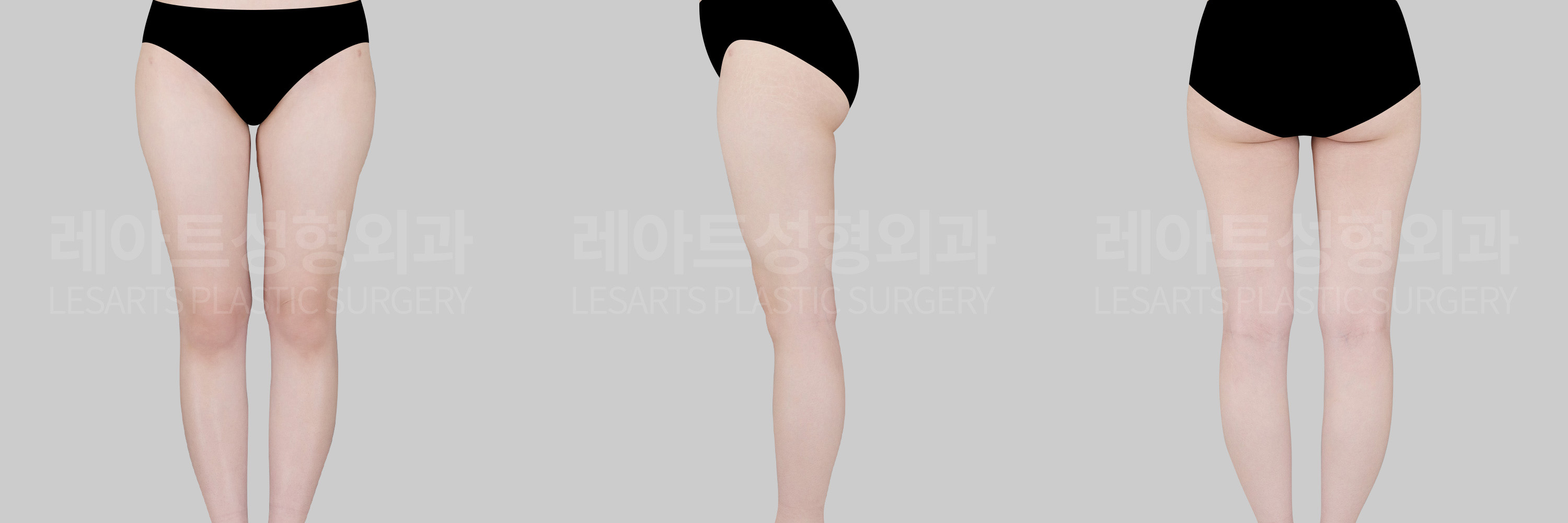
[Thigh Revision Liposuction Consultation & Diagnosis]
[Patient Profile]
Age: Early 20s
Height: 158 cm
Weight: 49.9 kg
BMI: 20.0 kg/㎡
Body Fat Percentage: 31.5%
* Clinical outcomes may vary individually depending on adipose distribution,
underlying musculoskeletal anatomy, and prior surgical status, even with similar physical measurements.
[Thigh Revision Liposuction Consultation & Diagnostic Findings]
The patient underwent primary thigh liposuction at another clinic approximately two years ago.
Following that procedure, her weight increased by approximately 4 kg,
giving her the impression that stubborn fat had re-accumulated across her thighs.
Her foremost aesthetic frustration was
the noticeable bilateral asymmetry observed along her medial inner thighs.
Furthermore, lateral trochanteric saddlebag protrusion persisted,
broadening the upper leg span
and leaving her dissatisfied with the overall smoothness of her leg silhouette.
[Diagnostic Ultrasound Findings]
Lateral (Saddlebag): 21 / 25 mm
Medial (Inner Thigh): 8 / 11 mm
Anterior: 10 / 6 mm
Posterior: 7 / 11 mm
Knee: 9 / 9 mm
While residual adipose tissue was present along the lateral saddlebags
and other regions, overall residual fat volume was not exceptionally heavy.
In particular, along the inner thighs—her primary aesthetic concern—
the actual difference in adipose depth between sides was modest
relative to the pronounced asymmetry perceived visually.
This finding served as a critical baseline in establishing the revision plan.
If one aggressively aspirates only the fuller side to correct visual asymmetry,
overall circumferential reduction may fall short of patient expectations.
Conversely, if one prioritizes total extraction volume and size reduction,
pre-existing subtle asymmetries may not be completely eliminated.
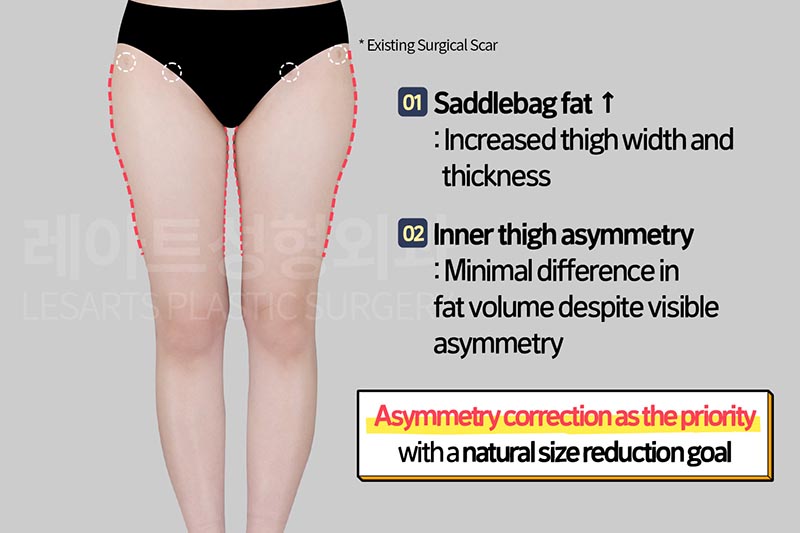
When adipose discrepancies are modest, forcing complete bilateral symmetry
may compromise overall circumferential reduction;
conversely, prioritizing extraction volume alone risks leaving subtle native asymmetries uncorrected.
We discussed these surgical trade-offs thoroughly with the patient to align treatment priorities.
[Surgical Design for Thigh Revision Liposuction]
Because the patient had already undergone primary thigh liposuction,
the procedure focused not simply on extracting remaining fat,
but on analyzing why dissatisfaction lingered after the first surgery and identifying
which anatomical factors could be refined under current tissue conditions.
✔ Medial Inner Thighs
Her primary concern was inner thigh asymmetry.
However, the actual adipose volume discrepancy was modest compared to visual perception,
and total residual fat along the medial aspect was relatively limited.
If bilateral fat were aggressively evacuated under these conditions,
circumferential reduction might occur,
yet underlying asymmetry could remain noticeable.
Therefore, this revision prioritized calibrated aspiration between sides
to minimize visual asymmetry as the primary surgical objective.
✔ Muscular Boundary Transitions
In revision surgery, residual fat should not be removed indiscriminately.
Aggressively stripping fat over muscular borders exposes raw muscular curvature,
which can cause surface irregularities.
Thus, aspiration depth was carefully calibrated to preserve a delicate adipose buffer along muscular transitions,
maintaining a continuous, smooth contour.
✔ Inherent Anatomical Limits in Revision Surgery
Outcomes in revision liposuction depend heavily on residual adipose volume
and internal tissue scarring from prior procedures.
We counseled her prior to surgery that if underlying asymmetry stems from skeletal or muscular differences,
achieving complete mathematical symmetry through liposuction alone
carries natural physiological limits.
[Before & After Comparison: Thigh Revision Liposuction at 2 Months]
(Photographed 2 months postoperatively under identical lighting and clinical conditions)
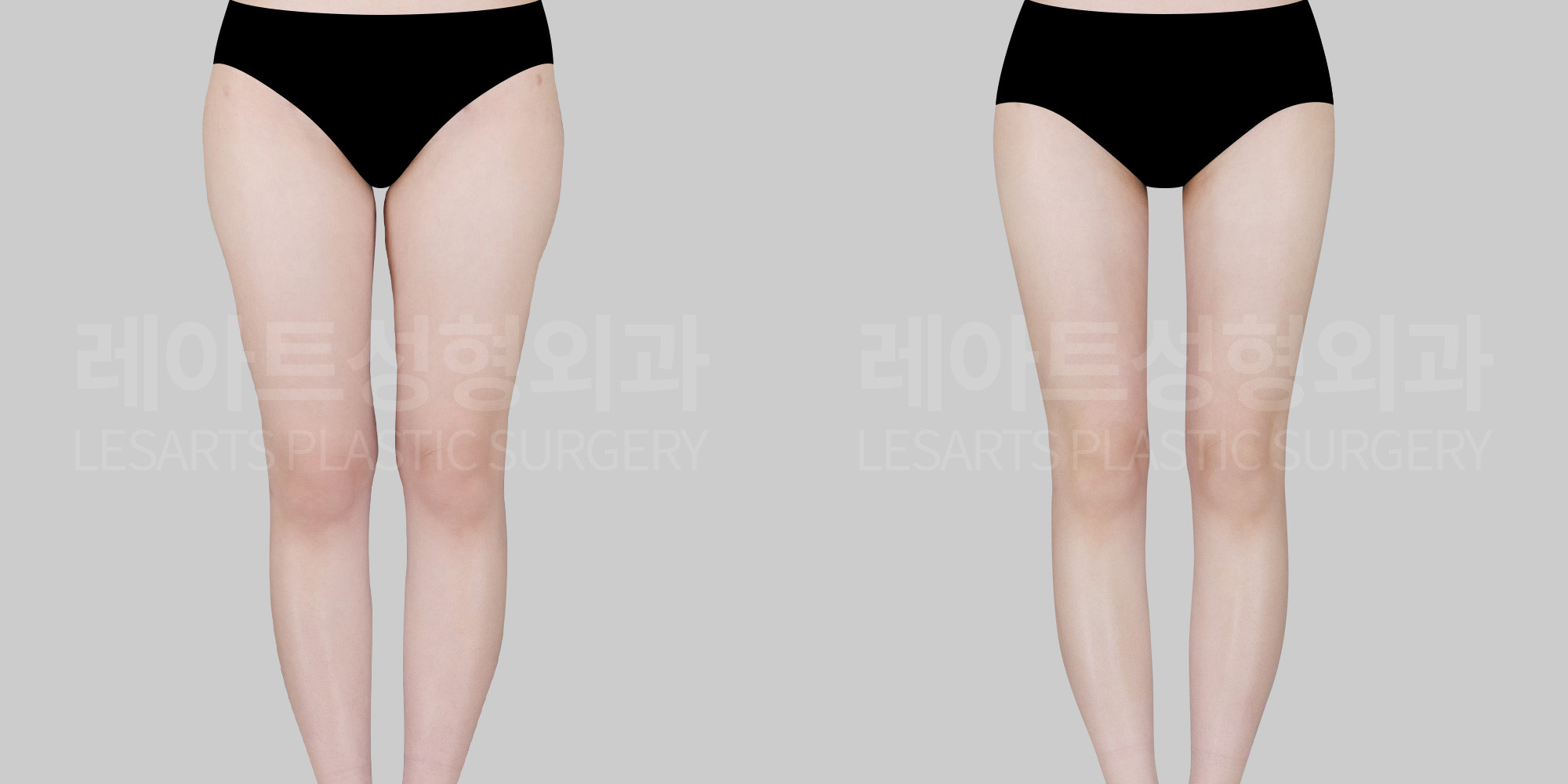 [Thigh Revision Liposuction Before & After - Dr. Yongseung Seo, Lesarts Plastic Surgery]
Preoperatively, inner thigh asymmetry was noticeable,
and irregular medial undulations left the contour line uneven.
At 2 months post-revision, irregular medial undulations settled smoothly,
establishing significantly improved bilateral balance between the legs.

[Inner Thigh Asymmetry Correction Post-Liposuction - Dr. Yongseung Seo, Lesarts Plastic Surgery]
Preoperatively, lateral saddlebag projection
caused the upper thighs to look broad and heavy.
Following revision, debulking lateral fullness
allowed the outer thigh contour to transition in a continuous, gentle curve.
Balancing medial asymmetry while reducing lateral volume concurrently
narrowed the overall horizontal span of the thighs.
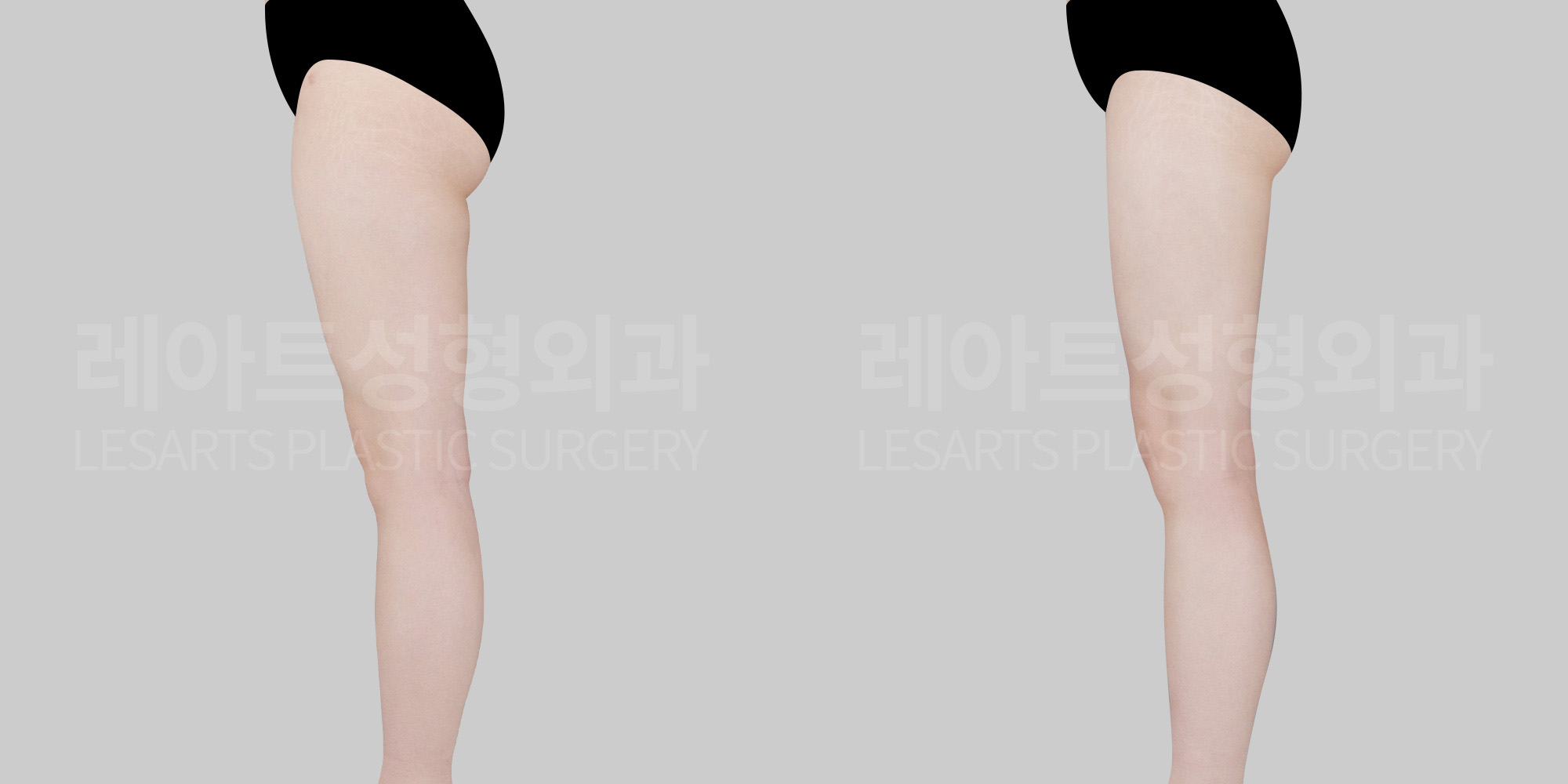
[Contour Changes Post-Revision Liposuction - Lesarts Plastic Surgery]
Rather than focusing solely on circumference reduction,
aspiration volumes were tailored to regional residual fat distribution
and baseline bilateral discrepancies from the primary surgery.
Consequently, medial and lateral undulations smoothed together,
transforming lower body lines into a balanced,
streamlined silhouette compared to baseline.
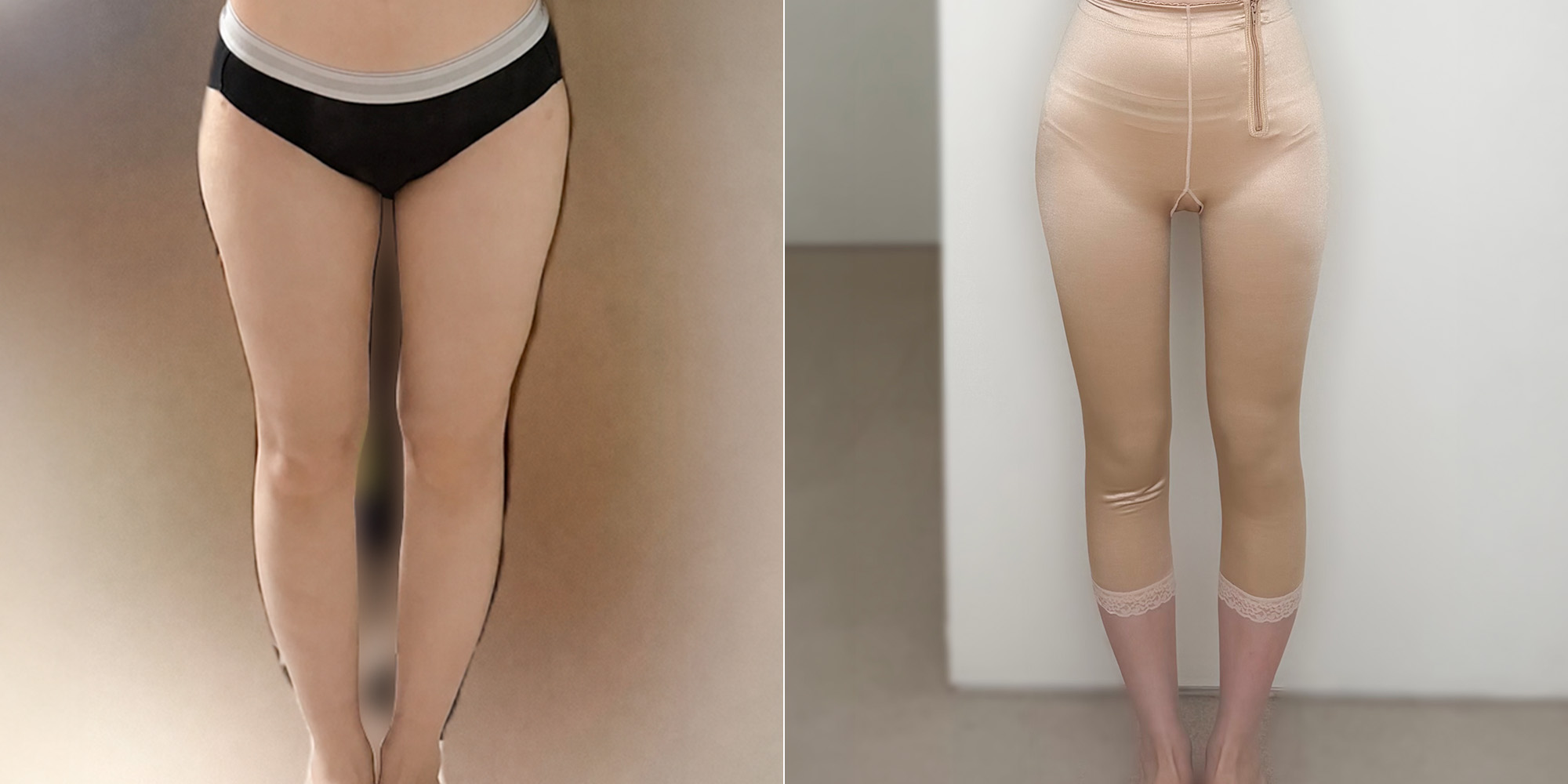 [Patient Follow-Up Photograph: Thigh Revision Liposuction - Dr. Yongseung Seo]
Photographs shared directly by the patient confirm
clean, streamlined contour lines along both the inner and outer thighs.
While revision procedures demand meticulous evaluation of cutaneous texture and internal fibrosis,
her 2-month follow-up showed well-aligned contours without noticeable step-offs or skin laxity,
and she expressed satisfaction, noting: “I have regained confidence in my leg lines.”
Thigh Revision Liposuction FAQ
Q1. Can you regain weight after thigh liposuction?
Yes. If systemic weight increases postoperatively, remaining adipocytes can hypertrophy.
This can alter the sculpted volume and lines of the thighs,
making ongoing weight management essential.
Q2. Can bilateral asymmetry remaining after primary liposuction be corrected via revision?
Revision surgery can adjust adipose volume between sides; however, visible asymmetry is not always caused solely by fat discrepancies.
Evaluating residual fat and musculoskeletal architecture is necessary to determine the achievable scope of correction.
Q3. Should revision liposuction aim to extract as much residual fat as possible?
No. Over-aspirating fat along muscular boundaries exaggerates underlying muscle contours, causing irregular surface lines.
Preserving a delicate buffer layer while harmonizing overall balance is critical.
Q4. Can asymmetry correction and thigh circumference reduction be accomplished simultaneously?
Both aspects are evaluated concurrently; however, depending on bilateral fat reserves and residual tissue volume, priorities may need to be balanced.
The operative direction is finalized after thorough consultation regarding whether to prioritize symmetry or total volume reduction.
Q5. How does thigh revision liposuction differ from a primary procedure?
Because the anatomical plane has already been treated, residual adipose distribution and internal fibrosis must be evaluated first.
Carefully analyzing why dissatisfaction persisted after primary surgery is necessary to re-plan aspiration volumes across each site.
Dr. Yongseung Seo


Cases finding
similar to my profile
Customer Diagnostics


Select the surgery and
area you are interestedto see real
before andafter changes.


we
make you,
the art
Clinic hours
MON - FRI
10 am – 7pm
SAT
10 am – 4pm
Holiday
SUN, HOLIDAY
Location
Lesarts Moon Clinic Tower 4-5F, 40, Nonhyeon-ro 168-gil,
Gangnam-gu, Seoul, Republic of Korea

Medical institution name Lesarts Plastic Surgery
Address Lesarts Moon Clinic Tower 4-5F, 40, Nonhyeon-ro 168-gil, Gangnam-gu, Seoul, Republic of Korea
Representative Moon sung jun
