




Online Consultation
Please accurately enter the information below.
Quick Cost Consultation
Quick Consultation & Reservation
Cases finding
similar to my profile






Doctor's Note
Medical columns by our surgeons
Abdominal Liposuction & Pelvic Fat Grafting in Your 40s Postpartum | 6-Month Changes After Abdominoplasty [Doctor's Note by Dr. Pyongrim Choi]
2026-09-21
Abdominal Liposuction & Pelvic Fat Grafting in Your 40s Postpartum | 6-Month Changes After Abdominoplasty [Doctor's Note by Dr. Pyongrim Choi]
In Your 40s and a Mother of Two: Can You Still Achieve an Hourglass Silhouette?
Q. If your weight is stable after childbirth but you struggle with lower abdominal laxity and deficient pelvic volume, what body contouring approaches can be considered?
A. Rather than focusing purely on weight reduction, it is essential to evaluate residual abdominal fat, skin laxity, and pelvic volume independently.
Unwanted abdominal fat can be refined with liposuction, postpartum skin laxity can be addressed with abdominoplasty, and harvested fat can be grafted to the pelvis if needed to harmonize waist-to-pelvis proportions.
[ View More Lesarts Plastic Surgery Body Contouring Cases ]
Written by Dr. Pyongrim Choi, Lesarts Plastic Surgery
This column was authored directly by our medical staff.
※ Unauthorized copying, editing, or redistribution is strictly prohibited. ※
During consultations with women in their 40s,
we frequently hear common frustrations.
“I maintain consistent workout and nutritional habits.”
“My scale weight hasn't significantly increased, yet my lower belly sags.”
“Deficient pelvic volume keeps my waistline from appearing tapered.”
Particularly after undergoing childbirth,
even when body weight remains in the normal range or leans toward a slender frame,
residual laxity and localized fat linger on the lower abdomen
or deficient volume around the pelvis leaves the overall silhouette
appearing flat and indistinct.
In such cases, the desired aesthetic change may not be simple numeric weight loss.
Highlighting the waistline indentation,
adding necessary volume to the pelvis,
and resolving lower abdominal fullness and laxity
to sculpt a continuous curve from waist to pelvis
is often the primary goal.
Can women in their 40s who have experienced childbirth successfully plan such contour improvements?
In this column, we review a clinical case of a 40-year-old patient (162 cm, 48 kg)
with a slender build and a history of two deliveries.

[Preoperative Assessment: Abdominal Liposuction, Thigh Liposuction & Pelvic Fat Grafting]
1. “I Thought Dieting Would Fix It…” Stubborn Postpartum Lower Belly Laxity
The patient was a 40-year-old mother of two with a lean frame,
who was troubled far more by lower abdominal ptosis and
deficient pelvic volume than by scale weight.
Because she already possessed a slender baseline build,
relying simply on further caloric restriction or weight loss
was neither realistic nor indicated.
Losing more weight in this state does not resolve overstretched lower abdominal skin laxity;
rather, it risks depleting facial or upper torso volume first
or making the pelvic and hip regions look even flatter.
Therefore, the surgical strategy focused not on generic weight reduction,
but on distinguishing areas needing debulking from zones requiring volumetric restoration
to balance full-body proportions.
2. In Slender Builds, the Priority Is Not Extraction Volume
Liposuction is often associated with large-volume debulking
to reduce overall body size in patients with higher adipose reserves.
However, liposuction also serves as a precise contouring modality in slender builds.
The procedural purpose, however, is distinct.
While higher-volume frames require general circumference reduction,
slender frames require refining stubborn localized fat pockets
to reveal natural waistline curvature and abdominal definition.
In this patient's case, residual lower abdominal fat was sculpted
to establish waist and abdominal contour lines,
while overstretched postpartum lower abdominal skin laxity
was addressed concurrently via abdominoplasty.
Additionally, autologous pelvic fat grafting was performed
to replenish deficient lateral pelvic volume.
[ Learn More About Lesarts Liposuction ]
3. What If Abdominal Fat Yield Is Insufficient in a Slender Patient?
In slender patients, harvesting sufficient autologous fat for grafting
cannot always be accomplished from the abdomen alone.
Because donor yield from the abdomen was limited,
fat was harvested concurrently from the inner thighs and trochanteric saddlebag areas.
Importantly, this was not done simply to gather fat indiscriminately.
Donor harvest sites must integrate seamlessly
with full-body contour design.
Refining excess fat along the inner thighs and saddlebags
allows the newly augmented lateral pelvic line to transition smoothly into the thighs,
while debulking the medial thigh reveals clearance between the legs.
Thus, this surgery combined targeted contouring of the abdomen and thighs
with pelvic volumetric augmentation,
harmonizing the entire kinetic chain from waist to pelvis and thighs.
Below are clinical follow-up photographs recorded at 6 months postoperatively.
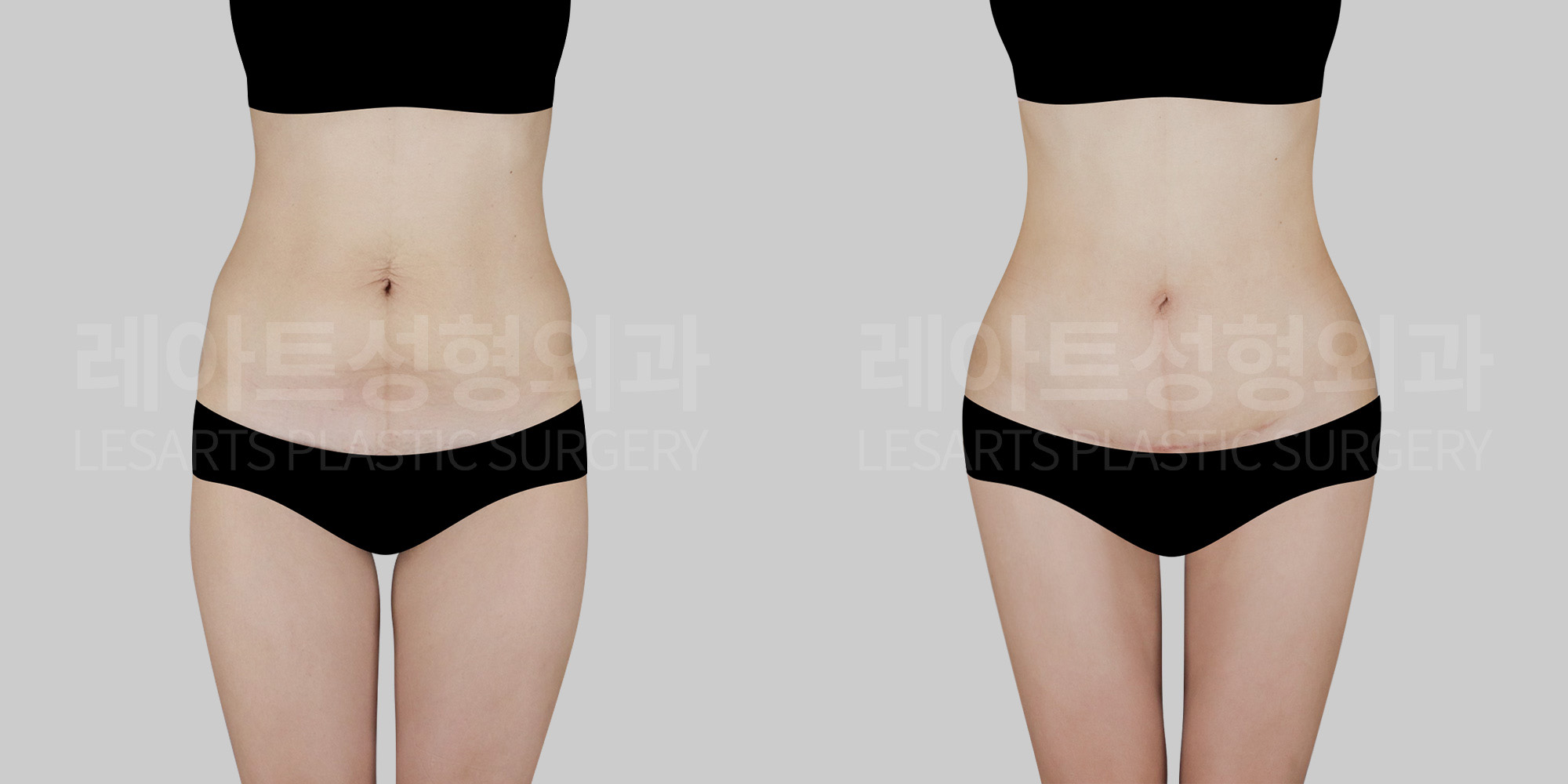
[Contouring in 40s: Abdominal Liposuction, Pelvic Fat Grafting, Thigh Liposuction & Abdominoplasty]
Postoperatively, debulking redundant abdominal volume
reveals a distinct, continuous curvature
extending from the waist down to the pelvis.
Rather than simple weight loss,
debulking targeted abdominal zones
while augmenting deficient pelvic volume
re-established balanced upper-to-lower body proportions.
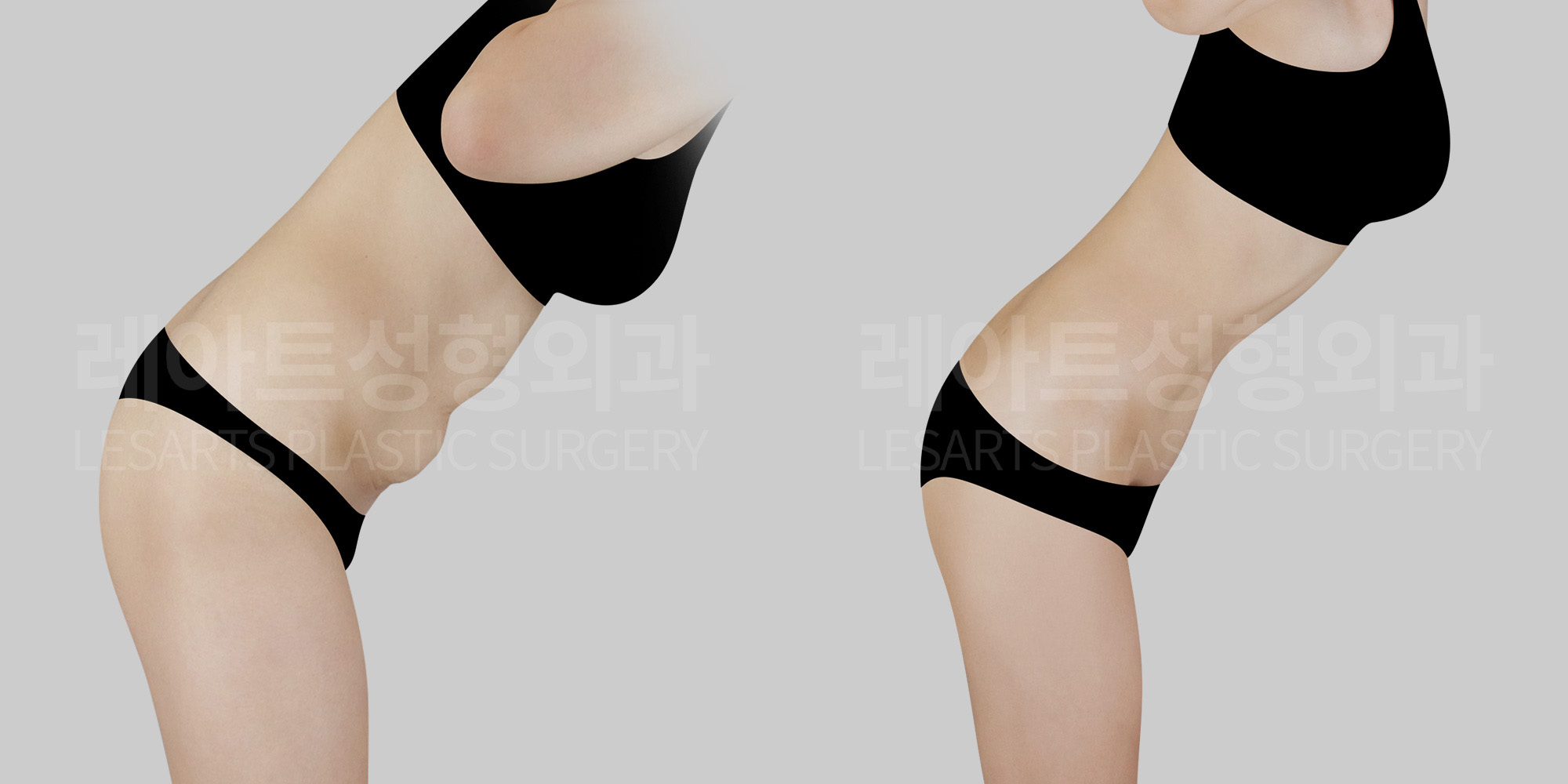
[Abdominoplasty, Abdominal Liposuction & Pelvic Contouring Review - Lesarts Plastic Surgery]
By correcting overstretched postpartum
lower abdominal skin via abdominoplasty,
the abdomen achieves more than just circumferential reduction;
lower abdominal laxity and excess volume resolve into a firm, supported surface.
To sculpt the waistline curve and abdominal contour,
liposuction and cutaneous laxity correction were calibrated to targeted extents
and performed concurrently in this clinical case.
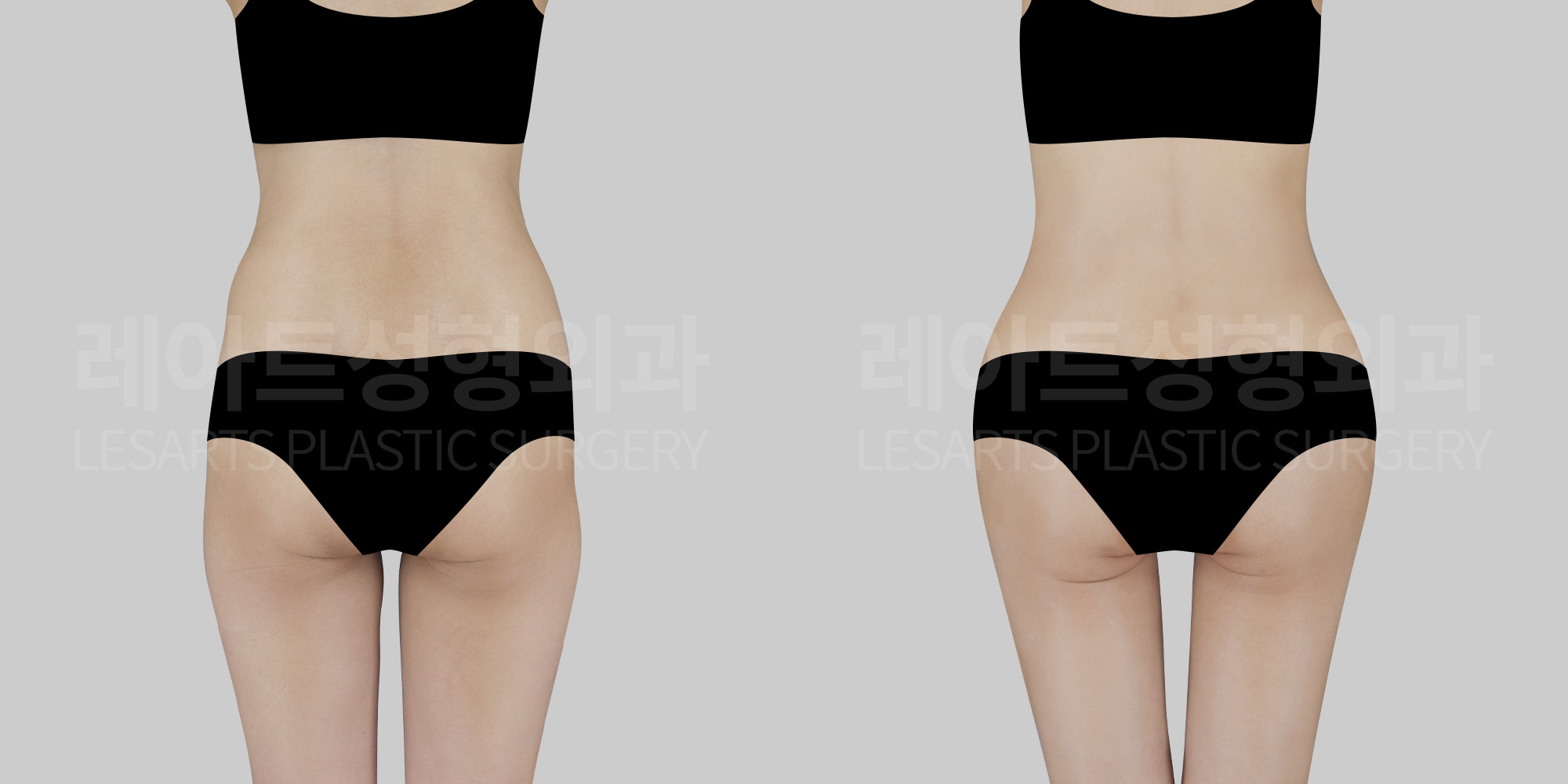
[Body Contouring & Pelvic Augmentation in 40s - Dr. Pyongrim Choi, Lesarts Plastic Surgery]
Through autologous fat grafting,
Dr. Pyongrim Choi


Cases finding
similar to my profile
Customer Diagnostics


Select the surgery and
area you are interestedto see real
before andafter changes.


we
make you,
the art
Clinic hours
MON - FRI
10 am – 7pm
SAT
10 am – 4pm
Holiday
SUN, HOLIDAY
Location
Lesarts Moon Clinic Tower 4-5F, 40, Nonhyeon-ro 168-gil,
Gangnam-gu, Seoul, Republic of Korea

Medical institution name Lesarts Plastic Surgery
Address Lesarts Moon Clinic Tower 4-5F, 40, Nonhyeon-ro 168-gil, Gangnam-gu, Seoul, Republic of Korea
Representative Moon sung jun
