




Online Consultation
Please accurately enter the information below.
Quick Cost Consultation
Quick Consultation & Reservation
Cases finding
similar to my profile






Doctor's Note
Medical columns by our surgeons
Simon Grade IIa Gynecomastia: 12-Day Postoperative Progress
2026-09-22
Simon Grade IIa Gynecomastia: 12-Day Postoperative Progress
Written by Board-Certified Plastic Surgeon Dr. Kukhan Lee, Lesarts Plastic Surgery
This column was authored directly by our medical staff.
※ Unauthorized copying, editing, or redistribution is strictly prohibited. ※
Q. If chest protrusion persists despite exercise and weight reduction, could it be gynecomastia?
If forward chest projection remains despite consistent workouts and weight loss, it is necessary to determine whether proliferated glandular tissue is present, confirming true gynecomastia alongside adipose deposits.
Through clinical palpation and high-resolution ultrasonography, the status of subcutaneous fat and glandular parenchyma can be clearly identified.
[Lesarts Gynecomastia Surgery Guide]
With the ongoing heatwave, outdoor activities in the sweltering weather feel increasingly burdensome.
As temperatures rise, one naturally reaches for thin, lightweight clothing,
yet for men troubled by protruding chest contours, summer can be a season of heightened self-consciousness.
Particularly when forward chest projection becomes visibly pronounced even under a single thin t-shirt due to gynecomastia,
many layer heavy garments despite the heat or avoid going out altogether.
Conversely, some hesitate to seek diagnosis and treatment,
worrying that the recovery phase after gynecomastia surgery might significantly disrupt daily routines.
Today, through a clinical case of a male patient in his 40s who visited Lesarts Plastic Surgery with these concerns,
we examine how his chest contours transformed at 12 days postoperatively following gynecomastia surgery.
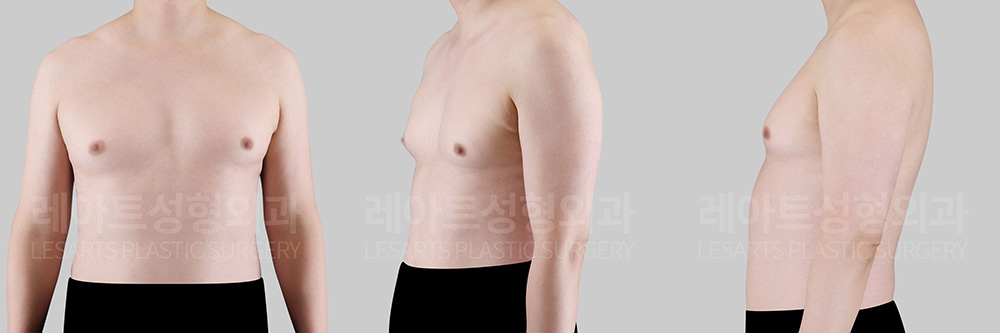
[Preoperative Upper Body Evaluation - Lesarts Plastic Surgery]
The patient had been self-conscious about forward chest projection since his teenage years.
Because gynecomastia was not widely recognized or understood at that time,
he did not visit a clinic for formal evaluation.
However, personal discomfort regarding his chest shape persisted over time,
and upon starting male androgenetic alopecia medication in his 30s,
he perceived an additional increase in breast volume and projection.
Because certain hair loss therapies can induce gynecomastia or exacerbate pre-existing glandular tissue,
we counseled him regarding these endocrine mechanisms, which he had also suspected upon noticing changes following medication use.
Although he subsequently adjusted his hair loss medication, lost weight, and exercised consistently,
the protruding chest shape exhibited no significant change.
Ultimately, he sought consultation to definitively diagnose gynecomastia and pursue necessary surgical treatment.
The patient measured 181 cm and 90 kg.
Physical examination revealed that, relative to his overall body fat composition,
his chest was not characterized by exceptionally heavy localized adiposity.
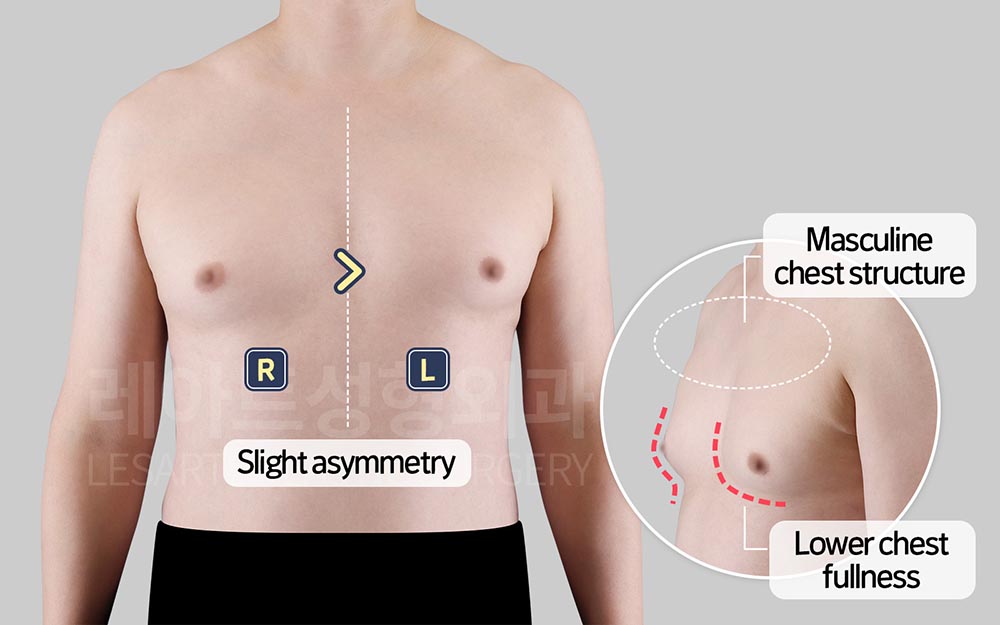
[Preoperative Diagnostic Assessment - Lesarts Plastic Surgery]
Pectoralis major development and upper chest lines retained an overall masculine contour,
yet moderate to severe hypertrophy was identified across the lower pole of the breast.
In particular, rounded anterior protrusion extending from the nipple and areola down to the lower breast
imparted distinctly feminine characteristics to the chest wall.
Subtle bilateral asymmetry was also observed,
with the right breast being slightly larger than the left.
Such minor bilateral variation is commonly observed, and human anatomy rarely exhibits absolute symmetry.
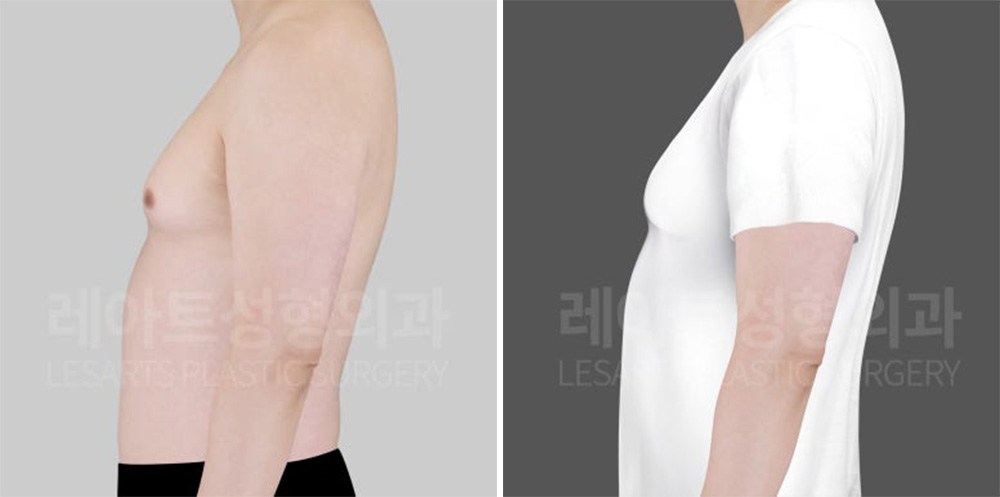
[Preoperative Periareolar Projection]
On lateral profile, the lower chest pole, including the periareolar complex,
represented the foremost apex of anterior projection,
making forward chest protrusion particularly evident beneath clothing.
High-resolution ultrasound confirmed hypertrophic glandular tissue proliferation
concentrated around the retroareolar region.
Glandular development was pronounced relative to subcutaneous adipose depth,
explaining why his chest shape had resisted change despite weight loss and physical training.
Synthesizing clinical examination and ultrasound imaging, he was diagnosed with true gynecomastia, Simon Grade IIa,
and a surgical plan combining subcutaneous glandular excision with targeted liposuction was established to flatten the anterior chest wall.
[Postoperative Progress at 12 Days]
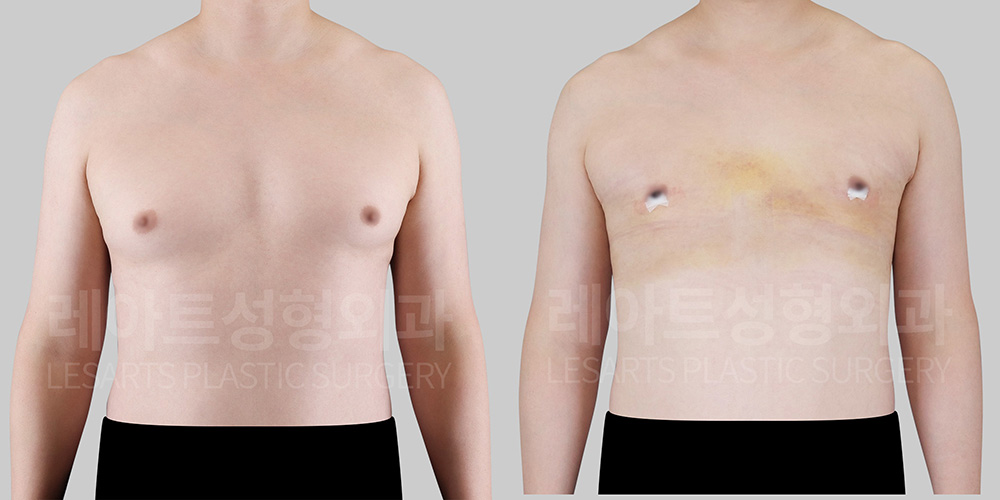
[Frontal Comparison Before and After Surgery - Dr. Kukhan Lee, Lesarts Plastic Surgery]
Above is the clinical appearance recorded at 12 days postoperatively.
Because this reflects the early recovery phase prior to the 2-week mark,
minor bruising and residual swelling were still present around the operative site.
Nonetheless, the primary aesthetic concern—prominent forward projection—has significantly resolved.
As rounded periareolar fullness decreased, the global chest profile reorganized into a masculine, contoured plane.
Debulking the lower breast pole flattened the anterior chest,
while the visual vertical length of the breast shortened into a compact, athletic proportion.
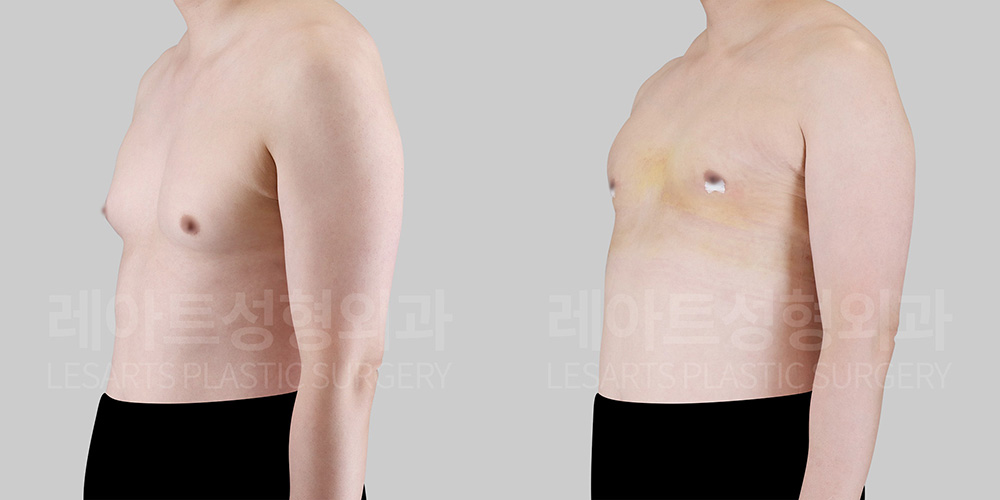
[Volume Reduction at 12 Days Post-Op - Lesarts Plastic Surgery]
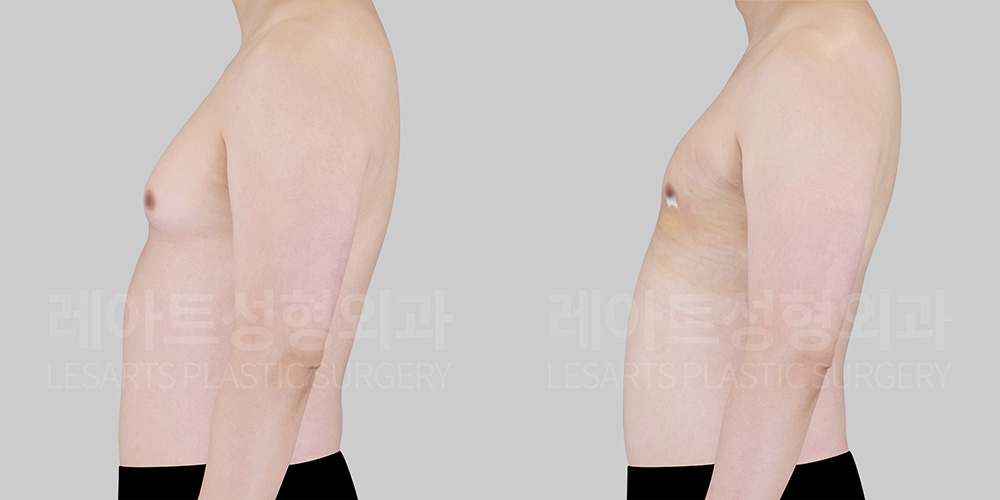
[Early Postoperative Outcomes - Dr. Kukhan Lee, Lesarts Plastic Surgery]
On oblique and lateral views, contour refinement is particularly noticeable.
Preoperatively, the lower pole and periareolar complex represented the highest peak of forward projection.
Following surgical excision of the glandular mass and adjacent fat, this protrusion flattened,
allowing the anatomical apex to transition naturally upward toward the upper pectoralis.
Consequently, lower pole volume resolved, sculpting a firm, masculine chest wall contour.

[T-Shirt Fit Post-Suture Removal - Lesarts Plastic Surgery]
Even during early recovery with residual swelling and bruising,
the reduction in anterior chest projection delivers distinct visual refinement.
Because contour lines transform early in the postoperative period,
patients readily appreciate the improved fit when wearing lightweight t-shirts.
Twelve days post-op represents an interim healing stage rather than the final clinical endpoint.
As residual edema subsides and internal tissues stabilize,
the chest silhouette will settle into an even more natural, refined contour.
With ongoing recovery, further smoothing and firming of the chest wall can be expected.
▼ View More Gynecomastia Surgery Results ▼

While gynecomastia poses no direct threat to physical health,
longstanding aesthetic self-consciousness regarding chest shape can lead to psychological distress and diminished confidence.
During summer when lightweight attire is worn, forward projection is easily exposed, often heightening personal frustration.
If you find yourself repeatedly stressing over clothing choices or hesitating to go out each summer,
evaluating whether your condition stems from true gynecomastia is recommended rather than assuming it is purely a fitness or weight issue.
Through accurate diagnostic evaluation,
we assess the status of glandular tissue and subcutaneous fat,
guiding you toward an appropriate, evidence-based treatment plan tailored to your anatomy.
FAQ
Q1. What characterizes Simon Grade IIa gynecomastia?
In this presentation, pectoralis major musculature and upper chest lines retain masculine characteristics, while moderate to severe hypertrophy and anterior projection center across the periareolar region and lower breast pole without cutaneous ptosis.
Q2. Can true gynecomastia resist exercise and dietary weight reduction?
Yes. True gynecomastia driven by hypertrophic glandular tissue proliferation will persist despite caloric restriction or physical workouts, as glandular parenchyma cannot be eliminated through weight loss alone.
Q3. Does gynecomastia surgery involve only glandular excision?
In this clinical case, ultrasound confirmed marked glandular hyperplasia, and a combined surgical approach incorporating subcutaneous glandular excision alongside targeted liposuction was executed to achieve smooth, natural contours.
Q4. How much does chest contour transform by 12 days post-op?
Although 12 days represents early recovery with residual edema and minor bruising, debulking periareolar and lower pole protrusion creates an immediately flatter chest wall and noticeably improved t-shirt fit.
Q5. Is the appearance at 12 days postoperatively the final result?
No. Twelve days post-op is an early recovery stage. As residual edema resolves and soft tissues soften and adapt, chest contours will progressively settle into an even more natural, refined masculine plane.
Dr. Kukhan Lee


Cases finding
similar to my profile
Customer Diagnostics


Select the surgery and
area you are interestedto see real
before andafter changes.


we
make you,
the art
Clinic hours
MON - FRI
10 am – 7pm
SAT
10 am – 4pm
Holiday
SUN, HOLIDAY
Location
Lesarts Moon Clinic Tower 4-5F, 40, Nonhyeon-ro 168-gil,
Gangnam-gu, Seoul, Republic of Korea

Medical institution name Lesarts Plastic Surgery
Address Lesarts Moon Clinic Tower 4-5F, 40, Nonhyeon-ro 168-gil, Gangnam-gu, Seoul, Republic of Korea
Representative Moon sung jun
