




Online Consultation
Please accurately enter the information below.
Quick Cost Consultation
Quick Consultation & Reservation
Cases finding
similar to my profile






Doctor's Note
Medical columns by our surgeons
[Medical Column] Flying After Gynecomastia Surgery: When Is It Safe? (Comprehensive Guide by Flight Duration & Scenario)
2026-09-22
[Medical Column] Flying After Gynecomastia Surgery: When Is It Safe? (Comprehensive Guide by Flight Duration & Scenario)
Written by Dr. Jihoon Moon, Lesarts Plastic Surgery
This column was authored directly by our medical staff.
※ Unauthorized copying, editing, processing, or redistribution is strictly prohibited. ※
When is it safe to fly after gynecomastia surgery?
The recommended timeline varies depending on flight duration.
Short-haul flights are feasible from postoperative days 2 to 3, medium-haul flights after days 3 to 5,
and long-haul flights exceeding 6 to 10 hours are possible after day 7, with after day 14 being strongly recommended.
[Lesarts Gynecomastia Surgery Guide]
Patients planning or recovering from gynecomastia surgery—particularly those
preparing for vacation travel or international patients visiting Korea for treatment—
frequently ask important questions regarding air travel:
“How soon after surgery can I safely board an airplane?”
“Could cabin pressure changes cause surgical dehiscence or severe pain?”
To address this directly: when you select an appropriate travel window based on medical guidance
and observe essential postoperative precautions,
there is no need for excessive worry or anxiety regarding air travel.
However, because commercial aircraft environments involve cabin pressure shifts, confined seating,
and luggage handling that differ substantially from quiet daily routines,
it is beneficial to understand clear, evidence-based guidelines
to ensure a comfortable, safe return home or journey.
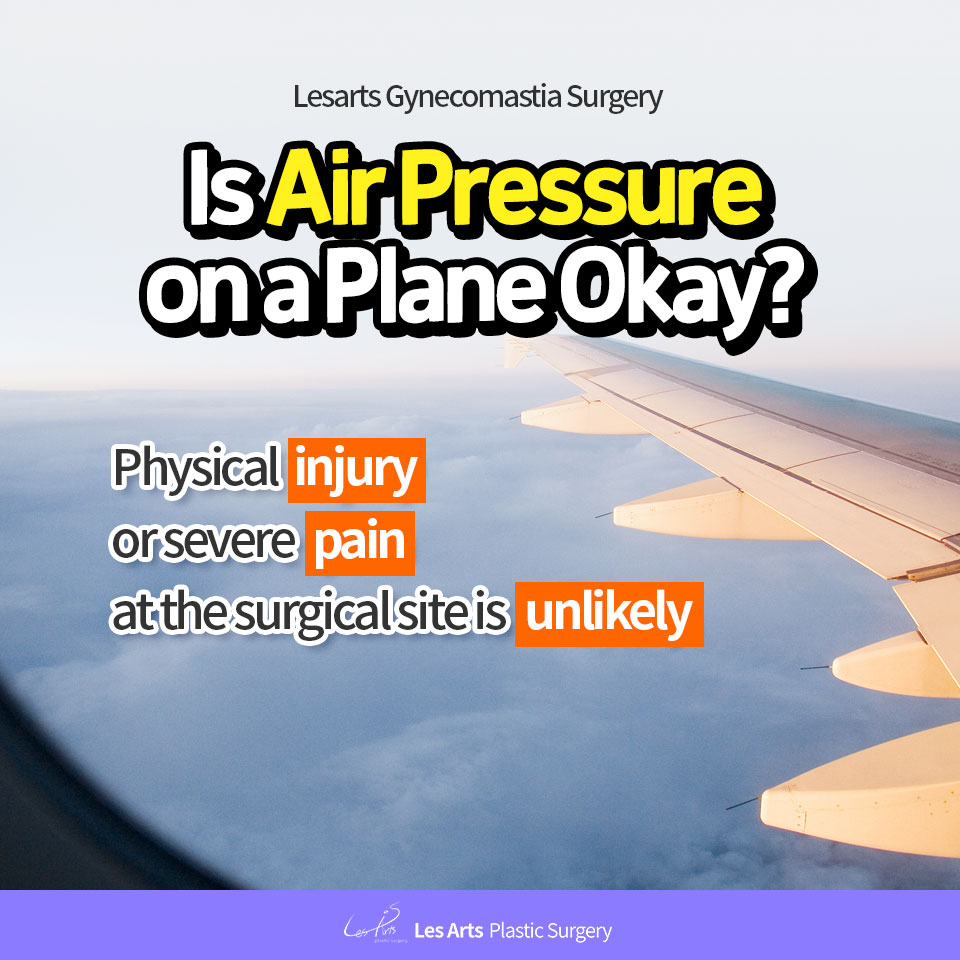
1. Cabin Pressure Differences and Pain: Does Flying Cause Severe Chest Discomfort?
As aircraft ascend to cruising altitudes, cabin barometric pressure decreases to approximately 75% to 80% of sea level.
Consequently, patients often worry that internal dead space or trace trapped air within the operative bed could expand,
leading to wound dehiscence or acute, severe pain.
However, gynecomastia surgery does not involve sealed visceral air cavities such as the lungs or gastrointestinal tract.
Furthermore, subcutaneous tissue planes are meticulously approximated and closed,
ensuring no clinically meaningful volume of air remains trapped internally.
Therefore, barometric pressure differential alone is virtually incapable of causing physical wound compromise or intense pain.
Mild barometric shifts may, however, slightly increase localized edema, causing the anterior chest to feel temporarily tight or tense.
This represents a transient physiological reaction to the cabin environment.
2. Flight Duration Guidelines & Recommended Travel Itineraries
Safe timing for air travel after gynecomastia surgery
correlates directly with flight duration and postoperative recovery days.
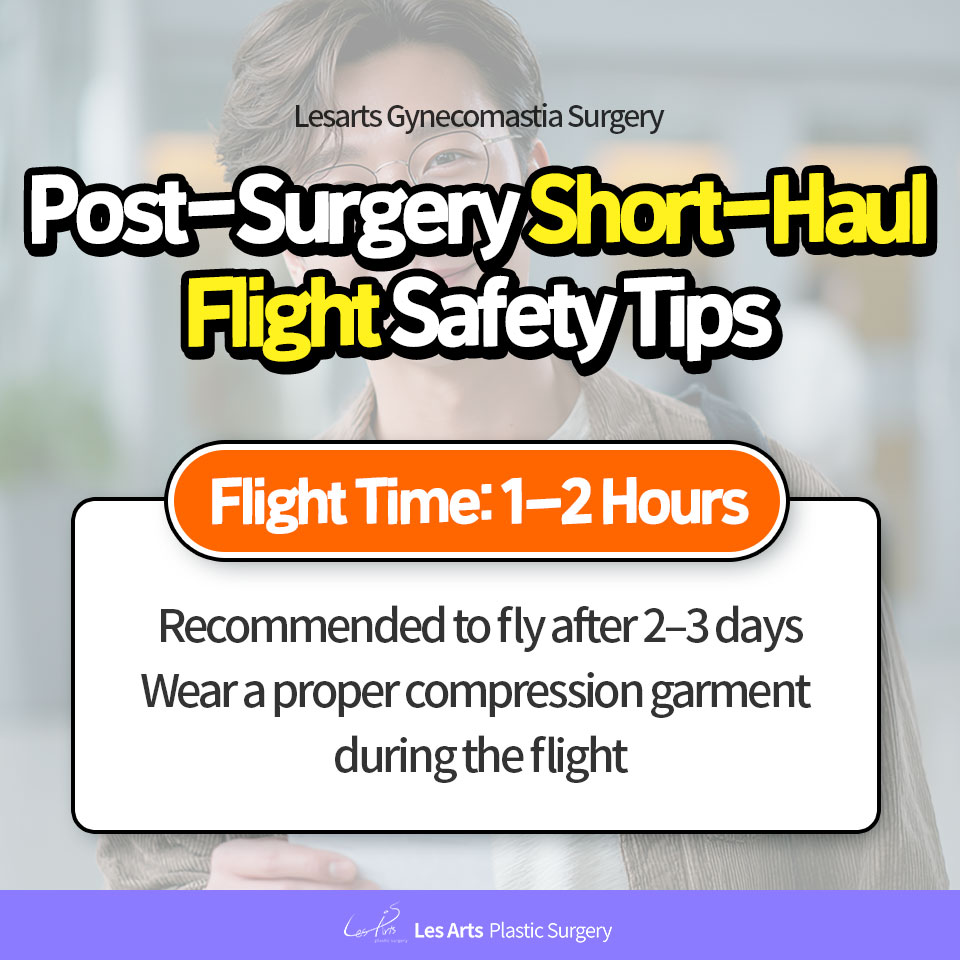
① Short-Haul Flights (Under 1 to 2 Hours) / e.g., Japan, Domestic Routes
✔ Safe Travel Window: Permissible from postoperative days 2 to 3
✔ Clinical Profile: Brief flight times impose minimal physical stress on systemic circulation.
✔ Key Guideline: When compression garments are worn correctly, short-distance transit is smooth and comfortable.
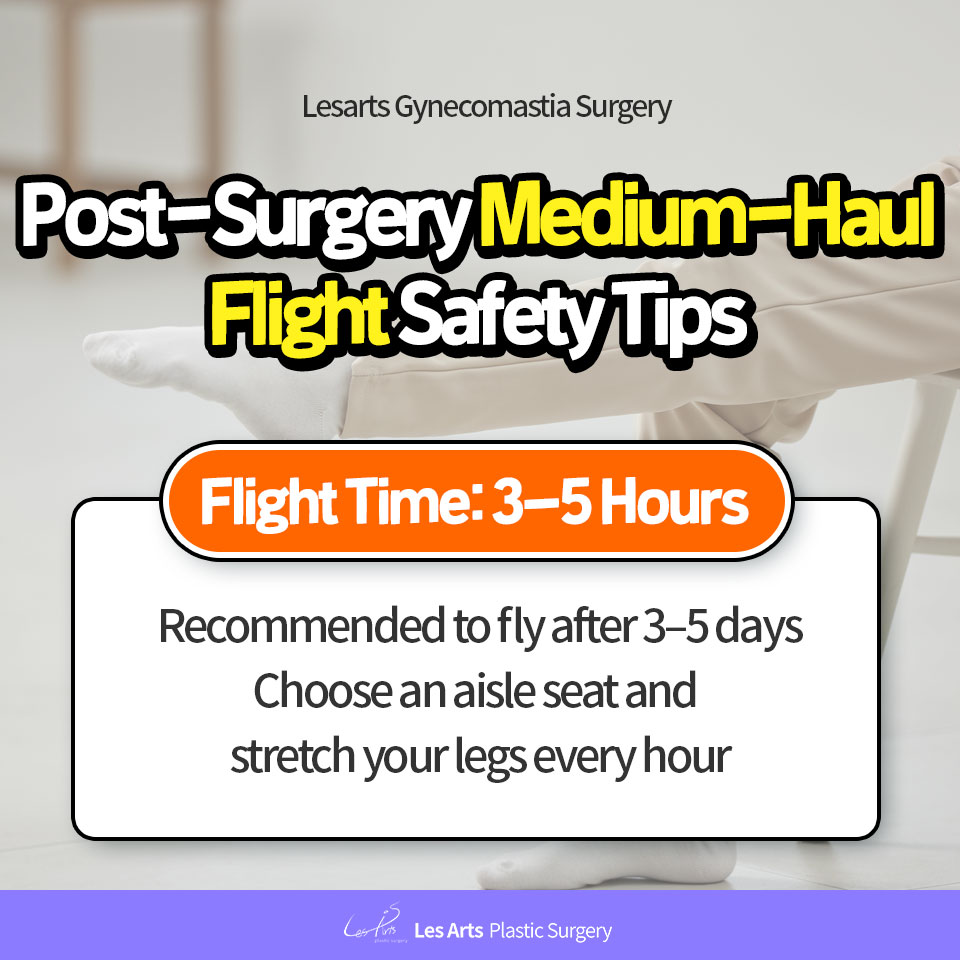
② Medium-Haul Flights (3 to 5 Hours) / e.g., Southeast Asia, Guam, Saipan
✔ Safe Travel Window: Recommended from postoperative days 3 to 5 onward
✔ Clinical Profile: Seated duration increases, requiring attention to venous circulation.
✔ Key Guideline: Select an aisle seat when possible, and perform ankle flexion and extension exercises once every hour to minimize dependent edema.
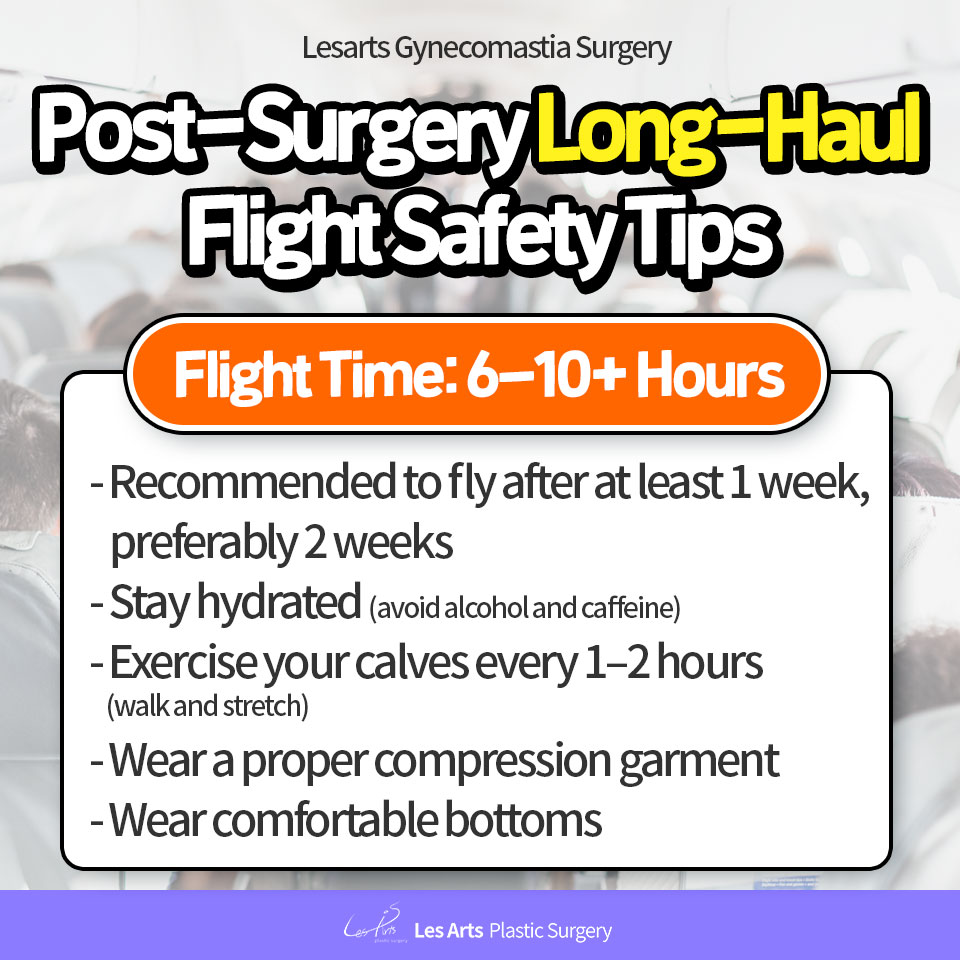
③ Medium-Long to Long-Haul Flights (6 to 10+ Hours) / e.g., Americas, Europe, Oceania
✔ Safe Travel Window: Permissible from postoperative day 7 onward once early incisions and bleeding risks stabilize; boarding after day 14 is strongly recommended.
✔ Critical Consideration (DVT Prevention): The foremost clinical priority on long flights is not the surgical site itself, but preventing Deep Vein Thrombosis (DVT, economy class syndrome) caused by prolonged lower extremity venous stasis.
Because physiological coagulation pathways are active in the early postoperative period, maintaining an immobile seated position for extended hours can elevate thrombosis risks.
✔ Long-Haul Safety Protocols:
▷ Because aircraft cabin air is dry, avoid alcohol (strict cessation recommended for 4 weeks post-op) and caffeine; drink water frequently to support microcirculation.
▷ Every 1 to 2 hours, walk the cabin aisle or perform calf raises in your seat.
※ Calf muscle contraction activates the muscular pump, promoting essential venous return from the lower limbs back to the heart.
▷ Wear chest compression garments properly, while avoiding restrictive pants that constrict the waist or thighs.
3. Real-World Physical Stressors to Avoid at the Airport
While patients primarily focus on inflight cabin conditions,
the greatest mechanical stress on the surgical site often occurs during airport transit and baggage handling.
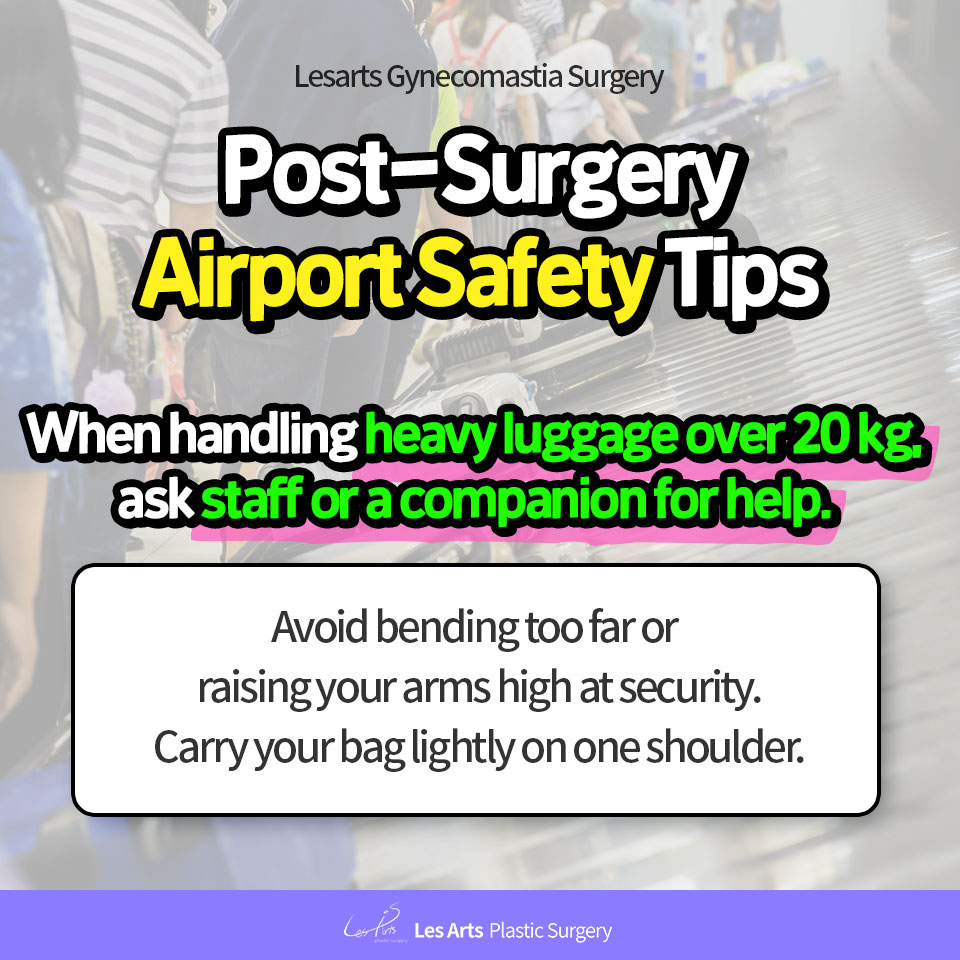
① Handling Heavy Luggage (Over 20 kg)
During the first 1 to 2 weeks postoperatively, forceful contraction of the pectoralis major must be avoided.
Lifting heavy baggage onto check-in scales
or hoisting carry-ons into overhead bins
can strain healing microvasculature, triggering acute bleeding (hematoma) or focal pain.
✔ Action Plan: Do not lift heavy luggage independently;
request assistance from porters, travel companions, or flight attendants.
② Security Screening Checkpoints
When placing personal items into inspection bins,
avoid deep bending or abrupt overhead reaching.
Carry backpacks loosely over one shoulder
to prevent friction against chest compression garments.
③ Inflight Comfort and Compression Garments
Because compression garments play a critical role in hemostasis and contour support,
they should be worn consistently throughout flights.
To ensure comfort during long-haul travel,
wear loose, breathable outer clothing over your compression garment.
4. Pre-Flight Safety Checklist
Before boarding your flight, review these three essential checkpoints:
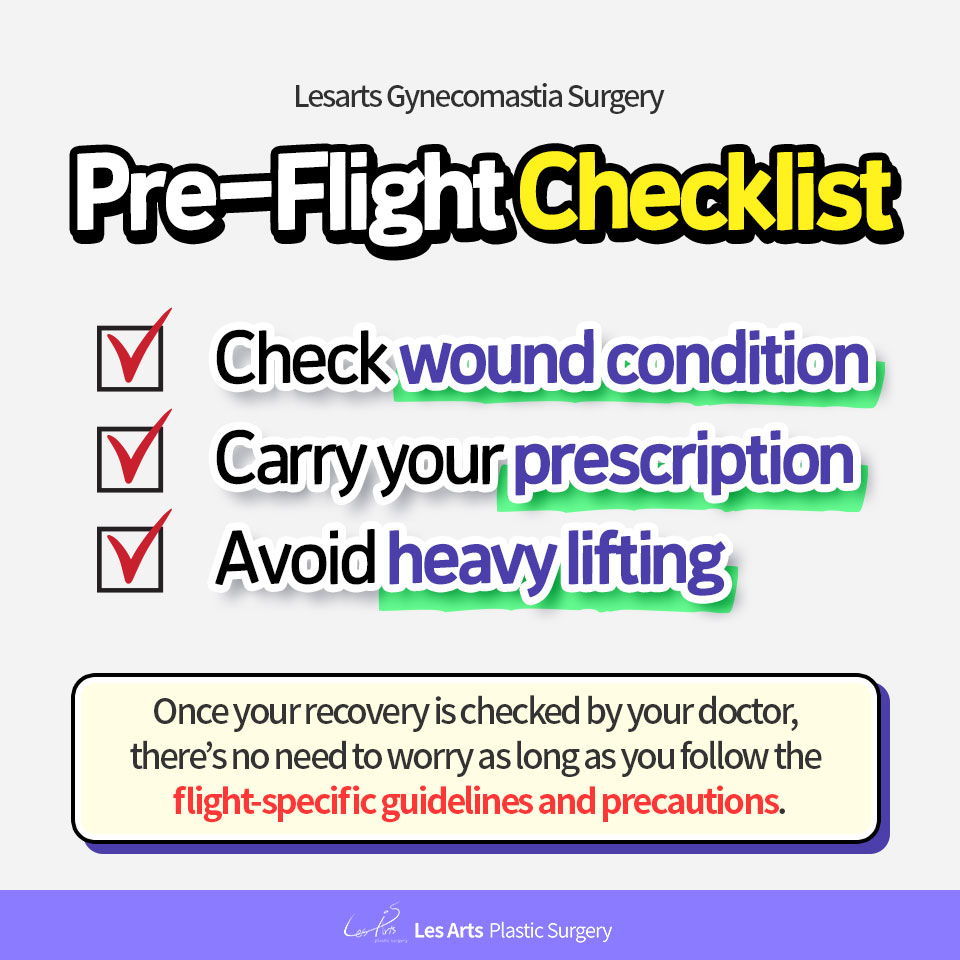
① Hemostasis and Surgical Site Condition
Verify that there is no sudden unilateral swelling,
tense firmness, or rapidly expanding ecchymosis.
② Carrying Prescribed Medications
Pack prescribed oral medications—including antibiotics and analgesics—
in your carry-on baggage to manage any unexpected discomfort inflight.
③ Strict Restriction on Heavy Lifting
Reconfirm the fundamental rule:
never lift heavy luggage independently.
5. Conclusion
Recovery following gynecomastia surgery is a smooth, physiological healing progression.
By confirming recovery status with your surgical team prior to departure
and following flight guidelines and baggage handling precautions,
you can complete international travel or your journey home comfortably and securely.
▽ View Lesarts Gynecomastia Surgical Cases ▽

FAQ
Q1. Can cabin barometric pressure cause the gynecomastia surgery site to rupture?
Gynecomastia surgery does not involve sealed internal air cavities such as the lungs or abdominal viscera; therefore, barometric pressure differentials alone are virtually incapable of causing wound rupture or acute, intense pain.
Q2. Can the chest feel tight or tense during a flight?
Barometric shifts may slightly increase localized edema, which can make the chest feel temporarily tight or tense. This is an expected, temporary physiological reaction to the cabin environment.
Q3. What is the most critical precaution during long-haul flights after gynecomastia surgery?
Prolonged sitting can cause dependent venous stasis in the lower extremities; perform calf exercises or walk the aisle every 1 to 2 hours, drink water frequently, and avoid restrictive clothing around the legs.
Q4. Can I lift heavy luggage or carry-on suitcases at the airport?
Forceful pectoralis major exertion must be avoided for 1 to 2 weeks postoperatively. Do not lift heavy luggage independently; request assistance from travel companions, porters, or cabin crew.
Q5. Is it necessary to wear compression garments during the flight?
Compression garments should remain on during flight transit to provide continuous support and minimize edema. For comfort on longer flights, wear loose, breathable outer clothing over the garment.
Dr. Jihoon Moon


Cases finding
similar to my profile
Customer Diagnostics


Select the surgery and
area you are interestedto see real
before andafter changes.


we
make you,
the art
Clinic hours
MON - FRI
10 am – 7pm
SAT
10 am – 4pm
Holiday
SUN, HOLIDAY
Location
Lesarts Moon Clinic Tower 4-5F, 40, Nonhyeon-ro 168-gil,
Gangnam-gu, Seoul, Republic of Korea

Medical institution name Lesarts Plastic Surgery
Address Lesarts Moon Clinic Tower 4-5F, 40, Nonhyeon-ro 168-gil, Gangnam-gu, Seoul, Republic of Korea
Representative Moon sung jun
