




Online Consultation
Please accurately enter the information below.
Quick Cost Consultation
Quick Consultation & Reservation
Cases finding
similar to my profile






Doctor's Note
Medical columns by our surgeons
Gynecomastia | “I Lost Over 20 kg, but My Chest Sagged Even More”: Unexpected Post-Weight Loss Concerns, Surgical Solutions, and Overcoming Clinical Dilemmas
2026-10-02
Gynecomastia | “I Lost Over 20 kg, but My Chest Sagged Even More”: Unexpected Post-Weight Loss Concerns, Surgical Solutions, and Overcoming Clinical Dilemmas
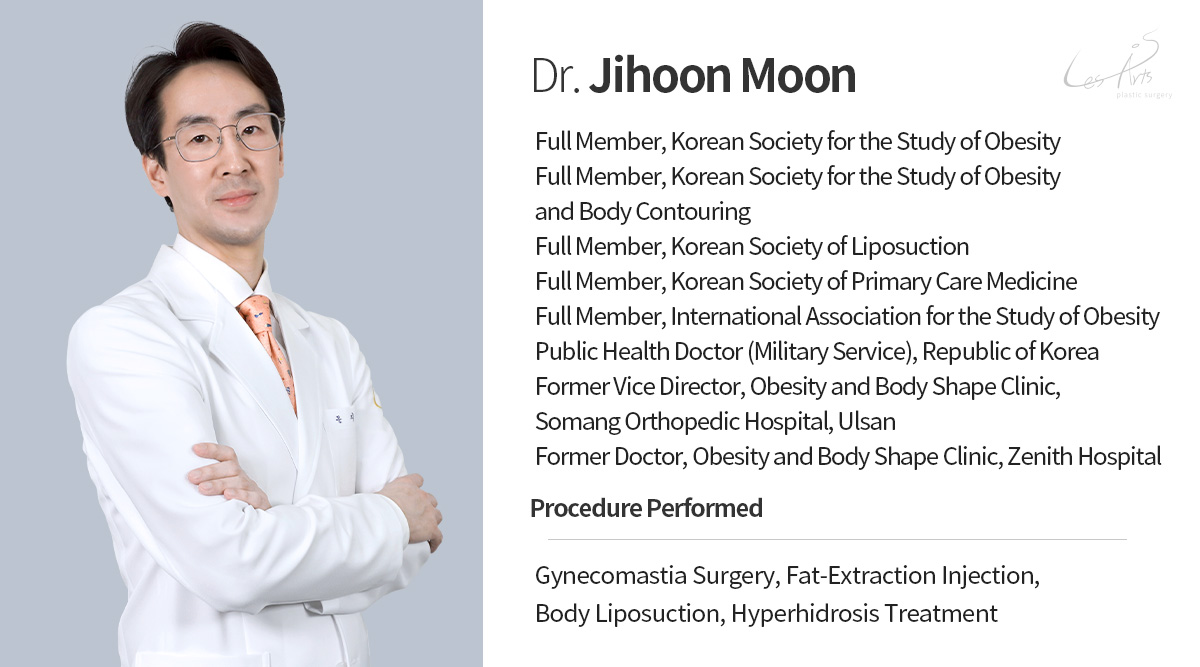
Written by Dr. Jihoon Moon, Lesarts Plastic Surgery
Q. Following massive weight loss of over 20 kg, why does the chest fail to shrink and instead droop like a deflated balloon, and what are the clinical solutions?
A. Glandular tissue proliferated via aromatase enzyme activity in expanded adipose tissue does not regress with weight loss, and when fat depletes while Cooper's ligaments and dermal elastic fibers remain stretched, breast ptosis develops.
Following precise resection of glandular parenchyma and liposuction, disciplined adherence to compression garment wear and suspension taping for 4 to 8 weeks is vital to promote dermal adherence to the pectoralis muscle and minimize tissue ptosis.
[▶ Learn More About Lesarts Gynecomastia Surgery]
This column was authored directly by our medical staff.
※ Unauthorized copying, editing, or redistribution is strictly prohibited. ※
Weight loss represents a transformative physical achievement and a meaningful health milestone.
To every patient who has achieved massive weight loss exceeding 20 kg, we extend our sincere respect as medical professionals.
However, many men visit Lesarts Plastic Surgery after dedicated dietary control and cardiovascular training because of unexpected contour changes or persistent chest protrusion.
“I disciplined myself to lose 20 kg, so why is the firm lump in my chest still sticking out?”
or
“After losing weight, my chest skin envelope hangs downward like a deflated balloon.”
These concerns represent frequent and deeply frustrating challenges.
In this column, we explore the physiological mechanisms behind male gynecomastia and cutaneous ptosis after massive weight loss, addressing the surgical dilemmas faced by operating surgeons and outlining precise clinical solutions.
1. Why Does the Anterior Chest Wall Fail to Flatten Despite Massive Weight Loss?
It is natural to assume that because the chest expanded during weight gain, shedding the pounds will automatically restore a flat masculine contour.
However, human endocrine metabolism and glandular physiological responses are significantly more complex.

Gynecomastia and Weight Loss - Dr. Jihoon Moon, Lesarts Plastic Surgery
① Aromatase Enzymatic Conversion in Expanded Adipose Tissue
Rapid weight gain causes substantial expansion of subcutaneous and visceral adipose depots.
Excess adipose tissue exhibits elevated activity of the aromatase enzyme,
which catalyzes the peripheral conversion of circulating androgens (testosterone) into estrogens (estradiol).
Consequently, prolonged obesity shifts the endocrine ratio toward relative estrogenic dominance, continuously stimulating dormant retroareolar glandular buds and prompting parenchymal proliferation.
② Irreversible Glandular Fibrosis
Once proliferated and fibrosed under hormonal influence, true glandular tissue cannot be metabolized, oxidized, or dissolved through caloric deficits or chest workouts.
While adipocyte volume diminishes with weight loss, firm fibroglandular parenchyma remains permanently anchored against the anterior chest wall as a palpable nodular mass.
③ Attenuation of Cooper’s Ligaments and Dermal Elastic Architecture
During periods when substantial adipose deposits distend the breast envelope, the underlying suspensory framework (Cooper's ligaments) and dermal collagen-elastin networks stretch beyond their physiological elastic recovery threshold.
When rapid weight loss evacuates internal fat volume, the overextended skin envelope lacks spontaneous recoil, causing the deflated soft-tissue envelope to droop downward under gravity.
*If the nipple-areolar complex angles downward toward the floor rather than projecting directly forward in an upright standing posture, clinically significant breast ptosis is confirmed.
2. Simon Classification and Post-Bariatric / Massive Weight Loss Characteristics
Male gynecomastia is graded internationally using the Simon classification system based on overall breast volume and the severity of cutaneous ptosis.

Morphological Evaluation of Gynecomastia (Simon Grade) - Dr. Jihoon Moon
Classification |
Clinical Presentation |
Simon I |
Mild breast enlargement without cutaneous ptosis or skin redundancy |
Simon IIa - ★ Most Common |
Moderate breast enlargement without skin redundancy or downward ptosis |
Simon IIb |
Moderate breast enlargement with mild-to-moderate skin redundancy and areolar descent |
Simon III |
Severe breast enlargement with pronounced cutaneous redundancy and true feminine ptosis |
While primary gynecomastia patients typically present as Simon IIa with intact dermal elasticity,
individuals who have undergone massive weight loss exceeding 20 kg frequently present as Simon IIb or Simon III due to attenuated skin envelopes.
Gynecomastia complicated by pronounced cutaneous laxity cannot resolve spontaneously through exercise, diet, or pharmacology; tailored surgical management by a board-certified plastic surgeon is required.
3. The Surgeon's Dilemma: Complete Evacuation vs. Exacerbated Skin Laxity
Operating on massive weight loss gynecomastia patients confronts the surgeon with a classic anatomical dilemma.

Preoperative Considerations for Gynecomastia Surgery - Lesarts Plastic Surgery
✔ If Subcutaneous Fat and Glandular Tissue Are Evacuated Maximally
Internal volume is eliminated rapidly, leaving the already attenuated skin envelope to collapse, fold, and droop downward.
Patients may observe: “My chest and nipples are flat, but the skin looks wrinkled and bunched, making thin clothing awkward.”
✔ If Soft Tissue Is Intentionally Preserved to Prevent Skin Redundancy (Under-Correction)
Artificially preserving soft tissue may maintain dermal tension and reduce wrinkling, but residual glandular parenchyma and adipose deposits leave the chest visibly protruded,
resulting in dissatisfaction: “I underwent surgery, but my chest still looks bulky and prominent.”
Overcoming this clinical challenge requires thorough preoperative evaluation of dermal recoil capacity, meticulous intraoperative planning, and aligned patient expectations.
4. Staged Strategies to Minimize Skin Laxity Post-Weight Loss
How do we navigate between over-aspiration wrinkling and under-correction fullness to establish a masculine contour?
Gynecomastia Surgery and Cutaneous Laxity - Lesarts Plastic Surgery
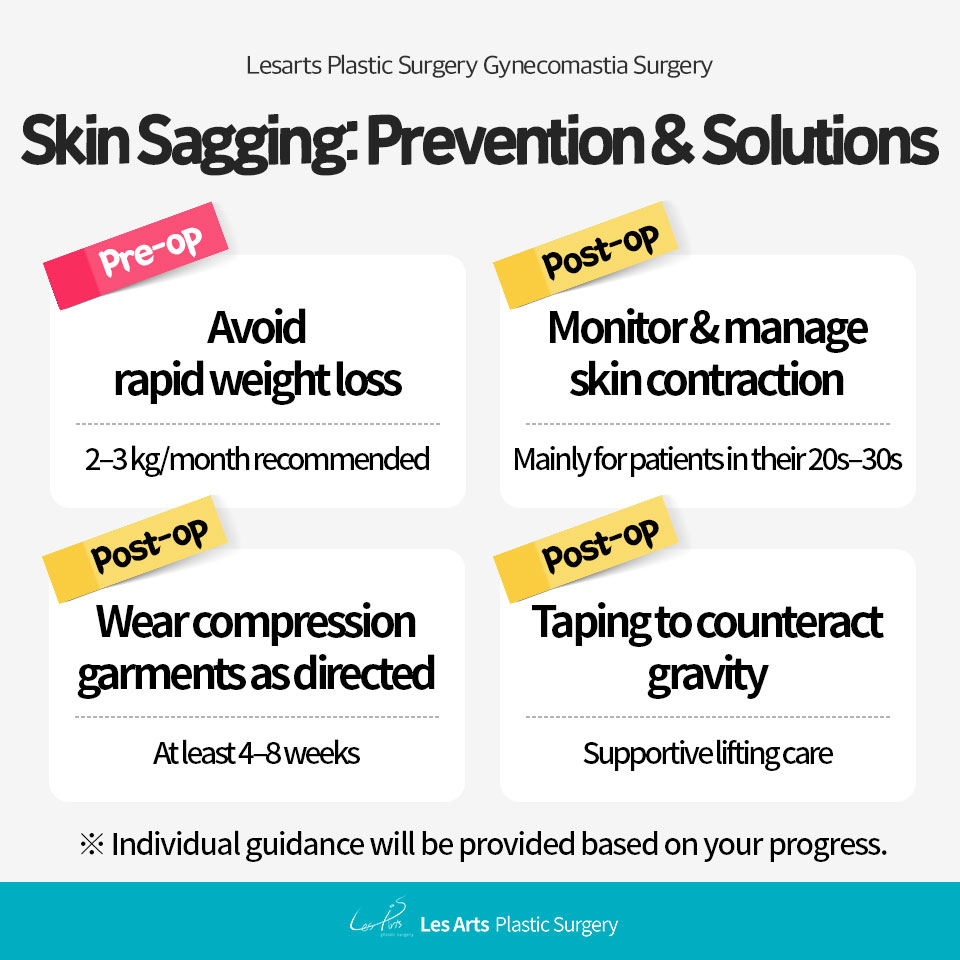
① Comprehensive Evaluation of Age and Skin Elasticity
Patients in their 20s and early 30s retain substantial capacity for dermal collagen remodeling and natural skin retraction.
Even if the skin envelope appears slightly loose immediately post-op, disciplined post-care compression allows the skin to contract firmly against the pectoralis major fascia over time.
② Disciplined Use of Customized Medical Compression Garments
In post-weight-loss gynecomastia, compression garments are not merely for managing swelling; they are an essential tool for chest wall redraping.
To ensure the expanded skin envelope adheres securely to the underlying pectoralis without dead space fluid accumulation,
customized medical compression garments must be worn continuously for a minimum of 4 to 8 weeks according to surgical protocol.
③ Application of Postoperative Suspension Taping
During the early postoperative weeks, specialized suspension taping is applied to support the lower breast pole and anchor soft tissues superiorly toward the clavicle.
This counteracts gravitational pull, promoting superior adherence and supporting natural skin contraction.
④ Avoiding Rapid Weight Crashes: Calibrated Weight Loss (Preoperative Strategy)
If currently undergoing active weight loss prior to surgery, aiming for a steady rate of 2 to 3 kg per month is preferable to rapid drops of 5 to 10 kg.
A measured pace allows dermal elastic fibers time to adapt to decreasing volume, significantly reducing post-surgical laxity.
[▶ View Before & After Cases of Weight Loss Gynecomastia with Skin Laxity]
5. Definitive Surgical Modalities: A Cautious Approach to Male Mastopexy
If severe cutaneous redundancy and fixed breast ptosis cannot be resolved through natural retraction and compression therapy,
male mastopexy—involving direct skin resection and superior transposition of the nipple-areolar complex—serves as a definitive option.
However, male breast lifting must be approached cautiously, with full awareness of specific clinical considerations.

Male Mastopexy Following Gynecomastia Surgery - Dr. Jihoon Moon
※ Three Key Considerations When Evaluating Male Mastopexy (Skin Resection)
1. Permanent Linear Incision Scars
Mastopexy requires excising redundant skin, inevitably creating scars along the inframammary fold or periareolar border.
While chest fullness is resolved, permanent visible scarring when shirtless can impact personal aesthetic satisfaction.
2. Staging Primary Gynecomastia Surgery Separately from Skin Resection
Even when noticeable laxity is anticipated, performing standard gynecomastia surgery (subcutaneous mastectomy + circumferential liposuction) concurrently with extensive skin resection in a single session is generally discouraged.
It is clinically safer to perform primary gynecomastia surgery first, allow 6 to 12 months for natural dermal retraction and soft-tissue remodeling, and evaluate secondary mastopexy only if debilitating laxity persists.
3. Insurance Coverage Considerations
While standard subcutaneous mastectomy for true gynecomastia meeting diagnostic criteria may qualify for national health insurance or private medical reimbursement,
skin excision and mastopexy procedures are classified as aesthetic body contouring and are excluded from coverage.
6. Conclusion: Clinical Guidance from a Plastic Surgeon
Persistent chest fullness and skin laxity following massive weight reduction are not consequences of personal negligence.
They represent an anatomical challenge commonly encountered after overcoming major obesity.
Particularly in Simon IIb and Simon III cases with coexisting skin ptosis, dermal elasticity, subcutaneous fat depth, and glandular volume vary widely among individuals.
Moving beyond the question of extraction volume alone,
an in-depth clinical consultation with an experienced plastic surgeon is essential to evaluate natural skin recoil capacity and formulate a structured post-care plan, including medical garments, suspension taping, and radiofrequency therapies.
You have dedicated significant effort to achieving a healthy physique; rather than struggling with residual chest laxity in isolation, we welcome you to visit Lesarts Plastic Surgery for an accurate diagnostic evaluation.
Gynecomastia FAQ
Q1. Why does a firm chest lump persist and protrude even after losing over 20 kg?
A. Elevated aromatase activity during obesity converted circulating androgens into estrogens, stimulating glandular proliferation. Glandular tissue is an irreversible structure that does not metabolize with diet or exercise, persisting as a palpable mass after weight loss.
Q2. What is the central surgical dilemma when treating post-weight-loss ptotic gynecomastia (Simon IIb, III)?
A. The balance between skin wrinkling from complete evacuation versus lingering prominence from under-correction. Maximally evacuating volume leaves an empty skin envelope prone to sagging, while leaving tissue behind to maintain tension risks persistent fullness, requiring disciplined skin-retraction protocols.
Q3. What clinical roles do compression garments and suspension taping play in skin redraping?
A. Compression garments eliminate dead space and secure the mobilized skin envelope firmly against the pectoralis major, while suspension taping counteracts gravity by anchoring tissues superiorly. Consistent application for 4 to 8 weeks optimizes dermal remodeling.
Q4. Why is a steady rate of 2 to 3 kg per month recommended over crash dieting prior to surgery?
A. Measured weight reduction provides dermal elastic fibers adequate physiological time to contract alongside decreasing volume. Crash dieting exhausts dermal recoil capacity, worsening tissue laxity and post-surgical ptosis.
Q5. Why is male mastopexy generally not recommended as an initial concurrent procedure?
A. Direct skin excision creates permanent linear scars along the inframammary fold and is excluded from insurance coverage. Observing natural dermal contraction for 6 to 12 months after primary gynecomastia surgery allows for conservative reassessment before considering secondary skin resection.
Dr. Jihoon Moon


Cases finding
similar to my profile
Customer Diagnostics


Select the surgery and
area you are interestedto see real
before andafter changes.


we
make you,
the art
Clinic hours
MON - FRI
10 am – 7pm
SAT
10 am – 4pm
Holiday
SUN, HOLIDAY
Location
Lesarts Moon Clinic Tower 4-5F, 40, Nonhyeon-ro 168-gil,
Gangnam-gu, Seoul, Republic of Korea

Medical institution name Lesarts Plastic Surgery
Address Lesarts Moon Clinic Tower 4-5F, 40, Nonhyeon-ro 168-gil, Gangnam-gu, Seoul, Republic of Korea
Representative Moon sung jun
