




Online Consultation
Please accurately enter the information below.
Quick Cost Consultation
Quick Consultation & Reservation
Cases finding
similar to my profile






Doctor's Note
Medical columns by our surgeons
Sagging and Wrinkling After Abdominal Liposuction | M-Type Full Abdominoplasty 5-Month Progress
2026-10-06
Sagging and Wrinkling After Abdominal Liposuction | M-Type Full Abdominoplasty 5-Month Progress [Doctor's Note by Dr. Kukhan Lee]
5-Month Progress of M-Type Abdominoplasty for Resolving Post-Liposuction Skin Laxity
Q. If skin laxity or wrinkling becomes more prominent after abdominal liposuction,
should secondary liposuction be performed?
A. If skin fails to retract adequately after previous liposuction, leaving laxity or deep folds,
simply removing more fat is rarely sufficient to resolve the underlying concern.
In particular, if adhesions or cicatricial scar tissue have formed between the dermis and subcutaneous planes,
it is essential to evaluate both skin redundancy and the extent of tethering to determine the necessity of abdominoplasty alongside surgical adhesiolysis.
[ View More Lesarts Abdominoplasty Cases ]
Written by Board-Certified Plastic Surgeon Dr. Kukhan Lee, Lesarts Plastic Surgery
This column was authored directly by our medical staff.
※ Unauthorized copying, editing, or redistribution is strictly prohibited. ※
When considering surgical correction for a protruding abdomen,
abdominal liposuction is frequently the first procedure that comes to mind.
In cases where localized subcutaneous fat has accumulated heavily across the abdominal wall,
liposuction alone can effectively reduce overall volume
and refine the bodily silhouette.
However, when large-volume liposuction has been performed,
or when liposuction was undertaken after dermal elasticity had already declined due to childbirth or natural aging,
the skin envelope may fail to retract adequately over the evacuated volume,
causing tissue laxity and wrinkling to appear even more pronounced.
In particular, if prior liposuction has created
internal fibrous adhesions and dense cicatricial scar tissue between the dermis and subcutaneous planes,
subsequent abdominoplasty requires evaluating surgical variables
that differ substantially from primary tummy tuck procedures.
When planning an abdominoplasty following prior abdominal liposuction,
evaluating the degree of internal scar tissue and tethered adhesions is the first critical step.
When tissue layers are rigidly adhered to underlying structures,
the mobile excursion range of the cutaneous flap is significantly constrained.
To mobilize the abdominal flap inferiorly to the targeted position during surgery,
surgical adhesiolysis to release tethered fibrous planes
is often concurrently indicated.
Incorporating this procedure increases operative duration and technical complexity,
and above all, requires meticulous clinical judgment regarding the extent of flap undermining.
If adhesiolysis is overly conservative, advancing the skin downward
to the desired closure level becomes challenging.
Conversely, excessively broad undermining
can compromise microvascular perfusion to the cutaneous flap,
elevating risks of delayed wound healing or, in severe instances, skin necrosis.
Therefore, analyzing the previous liposuction field, current adhesion severity,
and remaining dermal elasticity together is essential to determine the safe operative boundary for flap advancement.
In this column, we examine a case where
residual abdominal wrinkling, skin laxity, and adhesions remaining after childbirth and prior liposuction
were corrected through combined M-type full abdominoplasty and revision abdominal liposuction.
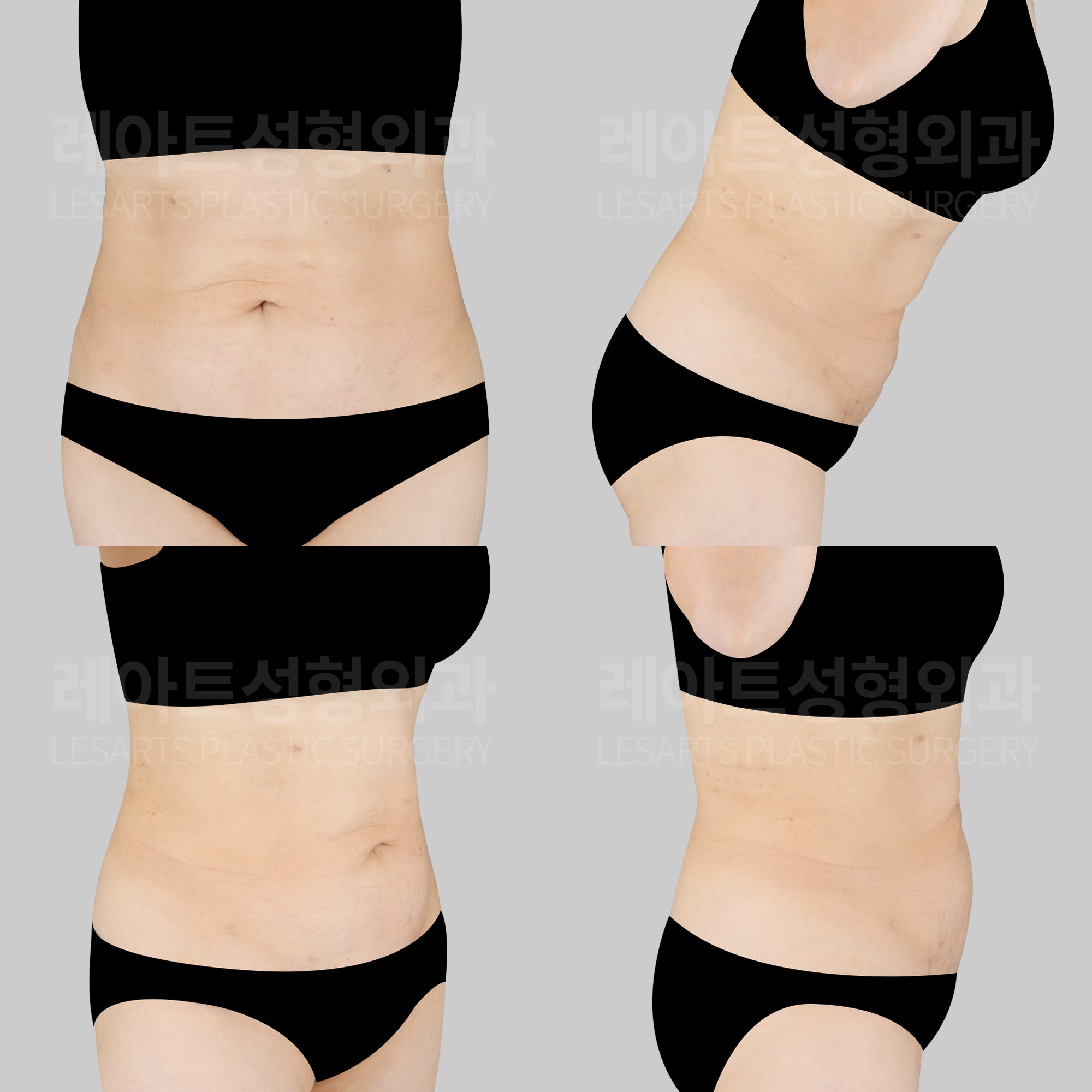
[Preoperative Abdominoplasty Baseline Evaluation]
The patient was a female in her 40s
with an obstetric history of two full-term vaginal deliveries.
At her initial visit, she measured 153 cm and 56 kg;
during her pregnancies, her weight peaked around 60 kg,
indicating that her lifetime weight fluctuations had not been extreme.
Approximately one year prior to visiting our clinic, however,
she had undergone abdominal liposuction at another hospital to refine an abdominal contour
that diet and workout regimens had failed to improve.
While global abdominal volume was debulked through that procedure,
deep horizontal creases across the epigastrium and skin laxity around the umbilicus
emerged as distressing secondary aesthetic concerns.
Physical examination confirmed
dense, firm fibrous adhesions throughout the dermis and subcutaneous planes
resulting from the prior liposuction.
These internal adhesions caused visible surface undulations and contour step-offs,
with deep transverse folding above the umbilicus being especially prominent.
Addressing both epigastric creasing and periumbilical ptosis concurrently
clearly indicated an M-type full abdominoplasty.
However, several anatomical constraints
required critical preoperative evaluation.
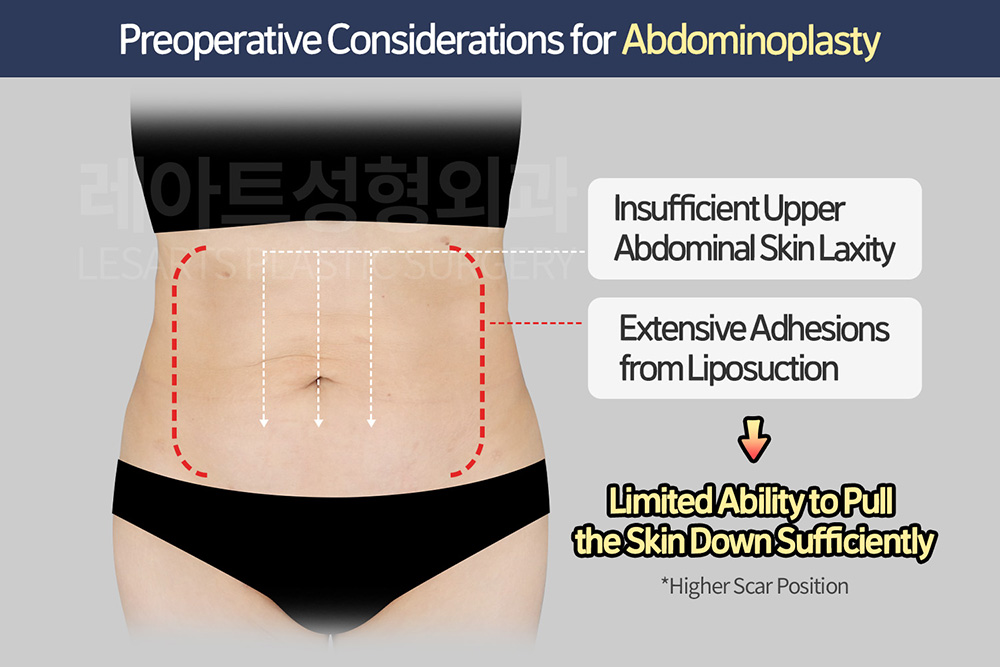
[Preoperative Surgical Planning - Dr. Kukhan Lee, Lesarts Plastic Surgery]
First, Epigastric Skin Redundancy Was Relatively Limited
Because the patient had not experienced massive gestational weight gain,
the total volume of redundant abdominal skin remaining
was comparatively modest.
Consequently, after resecting lower abdominal skin,
there were inherent anatomical boundaries regarding how far the upper abdominal flap
could be undermined and advanced inferiorly under tension-free conditions.
In essence, while full abdominoplasty was feasible,
the achievable degree of flap excursion
was strictly bounded by her baseline dermal reserve.
Second, Extensive Fibrous Adhesions Were Present from Prior Liposuction
To mobilize the flap to targeted levels,
surgical adhesiolysis to release dense scar bands was mandatory.
Even with thorough adhesiolysis, however,
because the cutaneous reserve was limited and tissues were anchored by scarring,
smoothing out and advancing upper abdominal folds completely
carried partial physiological limitations.
Under these anatomical parameters,
the final transverse closure scar risked settling slightly higher than in standard primary cases.
We counseled her transparently preoperatively regarding these anatomical boundaries,
aligning achievable aesthetic improvements with surgical realities before proceeding.
Furthermore, localized residual subcutaneous fat remained in select zones.
To soften prior adhesions safely while balancing global contour and volume,
revision abdominal liposuction was incorporated concurrently.
Below is the clinical presentation at 5 months postoperatively following M-type full abdominoplasty and revision liposuction.
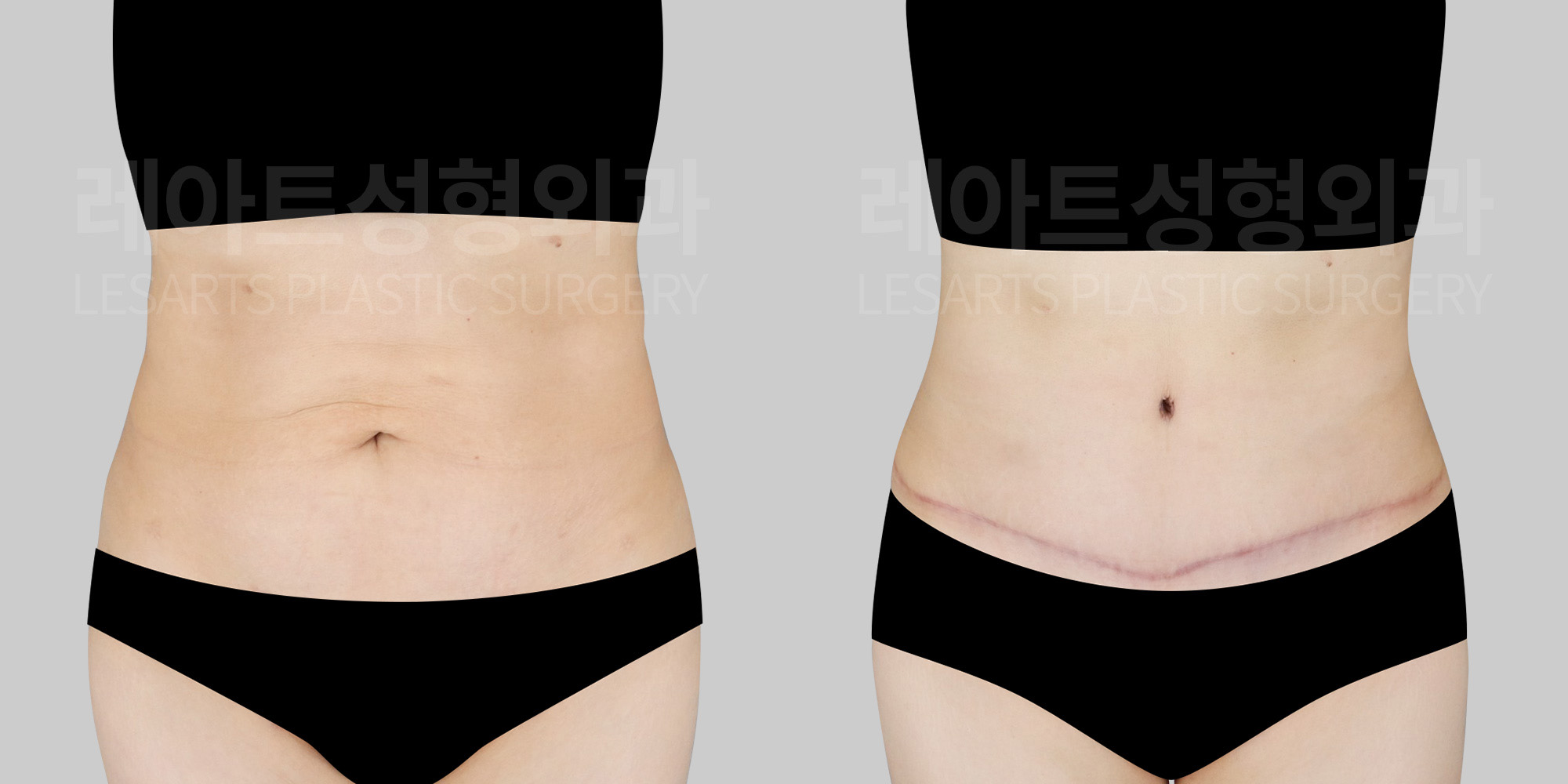
Abdominoplasty & Revision Liposuction Before and After - Dr. Kukhan Lee, Lesarts Plastic Surgery
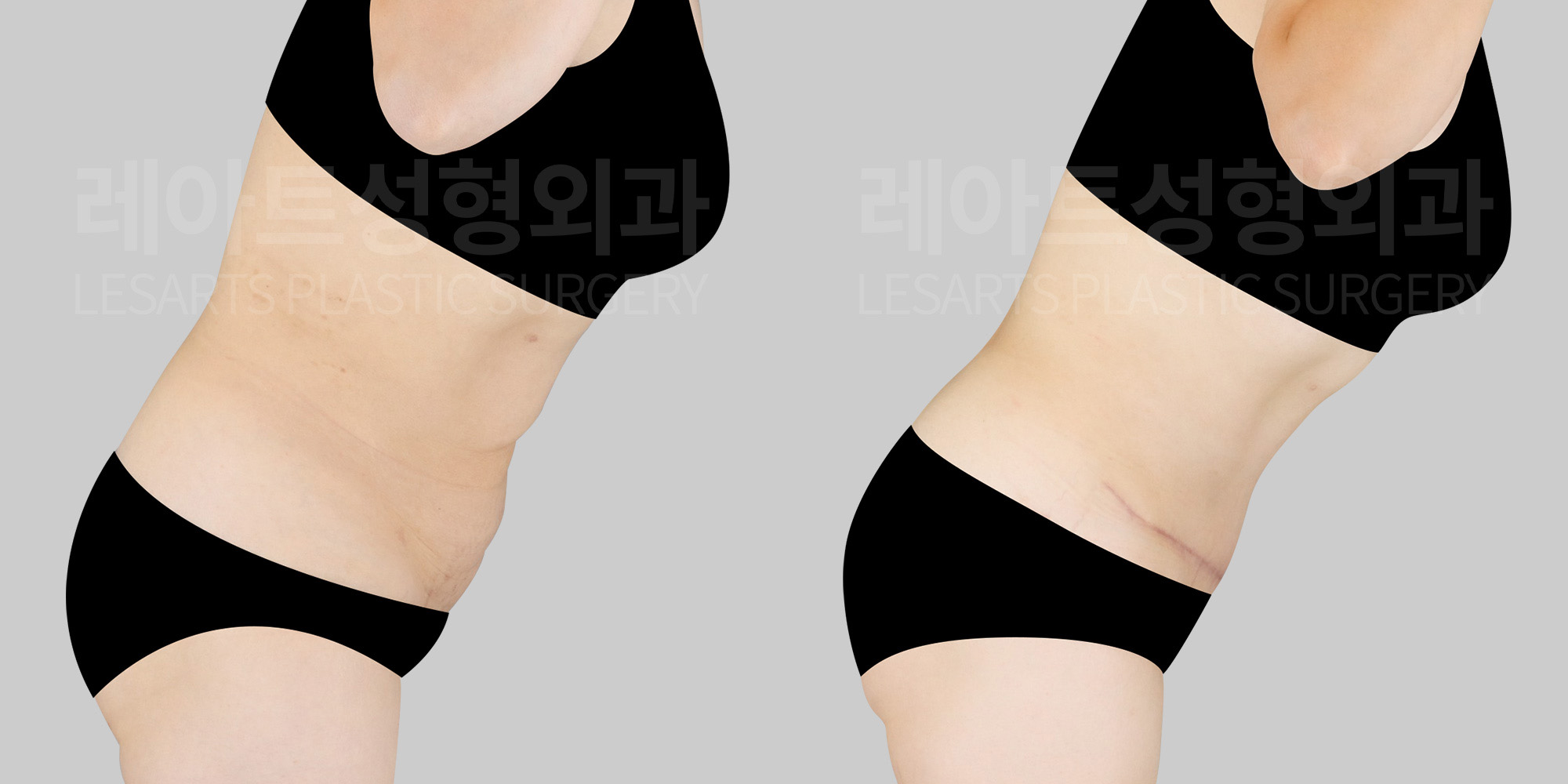
Correction of Post-Liposuction Abdominal Laxity - Dr. Kukhan Lee
At 5 months post-op,
the most apparent transformation
is the marked resolution of deep epigastric creases and periumbilical laxity.
Releasing dense adhesions between the dermis and subcutaneous bed
and redraping the flap inferiorly within safe vascular thresholds
substantially softened deep transverse creases,
establishing a smooth, continuous abdominal plane from supraumbilical to lower abdominal zones.
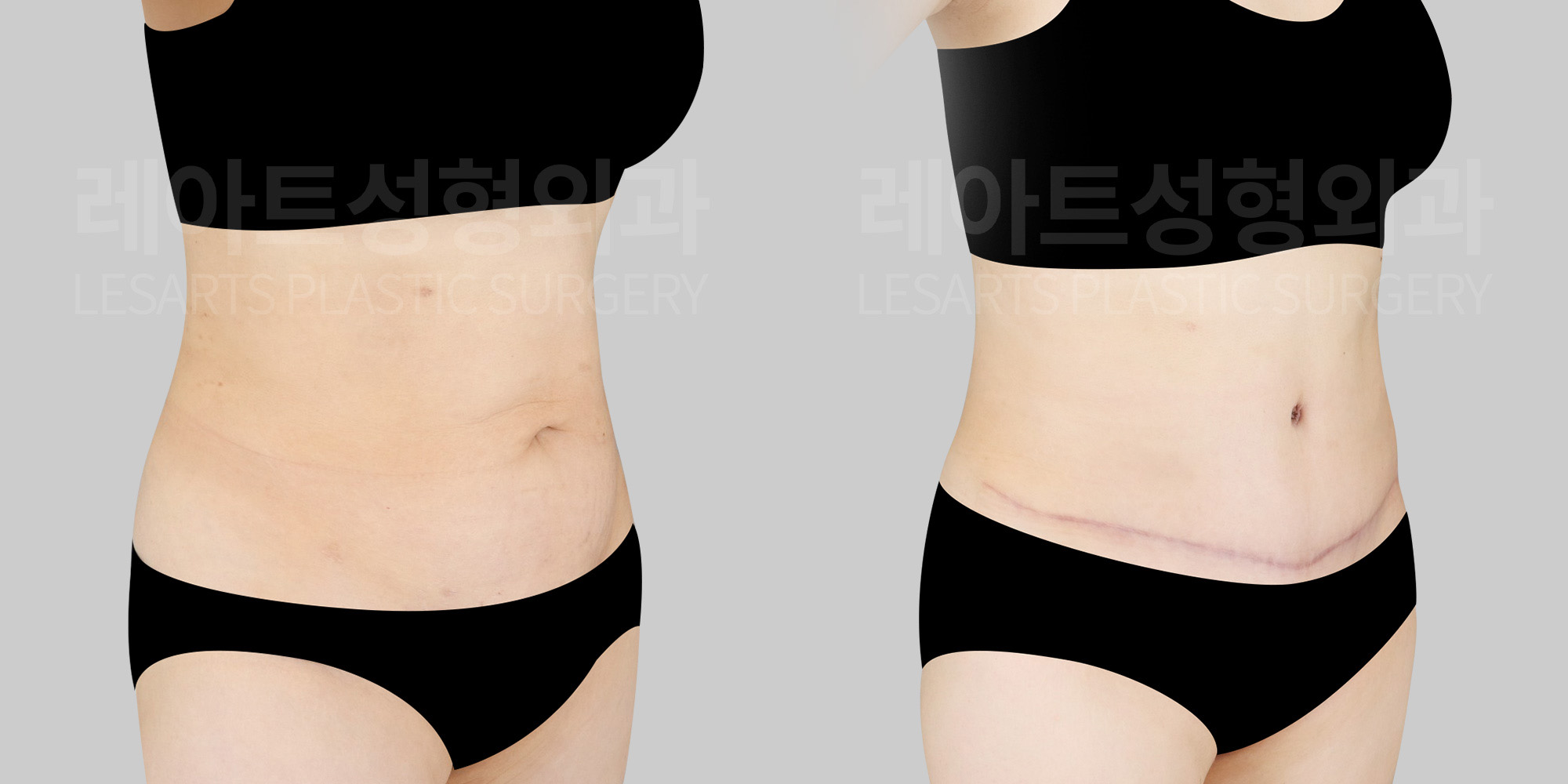
Resolving Wrinkles, Skin Laxity, and Adhesions via Abdominoplasty - Lesarts Plastic Surgery

Abdominoplasty Performed with Anterior Abdominal Adhesiolysis - Lesarts Plastic Surgery
By 5 months post-op, primary surgical edema has substantially subsided.
However, internal lymphatic recanalization and tissue maturation remain ongoing.
Because scarred planes were extensively mobilized,
soft tissues will continue to soften over subsequent months,
allowing minor residual surface irregularities to smooth further.
Thus, current 5-month findings represent an active recovery milestone
rather than the final structural endpoint.
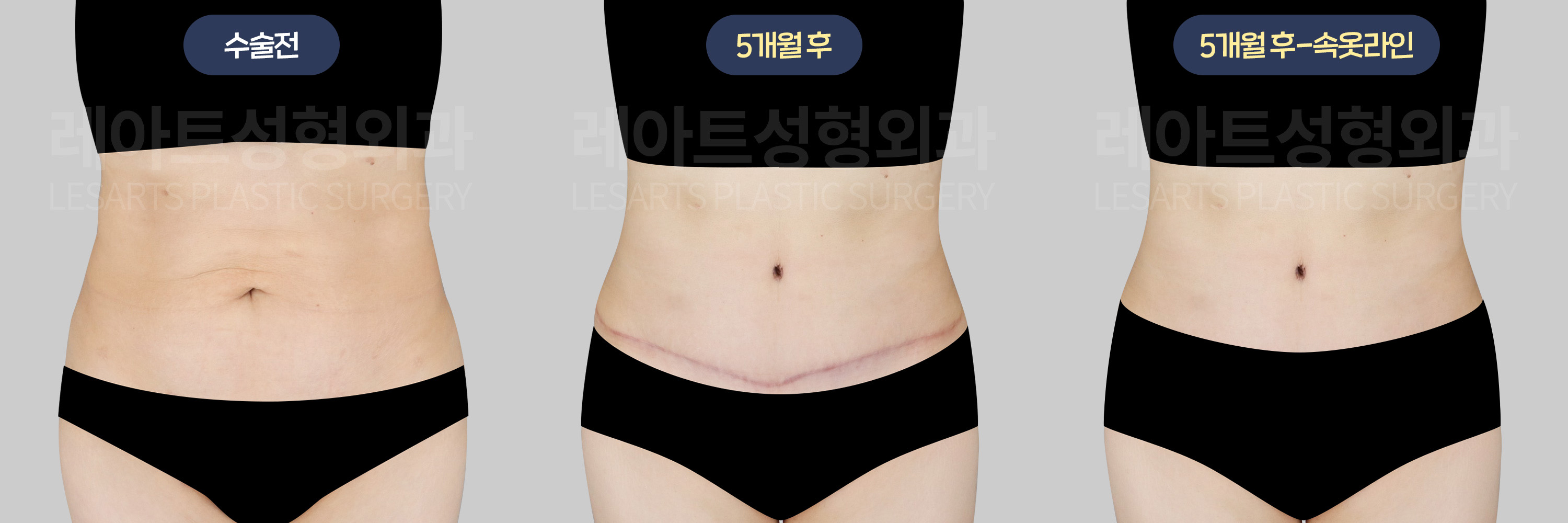 Abdominoplasty Scar Placement in Limited Skin Reserve - Dr. Kukhan Lee
Regarding scar position,
the incision resides within standard underwear lines,
and the patient expressed satisfaction without daily concern.
From a surgical standpoint,
positioning the scar slightly lower would be aesthetically preferred;
however, given her limited baseline skin redundancy
and dense adhesions from prior liposuction,
forcing the flap downward under extreme tension was clinically contraindicated.
Prioritizing dermal perfusion and flap viability over lower scar placement
was the sound clinical choice.
At 5 months, mild post-surgical erythema remains along the scar line.
With structured topical scar therapy and clinical treatments,
erythema will progressively fade, allowing the scar to mature into a soft, pale line.
[ View More Abdominoplasty Before & After Cases ]
Every patient considering abdominoplasty presents with a unique anatomical baseline and surgical history.
Rather than evaluating only surface laxity or creases,
dermal elasticity, residual skin reserve, adipose distribution, parity, previous operative fields, and internal adhesions must be thoroughly evaluated together.
This comprehensive diagnosis clarifies achievable corrective goals
alongside inherent anatomical boundaries before finalizing the surgical plan.
If skin redundancy, epigastric creasing, or contour undulations persist following prior liposuction,
verifying internal adhesions and remaining dermal reserve
is far more essential than simply considering another round of fat aspiration.
When skin reserve is modest and dense adhesions are present, as in this patient,
we recommend thorough consultation regarding adhesiolysis scope, scar positioning, and achievable outcomes before proceeding.
Post-Liposuction Abdominoplasty FAQ
Q1. If skin laxity develops after abdominal liposuction, is abdominoplasty necessary?
If the primary post-surgical concern is cutaneous redundancy and wrinkling rather than excess fat, secondary liposuction alone cannot resolve it. Evaluating skin reserve, dermal elasticity, and internal adhesions determines the indication for abdominoplasty.
Q2. Is abdominoplasty after prior liposuction more complex than primary abdominoplasty?
Yes. Dense fibrous adhesions between the dermis and subcutaneous bed from prior cannula trauma require careful surgical adhesiolysis to mobilize the flap, adding complexity to flap elevation.
Q3. Does more extensive adhesiolysis allow greater flap advancement?
Releasing tethered bands is necessary for advancement, but over-undermining can compromise microvascular perfusion to the skin flap. Adhesiolysis must be carefully calibrated to safe anatomical boundaries.
Q4. Can limited skin reserve cause the abdominoplasty scar to sit higher?
Yes. When skin reserve is limited, forcing the flap downward risks excessive tension and wound complications; placing the incision slightly higher protects dermal perfusion and surgical safety.
Q5. Are scars and contour undulations fully stabilized at 5 months post-op?
Five months marks significant resolution of primary swelling, but internal collagen remodeling continues over 1 to 2 years. Tissues will continue to soften, and scar coloration and minor step-offs will progressively mature.
Dr. Kukhan Lee


Cases finding
similar to my profile
Customer Diagnostics


Select the surgery and
area you are interestedto see real
before andafter changes.


we
make you,
the art
Clinic hours
MON - FRI
10 am – 7pm
SAT
10 am – 4pm
Holiday
SUN, HOLIDAY
Location
Lesarts Moon Clinic Tower 4-5F, 40, Nonhyeon-ro 168-gil,
Gangnam-gu, Seoul, Republic of Korea

Medical institution name Lesarts Plastic Surgery
Address Lesarts Moon Clinic Tower 4-5F, 40, Nonhyeon-ro 168-gil, Gangnam-gu, Seoul, Republic of Korea
Representative Moon sung jun
