




Online Consultation
Please accurately enter the information below.
Quick Cost Consultation
Quick Consultation & Reservation
Cases finding
similar to my profile






Doctor's Note
Medical columns by our surgeons
Arm Liposuction: What Is Key in Muscular Physiques?
2026-10-13
Arm Liposuction: What Is Key in Muscular Physiques?
Q. When performing arm liposuction on a physique with developed muscle mass, such as the deltoids, what is the most important design strategy to create a smooth, straight line rather than an overly bony appearance?
A. Avoiding indiscriminate over-aspiration and preserving an appropriate thickness of buffer fat along the lower boundary of the deltoid is paramount.
Because the underlying muscle cannot be reduced, the prominent lateral adipose layer is debulked while carefully retaining a thin buffer layer;
this achieves a sleek, straight contour from shoulder to elbow without exposing harsh muscular borders or creating a broad, bulky upper-body appearance.
[ Learn More About Lesarts Plastic Surgery Arm Liposuction ]
Written by Dr. Yongseung Seo, Lesarts Plastic Surgery
This column was authored directly by our medical staff.
※ Unauthorized copying, modification, editing, or redistribution is strictly prohibited. ※
Some individuals visit our clinic troubled by thick upper arms, only to feel disheartened upon learning that because their muscular volume is relatively well developed,
achieving an extremely thin, bone-narrow silhouette or a perfectly vertical line has clear anatomical boundaries.
Assuming that perceived arm fullness stems entirely from excess fat,
it is understandable to feel disappointed when informed that even after debulking subcutaneous fat, underlying muscle remains and may limit extreme thinning.
This observation is common among patients who train their arms consistently or possess naturally developed muscular frames.
However, this does not imply that surgery is not feasible or that circumference reduction cannot be achieved;
rather, it means that the location and thickness of the buffer fat preserved must be designed around the shape and volume of the shoulder and arm musculature.
Approaching surgery with uncalibrated over-aspiration risks creating surface irregularities and step-offs,
inadvertently producing a masculine or overly rugged appearance. In muscular builds, rather than pursuing extreme bone-thin measurements,
the priority shifts to creating a smooth, straight line that harmonizes with underlying muscular curves.
Even with identical arm circumferences, the surgical approach differs fundamentally based on the ratio of muscle to fat;
therefore, precise diagnostic ultrasound tailored to each patient's anatomy is indispensable.
The patient introduced today visited Lesarts Plastic Surgery troubled by outward lateral bulging along the outer arm on frontal view,
seeking accurate anatomical diagnosis and a targeted surgical solution.
[Patient Profile & Morphological Assessment]
Age: Early 20s female
Height: 159 cm
Weight: 56.1 kg
BMI: 22.2 kg/m² (normal range)
Body Fat Percentage: 35.5%
※ Clinical outcomes of liposuction may vary individually depending on tissue distribution, muscular anatomy, and dermal condition, even among patients with similar physical specifications.
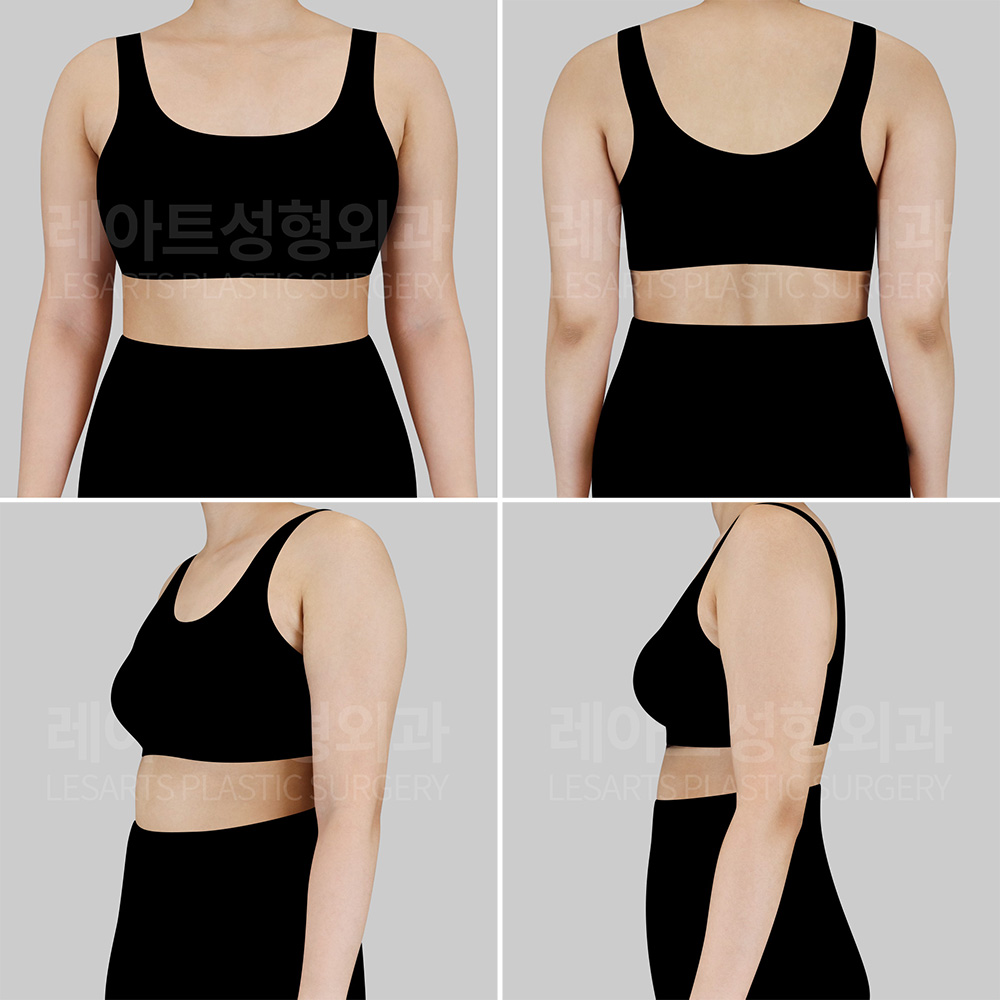
Preoperative Arm Contour Before Liposuction
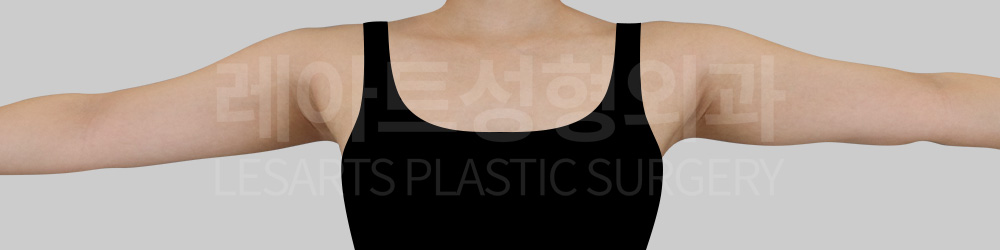
Preoperative Physical Examination Before Arm Liposuction
[Consultation & Diagnostic Findings]
“When looking in the mirror from the front, the outer lateral bulge of my arms bothers me. I want a clean, straight line that drops smoothly.”
The patient had undergone mini-liposuction at another clinic a few years prior, yet remained dissatisfied with the persistent thickness and undulating contours of her upper arms.
Her primary aesthetic concern centered on
the prominent outward bulge along the lateral arm line when resting her arms naturally at her sides,
desiring a straight, continuous line parallel to the torso on frontal view.
This lateral protrusion gave the upper arms a heavy impression, making the upper frame appear broader.
Because the deltoid muscle supporting the shoulder was well-developed and cannot be reduced surgically,
we counseled her preoperatively regarding the anatomical limitations of sculpting a completely vertical or square shoulder-arm angle.
Diagnostic Ultrasound Findings:
* Posterior Arm (Posterior Brachium): 12 / 12 mm
* Anterior Arm (Anterior Brachium): 10 / 10 mm
* Deltoid Muscle Thickness: 22 / 19 mm
These findings confirmed adequate subcutaneous fat to achieve noticeable circumference reduction through liposuction.
However, relative to total fat depth, deltoid muscle mass was distinctly prominent.
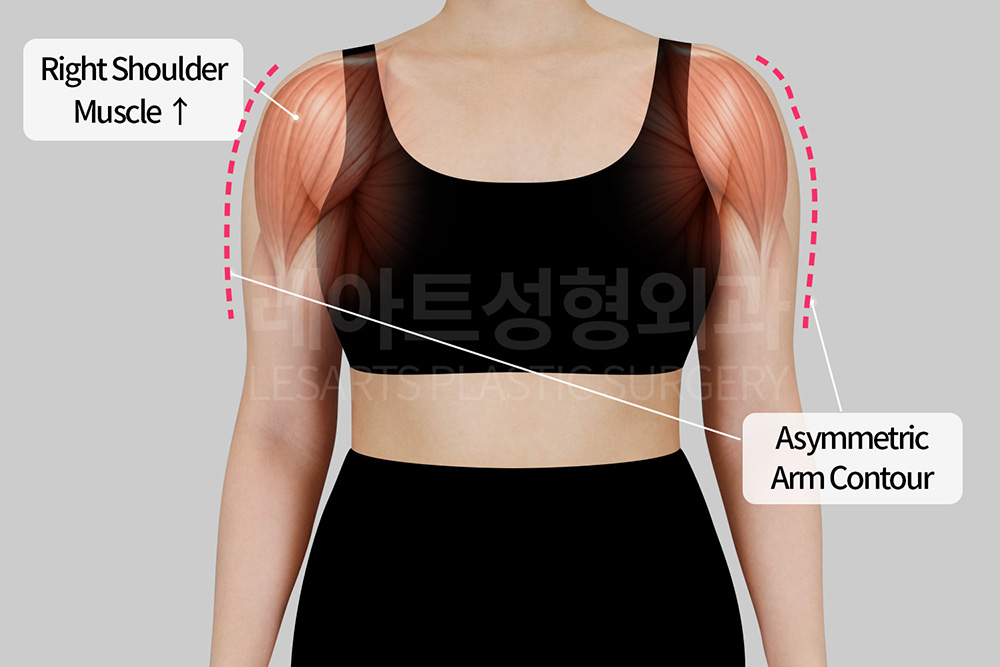
Additionally, an approximate 3 mm bilateral difference in deltoid muscle thickness was identified. This represents innate muscular asymmetry rather than subcutaneous fat, which cannot be corrected through liposuction alone.
While mild natural asymmetry is common, once overall arm volume diminishes following liposuction,
pre-existing muscular volume differences can become more noticeable on the surface, which was explained thoroughly prior to surgery.
[Customized Arm Design Balancing Muscularity and Straight Lines]
Because the priority was to soften the heavy impression caused by the bulky deltoid and improve the frontal silhouette,
we calibrated different thicknesses of buffer fat across specific anatomical zones.
The deltoid is firm muscle tissue that cannot be reduced via liposuction.
The thickness of buffer fat retained along its lower junction dictates the outer line seen on frontal view;
if the muscular border is exposed sharply, the arm can appear masculine and heavy. Therefore, a delicate buffer layer was preserved to ensure a smooth, continuous line without harsh demarcation.
The rounded lateral bulge that stood out most noticeably on frontal view was debulked thoroughly,
simultaneously smoothing the posterior triceps curve on lateral profile.
Regarding the 3 mm baseline deltoid asymmetry, because surgical intervention cannot alter muscle thickness,
we discussed whether to maximize overall reduction while accepting minor residual asymmetry, or retain slight fat on one side to match visual thickness.
The patient prioritized maximal circumference reduction,
choosing to minimize retained fat and achieve the slimmest possible profile.
[Before & After Comparison]

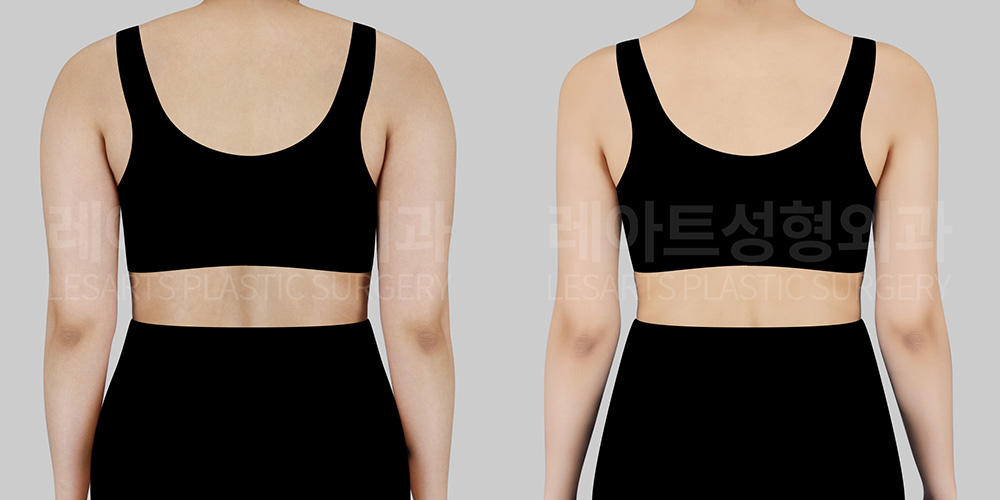
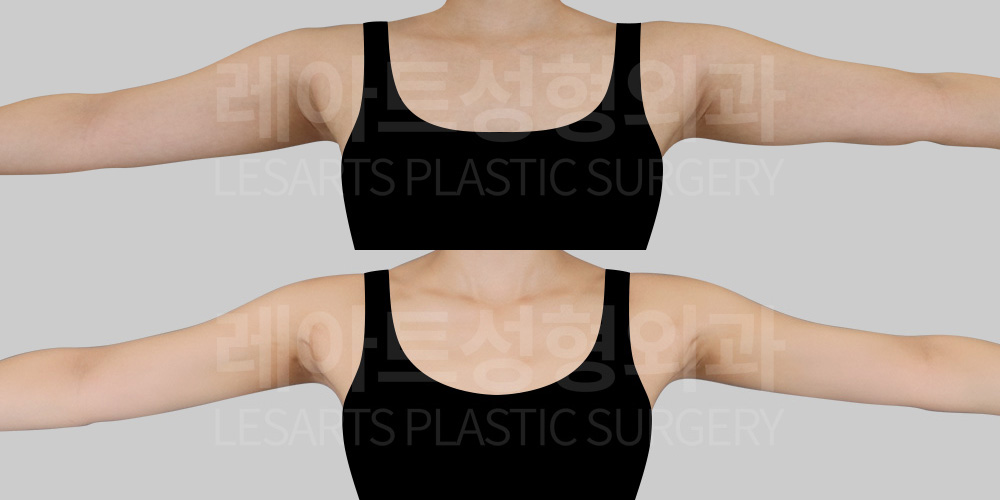
(※ Photographed 1.5 months postoperatively under identical clinic lighting and conditions.)
Arm Liposuction Before and After in a Muscular Frame - Dr. Yongseung Seo, Lesarts Plastic Surgery
The rounded prominence below the deltoid was debulked,
and the contiguous lateral line settled into a natural, straight silhouette,
creating a lighter, more slender appearance when resting the arms naturally at the sides on frontal view.
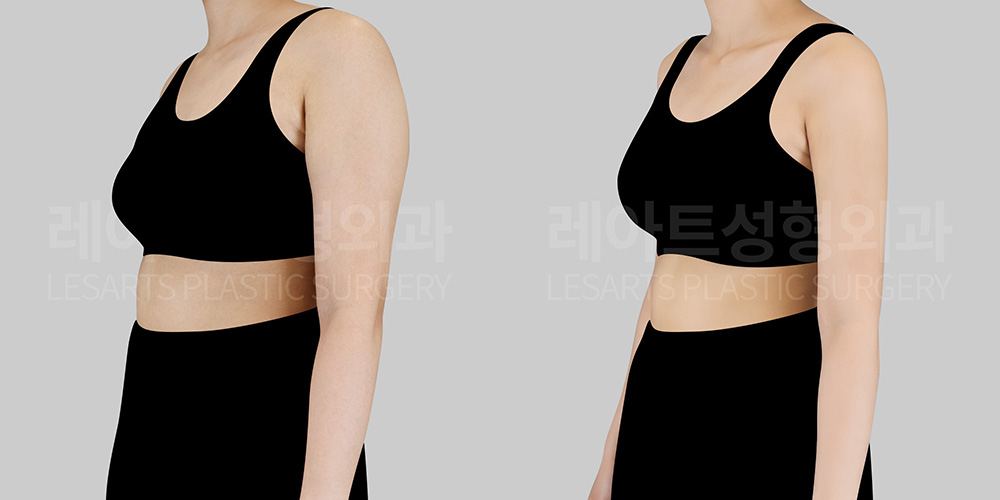
Muscular Arm Liposuction Before and After - Dr. Yongseung Seo

Contour Changes Before and After Arm Liposuction - Lesarts Plastic Surgery
On lateral profile, localized fullness along the upper posterior arm was smoothed, establishing a refined contour.
Muscular Arm Liposuction - Dr. Yongseung Seo, Lesarts Plastic Surgery
As explained preoperatively, subtle bilateral difference in deltoid muscle thickness remains perceptible upon close inspection,
yet does not detract from the balanced, feminine aesthetic of the arms.
Arm Liposuction Before and After - Dr. Yongseung Seo
Prior to surgery, when abducting the arms slightly,
the line from axilla to elbow presented a heavy, rounded appearance;
postoperatively, this zone smoothed into a slender, taut contour, noticeably refining the silhouette upon arm abduction.
View More Arm Liposuction Before and After Cases

In muscular builds, scraping away fat aggressively
can expose harsh muscular edges, compromising smooth bodily contours.
Therefore, debulking targeted zones while accurately identifying where and how much buffer fat to retain dictates surgical refinement.
Without comprehensive diagnosis accounting for muscle-to-fat ratios and native skeletal asymmetry,
patients may undergo surgery without achieving their desired straight-line outcome.
This tailored 1:1 design is a fundamental surgical principle,
and patients with developed muscularity or those considering revision after previous procedures benefit from thorough consultation.
If heavy arm contours cause ongoing concern or prior mini-liposuction fell short of expectations,
we welcome you to consult with Lesarts Plastic Surgery.
Through precise ultrasound evaluation and customized surgical planning, we guide you toward natural, balanced contours.
[Arm Liposuction FAQ]
Q1. Why is achieving an extremely thin, vertical 'bone arm' difficult in muscular physiques?
A. Liposuction removes subcutaneous fat; it cannot alter native muscular bulk. Particularly when the deltoid is developed,
the underlying muscular frame remains even after thorough fat evacuation, presenting inherent anatomical limits to sculpting a perfectly vertical shoulder-arm angle.
Q2. Why is buffer fat deliberately retained along muscular junctions in muscular arms?
A. Preserving buffer fat prevents harsh muscular borders from demarcating sharply, avoiding an overly masculine silhouette.
Retaining a thin, uniform buffer layer below the deltoid softens transitions, allowing contours to flow into a cohesive, straight line.
Q3. What causes arms to appear bulky when resting naturally at the sides on frontal view?
A. Outward lateral curvature along the outer arm widens horizontal width on frontal view, broadening the upper frame.
Targeting this lateral subcutaneous deposit delivers immediate visual narrowing.
Q4. Why might bilateral asymmetry become more apparent post-op when ultrasound confirms deltoid thickness differences?
A. Removing the overlying subcutaneous fat unmasks native bilateral muscular differences that were previously obscured.
Because intrinsic muscle asymmetry cannot be changed surgically, preoperative consultation must clarify whether the priority is maximal reduction or closer visual symmetry.
Q5. What visual refinements are observed at 1.5 months postoperatively?
A. Lateral bulging below the deltoid flattens into a sleek, straight line both at rest and upon abduction.
Posterior triceps fullness is smoothed on lateral profile, refining the overall upper-body silhouette.
Dr. Yongseung Seo


Cases finding
similar to my profile
Customer Diagnostics


Select the surgery and
area you are interestedto see real
before andafter changes.


we
make you,
the art
Clinic hours
MON - FRI
10 am – 7pm
SAT
10 am – 4pm
Holiday
SUN, HOLIDAY
Location
Lesarts Moon Clinic Tower 4-5F, 40, Nonhyeon-ro 168-gil,
Gangnam-gu, Seoul, Republic of Korea

Medical institution name Lesarts Plastic Surgery
Address Lesarts Moon Clinic Tower 4-5F, 40, Nonhyeon-ro 168-gil, Gangnam-gu, Seoul, Republic of Korea
Representative Moon sung jun
