




Online Consultation
Please accurately enter the information below.
Quick Cost Consultation
Quick Consultation & Reservation
Cases finding
similar to my profile






Doctor's Note
Medical columns by our surgeons
[Medical Column] “Told Not to Use My Arms for 2 Weeks Post-Op—What About My Work?”: Guidelines for Returning to Daily Activities and Managing Arm Movements After Gynecomastia Surgery
2026-10-19
[Medical Column] “Told Not to Use My Arms for 2 Weeks Post-Op—What About My Work?”: Guidelines for Returning to Daily Activities and Managing Arm Movements After Gynecomastia Surgery
Written by Dr. Jihoon Moon, Lesarts Plastic Surgery
This column was authored directly by our medical staff.
※ Unauthorized copying, modification, editing, or redistribution is strictly prohibited. ※
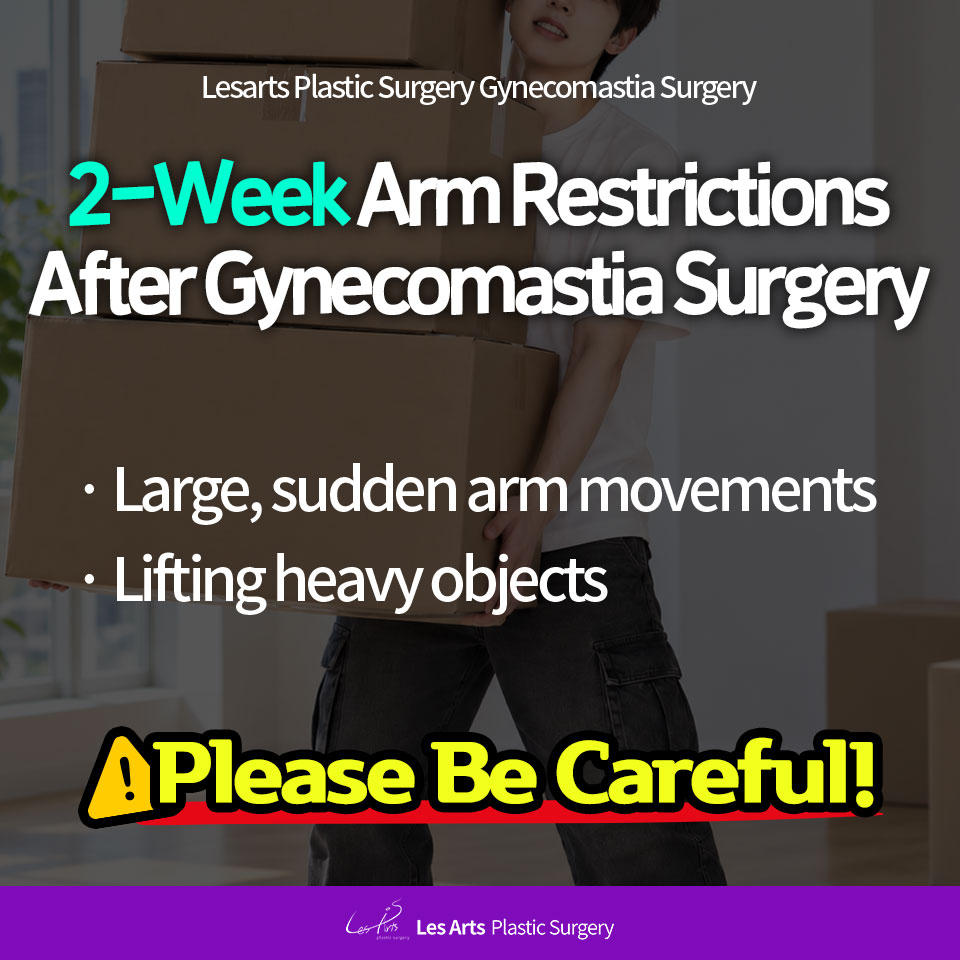
Is it safe to continue an occupation or daily routine requiring frequent arm movements during the first 2 weeks after gynecomastia surgery?
For approximately 2 weeks postoperatively, sudden, wide-ranging arm excursions
and lifting heavy loads exceeding 20 kg must be avoided.
However, by modifying arm mechanics and posture, standard daily tasks and many professional duties can be sustained safely.
[Learn More About Lesarts Male Gynecomastia Surgery]
Among patients visiting our clinic for gynecomastia consultations,
some hesitate not out of apprehension about the procedure itself,
but due to concerns over potential postoperative restrictions in daily life.
In particular, when we explain that
for approximately 2 weeks post-op, sudden, broad arm motions
and lifting heavy loads over 20 kg must be avoided,
patients often worry whether their work duties or domestic routines will be compromised.
[Postoperative Precautions for Gynecomastia - Lesarts Plastic Surgery]
Personal fitness routines such as weight training or swimming
can generally be paused for about 4 weeks without major disruption,
which patients accept with relative ease.
However, the situation differs entirely when professional duties or childcare responsibilities that cannot be put on hold
mandate continuous physical arm use.
Needing to fulfill daily occupational and household roles,
patients frequently wonder whether undergoing gynecomastia surgery right now is feasible.
Nevertheless, working in a field that involves regular upper-body motion
or having an active daily routine
does not mean you must postpone surgical treatment.
1. Why Arm Excursions Require Caution for 2 Weeks Post-Op
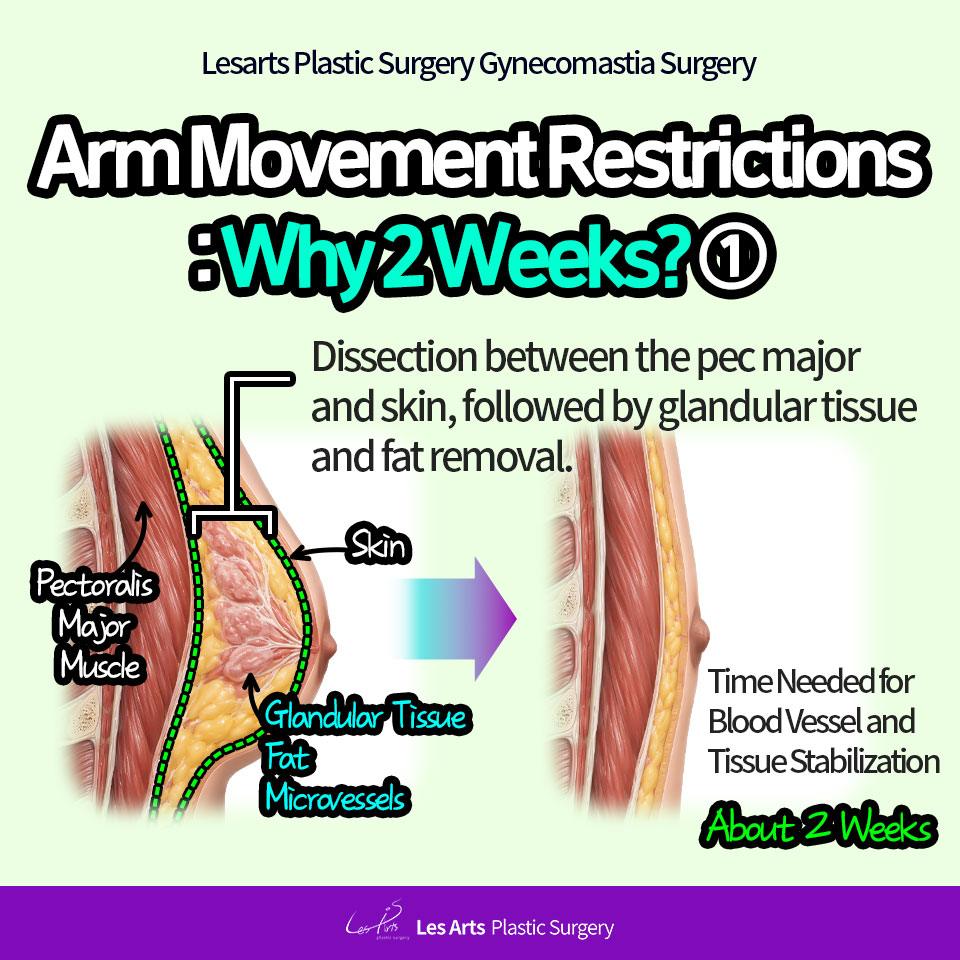
Gynecomastia surgery resects hyperplastic glandular tissue
and aspirates excess subcutaneous fat around the chest wall.
This procedure involves broad surgical undermining across the fascia of the pectoralis major muscle,
separating the cutaneous envelope from the underlying muscular bed.
In particular, the initial 1 to 2 weeks postoperatively
represent a vital healing window where microvascular networks stabilize
and mobilized tissue planes redrape and adhere firmly to the muscle fascia.
Careful attention to upper-body movement is therefore essential during this stage.
[Post-Treatment Guidance for Gynecomastia - Dr. Jihoon Moon, Lesarts Plastic Surgery]
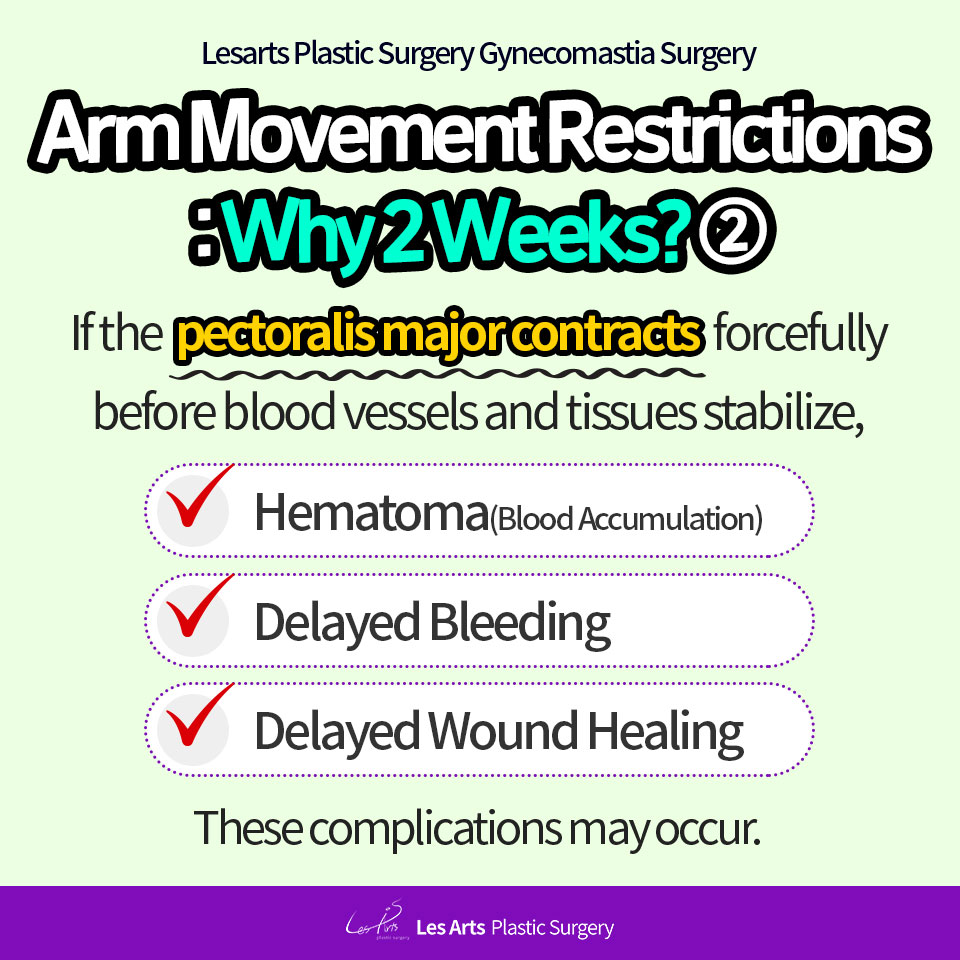
During this initial phase, making sudden, wide arm motions
or lifting heavy loads with arms extended away from the torso
triggers forceful contractions of the pectoralis major.
Such biomechanical strain disrupts the healing surgical bed,
increasing the risk of hematoma (internal blood pooling), delayed hemorrhage,
seroma formation, and prolonged wound recovery.
Consequently, advising arm movement restrictions
does not imply complete immobilization in daily life.
It is a targeted clinical precaution to avoid sudden, high-magnitude tensile strain
that forcefully stretches or shears healing tissue planes
across the pectoralis major.
2. Practical Biomechanical Guidelines: “Think Once Before You Move”
In clinical practice, we consult patients from diverse professional fields—
including logistics personnel, warehouse handlers,
hair stylists, culinary chefs, and equipment technicians.
Similarly, fathers caring for infants
must frequently hold and carry their children throughout the day.
Instructing these patients to immobilize their arms completely for 2 weeks is unrealistic.
Attempting to avoid all upper-limb motions creates unnecessary frustration and anxiety.
[Arm Mechanics Following Gynecomastia Surgery - Lesarts Plastic Surgery]
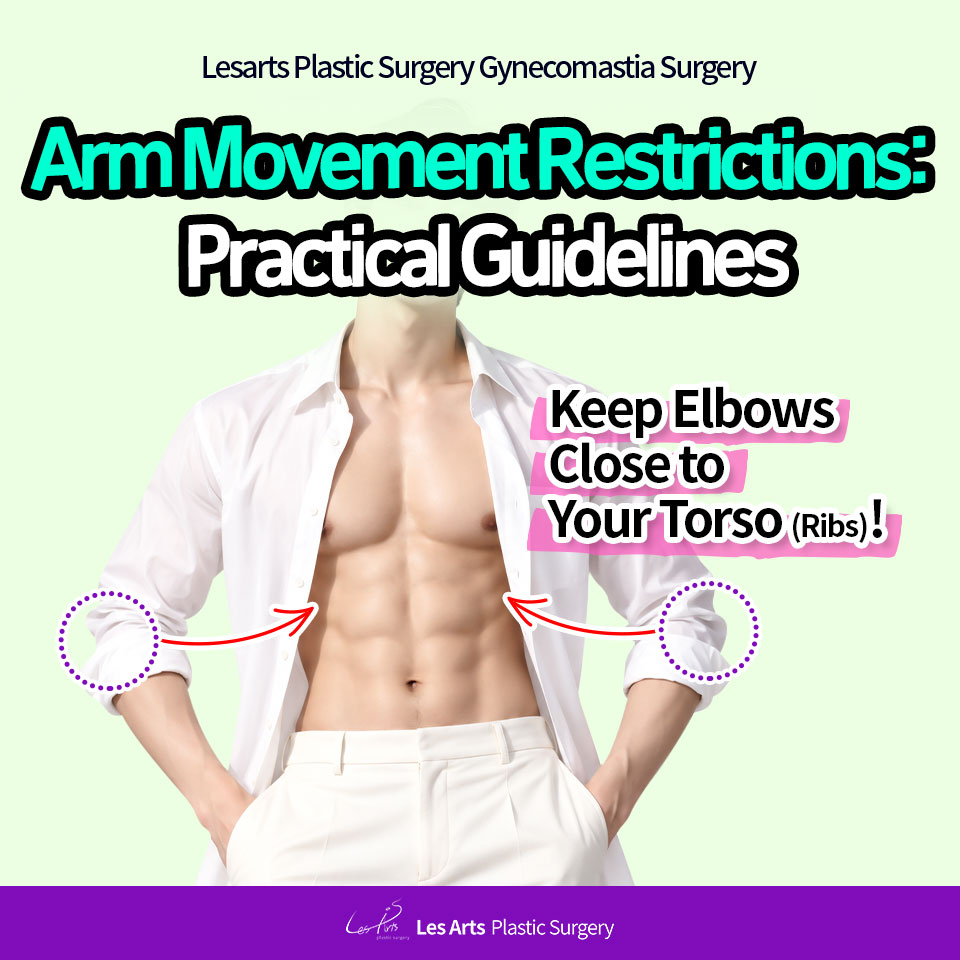
The practical biomechanical rule we emphasize
is straightforward:
“Keep your elbows close to your torso and ribcage whenever moving.”
While pinning elbows to the body all day is impractical,
keeping this principle in mind naturally curbs reflex reach-outs
and wide, sudden arm extensions.
When Lifting Objects:
Reaching outward with arms extended while lifting loads with hand and arm strength alone
concentrates severe tensile strain on the pectoralis major.
Instead, step close to the object,
keep your elbows tucked against your torso,
and lift using core and lower-body strength
to minimize mechanical stress across the chest wall.
When Holding a Child:
Rather than scooping a child up with extended arms from a standing position,
sit down first, bring the child onto your lap,
and hold them close against your chest
to avoid isolated pectoral engagement.
Calibrating postural angles and movement leverage in this manner
protects healing chest tissues while allowing patients
to manage desk duties, light domestic tasks,
and many workplace responsibilities comfortably.
3. High-Risk Occupations and Motions to Avoid
Workplace demands vary widely across individuals.
If your occupational role requires sudden, forceful contractions of the pectoralis major
or repetitive over-extension of the chest wall,
scheduling surgery and coordinating light-duty accommodations during the initial recovery window
demands thoughtful planning.
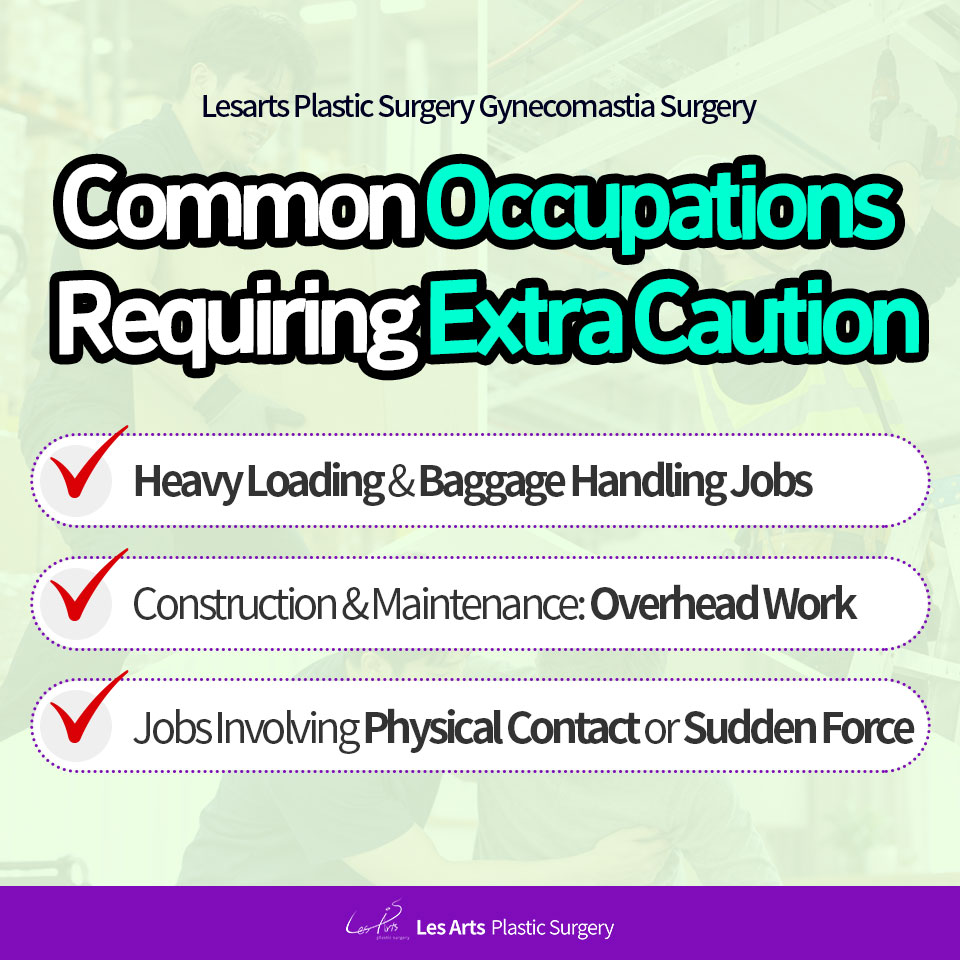
[Returning to Work Post-Gynecomastia Surgery - Lesarts Plastic Surgery]
① Occupations Requiring Heightened Caution Postoperatively:
• Repetitive Heavy Cargo Handling
• Logistics roles involving sudden pulling, throwing, or overhead lifting of parcels exceeding 20 kg
• Overhead Construction & Facility Maintenance
• Ceiling plumbing, electrical wiring, or wallpapering tasks requiring prolonged upward reaching under load
• Roles Involving Physical Restraint or Sudden Impact
• Law enforcement, security personnel, or animal handlers who may encounter sudden, uncontrolled external physical forces
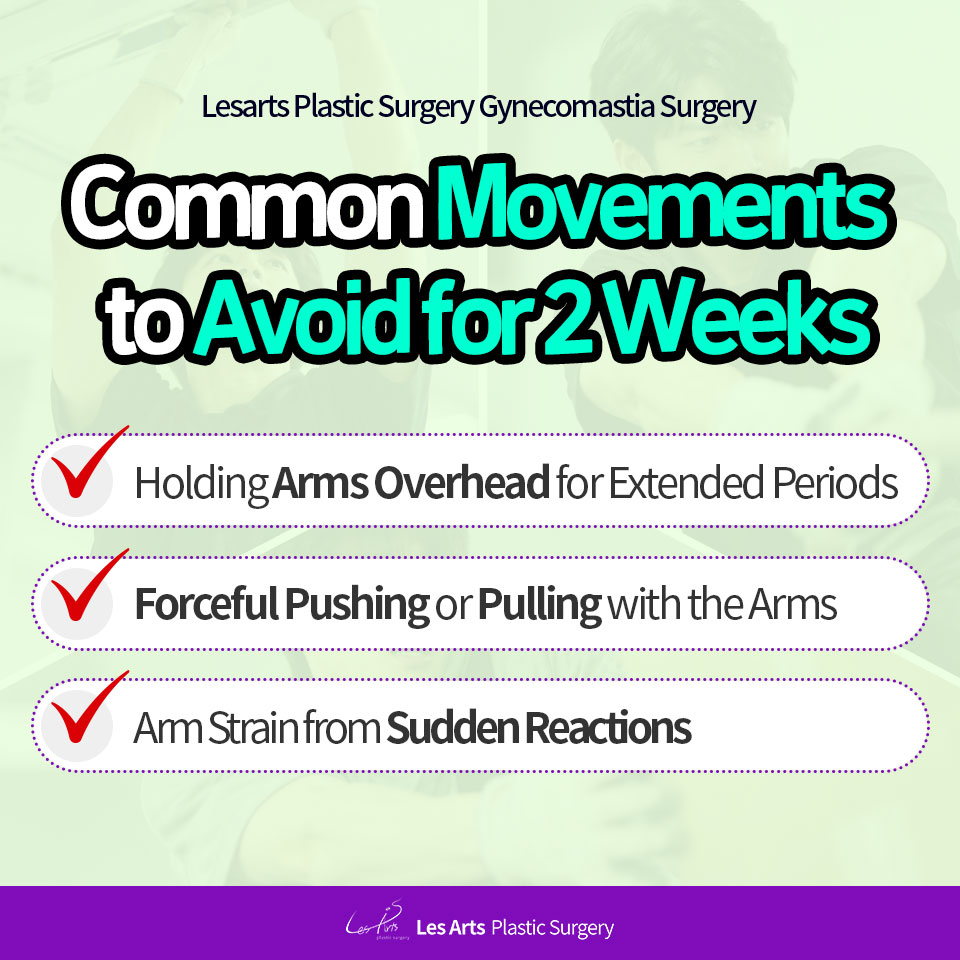
[Arm Movements to Restrict Post-Surgery - Dr. Jihoon Moon, Lesarts Plastic Surgery]
② Specific Movements to Avoid During the First 2 Weeks:
• Forceful Exertion with Arms Elevated Overhead
• Example: Bracing body weight on overhead subway straps or pulling down heavy items from high shelves.
• Pushing or Pulling with Arms Retracted Behind the Torso
• Example: Manually pushing heavy loaded carts or forcefully yanking heavy doors open.
• Sudden Reflexive Bracing with Extended Arms
• Example: Catching yourself with outstretched hands during a fall, or sudden leash jerks from an energetic pet.
While light walking is encouraged to aid circulation,
activities with slip hazards—such as outdoor trail hiking—should be avoided during early recovery.
4. Conclusion: With Mindful Habits, Returning to Daily Life Is Manageable
Protecting the surgical site and moderating excessive strain
supports optimal tissue recovery after gynecomastia surgery.
A properly fitted medical compression garment provides essential internal support,
and adopting the habit of keeping your elbows close to your body
substantially mitigates tension across the healing chest wall.
Many patients manage their daily responsibilities successfully
by practicing these straightforward postural adjustments.
If your professional responsibilities or lifestyle routines involve regular arm use,
we encourage you to discuss your typical daily tasks and repetitive motions with our medical team during consultation
rather than worrying in isolation.
We can outline practical, safe movement strategies
tailored directly to your workplace and daily routines.
Smoothly resuming daily life relies on understanding and avoiding specific high-risk mechanics
rather than imposing complete physical immobility.
With clear anatomical guidance and an individualized recovery plan,
you can prepare for surgery with confidence and minimal daily disruption.
Gynecomastia Recovery FAQ
Q1. Are arm movements completely prohibited for 2 weeks after gynecomastia surgery?
No. Everyday light activities are permitted; the restriction specifically targets sudden, wide-ranging motions and heavy exertion that forcefully engage the pectoralis major during the initial 1 to 2 weeks.
Q2. Can I return to work immediately after gynecomastia surgery?
Standard desk duties and light professional tasks can be performed comfortably with modified arm posture. However, jobs requiring heavy lifting or overhead reaching require temporary modification.
Q3. How should I lift objects after gynecomastia surgery?
Move close to the item, keep your elbows tucked against your torso, and lift using core and leg strength rather than reaching out with your arms.
Q4. Is it possible to hold or care for an infant after surgery?
Yes, with modified mechanics: sit down first, place the child on your lap, and hold them close to your torso rather than scooping them up from a standing position with outstretched arms.
Q5. What specific arm motions must be avoided postoperatively?
Holding onto high transit straps overhead, forcefully pushing heavy carts, bracing suddenly during a fall, or handling sudden leash pulls from pets should be avoided during early recovery.
Dr. Jihoon Moon


Cases finding
similar to my profile
Customer Diagnostics


Select the surgery and
area you are interestedto see real
before andafter changes.


we
make you,
the art
Clinic hours
MON - FRI
10 am – 7pm
SAT
10 am – 4pm
Holiday
SUN, HOLIDAY
Location
Lesarts Moon Clinic Tower 4-5F, 40, Nonhyeon-ro 168-gil,
Gangnam-gu, Seoul, Republic of Korea

Medical institution name Lesarts Plastic Surgery
Address Lesarts Moon Clinic Tower 4-5F, 40, Nonhyeon-ro 168-gil, Gangnam-gu, Seoul, Republic of Korea
Representative Moon sung jun
