




Online Consultation
Please accurately enter the information below.
Quick Cost Consultation
Quick Consultation & Reservation
Cases finding
similar to my profile






Doctor's Note
Medical columns by our surgeons
7-Month Progress of Full Abdominoplasty (M-type) for Improving Abdominal Skin Laxity and Periumbilical Wrinkling
2026-10-19
7-Month Progress of Full Abdominoplasty (M-type) for Improving Abdominal Skin Laxity and Periumbilical Wrinkling
Written by Board-Certified Plastic Surgeon Dr. Kukhan Lee, Lesarts Plastic Surgery
This column was authored directly by our medical staff.
※ Unauthorized copying, editing, processing, or redistribution is strictly prohibited. ※
How can abdominal skin laxity and periumbilical wrinkles that persist despite workouts and weight reduction be improved?
If cutaneous laxity and rectus diastasis cannot be resolved through exercise alone,
they can be corrected concurrently through M-type full abdominoplasty.
When indicated, abdominal liposuction can be performed simultaneously to streamline overall abdominal contours.
[Learn More About Lesarts M-Type Abdominoplasty]
As the seemingly endless summer heat gradually subsides,
a pleasant season well-suited for resuming workouts approaches.
Many individuals return to fitness routines paused during hot weather,
looking forward to positive changes in their physique.
However, even with disciplined exercise regimens and successful weight loss,
the abdomen often fails to change as anticipated,
creating unexpected aesthetic frustration.
In particular, individuals with a history of significant weight fluctuations or pregnancy and childbirth
often find that despite reducing body weight, residual skin laxity, folding, and stretch marks
prevent the abdomen from achieving a firm, streamlined contour.
Overextended skin that has lost dermal elasticity and separated rectus abdominis muscles
face clear biological limitations to spontaneous recovery through diet and exercise alone.
Furthermore, during core workouts or when bending the torso forward in daily life,
loose abdominal skin folds become distinctly prominent.
When wearing crop tops, swimwear, or clothing that exposes the midriff,
wrinkling and laxity around the umbilicus can stand out,
amplifying personal self-consciousness.
In this column, we review the 7-month postoperative follow-up of a patient
who underwent abdominal liposuction combined with M-type full abdominoplasty
to resolve longstanding abdominal skin laxity and periumbilical wrinkles
that persisted despite years of disciplined exercise and weight maintenance.
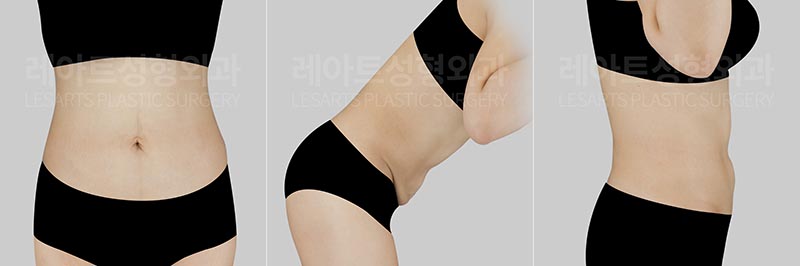
[Preoperative Baseline Evaluation for Abdominoplasty - Lesarts Plastic Surgery]
The patient was a female in her 40s presenting at 166 cm and 55 kg.
Her medical history included severe obesity during her teenage years, with body weight peaking near 90 kg;
through dedicated exercise and dietary discipline, she achieved substantial weight loss
and had stably maintained a weight of approximately 55 to 60 kg to date.
She had delivered one child via vaginal delivery,
with gestational weight reaching approximately 70 kg at full term.
Having experienced multiple cycles of major weight shifts,
cutaneous laxity persisted across her entire abdominal wall.
Because she frequently favored attire that exposed the midriff or upper abdomen,
the fine wrinkling and loose skin gathered around the umbilicus
caused significant aesthetic distress.
Physical examination revealed that generalized subcutaneous fat volume was relatively modest.
Reflecting years of consistent workouts and weight management,
her overall physical frame and body proportions were well preserved.
However, localized subcutaneous fat remained across the upper abdomen and waistline,
indicating that targeted liposuction was appropriate to refine regional contours.
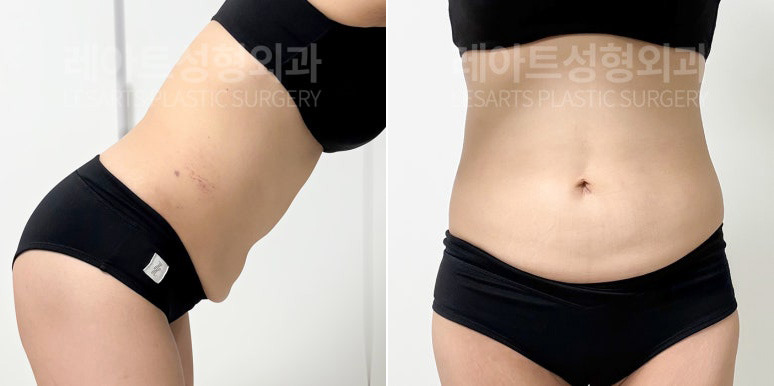
[Preoperative Baseline Status (Patient Provided) - Lesarts Plastic Surgery]
Cutaneous laxity was present across both the epigastrium and infraumbilical abdomen.
While loose skin directly surrounding the umbilicus was not exceedingly redundant,
the combination of localized laxity, stretch marks, fine folds, and underlying rectus diastasis
visually magnified the appearance of periumbilical sagging beyond true skin excess alone.
The lower abdomen exhibited redundant skin folding above the underwear waistband,
and palpation confirmed clear midline fascial separation of the rectus abdominis muscles.
Therefore, correcting both redundant skin and structural rectus diastasis was essential.
The most critical consideration in surgical planning was the final anatomical placement of the incision scar.
Evaluating her full abdominal anatomy and her primary focus on supraumbilical wrinkling,
an M-type full abdominoplasty was established as the indicated operative approach.
However, when setting aside striae and superficial creasing,
the absolute volume of redundant upper abdominal skin was moderate rather than excessive.
If upper abdominal skin reserve is limited,
the distance the cutaneous flap can be advanced inferiorly during surgery is anatomically bounded.
Consequently, how low the transverse scar can settle is also constrained.
We thoroughly counseled her regarding the anticipated incision line and these clinical boundaries,
evaluating the cut of her preferred swimwear and underwear styles
to support an informed, confident surgical decision.
The patient elected to proceed following detailed consultation,
and we executed an integrated plan combining abdominal liposuction and M-type full abdominoplasty.
[7-Month Postoperative Follow-Up: Liposuction & Abdominoplasty]
Below is the clinical appearance evaluated at 7 months postoperatively.
Because periumbilical wrinkling and folding served as her primary motivation for surgery,
reshaping the navel and redraping surrounding dermal planes into a firm, natural contour
represented the focal technical objective during the procedure.
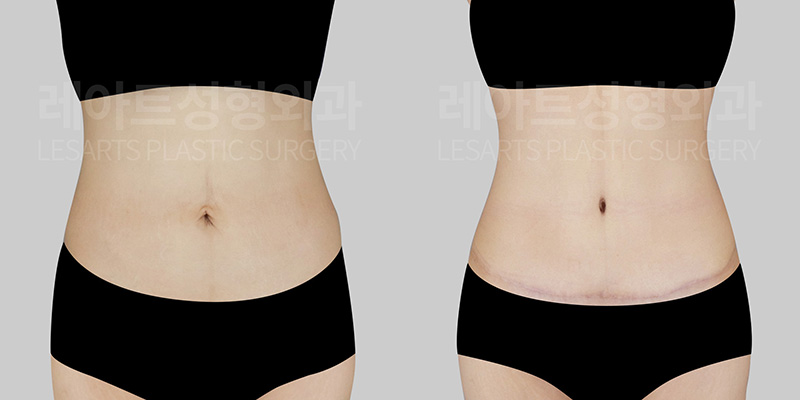
[7-Month Follow-Up Before & After Abdominoplasty - Dr. Kukhan Lee, Lesarts Plastic Surgery]
During surgery, residual upper abdominal fat was aspirated,
the separated rectus abdominis muscles were plicated back to the midline, and the mobilized flap was advanced inferiorly,
redraping the periumbilical skin into a taut, smooth surface.
The umbilicus was reconstructed into a slender vertical shape aligning with her personal preference,
settling into a harmonious position that integrates naturally
with the restored abdominal wall contour.

[Everyday Wardrobe Fit Before & After Abdominoplasty - Dr. Kukhan Lee]
Lower abdominal skin redundancy also achieved stable, complete correction.
The surgical margins were meticulously feathered to prevent surface step-offs,
allowing the entire lower abdomen to transition seamlessly into a flat plane.

[Everyday Presentation Post-Abdominoplasty - Dr. Kukhan Lee, Lesarts Plastic Surgery]

[Correction of Lower Abdominal Laxity: Before & After - Lesarts Plastic Surgery]
[Lifting Sagging Abdominal Skin and Supraumbilical Creasing - Lesarts Plastic Surgery]
When bending the torso forward, the improvement in tissue laxity
is evident on lateral and oblique profiles even more distinctly than on frontal view.
The patient had previously experienced persistent distress during core workouts,
as forward-bending postures caused loose abdominal skin to fold and hang downward.
Postoperatively, redundant folding has resolved significantly even in dynamic bending postures,
representing a clinically meaningful milestone of this procedure.
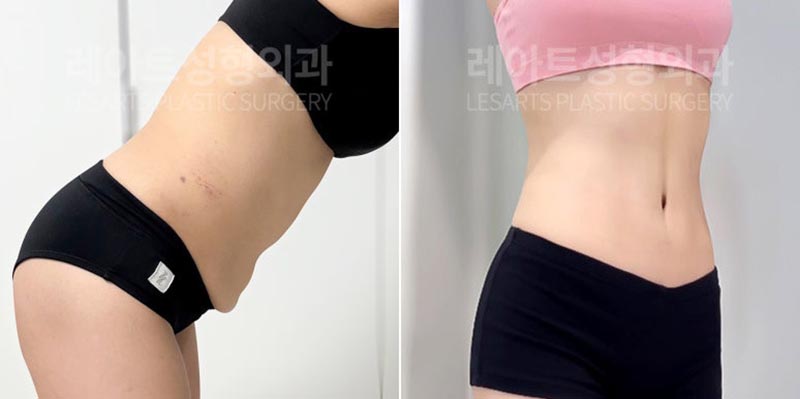
[Lower Abdominal Line Changes Before and After Abdominoplasty - Lesarts Plastic Surgery]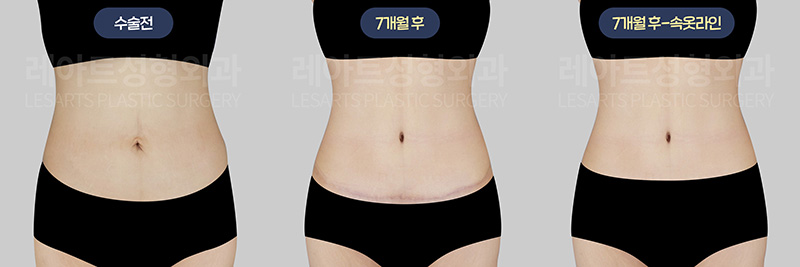
[Abdominoplasty Scar Location, Length, and Maturation Process - Lesarts Plastic Surgery]
The surgical incision was planned to sit at the lowest possible anatomical position.
Because tissue reserve and vascular safety dictate advancement boundaries,
the incision line cannot be lowered indefinitely under excessive tension.
In this patient, the incision settled slightly lower than conservatively anticipated preoperatively,
resting comfortably concealed beneath standard underwear lines.
The scar displays typical 7-month physiological maturation.
It remains stable without hypertrophic widening or elevation,
and will continue to soften in texture and fade in coloration over coming months.
Abdominoplasty is not merely an excisional procedure to remove excess skin.
It requires evaluating skin laxity depth, adipose distribution,
rectus diastasis, umbilicus position and morphology,
and the strategic placement of the resulting scar.
Harmonizing these structural elements is essential to sculpting a balanced, natural abdominal profile.

[Daily Activity Following Abdominoplasty - Dr. Kukhan Lee, Lesarts Plastic Surgery]
This patient maintained balanced physical conditioning through years of consistent workouts.
Yet cutaneous laxity and periumbilical wrinkles
that resisted exercise and dietary control persisted;
these anatomical concerns were successfully corrected
through combined abdominal liposuction and M-type full abdominoplasty.
By 7 months postoperatively,
functional and daily lifestyle limitations have largely resolved.
However, complete deep tissue stabilization and scar maturation require an extended timeline.
Internal collagen remodeling and scar softening typically continue
over 1 to 2 years following surgery.
Over time, deep induration softens,
and the scar line lightens progressively toward natural skin tones.
Allowing adequate time for the remaining healing phase alongside current achievements
ensures an even more stable, natural abdominal contour.
Even when body weight is maintained through dedicated fitness routines,
overstretched skin that has lost dermal elasticity, separated rectus muscles,
and periumbilical folding face clear biological boundaries with exercise alone.
If midriff-baring clothing or skin folding during workouts causes ongoing distress,
exploring surgical correction tailored to your abdominal wall anatomy is a valid option.
Abdominoplasty encompasses more than simply excising redundant skin.
Adipose depth, fascial separation, navel contour,
and incision placement must be evaluated cohesively.
Establishing a personalized surgical plan based on comprehensive consultation
ensures safe, refined, and long-lasting anatomical outcomes.
FAQ
Q1. Can loose abdominal skin after weight loss be resolved with workouts alone?
Skin that has overextended and lost dermal elasticity faces biological limits to contracting through exercise and diet alone. Abdominoplasty can be considered depending on the extent of laxity.
Q2. When is M-type full abdominoplasty indicated?
It is indicated when cutaneous laxity involves both the upper and lower abdomen, especially when accompanied by periumbilical creasing or rectus diastasis.
Q3. Can abdominoplasty improve wrinkling around the umbilicus?
Yes. Advancing the upper abdominal flap inferiorly and reconstructing the navel concurrently smooths periumbilical folding and tissue laxity.
Q4. Can the abdominoplasty scar be concealed beneath underwear?
Within the boundaries of skin reserve and vascular safety, the incision is placed as low as possible; precise placement depends on individual abdominal anatomy and dermal laxity.
Q5. Is recovery finalized at 7 months post-abdominoplasty?
While daily activities proceed comfortably by 7 months, internal tissue remodeling and scar maturation continue over 1 to 2 years postoperatively.
Dr. Kukhan Lee


Cases finding
similar to my profile
Customer Diagnostics


Select the surgery and
area you are interestedto see real
before andafter changes.


we
make you,
the art
Clinic hours
MON - FRI
10 am – 7pm
SAT
10 am – 4pm
Holiday
SUN, HOLIDAY
Location
Lesarts Moon Clinic Tower 4-5F, 40, Nonhyeon-ro 168-gil,
Gangnam-gu, Seoul, Republic of Korea

Medical institution name Lesarts Plastic Surgery
Address Lesarts Moon Clinic Tower 4-5F, 40, Nonhyeon-ro 168-gil, Gangnam-gu, Seoul, Republic of Korea
Representative Moon sung jun
