




Online Consultation
Please accurately enter the information below.
Quick Cost Consultation
Quick Consultation & Reservation
Cases finding
similar to my profile






Doctor's Note
Medical columns by our surgeons
3-Month Result of M-type Full Abdominoplasty (Tummy Tuck) - Belly Button Piercing Scar and C-section Scar Removal
2026-11-06
3-Month Result of M-type Full Abdominoplasty (Tummy Tuck) - Belly Button Piercing Scar and C-section Scar Removal
Written by Dr. Kukhan Lee, Board-Certified Plastic Surgeon, Lesarts Plastic Surgery
This column was authored directly by our medical staff.
※ Unauthorized copying, modification, editing, or redistribution is strictly prohibited. ※
Can abdominoplasty (tummy tuck) remove both a belly button piercing scar and a C-section scar at the same time?
In some cases, both scars can be removed simultaneously through M-type full abdominoplasty (tummy tuck).
However, since the possibility of removal depends on the laxity of the upper abdomen skin and the amount of skin that can be pulled downward,
a thorough pre-operative evaluation is required.
[Lesarts Plastic Surgery Abdominoplasty (Tummy Tuck) Surgery Information]
Pregnancy and childbirth are meaningful journeys of welcoming a new family member,
yet at the same time, they can bring various changes to a woman's body.
In particular, as the skin on the abdomen stretches and the abdominal wall expands during pregnancy,
it may not fully return to its pre-pregnancy state even after childbirth.
Before pregnancy, some women maintain a smooth abdomen line
and get a piercing around the belly button,
but as the skin stretches and the abdominal contour changes after childbirth,
the existing piercing scar can become even more noticeable than before.
Additionally, there are cases where the surrounding skin laxity
appears more prominent due to these scars.
Such abdominal changes caused by pregnancy and childbirth
may be difficult to sufficiently improve through weight loss
or consistent exercise alone.
In this post, we will review the case of a patient who was concerned about remaining abdominal skin laxity after childbirth
and a belly button piercing scar.
Through this case, we will explore what factors should be considered together
when planning abdominoplasty (tummy tuck).
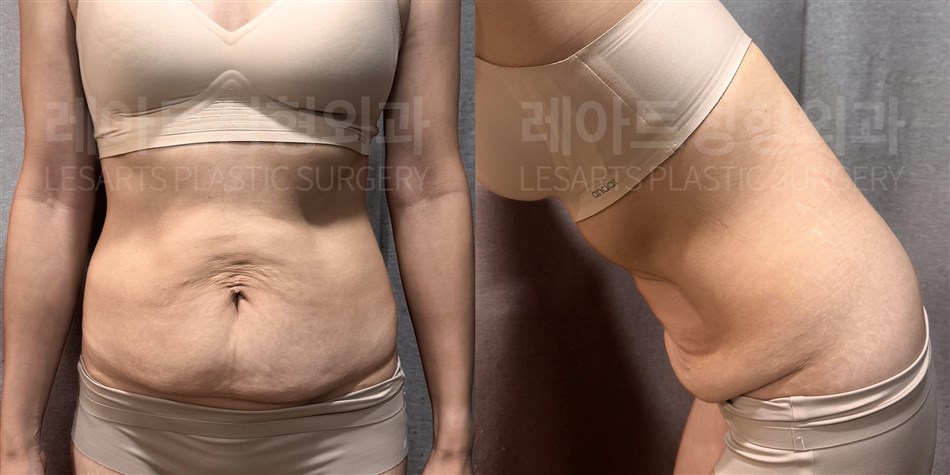
[Condition in daily life before Abdominoplasty (Tummy Tuck) - Provided by the patient]
The patient was a woman in her 40s
who had given birth to two children via C-section.
At the time of her visit, her height was 172cm and her weight was 64kg,
and she mentioned that her weight had increased up to 90kg at full term during pregnancy.
Even after childbirth, she maintained a weight of around 70~80kg for a while,
but she recently lost about 18kg while using Mounjaro.
However, as her weight decreased, the remaining skin laxity and wrinkles
around her belly button actually became more distinct than before.
In particular, the appearance of loose skin on the lower abdomen bulging over the beltline
was also one of the areas that bothered the patient greatly.
Even after successfully losing weight, these abdominal changes did not sufficiently improve,
so she visited our clinic to surgically correct the remaining skin laxity and wrinkles.
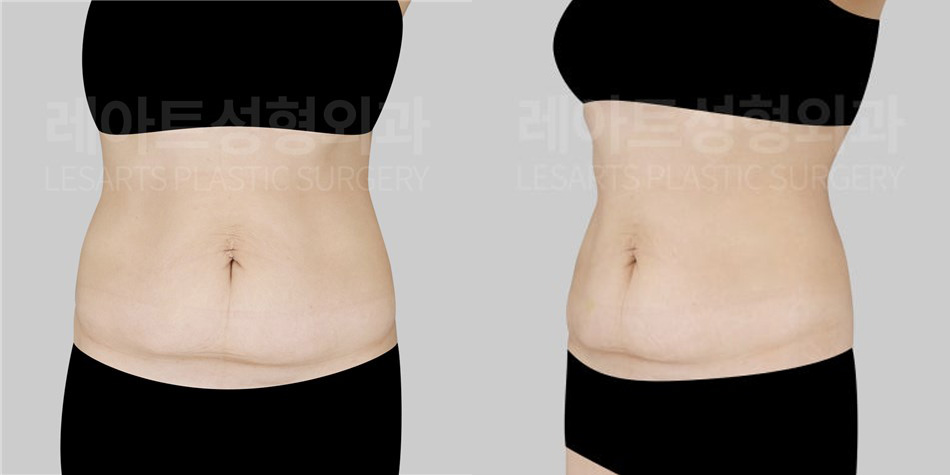
[Pre-operative physical examination for Abdominoplasty (Tummy Tuck)]
Upon conducting a pre-operative physical examination,
stretched and sagging skin was confirmed in both the upper abdomen and lower abdomen.
In the upper abdomen, stretch marks formed during pregnancy
and skin that had lost elasticity due to weight fluctuations remained,
and combined with the existing belly button piercing scar,
the skin appeared to sag even more severely than the actual degree of laxity.
In the lower abdomen, above the scar left from her previous C-section surgery,
loose skin folded and overlapped,
showing a bulging appearance in the lower belly.
Like this, when skin overlaps or sags around an existing surgical scar,
the lower abdomen can appear to protrude even more than the actual degree of abdominal bulge.

[Pre-operative condition before Abdominoplasty (Tummy Tuck)]
Through a pre-operative palpation exam, diastasis recti (abdominal muscle separation), a condition where the rectus abdominis muscles are separated, was also confirmed.
It is likely that the gap between the rectus abdominis muscles widened as the abdomen stretched during pregnancy,
and such changes can also affect the overall shape and contour of the abdomen.
Overall, the amount of subcutaneous fat accumulated in the abdomen was not large,
but to refine the contour of the upper abdomen and flank (waist) lines on both sides more naturally,
it was determined appropriate to selectively combine liposuction in necessary areas.
Therefore, rather than focusing on removing as much fat as possible,
we comprehensively considered the degree of loose skin and the condition of the abdominal wall
and planned the surgery in a direction that improves the overall abdomen line in balance.
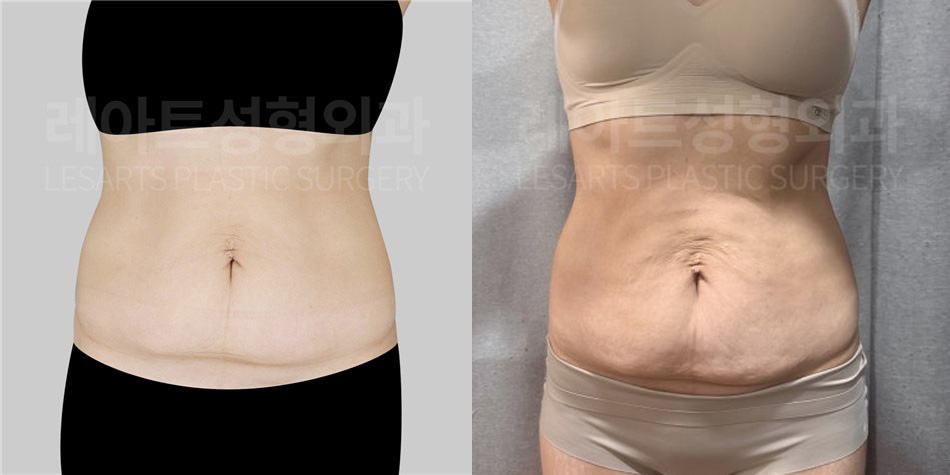
[Pre-operative photos taken under bright lighting and self-taken photos in everyday lighting]
To improve the wrinkles and skin laxity around the belly button, which were the patient's biggest concerns,
M-type full abdominoplasty (tummy tuck) was judged to be suitable.
However, in the process of establishing a specific surgical plan,
there was an aspect that needed careful consideration.
It was the question of how to correct the existing belly button piercing scar and C-section scar.
To completely remove the belly button piercing scar,
additional skin containing the scar must also be excised.
However, if the remaining skin laxity in the upper abdomen is not sufficient,
excessively pulling the skin downward
can place tension on the position of the lower abdomen incision line or the suture area.
Therefore, whether both scars could be removed
had to be determined by comprehensively examining the actual amount of remaining skin
and the amount of skin that could be mobilized downward after dissection.
The most ideal method was to remove both the piercing scar and the C-section scar
in a single surgery.
However, if skin laxity is insufficient and it is difficult to eliminate both scars simultaneously,
a decision must be made on which area to prioritize for correction.
We had to consider whether to remove the existing C-section scar while leaving the piercing scar,
or to remove the piercing scar while accepting the possibility
that a new incision line might remain higher than the C-section scar.
The patient's C-section scar had already matured relatively stably
and was not very noticeable in appearance.
On the other hand, if the belly button piercing scar were to remain after shifting downward,
there was a possibility it could become another concern for the patient.
After comprehensively reviewing these conditions,
in this surgery, we set removing the belly button piercing scar
as our primary goal.
Next, let's take a look at the progress at 3 months post-op after M-type full abdominoplasty (tummy tuck).
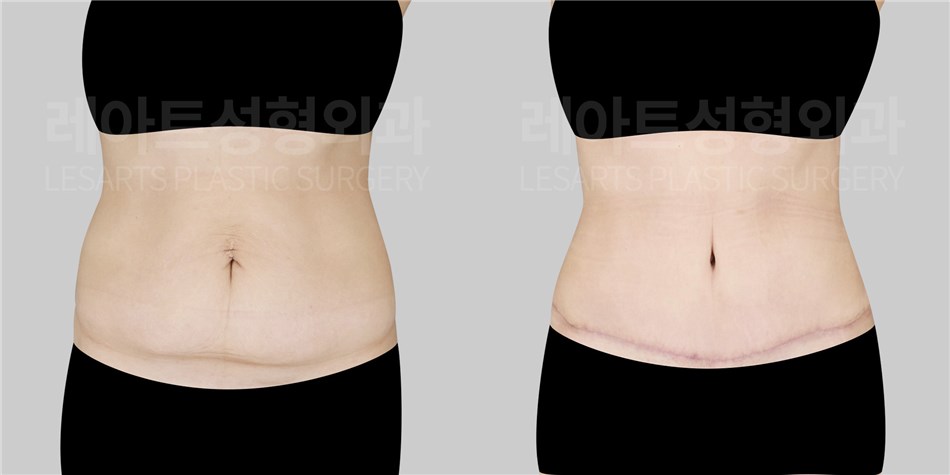
[Before & After comparison of Abdominoplasty (Tummy Tuck) (Removal of belly button piercing scar and C-section scar) - Lesarts Plastic Surgery]
Both the belly button piercing scar and the C-section scar, which were the most important considerations before surgery,
were able to be completely removed through this surgery.
During the actual surgical procedure, after dissecting the upper abdomen skin, we confirmed that
the amount of skin that could be pulled and shifted downward
was more sufficient than expected before surgery.
Accordingly, both existing scars could be excised,
and ultimately, only the new incision line from the abdominoplasty (tummy tuck) remained.
The wrinkles and stretch marks around the belly button, which particularly concerned the patient,
also improved into a much firmer and smoother appearance than before surgery
through the process of pulling the loose skin downward and refining it.
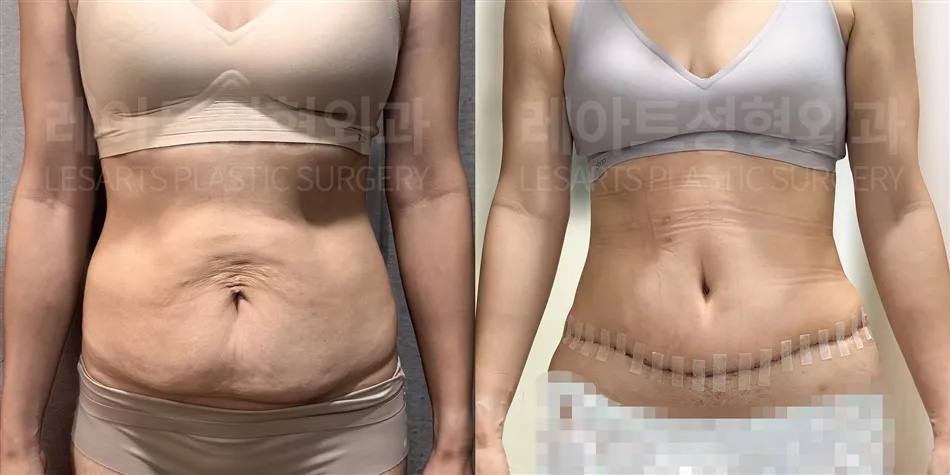
[Before and 1 month post-op comparison of Lesarts Plastic Surgery Abdominoplasty (Tummy Tuck) - Provided by the patient]
The area that appeared to bulge above the beltline
due to remaining skin laxity in the lower abdomen was also improved together.
As the loose skin was refined,
you can see that the overall contour of the abdomen has become much smoother and more organized than before surgery.
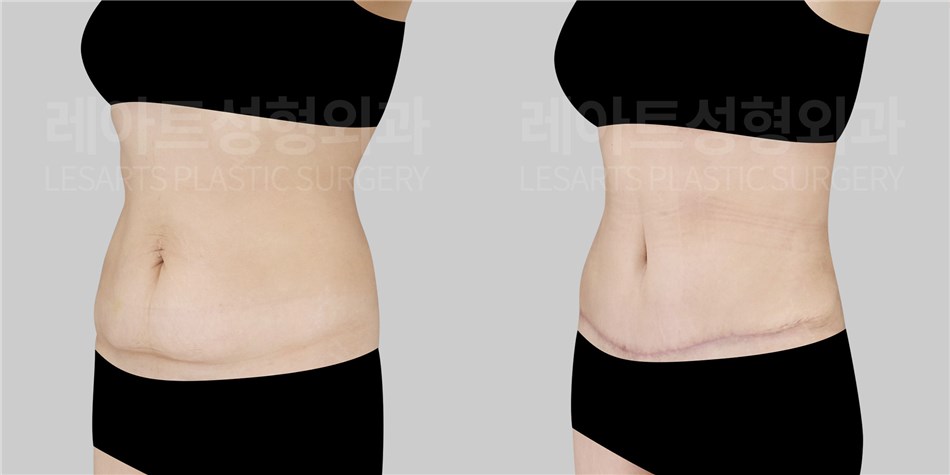
[Before and 3 months post-op comparison of Abdominoplasty (Tummy Tuck) - Dr. Kukhan Lee, Lesarts Plastic Surgery]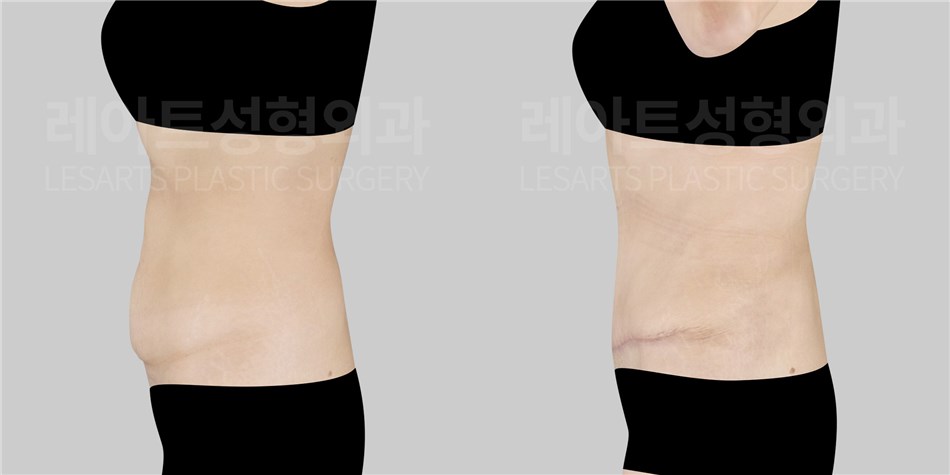
[Diastasis recti and skin folding above the C-section scar - Dr. Kukhan Lee, Lesarts Plastic Surgery]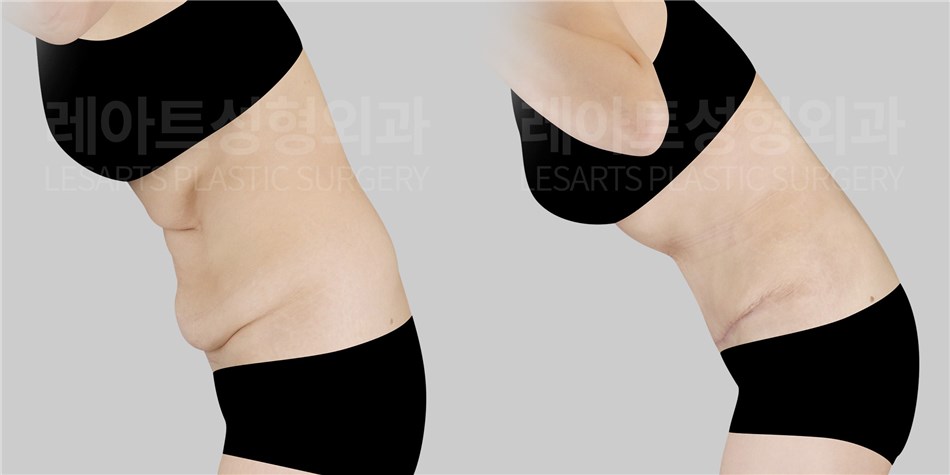
[Degree of skin folding improvement after Abdominoplasty (Tummy Tuck) - Dr. Kukhan Lee, Lesarts Plastic Surgery]
Diastasis recti, which had been confirmed during the pre-operative examination,
was also corrected while performing the abdominoplasty (tummy tuck).
In particular, the rectus abdominis muscles around the belly button were separated by about 6cm,
and that area was sutured to restore the function of the abdominal wall.
Through this correction process, the overall contour of the abdomen became much more refined,
and not only from the front but also from the side and oblique angles,
you can see that the abdominal wall has improved more firmly than before.
However, 3 months post-op is still a period when tissue recovery is ongoing.
Currently, redness and a firm sensation remain on the surgical scar,
and in some parts of the abdomen, scar tissue and biobond (post-op firmness/lumpiness) have not completely disappeared,
so the skin surface may partially appear uneven.
These are changes that can occur during the post-operative recovery process,
and sufficient time has not yet passed
to judge the final surgical outcome based solely on the current appearance.
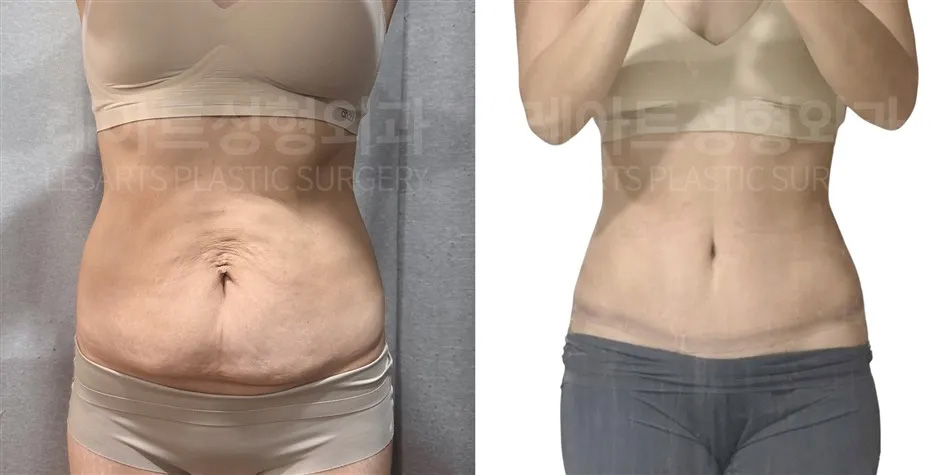
[Before & After (80 days) daily life photos of Lesarts Plastic Surgery Abdominoplasty (Tummy Tuck) - Provided by the patient]
The scar left after surgery gradually goes through a maturation process over time.
The redness or pigmentation changes that appear initially,
as well as the firmness in the scar area, can also gradually subside as recovery progresses.
The shape around the belly button can also settle into a slightly more natural appearance
as the tissues stabilize.
Since the firm sensation or tissue clumping remaining in the lower abdomen
can also gradually change depending on the recovery stage,
it is important to steadily monitor the progress moving forward.
Check More Abdominoplasty (Tummy Tuck) Surgery Cases
▼▼▼

In this post, we reviewed the progress of a patient at 3 months post-op
after undergoing M-type full abdominoplasty (tummy tuck).
Those considering abdominoplasty (tummy tuck) often wonder
when the swelling and discomfort that occur immediately after surgery begin to subside,
and how much change can be seen
at about 3 months post-op.
However, 3 months post-op is a point where recovery is not yet complete.
It should be considered that the remaining swelling and tissue firmness can gradually subside thereafter,
and the color of the scar and skin texture
can also change progressively over time.
Abdominal skin laxity caused by pregnancy, childbirth, and subsequent weight changes
often cannot be sufficiently improved through consistent exercise or weight loss alone.
Especially in cases like this patient, where loose skin, diastasis recti,
and existing surgical scars appear together,
a process of closely examining each condition is necessary.
Therefore, it is important to comprehensively evaluate the degree of skin laxity, the condition of the abdominal wall, and the location of scars,
and establish a surgical plan tailored to the individual while considering the balance of the entire abdomen.
If you have any concerns about your abdomen, please feel free to visit us anytime for a detailed consultation.
FAQ
Q1. Can abdominoplasty (tummy tuck) remove a belly button piercing scar?
It can be removed by excising the skin containing the piercing scar together.
However, there must be sufficient skin laxity in the upper abdomen,
and the tension placed on the incision line location and suture area must also be considered.
Q2. Can abdominoplasty (tummy tuck) also remove an existing C-section scar?
If the skin can be pulled downward sufficiently,
the existing C-section scar can be excised together.
However, the possibility of removal varies depending on the skin condition.
Q3. Can abdominoplasty (tummy tuck) also correct diastasis recti?
Separated rectus abdominis muscles can be corrected together while performing abdominoplasty (tummy tuck).
In this case, diastasis recti of about 6cm around the belly button was sutured
to improve abdominal wall function and abdominal contour.
Q4. Can I see the final result 3 months post-op after abdominoplasty (tummy tuck)?
3 months post-op is still a period when tissue recovery is ongoing.
Since swelling, tissue firmness, and partial unevenness may remain,
it is difficult to judge the final outcome based solely on the appearance at this point.
Q5. Do the scar and belly button shape change over time after abdominoplasty (tummy tuck)?
As recovery progresses, the redness and firmness of the scar
can gradually subside.
Dr. Kukhan Lee


Cases finding
similar to my profile
Customer Diagnostics


Select the surgery and
area you are interestedto see real
before andafter changes.


we
make you,
the art
Clinic hours
MON - FRI
10 am – 7pm
SAT
10 am – 4pm
Holiday
SUN, HOLIDAY
Location
Lesarts Moon Clinic Tower 4-5F, 40, Nonhyeon-ro 168-gil,
Gangnam-gu, Seoul, Republic of Korea

Medical institution name Lesarts Plastic Surgery
Address Lesarts Moon Clinic Tower 4-5F, 40, Nonhyeon-ro 168-gil, Gangnam-gu, Seoul, Republic of Korea
Representative Moon sung jun
