




Online Consultation
Please accurately enter the information below.
Quick Cost Consultation
Quick Consultation & Reservation
Cases finding
similar to my profile






Doctor's Note
Medical columns by our surgeons
Thigh Liposuction | If Your Thighs Keep Chafing Due to Thigh Fat...
2026-11-06
Thigh Liposuction|If Your Thighs Keep Chafing Due to Thigh Fat...
Written by Dr. Yongseung Seo, Lesarts Plastic Surgery
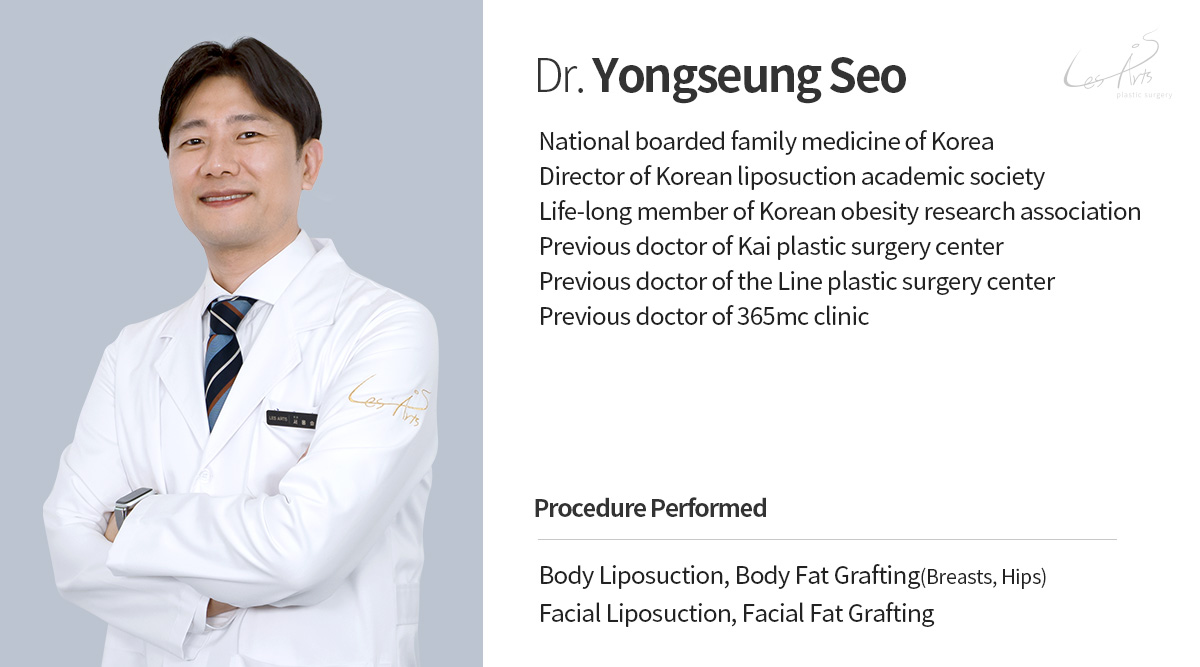
This column was authored directly by our medical staff.
※ Unauthorized copying, modification, editing, or redistribution is strictly prohibited. ※
If the inner thighs rub against each other and chafe, can liposuction create a thigh gap?
If there is sufficient fat distributed in the inner thigh, liposuction can help create a thigh gap.
However, results vary depending on fat thickness and skin elasticity, and the risks of skin sagging and uneven contours caused by excessive fat removal must also be considered.
[Lesarts Plastic Surgery Liposuction Surgery Information]
There are days when you cannot easily choose your favorite pants
because of how your inner thighs touch each other when standing in front of a mirror.
Even in photos taken with friends, your leg line stands out to you in particular,
and you may hesitate to wear short clothes even in the hot summer.
There are also cases where your eyes keep going only to your thighs even though your weight is not a major issue.
Whenever this happens, quite a few people needlessly blame themselves,
wondering if they neglected self-care.
In actual consultations,
more people visit our clinic with similar concerns than you might think.
While it may seem like a minor concern to others,
for the person experiencing it, it can be something that bothers them for a long time,
enough to affect their mood for the entire day.
However, thighs often do not change as easily as the effort put into them.
We frequently hear people say that when they lose weight, the volume in their breasts or hips—which they wanted to keep—decreases first,
while the thighs they most wanted to improve show little change.
Even after managing their diet and reaching their target weight,
some feel frustrated because fat in the desired area does not decrease.
This is because body fat cannot be selectively reduced in only the specific area you want.
Therefore, please keep in mind that concerns about the thigh line are not simply a matter of body weight,
but are also related to where and how much fat is distributed.
In the thigh—such as the front thigh, inner thigh, and outer lateral thigh (saddlebags)—
the amount and thickness of accumulated fat differ depending on each area.
Because these differences in fat distribution affect the overall contour of the legs,
even if people have similar thigh concerns,
the suitable method of improvement may differ for each individual.
In particular, the inner thigh is closely related to the space between both legs,
known as the thigh gap,
making it one of the areas many people care deeply about.
The patient we are introducing today also had similar concerns.
Although she normally maintained a consistent weight,
her biggest concerns were the volume in her inner thigh and front thigh,
as well as the thigh gap.
Let's take a look at how her leg line changed at about 3.5 months post-op
after undergoing thigh liposuction.
If you have been worried about your thigh line,
please check the changes shown through these actual before & after photos.
[Patient Information]
Age: Early 30s
Height: 150cm
Weight: 47.9kg
BMI: 21.3kg/m²
Body Fat Percentage: 31.5%
[Consultation and Diagnosis]
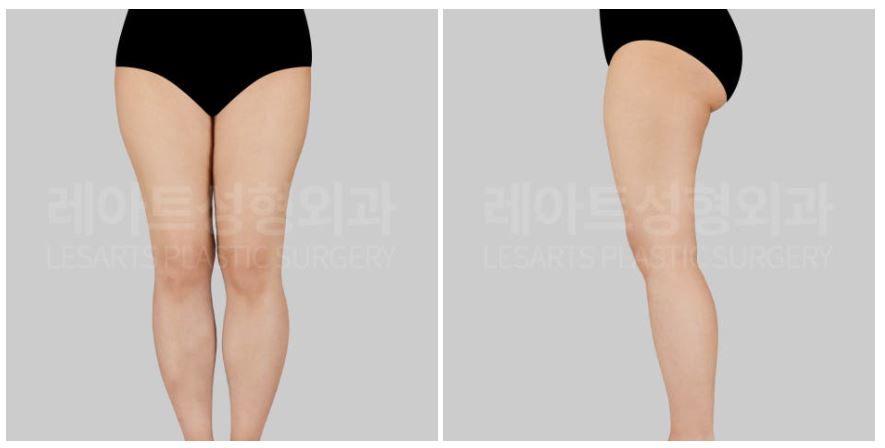
[Areas of concern before Thigh Liposuction - Inner Thigh, Front Thigh]
Among the various areas of the thigh, the patient was most concerned about
the volume of her inner thigh and front thigh in particular.
She wanted a natural thigh gap to form between both thighs,
and shared that she wished to preserve her existing hip line as much as possible.
Although she did not do separate workouts regularly,
she maintained a relatively consistent weight between 47~48kg.
She had previously undergone abdominal liposuction and hip dip fat grafting,
and had a history of receiving 1 session of fat-dissolving injections in her thighs about 1 month before visiting our clinic.
Looking at her body metrics, her BMI was 21.3, falling within the standard range,
while her body fat percentage was 31.5%, corresponding to mild obesity.
Additionally, her body fat mass was 15.1kg,
which was close to the upper limit of the standard range.
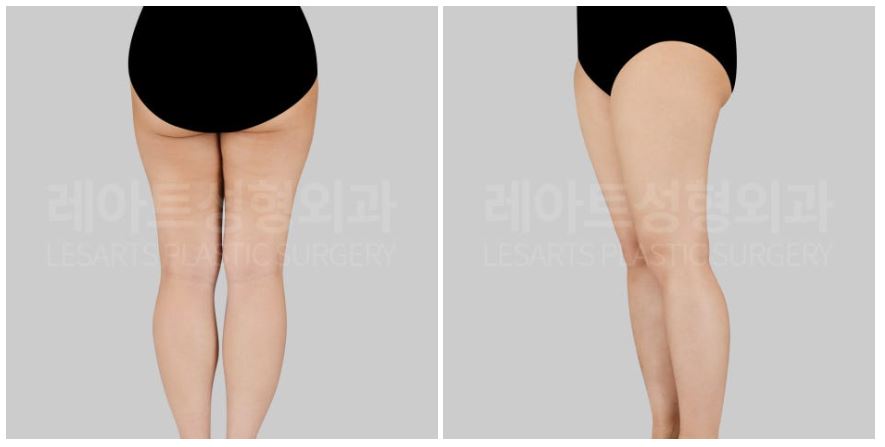
[Leg line before Thigh Liposuction]
Looking at her standing with both feet together from the front before surgery,
the inner thighs touched each other from below the groin down to above the knee,
so almost no space was formed between both thighs.
The width of the thighs starting below the pelvis was relatively wide,
and the bulging contour extending along the outer lateral thigh (saddlebags)
was observed even more clearly from the oblique and rear views.
From the side view, the front thigh line extending from the groin to the knee
appeared to protrude forward.
The fat thickness by area confirmed via ultrasound examination was as follows:
Lateral Thigh (Saddlebags): Right 29mm / Left 27mm
Inner Thigh: Right 21mm / Left 20mm
Front Thigh: Right 19mm / Left 17mm
Back Thigh: Right 8mm / Left 10mm
Knee: Right 13mm / Left 11mm
The examination showed that the lateral thigh (saddlebags), inner thigh, front thigh, and knee areas
all had a fat thickness exceeding 10mm,
meeting the conditions where noticeable changes can be expected through liposuction.
In particular, the inner thigh was confirmed to be over 20mm thick on both the left and right sides,
so we expected a relatively significant change in creating a thigh gap
when reducing the fat volume.
However, the more fat is removed, the higher the possibility that the skin fails to contract to match the reduced volume,
leading to post-operative skin sagging.
This aspect was thoroughly explained during the pre-operative consultation.
On the other hand, the back thigh measured about 8~10mm,
having a thinner fat layer compared to other areas.
[Surgical Design]
The inner thigh was the area the patient most wanted to improve.
Just as the fat layer was thick, the post-suction change could be significant,
which equally required caution regarding skin sagging.
Therefore, after informing her in advance about the possibility of post-operative sagging,
we planned to remove as much fat as safely possible from the upper inner thigh,
where both thighs press most closely together.
However, if fat is excessively removed down to the middle section of the inner thigh,
uneven contours may form on the skin surface
or the legs may actually appear thicker.
Considering this, a certain amount of fat was left in the middle section
to maintain a natural contour.
The front thigh was also one of the areas the patient was concerned about.
Compared to the inner thigh, the front thigh is an area where skin sagging occurs relatively less
even when a significant amount of fat is removed,
so we set the basic direction to remove as much fat as possible
within a safe range free of side effects.
However, we also explained that if there is a large difference in muscle thickness between the left and right thighs,
some fat may be left in one front thigh
to balance overall symmetry.
For the lateral thigh (saddlebags), the surgical scope was decided
considering the patient's request to preserve her existing hip line.
While refining the protruding fat of the lateral thigh (saddlebags) as much as possible,
the area where the hip and thigh connect had a structure
where the muscle contour curves inward.
If fat in this area is removed excessively as well,
it can actually make the legs look thicker or shorter.
Therefore, an appropriate amount of fat was preserved in that area
so that the curve flowing from the pelvis to the thigh remains smooth,
allowing the entire leg to look visually longer.
[Before & After Comparison of Thigh Liposuction]
(3.5 months post-op, taken under identical conditions)
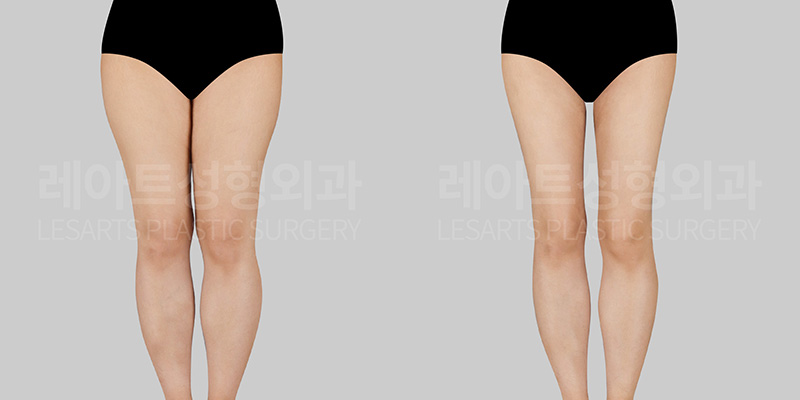
[Improving inner thigh fat with Liposuction - Dr. Yongseung Seo, Lesarts Plastic Surgery]
1. Inner Thigh
Comparing the front photos while standing with both feet together,
before surgery, the inner thighs were almost touching each other
from right below the groin down to above the knee.
On the other hand, after surgery, you can see that a clear space between the thighs
has formed extending from below the groin toward the knees.
As the volume of the inner thigh decreased, the overall contour was also refined much more smoothly,
showing a change where the legs appear straighter and slimmer than before.
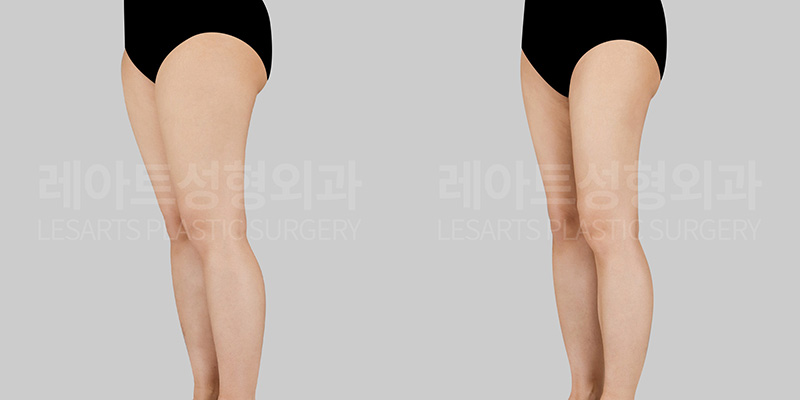
[Before & After comparison of Front Thigh Liposuction - Dr. Yongseung Seo, Lesarts Plastic Surgery]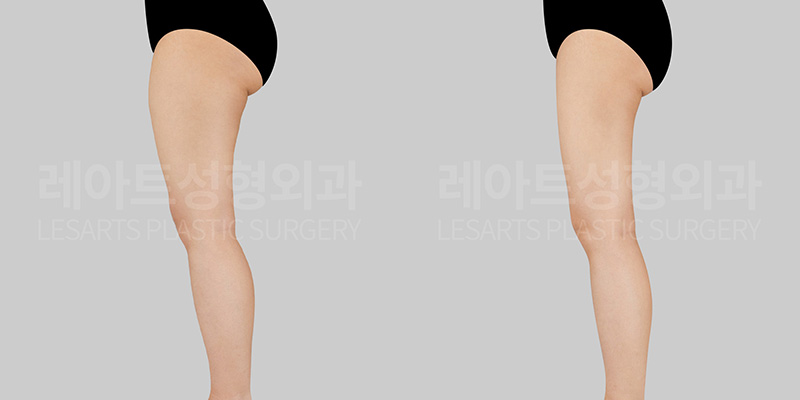
[Circumference change after Thigh Liposuction - Dr. Yongseung Seo, Lesarts Plastic Surgery]
2. Front Thigh
Comparing the before & after photos from the front,
before surgery, the overall width of the thigh was wide
and fat protruded forward.
After surgery, as the volume of the front thigh decreased,
you can see that the width of the thigh became much narrower than before.
Changes also appeared from the side view.
Before surgery, the front thigh line extending from the groin to the knee
protruded forward in a rounded curve.
In contrast, after surgery, this bulging curve softened,
making the front contour of the thigh flow straighter and more smoothly.

[Removal of inner thigh fat and lateral thigh (saddlebags) - Dr. Yongseung Seo, Lesarts Plastic Surgery]
3. Outer Thigh
Before surgery, on the outer thigh starting below the pelvis,
the lateral thigh (saddlebags) protruded outward.
After surgery, as the outward-bulging lateral thigh (saddlebags) was refined,
her existing hip line became even more accentuated than before.
The contour flowing from the pelvis to the thigh also became much smoother,
showing a change where the thighs look slimmer and longer overall.
4. Skin Elasticity
During the pre-operative consultation, we thoroughly informed the patient
that removing fat from the upper inner thigh carried a high possibility of causing skin sagging.
Accordingly, in the post-operative follow-up photos as well,
we carefully checked how well the skin in that area was holding up
and whether any sagging had occurred.
Fortunately, in the post-op photos,
no noticeable skin sagging or looseness
was clearly observed in the upper inner thigh.
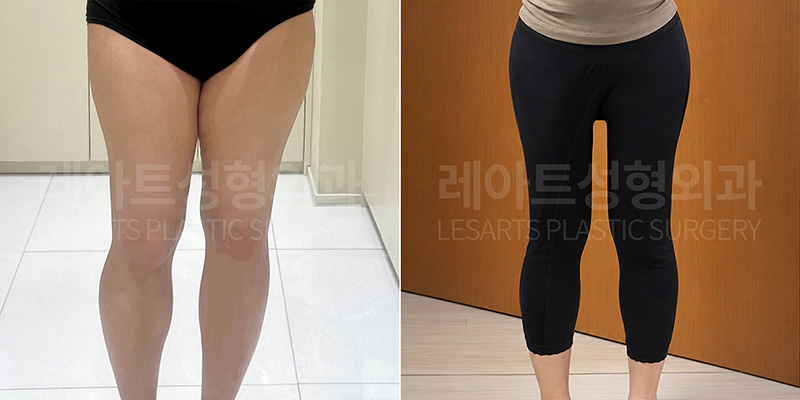
[Thigh Liposuction Surgery Reviews - Lesarts Plastic Surgery]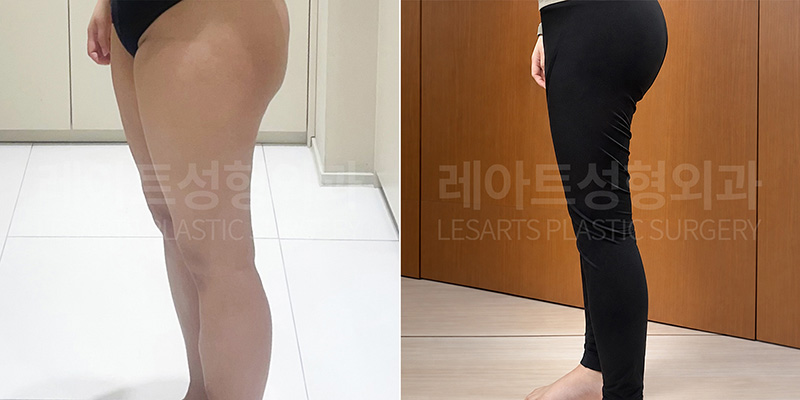
[Reducing front thigh with Liposuction - Lesarts Plastic Surgery]
The patient also expressed satisfaction with the reduced thigh circumference
and the changed overall leg line after surgery.
In particular, she was very pleased with the formation of the thigh gap,
which was what she desired most.
Check More Before & After Case Analyses of Thigh Liposuction
▼▼▼
When body weight increases or decreases,
fat does not change at the same rate across all areas.
Therefore, there may be areas that cause long-term concern
because fat is particularly stubborn there compared to other parts of the body.
If fat in a specific area does not decrease easily like this,
rather than repeatedly forcing weight loss,
considering improvement through procedures or liposuction
can be a more effective choice.
If you are worried about fat in a specific area,
it is advisable to receive a diagnosis and consultation from a specialist
to accurately check your current condition.
At Lesarts Plastic Surgery, we closely examine the patient's body type and fat distribution,
and based on the leg line you desire,
we clearly distinguish and guide you on what can actually be improved and what is difficult.
Even when the fat layer is sufficiently thick as in this case,
we do not simply say that liposuction will only yield good results.
If there is a possibility of skin sagging occurring during fat removal,
we thoroughly explain even these risk factors before surgery.
If you are wondering how much your long-standing concern about your thigh line
can be improved with a single surgery,
please visit Lesarts Plastic Surgery for a consultation.
Considering your current body type and skin condition,
we will explore a suitable direction for improvement together.
FAQ
Q1. Can I undergo thigh liposuction even if my weight is normal?
Even if your BMI is within the normal range, liposuction can be considered if fat is concentrated in specific areas.
In this case as well, the patient had a normal BMI of 21.3, and surgery was performed considering the fat distribution in her inner thigh and front thigh.
Q2. Can thigh liposuction create a thigh gap?
Reducing fat in the inner thigh can form space between both thighs.
In this case, the inner thigh fat thickness was 20~21mm on the left and right sides, and a thigh gap was confirmed at 3.5 months post-op.
Q3. Can the skin sag if as much inner thigh fat as possible is removed?
The inner thigh is an area where skin sagging can occur if a large amount of fat is removed.
Therefore, skin elasticity and fat thickness must be considered, and in this case too, the surgical scope was decided after informing the patient of the sagging risk in advance.
Q4. Is it better to perform liposuction on the front thigh and lateral thigh (saddlebags) together?
If fat distribution in the front thigh and lateral thigh (saddlebags) affects the leg contour, correcting them together can be considered.
However, it is important to adjust the suction volume by area—such as leaving some fat—to preserve the hip line and create a natural transition.
Q5. What changes can be seen 3.5 months post-op after thigh liposuction?
In this case, at 3.5 months post-op, we could see that a thigh gap had formed and the volume of the front thigh and lateral thigh (saddlebags) had decreased.
No distinct skin sagging was observed in the inner thigh either, though actual changes and recovery progress may vary depending on individual fat distribution and skin condition.
Dr. Yongseung Seo


Cases finding
similar to my profile
Customer Diagnostics


Select the surgery and
area you are interestedto see real
before andafter changes.


we
make you,
the art
Clinic hours
MON - FRI
10 am – 7pm
SAT
10 am – 4pm
Holiday
SUN, HOLIDAY
Location
Lesarts Moon Clinic Tower 4-5F, 40, Nonhyeon-ro 168-gil,
Gangnam-gu, Seoul, Republic of Korea

Medical institution name Lesarts Plastic Surgery
Address Lesarts Moon Clinic Tower 4-5F, 40, Nonhyeon-ro 168-gil, Gangnam-gu, Seoul, Republic of Korea
Representative Moon sung jun
