




Online Consultation
Please accurately enter the information below.
Quick Cost Consultation
Quick Consultation & Reservation
Cases finding
similar to my profile






Doctor's Note
Medical columns by our surgeons
Gynecomastia (Male Breast Reduction) | "I'm Stressed Because Only My Nipples/Areolas Protrude." - A Case of Gynecomastia Suspected to Be Associated with Hair Loss Prevention Medication
2026-11-06
Gynecomastia (Male Breast Reduction)|"I'm Stressed Because Only My Nipples/Areolas Protrude." - A Case of Gynecomastia Suspected to Be Associated with Hair Loss Prevention Medication
Written by Dr. Jihoon Moon, Lesarts Plastic Surgery
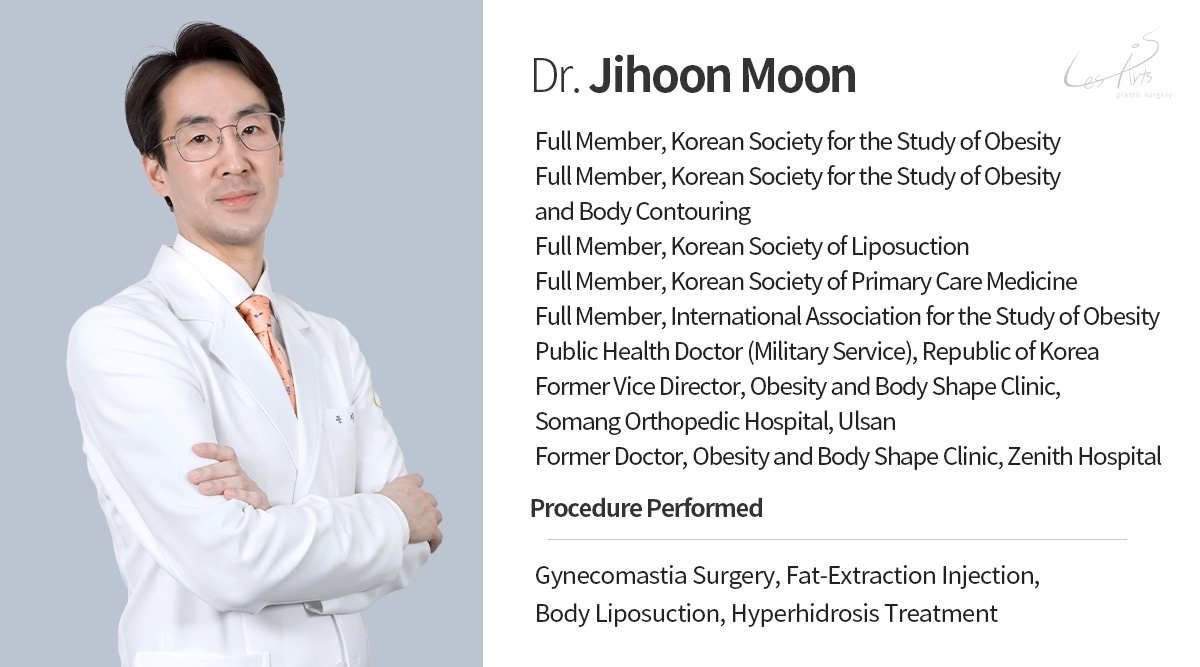
This column was authored directly by our medical staff.
※ Unauthorized copying, modification, editing, or redistribution is strictly prohibited. ※
Can long-term use of hair loss prevention medication cause gynecomastia?
Yes. 5α-reductase inhibitors used in certain hair loss prevention medications are known to be associated with the development of gynecomastia.
However, the cause cannot be definitively attributed to medication use alone; the duration of medication, the degree of nipple and areola protrusion, and the condition of the mammary gland tissue must be evaluated comprehensively.
[Lesarts Plastic Surgery Gynecomastia Surgery Information]
Hello.
Today, through the surgical case of a patient diagnosed with Simon grade IIa gynecomastia,
we will look at the characteristics of gynecomastia and related details together.
This patient was a male in his early 30s
who maintained a toned physique through regular exercise.
With a height of 174cm and a weight of 75kg, he fell into the mildly overweight category,
but his body fat percentage was not high, and during the physical examination,
his skin elasticity was confirmed to be very good.
Therefore, the likelihood that mammary gland tissue proliferated due to increased aromatase activity from excessive fat accumulation,
converting male hormones into female hormones,
did not appear to be high.
The biggest concern identified during the consultation with the patient
was the shape around the nipples and areolas rather than the overall size of the chest.
In particular, he felt significant discomfort due to a palpable lump beneath the nipples and areolas
and the nipples and areolas appearing larger and more protruding than before.
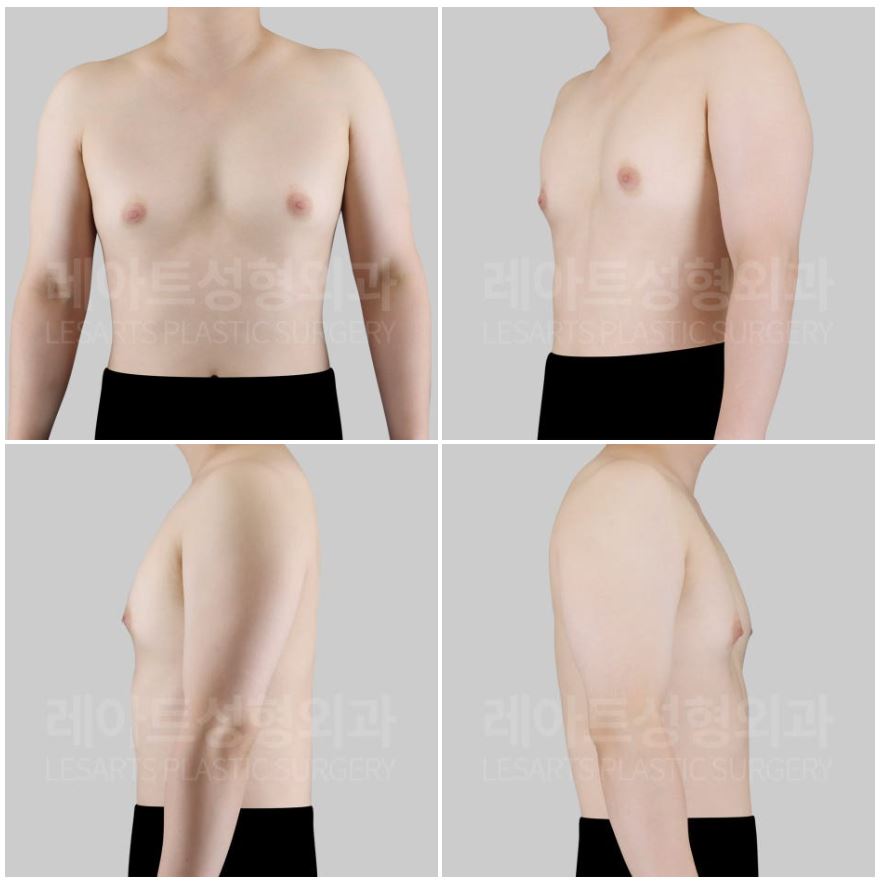
Pre-operative physical examination for Gynecomastia - Lesarts Plastic Surgery
The symptoms the patient mentioned during the consultation
were all confirmed during the actual physical examination.
In the ultrasound examination, mammary gland tissue measuring about 1.5~1.9cm in thickness and over 3.0cm in width
was observed in the subareolar space of both breasts.
Additionally, a honeycomb appearance on ultrasound, which suggests relatively firm and fibrous mammary gland tissue,
was also confirmed.
What caused this form of gynecomastia to develop?
What stood out while examining the cause
was the medication the patient had been taking long-term.
The patient had been consistently taking related medication for the past several years
for the purpose of preventing hair loss.
The medication he was taking belongs to the 5α-reductase inhibitor class,
with medications such as Propecia being representative examples.
Medications in this class are known to be associated with the occurrence of gynecomastia.
Of course, it is difficult to attribute the cause of gynecomastia solely to a specific drug
or a single factor.
However, in this patient's case, it was necessary to comprehensively consider his multi-year history of medication use,
the protrusion concentrated around the nipples and areolas rather than an overall enlargement of the chest,
the palpable lump in that area, and the ultrasound examination results.
Based on these findings, we determined that long-term use of hair loss prevention medication
may have contributed to some extent to the development of gynecomastia
or the proliferation of mammary gland tissue.
After evaluating the overall size and shape of the chest
as well as the presence of skin sagging,
he was diagnosed with Simon grade IIa gynecomastia,
and surgical treatment was actively recommended.
The patient had also received the same Simon grade IIa diagnosis
at another medical institution he had previously visited.
Ultimately, he decided to undergo surgery at Lesarts Plastic Surgery,
and bespoke surgery tailored to the patient's physical characteristics
and the condition of his mammary gland tissue was performed.
[2 Weeks Post-op Before & After Comparison of Gynecomastia Surgery - Front View]
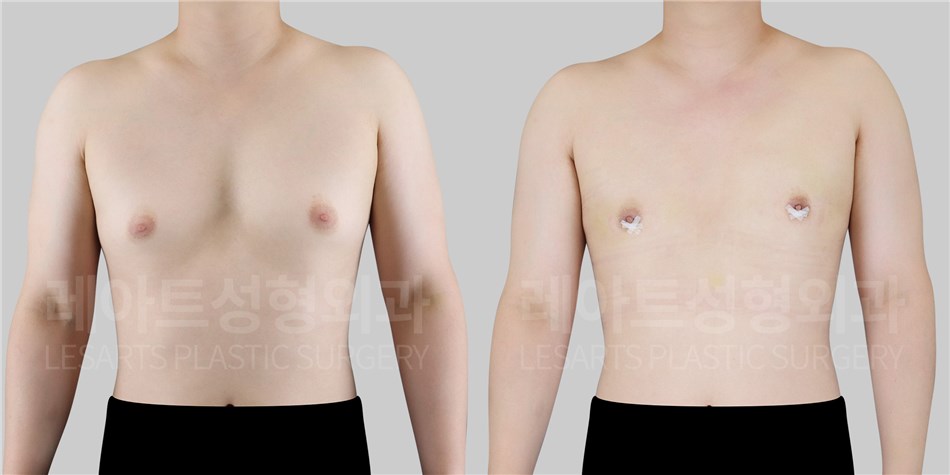
[Early 2-week post-op before & after comparison of Gynecomastia surgery - Dr. Jihoon Moon, Lesarts Plastic Surgery]
[Front view before & after Gynecomastia surgery - Lesarts Plastic Surgery]
Through consistent exercise, the patient had
well-defined, firm muscle contours across his upper body.
Fat was relatively concentrated in the center of both breasts,
where a slight volume was observed,
while almost no distinct fat accumulation was found
in front of the armpit (axilla) or along the sides of the chest.
In particular, due to the mammary gland tissue located beneath the areola,
a widened and forward-protruding areola was a characteristic feature.
2 weeks post-op is a period when a considerable amount of swelling may still remain.
Even when taking this recovery stage into account,
you can see that the volume previously formed in the center of the chest has decreased,
and the diameter of the areola has also slightly reduced compared to before.
However, gynecomastia surgery is a procedure that removes mammary gland tissue,
and does not directly reduce the physical width or height of the nipple itself.
Therefore, in the before & after photos as well,
no distinct change is observed in the size of the nipple itself.
If the size of the nipple remains an additional concern,
nipple reduction surgery can be considered after more than 6 months post-op
once the tissues have sufficiently stabilized.
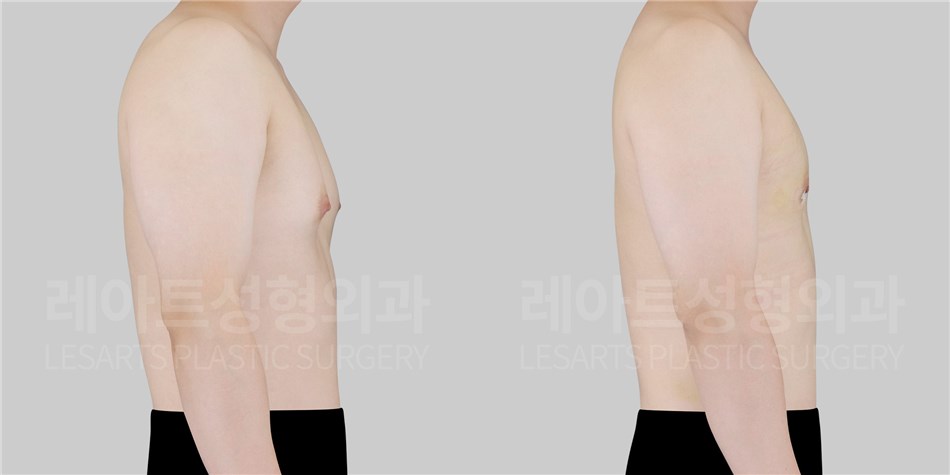
[2 Weeks Post-op Before & After Comparison of Gynecomastia Surgery - Left Side View]

[Causes and treatment methods of Male Gynecomastia - Dr. Jihoon Moon, Lesarts Plastic Surgery]
[Correlation between Male Gynecomastia and hair loss medication - Lesarts Plastic Surgery]
The highest point of the chest, which had been formed by the forward protrusion of the nipple and areola before surgery,
can be seen to have sufficiently receded backward
after the causative mammary gland tissue was removed.
On the other hand, as the volume of the upper chest became relatively more emphasized,
a masculine chest contour is revealed more naturally than before
even when wearing thin clothing.
Additionally, as the protrusion of the nipple and areola improved,
the issue of nipples showing prominently through shirts
is almost no longer observed.
[2 Weeks Post-op Before & After Comparison of Gynecomastia Surgery - Right Side View]
[Gynecomastia surgery with chest size asymmetry - Lesarts Plastic Surgery]
[T-shirt fit after Gynecomastia surgery - Lesarts Plastic Surgery]
Just like on the left chest, on the right side as well,
as the overall volume decreased after surgery,
you can see that the nipple and areola that had been protruding forward
have receded backward.
In particular, before surgery, left-right asymmetry (Left > Right) was observed,
where the left chest protruded more than the right.
As this asymmetry improved after surgery,
the contour was refined so that the part of the opposite chest, nipple, and areola that used to peek out
are no longer visible.
[2 Weeks Post-op Before & After Comparison of Gynecomastia Surgery - Oblique View]
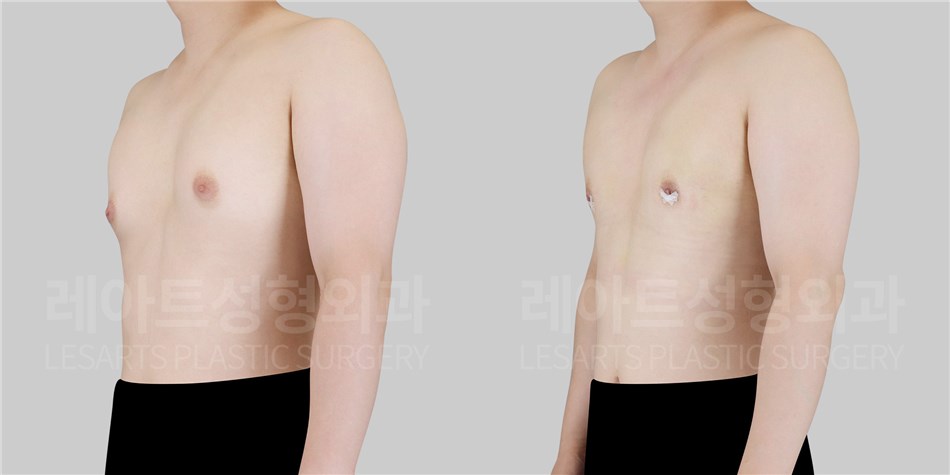
[Gynecomastia surgery for a patient taking hair loss prevention medication - Dr. Jihoon Moon, Lesarts Plastic Surgery]
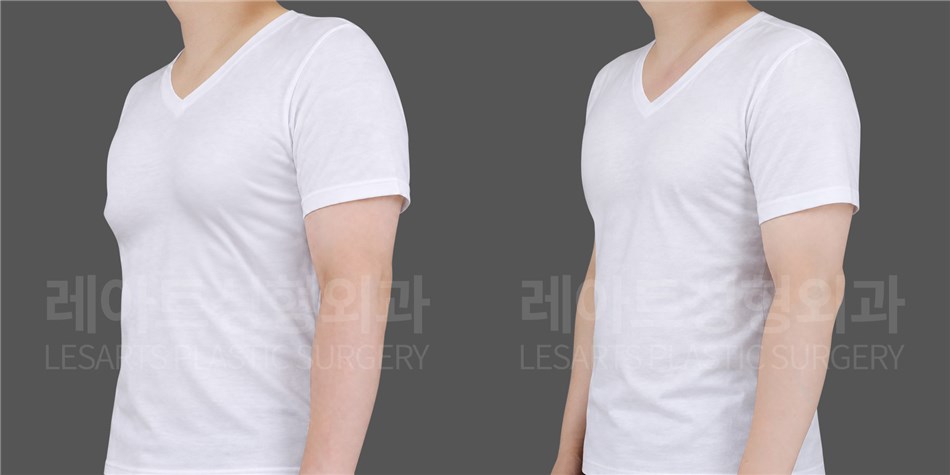
[Before & After Changes of asymmetric Gynecomastia surgery - Lesarts Plastic Surgery]
In the photos taken from the oblique angle,
you can see a more distinct masculine chest contour after surgery.
Check More Gynecomastia Surgery Case Analyses
▼▼▼

Firmly formed mammary gland tissue beneath the nipple and areola
is difficult to resolve easily even if you develop chest muscles through weight training
or lower your body fat percentage through aerobic exercise.
In particular, mammary gland tissue suspected to have proliferated in association with hair loss prevention medication
may have hardened as fibrosis progressed.
Since the difficulty of the surgical procedure can increase in such cases,
it is important to closely examine the condition of the mammary gland tissue
and take a more meticulous approach.
If a distinct lump is palpable beneath your nipple and areola,
if tingling pain occurs repeatedly,
or if only the areola appears particularly protruding compared to other parts of the chest,
please visit a medical institution to receive an accurate diagnosis.
Furthermore, when an association between hair loss prevention medication and the development of gynecomastia is suspected,
post-operative medication use also needs to be reviewed together.
It is advisable to consult with your prescribing physician to check whether adjusting the dosage
or switching to a different class of medication is possible.
While maintaining the effectiveness of hair loss treatment,
it is important to establish a medication plan tailored to your individual condition
to reduce the possibility of side effects such as the re-proliferation of mammary gland tissue.
Thank you.
FAQ
Q1. What are the characteristics of gynecomastia caused by hair loss prevention medication?
Rather than an overall change in chest size, it may appear as a convex protrusion around the nipple and areola or a palpable lump.
In this case as well, enlargement and protrusion of the nipple and areola were observed along with the proliferation of subareolar mammary gland tissue.
Q2. Can gynecomastia be improved through exercise or body fat reduction?
Mammary gland tissue that has proliferated beneath the nipple and areola is difficult to remove through weight training or aerobic exercise alone.
Gynecomastia caused by mammary gland tissue can also occur in men with a low body fat percentage and well-developed muscles.
Q3. What condition is Simon grade IIa gynecomastia?
Simon grade IIa is a stage where chest size has moderately increased without noticeable skin sagging.
This patient was diagnosed with Simon grade IIa after comprehensively evaluating chest shape, size, and skin elasticity.
Q4. Does the protrusion of the nipple and areola also improve after gynecomastia surgery?
Removing the mammary gland tissue located beneath the nipple and areola allows the protruding area to recede backward, improving the chest contour.
However, since gynecomastia surgery itself does not directly reduce the width or height of the nipple, a separate reduction procedure can be considered after recovery if nipple size is a concern.
Q5. Can I continue taking hair loss prevention medication even after gynecomastia surgery?
If a connection between hair loss prevention medication and gynecomastia is suspected, it is best to consult your prescribing physician regarding your post-operative medication plan.
Adjusting the dosage or switching to another medication may be considered if necessary, taking into account the possibility of mammary gland tissue re-proliferation.
Dr. Jihoon Moon


Cases finding
similar to my profile
Customer Diagnostics


Select the surgery and
area you are interestedto see real
before andafter changes.


we
make you,
the art
Clinic hours
MON - FRI
10 am – 7pm
SAT
10 am – 4pm
Holiday
SUN, HOLIDAY
Location
Lesarts Moon Clinic Tower 4-5F, 40, Nonhyeon-ro 168-gil,
Gangnam-gu, Seoul, Republic of Korea

Medical institution name Lesarts Plastic Surgery
Address Lesarts Moon Clinic Tower 4-5F, 40, Nonhyeon-ro 168-gil, Gangnam-gu, Seoul, Republic of Korea
Representative Moon sung jun
