Gynecomastia in Your 40s | Is It Just Middle-Age Weight Gain? 2-Week Results for Gynecomastia Developing With Weight Gain in Middle Age [Doctor's Note by Dr. Moon Ji-hoon]
Written by Dr. Moon Ji-hoon, Lesarts Plastic Surgery
This post was written directly by the attending physician.
Q. If my chest became larger along with weight gain in my 40s or 50s,
is it simply middle-age weight gain or gynecomastia?
A. In middle age and beyond, fat can accumulate in the chest due to weight gain,
but gynecomastia involving actual glandular tissue development
can also occur alongside hormonal changes.
Because it is difficult to distinguish by appearance alone between pseudogynecomastia caused primarily by fat
and true or mixed-type gynecomastia involving developed glandular tissue,
it is important to identify the cause through a physical examination and ultrasound.
Men can experience
"physiological gynecomastia" roughly three times in their lives.
First, neonatal gynecomastia can appear temporarily
while the effects of maternal hormones transferred during pregnancy
remain in the newborn's body.
In the past, there was a myth that squeezing a newborn's chest
would prevent lumps from remaining,
but this has no medical basis and should be avoided
because it can cause infection or damage to the nipple and areola.
The second is pubertal gynecomastia.
During puberty, temporary shifts in hormonal balance
can cause firm lumps beneath the areolas or noticeable chest enlargement.
In most cases, it improves naturally over time,
but in some individuals, glandular tissue remains and continues into adult gynecomastia.
The third, as in this patient's case,
is gynecomastia that develops in middle age and beyond.
Age-related hormonal changes, weight gain,
and increased fatty tissue can all contribute to changes in chest size.
On the other hand, simple fat accumulation and reduced skin elasticity
can also mimic gynecomastia (pseudogynecomastia), so
if your chest has suddenly become larger in middle age,
rather than assuming it is just "middle-age weight gain," it is best to have
your current tissue condition evaluated.

[T-Shirt Fit Before Gynecomastia Surgery in a Man in His 40s - Lesarts]
The patient had never been particularly concerned about his chest in the past,
but as his weight steadily increased after his 30s, he noticed
his chest also becoming larger and more protruding.
At first, he assumed it was simply "middle-age weight gain,"
but over time it began to bother him more,
so he visited the clinic to confirm whether it was actually gynecomastia.
On physical examination, he was 173 cm tall and weighed 81 kg—
somewhat heavier, but with a solid, well-built frame overall.
There was moderate-to-marked enlargement and protrusion across the chest,
with volume extending to the sides of the chest.
Fat accumulation appeared to play a significant role
in the overall fullness, including along the outer chest.
In addition to the visible fat, palpation around the nipples and areolas
confirmed thick, firm, lump-like tissue on both sides.
Ultrasound examination also revealed developed glandular tissue
measuring over 2.0 cm in thickness and over 3.5 cm in width on both sides.
While his skin elasticity was relatively well preserved,
slight shadowing caused by mild sagging was observed on the left chest.
Strictly speaking, his outward appearance corresponded to Simon Grade 2A,
though its actual contour was close to Grade 2B.
Because the patient's primary goal at first was simply to confirm whether he had gynecomastia,
he mentioned needing time to think about whether to proceed with surgery right away.
However, after hearing an explanation of his current chest condition
and the causes of gynecomastia in middle age,
he decided to move forward with surgery.
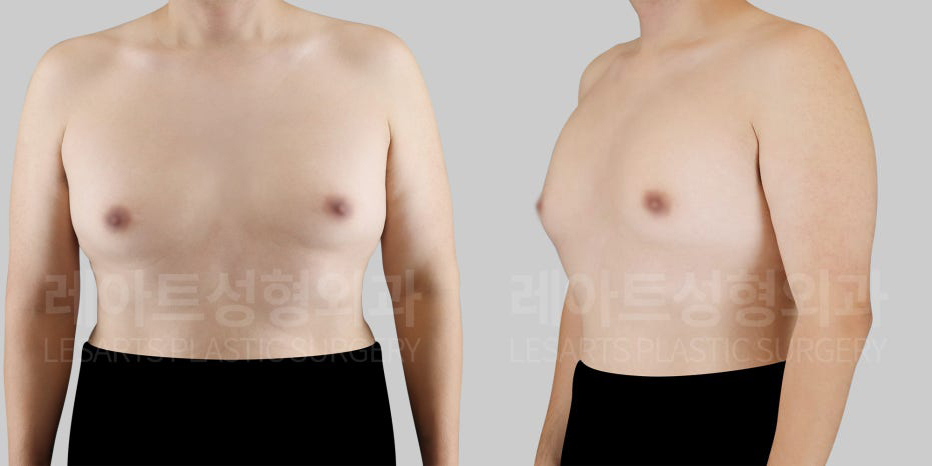
[Pre-Operative Physical Examination for Gynecomastia Surgery - Lesarts]
Bulging fullness extending to the side of the chest and
enlarged areolas are noticeable.
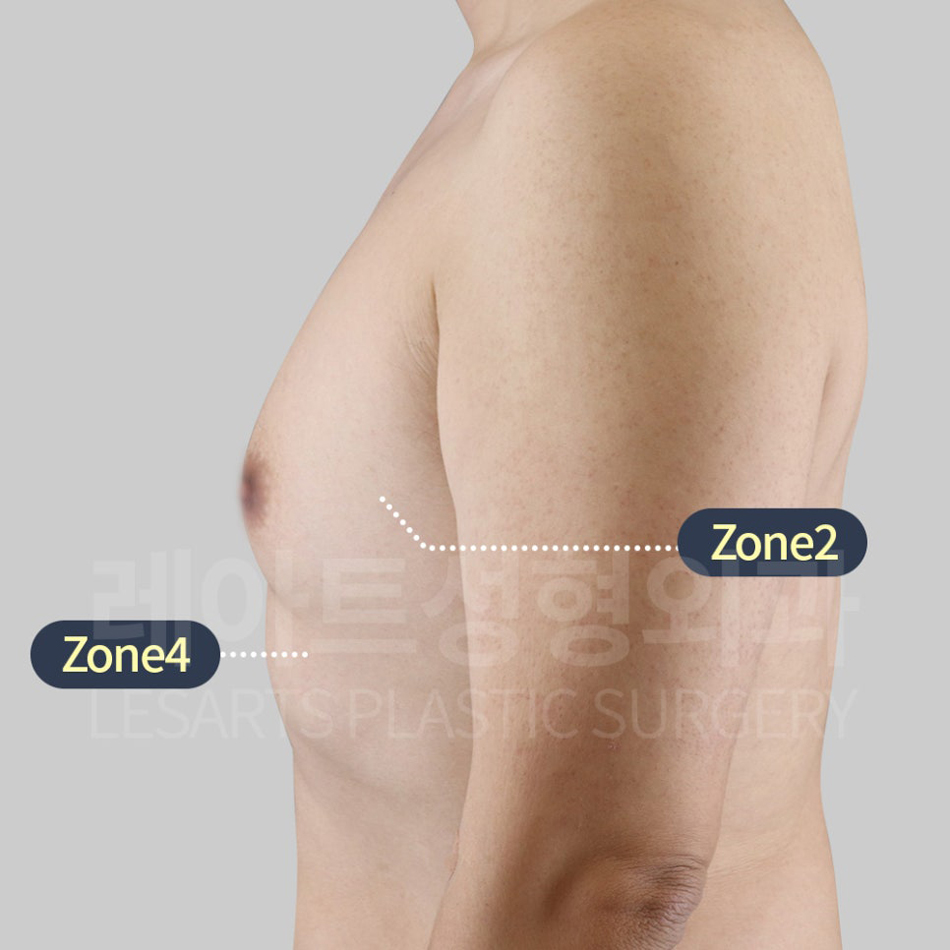
[Side View Before Gynecomastia Surgery - Lesarts Plastic Surgery]
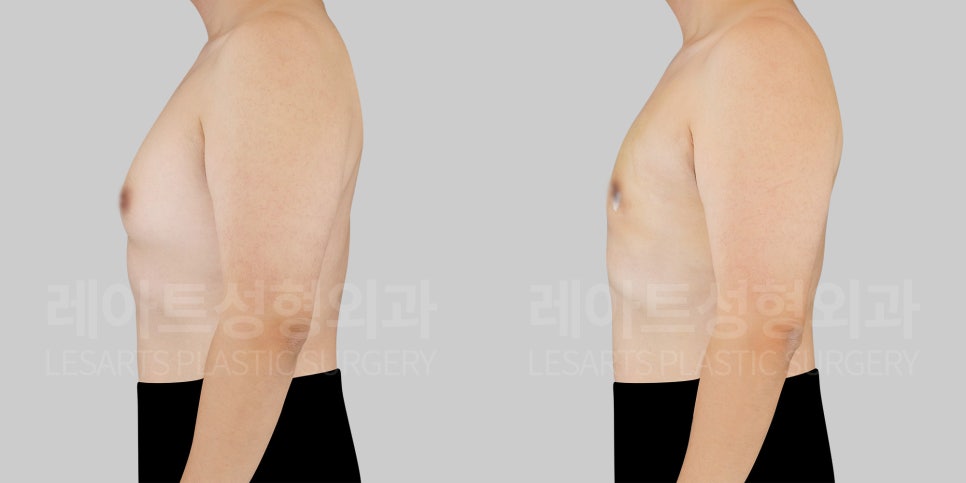
On the left side view,
protrusion of the chest itself (Zone 2) and
protrusion below the inframammary fold (Zone 4) appeared distinct from one another.
Therefore, we determined that rather than reducing fat only in the chest itself,
contouring the fat distributed in Zone 4 together
would allow us to smooth the lower chest border
and the volume above and below it more naturally.
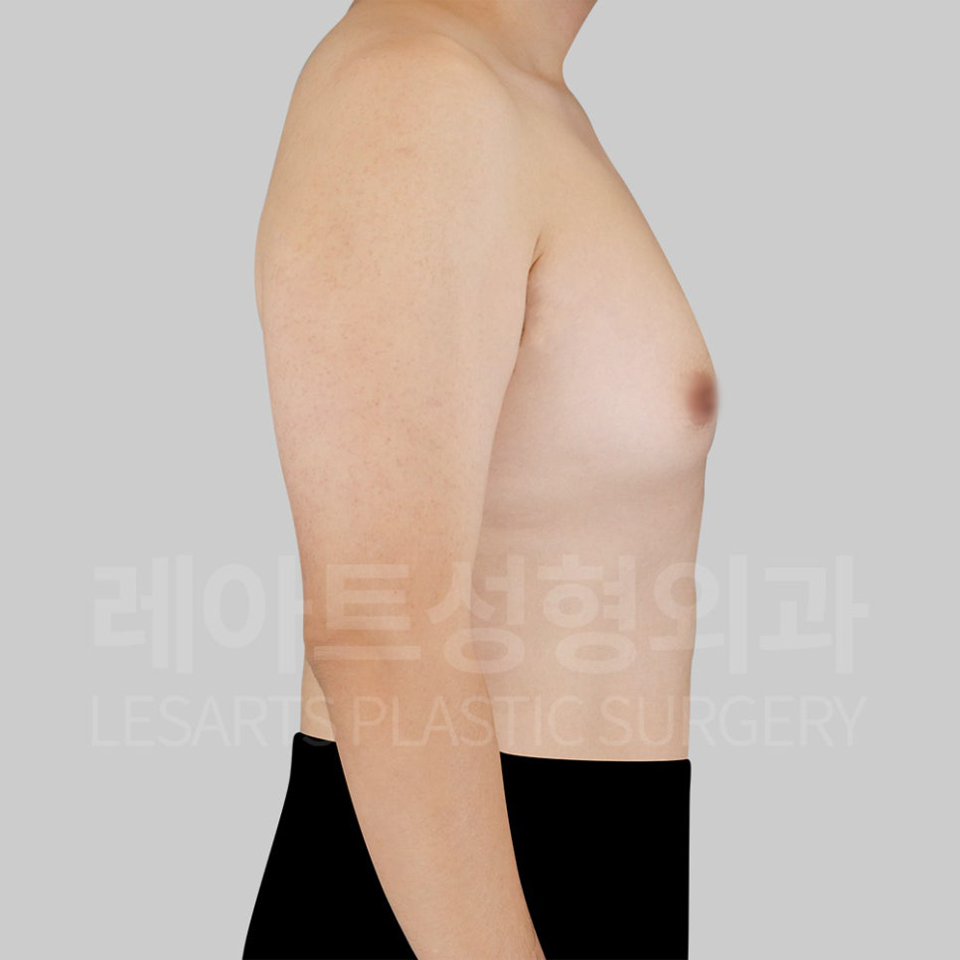
[Side View Before Gynecomastia Surgery - Lesarts Plastic Surgery]
On the right side as well, the entire chest projected forward,
but compared with the left side, unevenness around the lower chest
was relatively less pronounced.
Here are the post-operative photos.
[Front View]
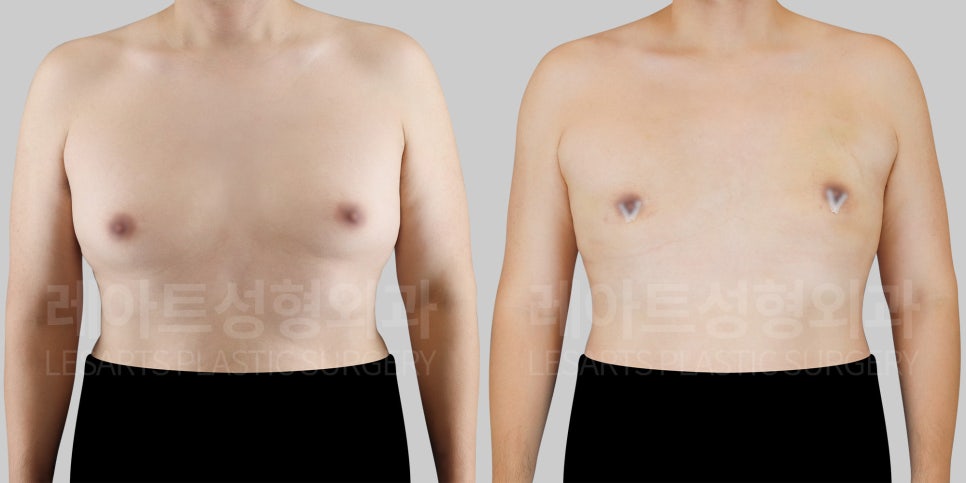
[Before and 2 Weeks After Gynecomastia Surgery (Front View) - Dr. Moon Ji-hoon, Lesarts]
This is approximately 2 weeks after surgery.
As overall chest volume decreased,
the faint lower chest border visible on the left softened,
and the fullness extending to the sides of the chest was also reduced.
With the removal of fat and glandular tissue,
the diameter of the areolas also appears slightly smaller than before surgery.

[Changes in T-Shirt Fit 2 Weeks After Gynecomastia Surgery - Lesarts Plastic Surgery]
[Both Side Views]
[Before and After Gynecomastia Surgery Comparison: Left Side View - Lesarts]
On the left side view,
forward projection of the nipple and areola decreased,
and with fat in Zone 4 below the lower chest crease also contoured,
the uneven contour seen before surgery has become much smoother.

[Side-View Changes After Gynecomastia Surgery - Lesarts]

[Before and After Gynecomastia Surgery: Right Side View - Lesarts Plastic Surgery]
On the right side view as well, the thickness of the forward-protruding chest decreased,
resulting in a smoother side contour than before.
[Both Oblique Views]
[2 Weeks After Gynecomastia Surgery - Dr. Moon Ji-hoon, Lesarts]

[Before and After Gynecomastia Surgery - Lesarts Plastic Surgery]
[Changes in Chest Size After Gynecomastia Surgery - Dr. Moon Ji-hoon, Lesarts]
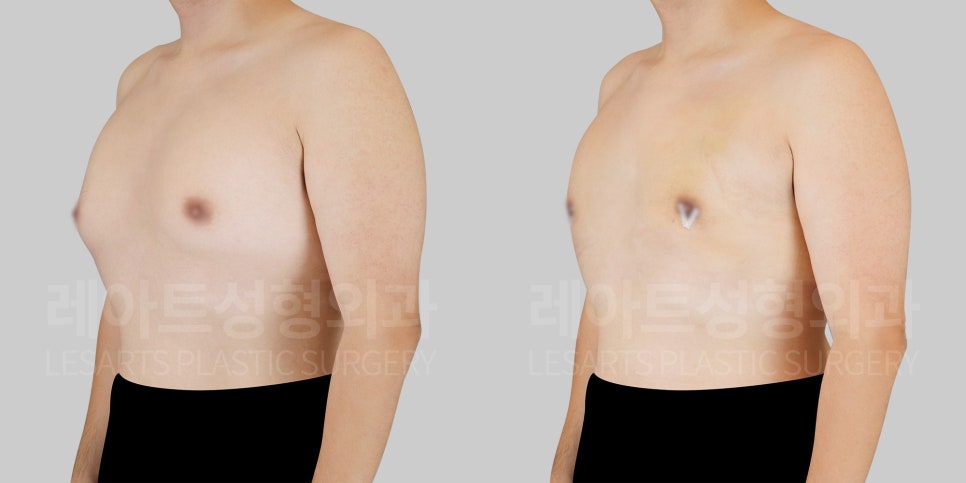
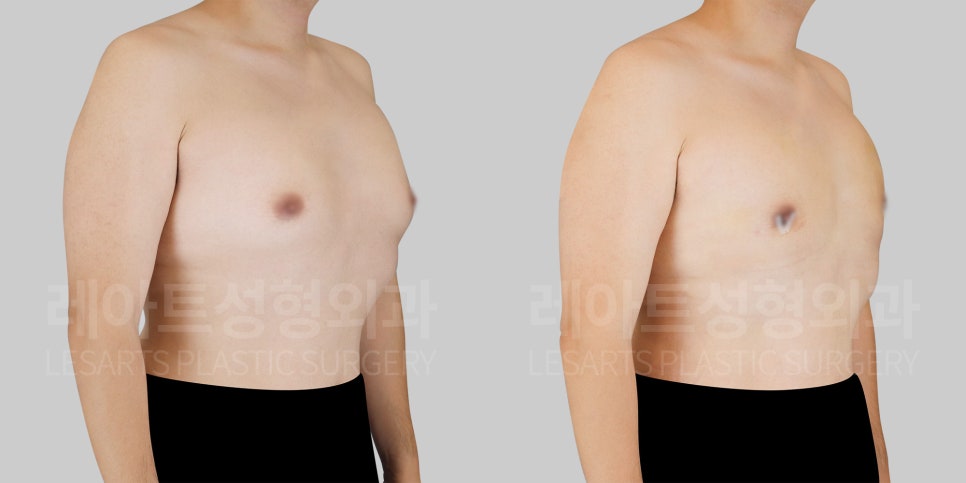
In the oblique views, as thickness in the upper chest
and the contour created by areolar protrusion decreased,
the overall upper-body line appears
more refined than before.
Although gynecomastia surgery is often considered by men in their 20s and 30s,
many men in their mid-40s and older are also concerned about chest protrusion.
If your chest has grown larger alongside weight gain in middle age,
it is worth checking first whether it is simply age-related fat
or gynecomastia involving developed glandular tissue.
If chest protrusion remains unchanged despite exercise and weight management,
consider having an accurate examination to assess your current condition.
Accurately understanding your current chest condition
can be the first step in treating gynecomastia.
Middle-Aged Male Gynecomastia FAQ
Q1. Can gynecomastia newly develop in your 40s or 50s?
In middle age and beyond, hormonal changes and weight gain
can affect chest size.
Because it may be simple fat accumulation or actual glandular tissue
development, an accurate evaluation is needed.
Q2. If a middle-aged man's chest gets larger, is it always gynecomastia?
Not necessarily. It may be pseudogynecomastia caused mainly by fat accumulation,
or true or mixed-type gynecomastia involving developed glandular tissue.
Q3. How can you tell middle-age weight gain apart from gynecomastia?
It can be difficult to distinguish accurately by appearance alone.
Palpation and an ultrasound examination can confirm the presence of glandular tissue
and the distribution of surrounding fat.
Q4. Does gynecomastia surgery also remove fat below the lower chest crease?
If fat in the lower chest or below the inframammary fold affects
the overall chest contour, liposuction can be planned for that area as needed.
Q5. Is 2 weeks after gynecomastia surgery the final result?
Two weeks is still an early recovery phase when swelling and tissue changes remain.
As swelling subsides and the tissues stabilize afterward, the chest contour
may continue to change further.












