




Online Consultation
Please accurately enter the information below.
Quick Cost Consultation
Quick Consultation & Reservation
Cases finding
similar to my profile






Doctor's Note
Medical columns by our surgeons
Thigh Liposuction | Lower Body Obesity with Low Muscle Mass? Thigh Liposuction Results Will Differ.
2026-11-24
Thigh Liposuction | Lower Body Obesity with Low Muscle Mass? Thigh Liposuction Results Will Differ.
Written by Dr. Pyongrim Choi, Lesarts Plastic Surgery
This column was authored directly by our medical staff.
※ Unauthorized copying, modification, editing, or redistribution is strictly prohibited. ※
If your thighs have a lot of fat and little muscle, how do liposuction results differ?
Even with the same thigh circumference, results vary depending on whether the volume consists of muscle or fat.
If the fat ratio is high and skin elasticity is good, it is relatively advantageous for refining the leg line through liposuction,
whereas the muscle type has limits to thickness reduction because the muscle volume remains. The achievable scope is determined through physical examination.
[Lesarts Plastic Surgery Liposuction Surgery Information]
When people think of lower body obesity, they usually picture someone with well-developed thigh muscles or a wide pelvis first.
However, when we actually meet patients in the consultation room, there are quite a few people who do not have much muscle, yet have fat concentrated in their lower body rather than their upper body.
People with this body type share a unanimous concern: even when they lose weight through diet and exercise, their thighs stubbornly refuse to slim down.
When losing weight, the face and upper body slim down first, while the inner thighs and outer lateral thighs (saddlebags) that actually bother them tend to remain unchanged.
The patient we are introducing today had the exact same body type.
With a height of 163cm and a weight of 55kg, her overall frame was not large, but her lower body stood out compared to her upper body, and the volume in her inner thighs and lateral thighs (saddlebags) was her biggest worry.
Pre-operative Photos Before Thigh Liposuction
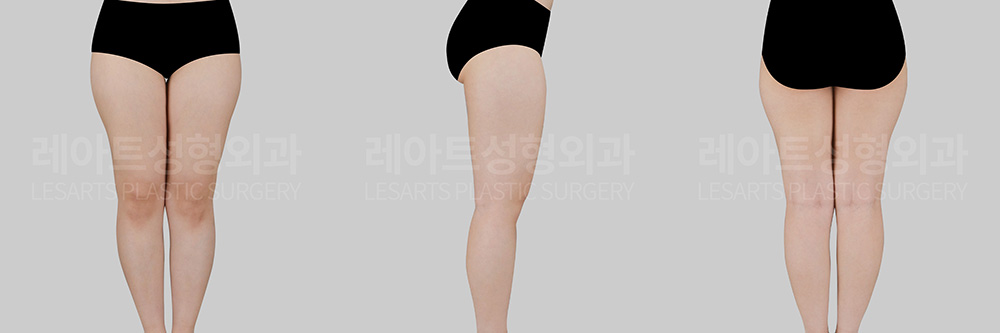
[Pre-operative Diagnosis for Thigh Liposuction - Lesarts Plastic Surgery]
1. Thighs with More Fat Than Muscle: What Do They Look Like?
Looking solely at her weight, this patient was close to an average build. However, looking closely at her body balance, her lower body was more developed than her upper body,
and thick fat was distributed across her entire thighs.
There were three noticeable characteristics:
First, her inner thighs touched each other, making the overall impression look heavy and stuffy when standing with both legs together.
Second, her outer lateral thighs (saddlebags) bulged out below the pelvis, making the line descending from the pelvis to the thighs uneven.
Third, not only from the front but also from the side, the volume of her front thighs was large, making the front-to-back thickness of her legs look thick.
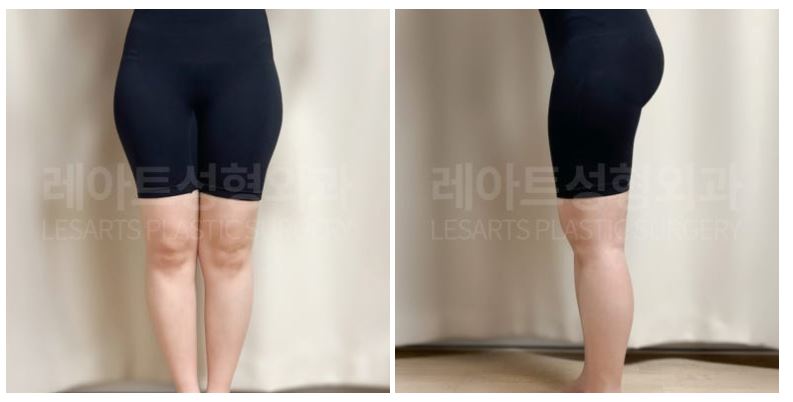
[Pre-operative Selfie Before Liposuction]
Meanwhile, her skin elasticity was relatively good, and she was not a muscle type with particularly overdeveloped thigh muscles.
Thighs with a high fat ratio supported by good skin elasticity like this offer relatively favorable conditions for reducing volume and refining the entire leg line through liposuction.
However, because the ratio of muscle to fat, skin elasticity, and fat distribution vary from person to person, the extent of achievable improvement must be determined through physical examination.
3 Months Post-op After Thigh Liposuction (Front / Side / Back)
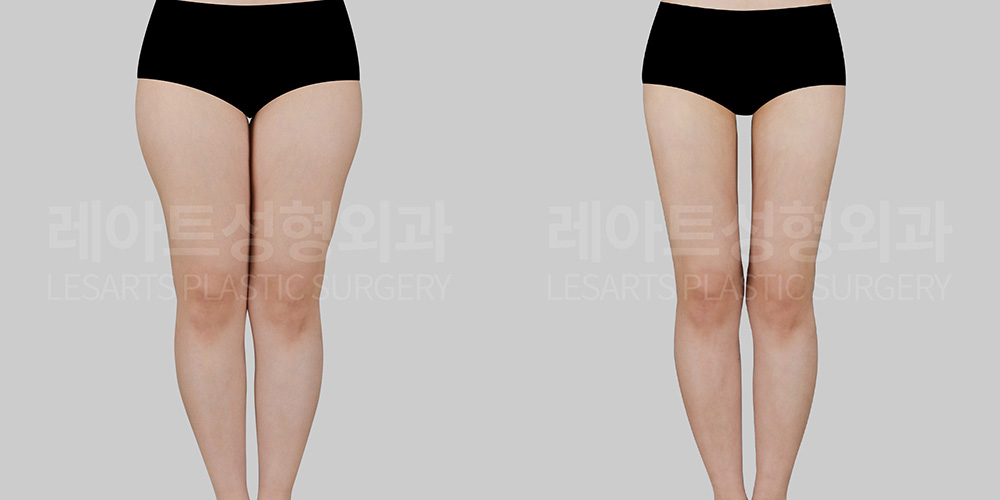
[Before & After Thigh Liposuction at Lesarts Plastic Surgery - Dr. Pyongrim Choi, Lesarts Plastic Surgery]
2. What Changed Most Significantly 3 Months After Thigh Liposuction?
The focus of this surgery was not to blindly make the thighs as thin as possible.
The goal was to refine the bulging areas so that the entire leg appears to flow long and straight.
1) A natural thigh gap formed between the previously touching inner thighs.
Before surgery, her inner thighs touched each other so almost no empty space was visible between her legs.
After surgery, as inner thigh fat decreased, a natural gap formed between both thighs.
Thanks to this, standing with her legs together gives a much lighter and sleeker impression.
However, the thigh gap also depends on pelvic width, femur angle, and the spread of muscle and fat, so it varies from person to person.
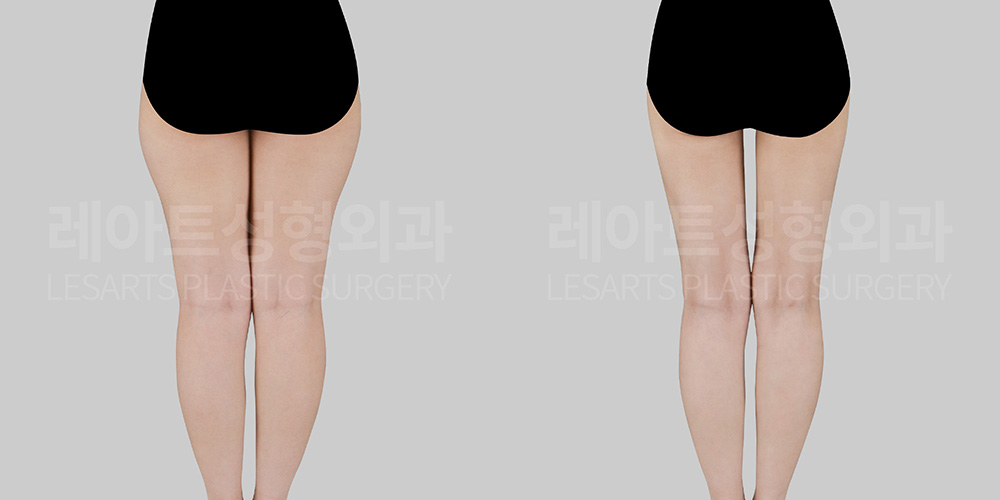
[Liposuction Effect for Lower Body Obesity - Dr. Pyongrim Choi, Lesarts Plastic Surgery]
2) Protruding lateral thighs (saddlebags) decreased, creating a smooth hip line transition.
Before surgery, the lateral thighs (saddlebags) protruded outward below the pelvis, making the pelvis and thighs look disconnected.
This protrusion not only increases actual thigh circumference, but also makes the side-to-side width of the legs appear wider and causes the legs to look relatively shorter.
After surgery, the protrusion of the lateral thighs (saddlebags) decreased, making the curve descending from the pelvis to the thighs much gentler.
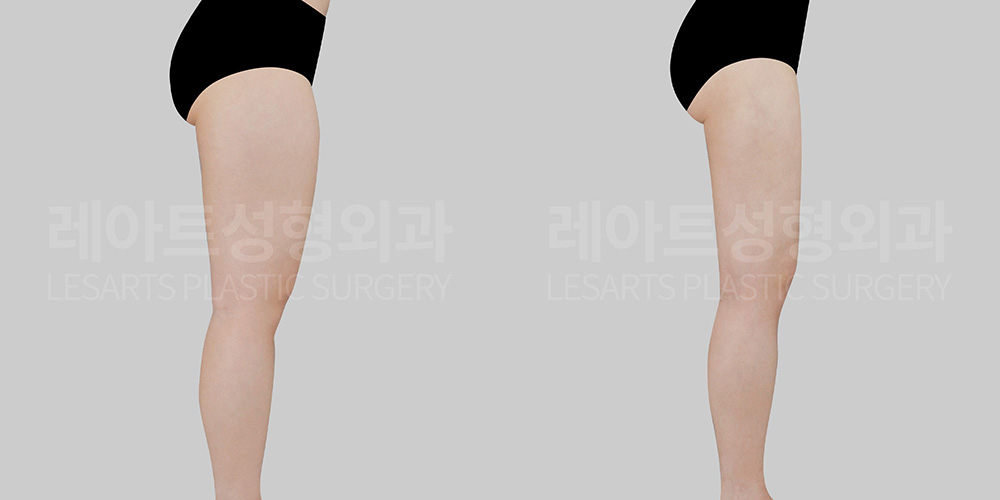
[Front Thigh Thickness Change After Thigh Liposuction - Dr. Pyongrim Choi, Lesarts Plastic Surgery]
3) Front thigh volume decreased, changing the side-profile thickness of the legs.
Just as important to check as the front view is the side view photo.
As front fat decreased, the thickness of the thigh viewed from the side became noticeably thinner.
The shape of the knee is also worth noting. Before surgery, the large front thigh volume somewhat obscured the knee contour.
After liposuction lightened the front thigh, the area around the knee became clearer, creating a proportional change where the knee appears to sit slightly more forward.
This is not because the knee itself changed, but rather a visual change resulting from the shift in relative volume difference between the thigh and the knee.

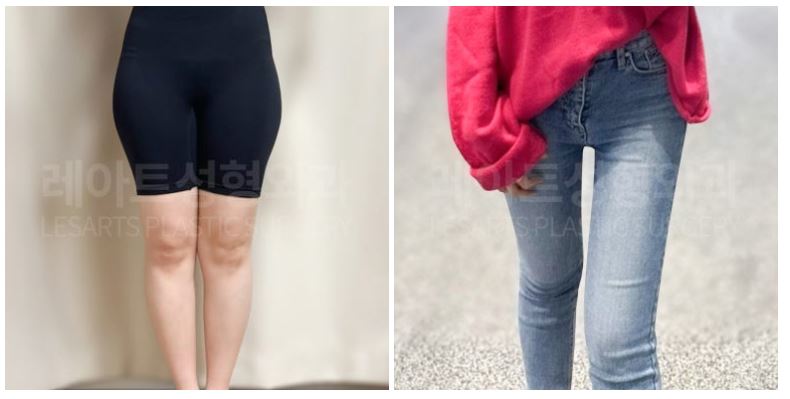
[Thigh Liposuction Surgery Reviews at Lesarts Plastic Surgery (Provided directly by the patient)]
3. Is Having High Lower-Body Fat and Low Muscle Advantageous for Liposuction?
This is the key message we most want to convey through this case.
Thigh liposuction results are not determined by a single number like body weight or thigh circumference.
The key is what kind of tissue makes up the thigh volume.
Even with the same thigh circumference, someone with a high muscle ratio and someone with a high subcutaneous fat ratio can expect different changes after surgery.
For the muscle type, there is a limit to reducing thickness because the volume of the muscle itself remains.
On the other hand, for the fat type, appropriately reducing the fat layer can produce noticeable volume changes.
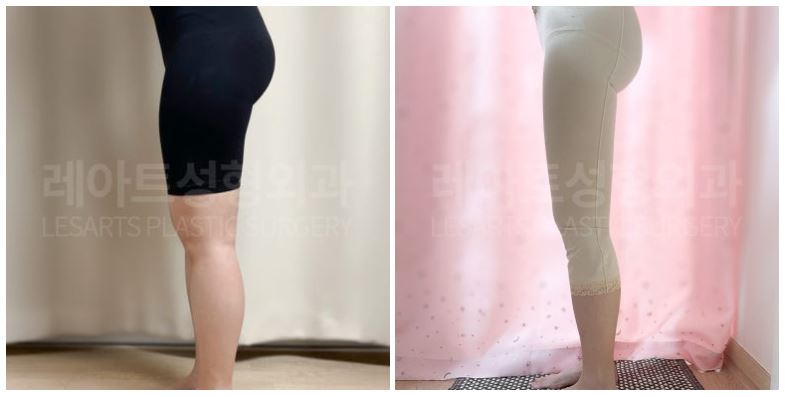
[Thigh Liposuction Surgery Reviews at Lesarts Plastic Surgery]
Those who fall into the following categories may have favorable conditions when considering liposuction:
✔ Body types where fat is concentrated in the lower body rather than the upper body
✔ Body types where the inner thighs or lateral thighs (saddlebags) do not easily slim down even with weight loss
✔ Thighs with more subcutaneous fat than muscle
✔ Body types with generally good skin elasticity
✔ Cases where fat is localized in the inner, outer, and front thighs
Rather than unconditionally removing as much fat as possible, adjusting volume by area to balance the entire thigh is much more important.
Having lower body obesity does not necessarily mean you need to lose more weight. Especially if your upper body is slim while fat is concentrated only in your thighs,
it can be difficult to achieve your desired leg line through weight loss alone.
In cases like this patient, where the fat ratio is higher than muscle and skin elasticity is good, thigh liposuction can significantly transform the overall silhouette of the legs.
The approach differs depending on whether the cause of thick thighs is muscle or fat.
If only your thighs refuse to change despite dieting, we recommend first checking the fat distribution and muscle ratio of your current body type.
FAQ
Q1. Why is it hard to lose fat only in the thighs even when dieting?
When losing weight, the face and upper body often slim down first, while the inner thighs and outer lateral thighs (saddlebags) tend to remain.
This concern is especially common in body types where fat is concentrated in the lower body compared to the upper body and muscle mass is low.
Q2. Do results differ depending on whether thick thighs are caused by muscle or fat?
Yes, they can differ. Even with the same thigh circumference, expected post-operative changes differ between those with a high muscle ratio and those with a high subcutaneous fat ratio.
The muscle type has limits to thickness reduction because muscle volume remains, whereas the fat type can show noticeable volume changes when the fat layer is appropriately reduced.
Q3. What body type offers favorable conditions for liposuction?
This includes body types with fat concentrated in the lower body rather than the upper body, body types where inner thighs or lateral thighs (saddlebags) resist slimming even with weight loss,
thighs with more subcutaneous fat than muscle, body types with good skin elasticity, and localized fat in the inner, outer, and front thighs. However, the final assessment must be made through physical examination.
Q4. Does everyone get a thigh gap after surgery?
It varies from person to person. The space between the thighs is influenced not only by fat volume, but also by pelvic width, femur angle, and the distribution of muscle and fat.
Q5. Should I lose more weight if I have lower body obesity?
Not necessarily. If your upper body is slim and fat is concentrated only in your thighs, it can be difficult to achieve your desired leg line through weight loss alone.
Rather than unconditionally removing a large amount of fat, adjusting volume by area to balance the whole is important, and the actual achievable surgical scope is determined through physical examination.
Dr. Pyongrim Choi


Cases finding
similar to my profile
Customer Diagnostics


Select the surgery and
area you are interestedto see real
before andafter changes.


we
make you,
the art
Clinic hours
MON - FRI
10 am – 7pm
SAT
10 am – 4pm
Holiday
SUN, HOLIDAY
Location
Lesarts Moon Clinic Tower 4-5F, 40, Nonhyeon-ro 168-gil,
Gangnam-gu, Seoul, Republic of Korea

Medical institution name Lesarts Plastic Surgery
Address Lesarts Moon Clinic Tower 4-5F, 40, Nonhyeon-ro 168-gil, Gangnam-gu, Seoul, Republic of Korea
Representative Moon sung jun
