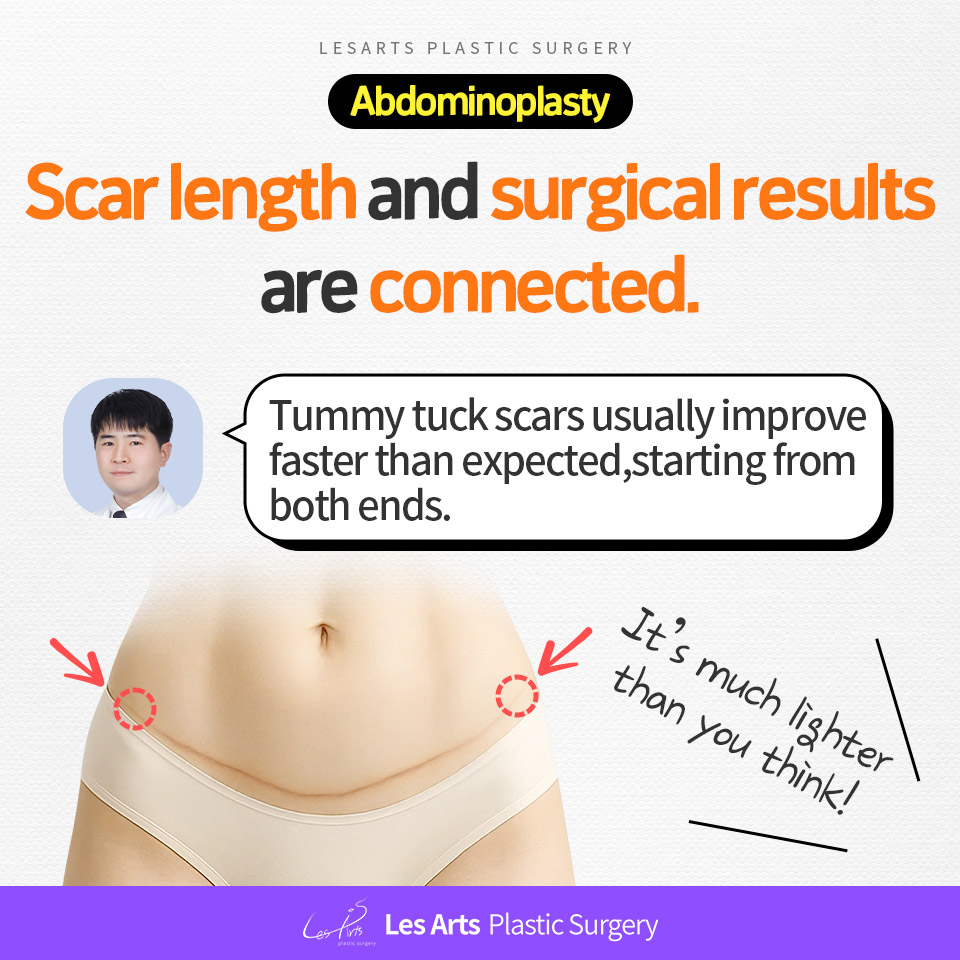
Hello, I am Dr. Kukhan Lee, Board-Certified Plastic Surgeon at Lesarts Plastic Surgery Clinic.
Today, we will discuss how tummy tuck scar lengths are clinically calculated,
and explore the anatomical complications that arise when attempting to force an artificially short incision.

For patients considering abdominoplasty,
the final length and visibility of the surgical scar is invariably the primary concern.
Surgeons also strive to keep incisions as minimal as possible,
yet strict geometrical and anatomical principles govern safe surgical design.
In abdominoplasty, to excise sagging tissue and close the wound smoothly without puckering,
the surgical blueprint adheres to the principles of fusiform excision design.
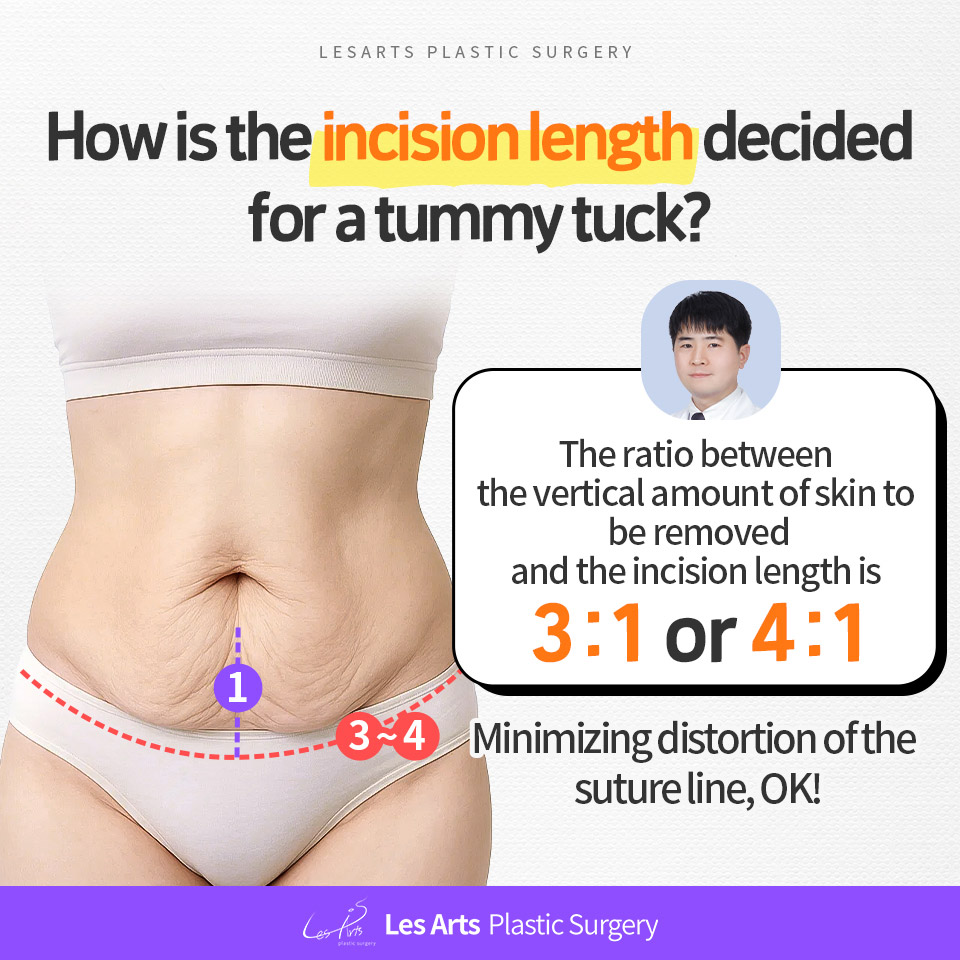
Here, the ratio between the horizontal incision length and vertical skin resection height
must maintain a Width (Horizontal Incision) : Height (Vertical Skin Resection) ratio of 3:1 or 4:1
to prevent standing cone deformities and achieve a flat, tension-free closure.
For example, if the vertical span of redundant lax skin measures 7 cm,
surgical geometry requires a horizontal incision span of at least 21 to 28 cm.
In essence, the more severe the skin sagging, the broader the resection area becomes,
which proportionally dictates a longer surgical incision line.
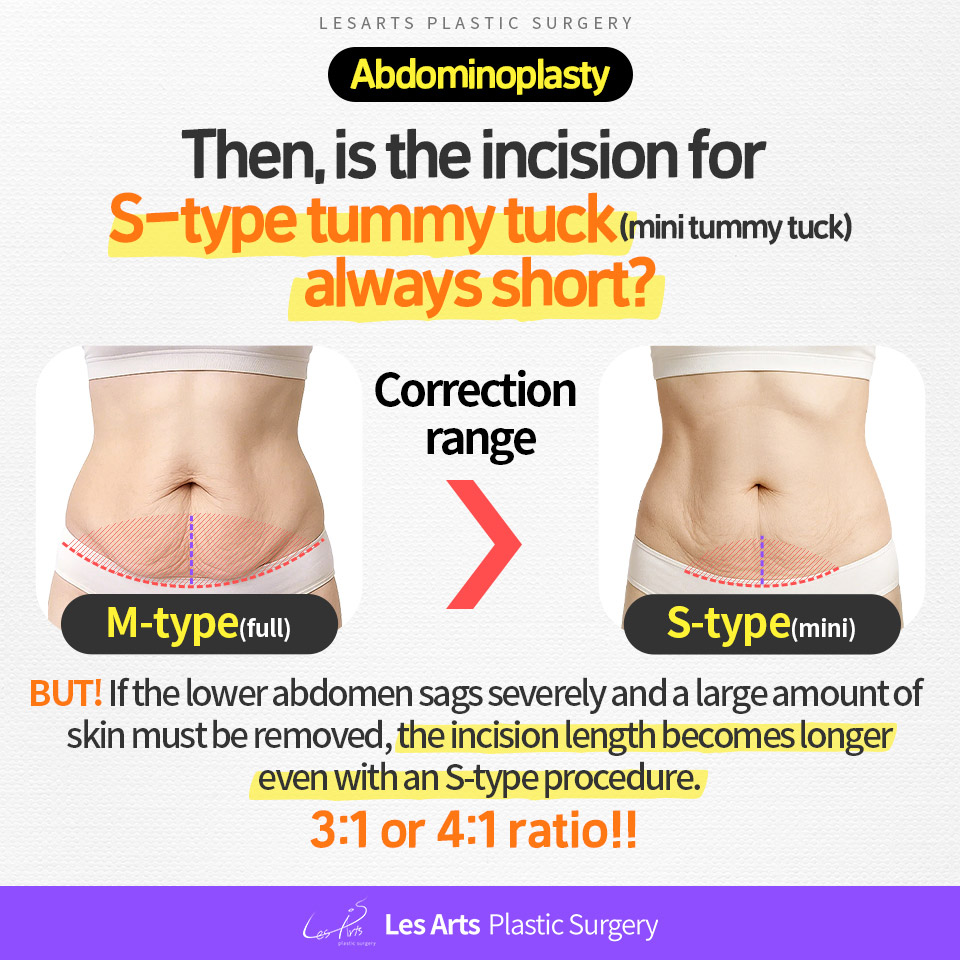
How does incision length vary across surgical methods?
Mini Tummy Tuck (Type S) vs. Full Tummy Tuck (Type M)
Because a full abdominoplasty (Type M) addresses widespread laxity spanning from upper to lower abdomen,
its incision is inherently longer than that of a standard mini tummy tuck (Type S).
Crucially, choosing a mini tummy tuck (Type S) does not guarantee a tiny scar.
If lower abdominal skin laxity extends broadly across the pelvis laterally,
even a mini tummy tuck requires an incision length comparable to a full Type M procedure
to fully eradicate redundant skin folds without distortion.
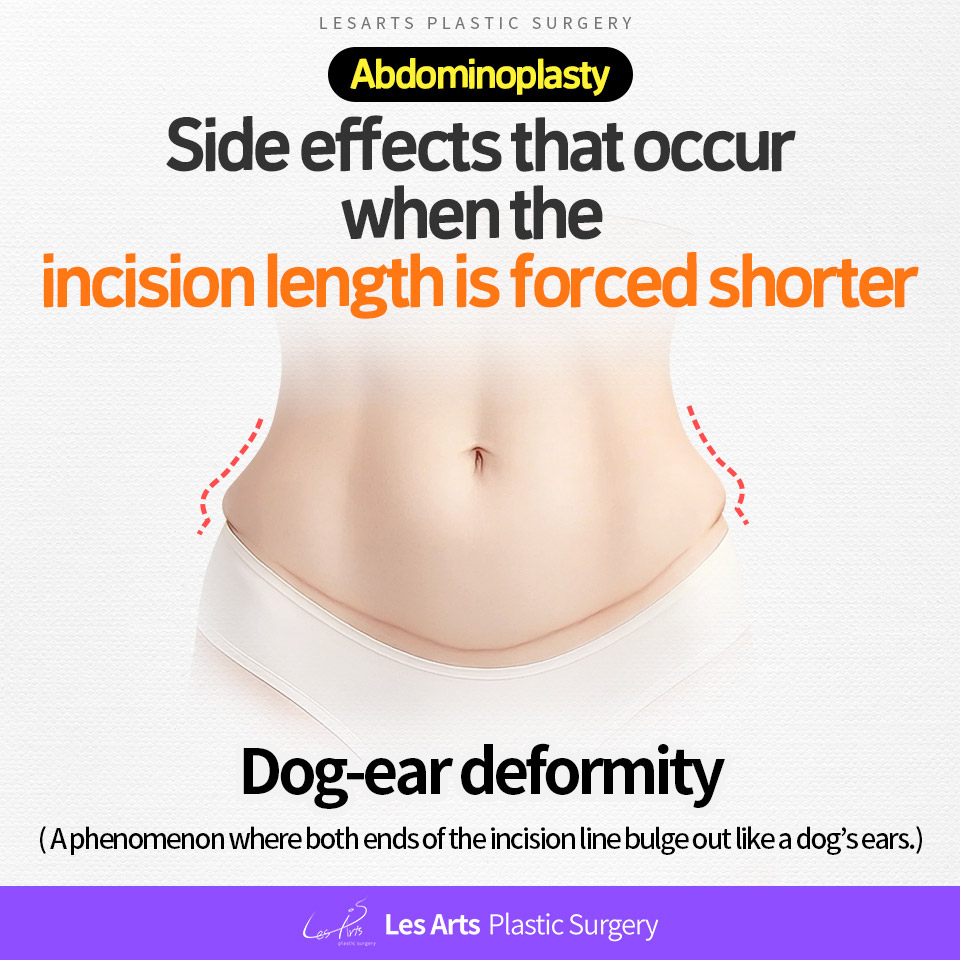
What clinical complications occur if the scar length is shortened aggressively?
The most prominent secondary deformity is the
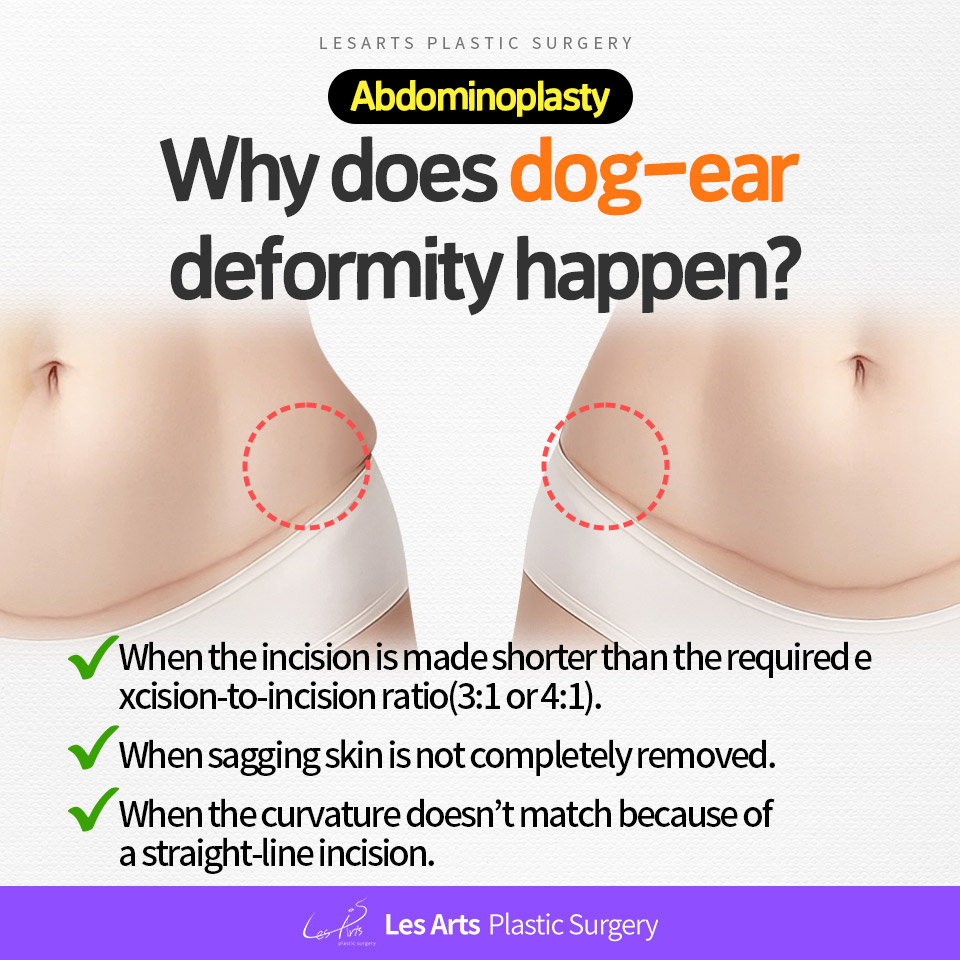
"dog-ear" deformity (standing cone deformity).
● What is a dog-ear deformity?
It refers to cone-shaped tissue puckering or protruding mounds at the lateral tips of an incision line.
This anatomical outcome can occur not only in tummy tucks,
but in breast lifts (mastopexy), breast reductions, and facelifts—
essentially any surgical procedure involving substantial skin excision and advancement.
● What causes dog-ear deformities?
- Designing an incision too short relative to the vertical laxity span (below the required 3:1 or 4:1 geometric ratio)
- Inadequate tailoring and tapering of residual lateral skin laxity
- Drawing a rigid straight incision that ignores the body's natural three-dimensional pelvic curvature
For instance, if 7 cm of vertical tissue must be excised,
limiting the horizontal incision to only 14 cm
carries an exceptionally high probability of dog-ear puckering.
This explains why abdominoplasty scars follow a gently curved contour,
aligning with natural relaxed skin tension lines (RSTLs)
while serving as a vital clinical design principle to prevent standing cones.
Even after these anatomical realities are explained,
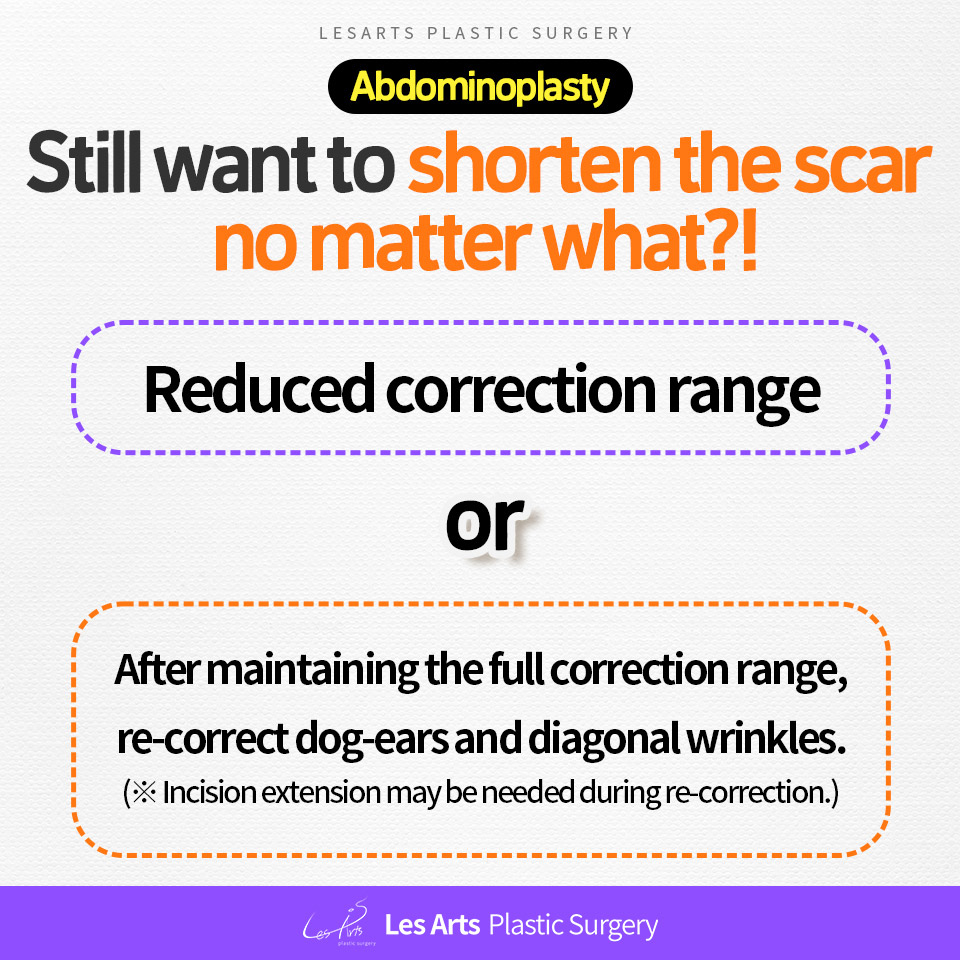
some patients still request: "I just want the shortest scar possible."
While surgeons always optimize incision placement within safe margins,
under-designing an incision inherently limits the primary objective of a tummy tuck:
achieving complete, smooth correction of sagging skin.
Forcing an overly short incision frequently results in:
- Bulbous dog-ear protrusions at both ends of the closure line
- Oblique, diagonal tension pleats and puckering above the scar
When these deformities manifest, patients frequently face a 6-month observation period followed by
secondary surgical revision.
Crucially, during secondary revision,
the incision must ultimately be extended to the exact anatomical length
originally predicted in the primary consultation.
Therefore, designing the incision with an appropriate, proportionate length from the beginning
remains the most effective, safe, and stable approach.
Understanding how deeply patients care about scar aesthetics,
we dedicate meticulous attention to low bikini-line positioning, precision suturing, and structured aftercare.
In practice, the most time-intensive phase of an abdominoplasty procedure
is precisely the multi-layered wound closure.
Although scar length is inextricably tied to the degree of tissue laxity,
we conceal incisions low within natural underwear and swimwear borders,
employing meticulous anatomical multi-layer tension-relieving closure
to minimize tension on the epidermal surface.
Furthermore, tummy tuck scars naturally mature and fade
from both lateral ends inward over time.
Even if the scar appears prominent during the initial healing months,
as scar maturation completes, patients frequently note that
"the scar faded significantly more than expected."
Most patients consulting for abdominoplasty harbor understandable anxieties about scarring.
However, when clinical examination identifies the exact grade of tissue laxity,
and provides clear, transparent explanations of predicted scar location, length,
and tailored surgical design,
concerns are transformed into confident, realistic expectations.
Because surgical body contouring demands prudent decision-making,
we are committed to delivering exceptional patient satisfaction through
precise pre-operative diagnosis, individualized surgical planning,
and meticulous microsurgical execution.
FAQ
Q1. How is the scar length calculated in tummy tuck (abdominoplasty) surgery?
The scar length is governed by the volume and horizontal-vertical span of loose skin that must be excised.
Greater degrees of skin laxity necessitate broader tissue resection, which proportionally requires a longer incision to close smoothly without bunching.
Q2. Does a mini tummy tuck (Type S) always result in a shorter scar?
Not necessarily. When lower abdominal laxity extends widely toward the lateral flanks, even a mini tummy tuck
requires an incision length similar to a full tummy tuck (Type M) to ensure complete tissue excision without residual skin folds.
Q3. What causes dog-ear deformities in abdominoplasty?
When an incision is designed too short relative to the vertical resection height, or when lateral redundant tissue is not fully tapered,
tissue bunches at both ends of the wound, forming elevated mounds known as dog-ear deformities.
Q4. What complications can arise from forcing an artificially short scar?
It significantly increases the risk of dog-ear puckering and diagonal skin tension pleats,
often requiring a secondary revision surgery after 6 months to lengthen the scar and excise the puckered tissue.
Q5. Do tummy tuck scars remain permanently conspicuous over time?
Abdominoplasty scars progressively soften and fade over time, typically lightening from both lateral edges inward.
Although the scar appears prominent initially, most patients find that long-term scar maturation makes it far less noticeable than anticipated.