




Online Consultation
Please accurately enter the information below.
Quick Cost Consultation
Quick Consultation & Reservation
Cases finding
similar to my profile






Doctor's Note
Medical columns by our surgeons
Arm Liposuction | Between Stick-Thin and Straight Contours: Standards for Natural Arm Lines
2026-07-14
Arm Liposuction | Between Stick-Thin and Straight Contours: Standards for Natural Arm Lines
Does removing more fat during arm liposuction always result in a more attractive shape?
A graceful arm contour cannot be achieved
simply by maximizing fat volume removal.
Only by evaluating skin elasticity, adipose distribution, muscular contours,
and neurovascular-lymphatic anatomy together can we sculpt a streamlined,
straight arm contour that avoids
an overly emaciated, hollowed appearance.
▶ Lesarts Liposuction Procedure Guide
Hello, I am Dr. Pyongrim Choi, Board-Certified Plastic Surgeon at Lesarts Plastic Surgery Clinic.
Because the arm line heavily influences overall body balance
and the aesthetic impression of the upper torso,
many patients share detailed concerns during liposuction consultations.
A particularly common request is:
“I do not want an unnaturally skeletal arm,
but please make it look smoothly contoured
with a clean, straight line.”
Excessive fat extraction can leave the arm looking emaciated
or expose harsh, irregular muscular step-offs,
while insufficient debulking in key areas
can result in minimal visible change post-operatively.
Therefore, preserving an appropriate adipose buffer while refining
the continuous transition across the entire arm is paramount.
At Lesarts, factoring in individual musculoskeletal anatomy
and systemic body balance, we tailor our designs between stick-thin reduction and straight contours
to deliver the most harmonious arm shape for each patient.
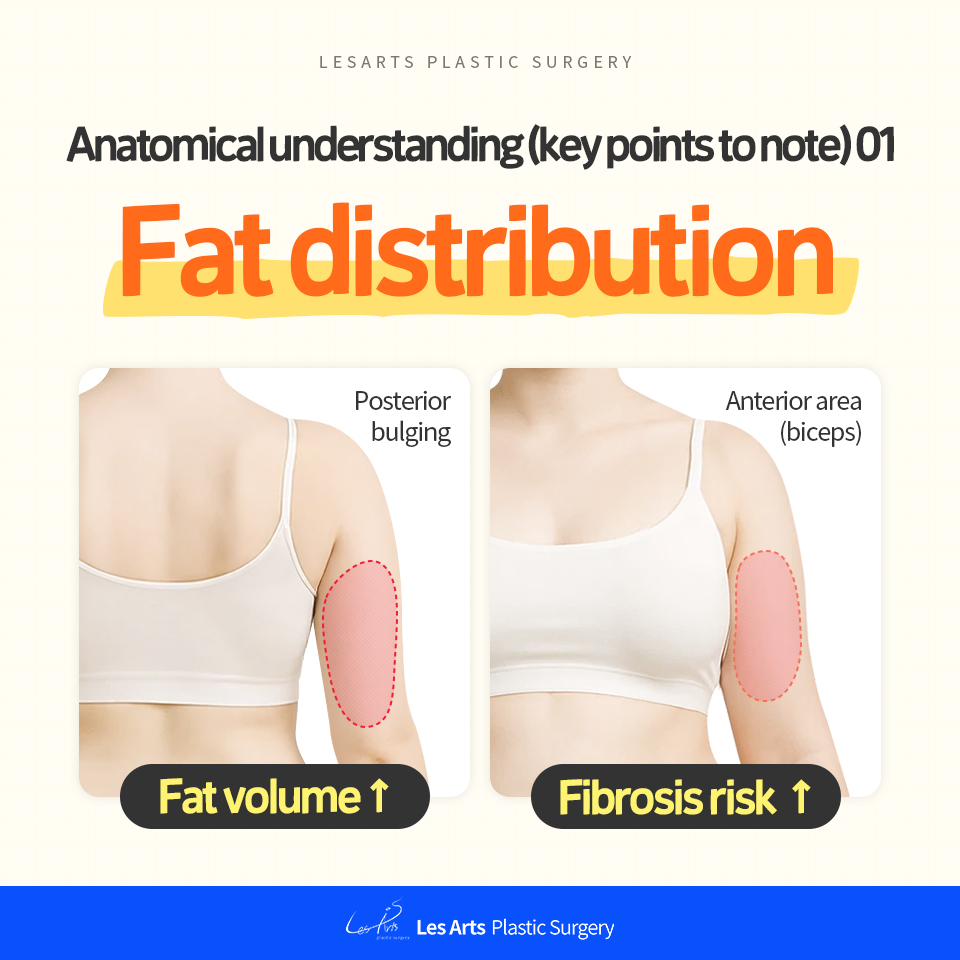
[Key Anatomical Factors to Evaluate Before Arm Liposuction]
First, evaluate the exact distribution of localized adipose deposits.
In the upper arm, subcutaneous fat often aggregates
heavily along the posterior triceps,
frequently referred to as the posterior bulge.
In contrast, the adipose tissue overlying the anterior biceps
exhibits higher fibrous density; applying uniform suction here
can produce surface irregularities and contour step-offs.
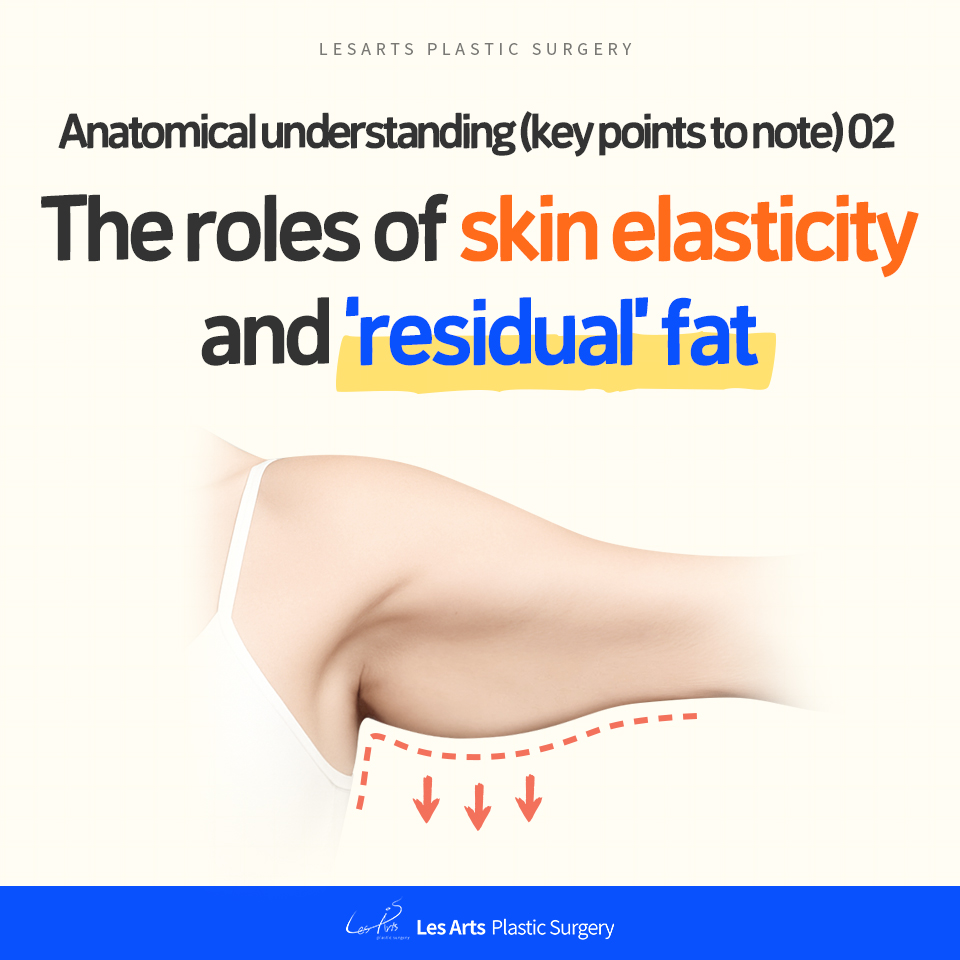
Second, assess dermal elasticity and the residual fat layer to be preserved.
When skin elasticity is favorable,
a broader resection scope can be safely planned.
However, when elasticity is compromised by aging or massive weight loss,
aggressive fat extraction can accentuate
sagging, redundant skin folds.
In such presentations, aspirate volume must be calibrated,
or a concurrent arm lift (brachioplasty) should be evaluated.

Third, safeguard critical neurovascular and lymphatic structures.
Sensory cutaneous nerves traverse superficial planes along the medial arm,
while major neurovascular bundles and lymphatic channels concentrate around the axilla.
Port site placements and superficial cannulation planes must be meticulously controlled
to minimize the risk of paresthesia
or prolonged lymphatic drainage compromise.
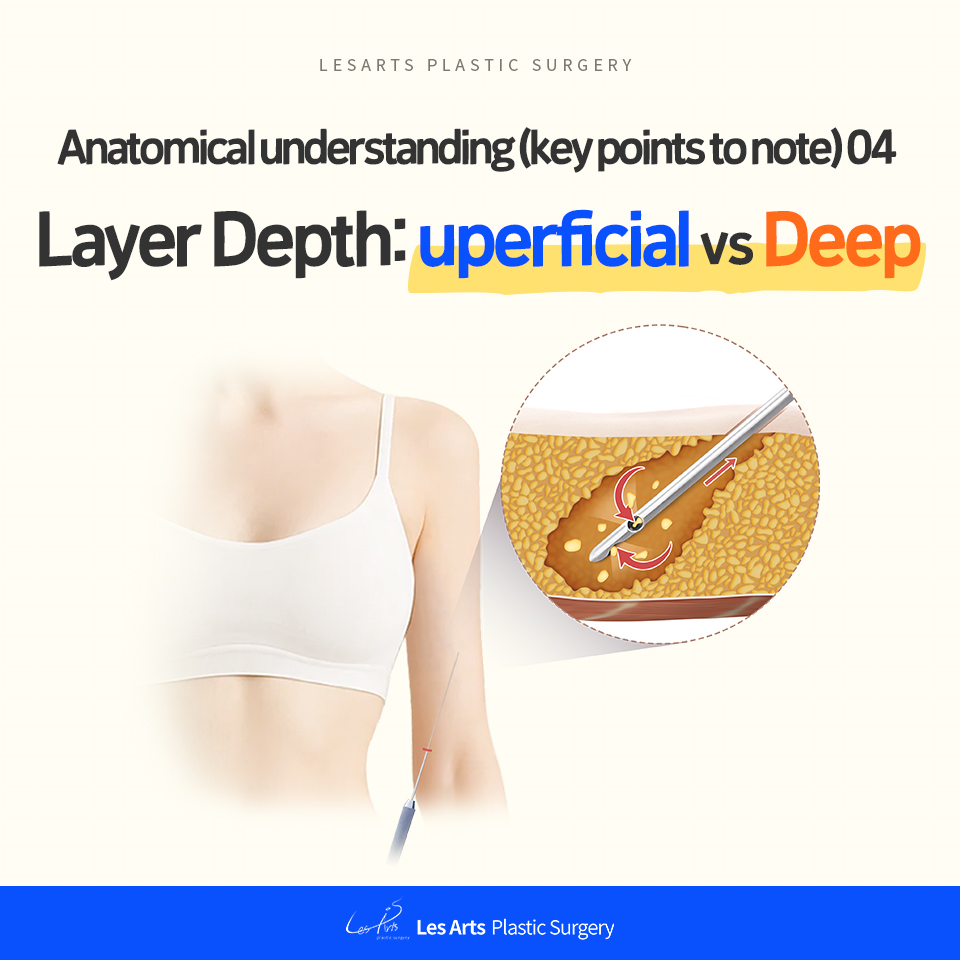
Fourth, distinguish deep from superficial adipose layers.
Subcutaneous fat is anatomically stratified into superficial and deep compartments;
over-resecting the superficial layer directly beneath the dermis induces visible waviness and adhesions.
Surgical debulking should concentrate in the deep adipose plane,
delicately feathering superficial fat only where needed for seamless contouring.
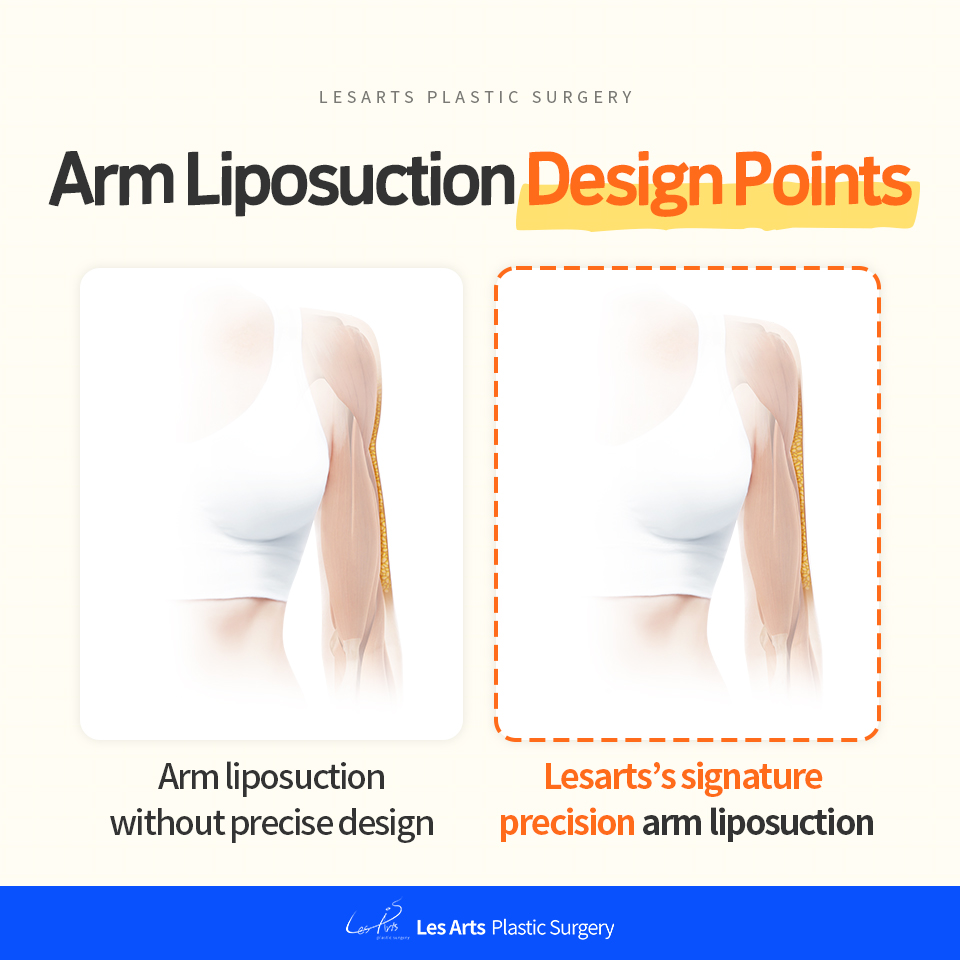
[Design Standards for a Natural, Straight Arm Contour]
Arm liposuction requires evaluating the entire anatomical axis
from the shoulder down to the elbow
as a single continuous unit.
The design should taper smoothly from the mid-brachium,
intentionally preserving subtle volume around the elbow epicondyles
to prevent an unnatural, conical constriction.
Dense posterior adipose deposits are debulked uniformly,
while anterior zones are approached conservatively in deep planes
respecting unique dermal and fascial characteristics.
Blending the axillary and lateral chest extensions simultaneously
ensures the arm does not appear isolated or pinched,
creating an effortless flow into the torso.
In patients with mild skin laxity, preserving a delicate superficial fat buffer or reducing aspirate volume
prevents surface sagging. The superficial plane is refined using vibrating micro-cannulas or
precision manual aspiration
to ensure a completely smooth surface.
[Arm Liposuction Clinical Case]
[Patient Profile]
Female in her mid-20s
Height & Weight: 165 cm / 60 kg
BMI: 22
[Surgical Plan & Scope]
Circumferential 360 arm & axillary liposuction
Aesthetic Goal: Maximal safe debulking
sculpted into a smooth, natural straight-line contour
While seeking substantial volume reduction,
the patient preferred an uninterrupted, straight line
rather than an overly skeletonized, stick-thin appearance.
Accordingly, posterior triceps fat was extensively debulked,
while suction was calibrated across the biceps and elbow junction
to preserve anatomical line integrity.

[Anterior View 5 Months Post-Op Showing Refined Lateral Arm Contour]

[Posterior View Post-Op Demonstrating a Natural, Straight Arm Line]
In neutral stance on both front and back views,
eliminating posterior triceps fullness straightened the line
flowing from the shoulder down to the elbow.
Because fat around the elbow was not over-resected,
the transition connects smoothly without abrupt hollows or joint demarcation.

[Anterior View Post-Op Without Harsh Biceps Demarcation]

[Posterior Abduction Pre-Op vs. 5 Months Post-Op Showing Flaccid Fat Reduction]
In abducted positions, minimal suction along the biceps
was balanced with thorough clearance of dependent, sagging posterior fat.
As a result, posterior hanging bulk was eliminated
without exposing aggressive muscular topography, unveiling soft, natural lines.
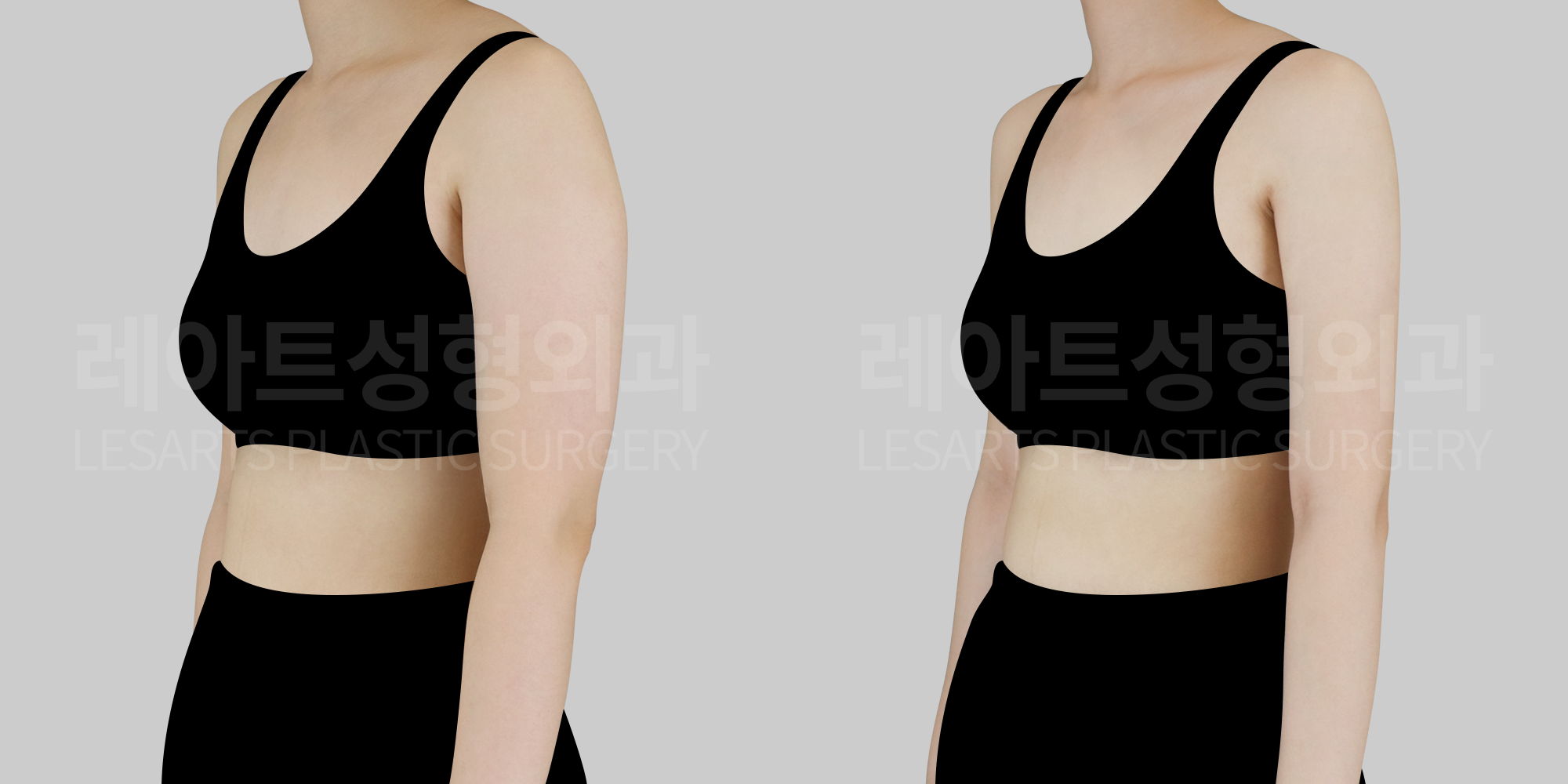
[Oblique Profile Pre-Op vs. 5 Months Post-Op Showing Smooth Elbow Transition]
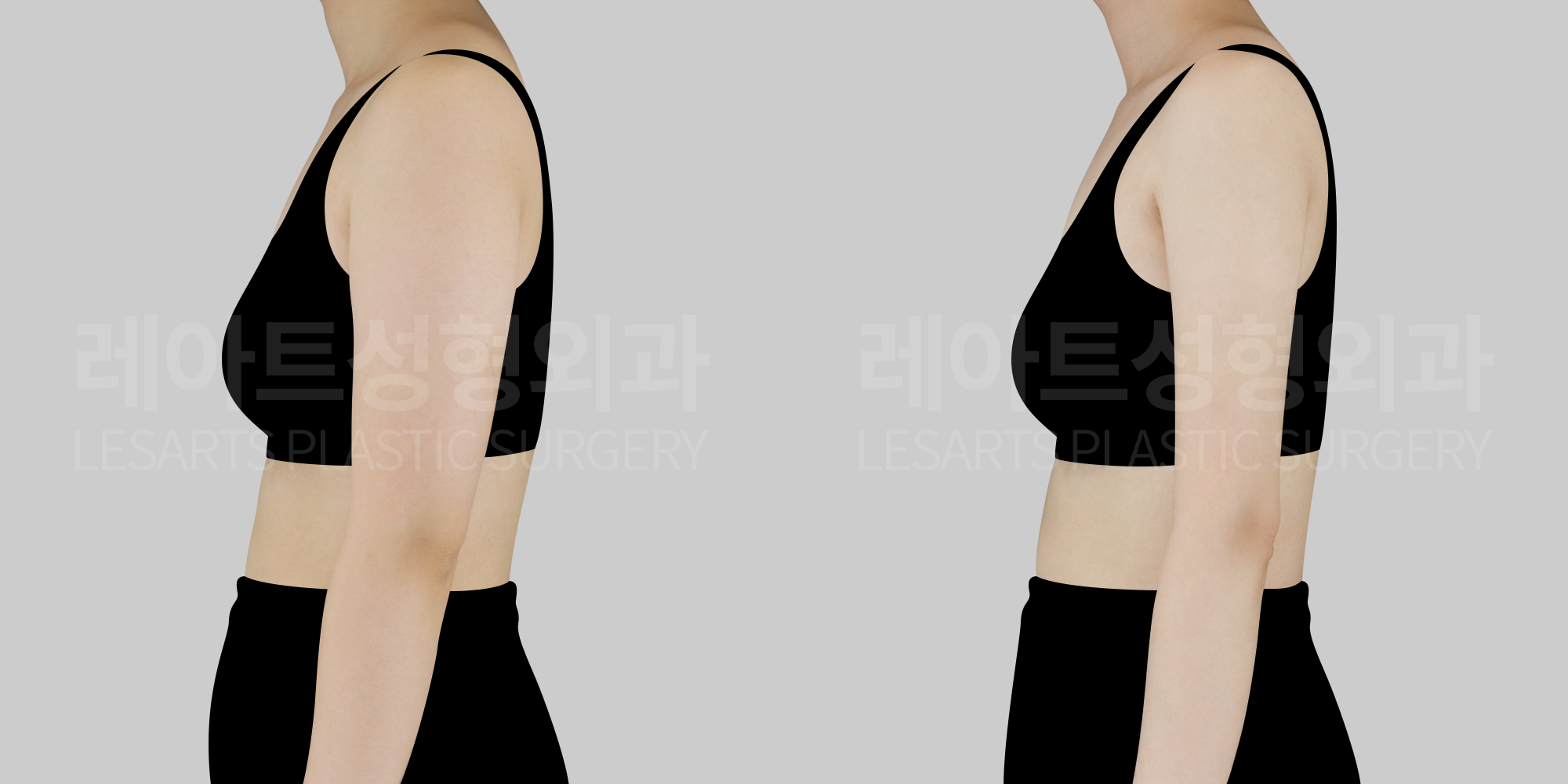
[Seamless Straight Contour Connecting Upper Arm and Elbow Post-Op]
On oblique profile, suction was kept minimal along the anatomical
concavity where the upper arm meets the elbow.
Avoiding mid-arm depression allows the brachium to flow
into the elbow in a sleek, unbroken straight line.
The essence of successful arm liposuction
does not lie in simple volume extraction.
Treatment scope and intentional volume preservation must be determined
after thoroughly analyzing overall limb proportions, muscle volume, skin tone, and body type.
Rather than pursuing skeletal reduction, Lesarts Plastic Surgery Clinic focuses
on meticulous architectural design aimed at delivering
a balanced, smooth line with an elegant, feminine silhouette.
If rounded bulges or posterior fullness
make your upper body appear heavy,
or if you desire a sleek, straight arm contour
that avoids an emaciated appearance,
we invite you to consult with Lesarts Plastic Surgery Clinic
to assess your musculoskeletal anatomy and fat distribution,
and determine the ideal arm liposuction plan tailored to your physique.
Arm Liposuction FAQ
1. Does removing more fat always produce
better arm liposuction results?
Excessive extraction can exaggerate muscle contours, skin laxity,
and surface waviness; strategic adipose buffers must be preserved
to complement your body framework.
2. Can anyone achieve an ultra-thin, stick-thin arm?
Skeletal dimensions and muscle thickness cannot be altered by liposuction.
Surgical design focuses on sculpting a smooth,
streamlined straight-line contour within safe anatomical limits.
3. Why is anterior arm fat not aggressively suctioned?
The skin overlying the biceps is thin and frequently fibrotic,
making aggressive superficial aspiration prone to surface irregularities.
4. Is arm liposuction inadvisable if skin elasticity is poor?
Aspirate volume must be carefully calibrated, and in cases of severe skin laxity,
a concurrent arm lift (brachioplasty) can be considered.
5. Should axillary fat be contoured simultaneously?
When the junction between arm and torso lacks definition,
treating the adjacent axillary and lateral chest fat
is essential to create a seamless, cohesive transition.
Dr. Pyongrim Choi


Cases finding
similar to my profile
Customer Diagnostics


Select the surgery and
area you are interestedto see real
before andafter changes.


we
make you,
the art
Clinic hours
MON - FRI
10 am – 7pm
SAT
10 am – 4pm
Holiday
SUN, HOLIDAY
Location
Lesarts Moon Clinic Tower 4-5F, 40, Nonhyeon-ro 168-gil,
Gangnam-gu, Seoul, Republic of Korea

Medical institution name Lesarts Plastic Surgery
Address Lesarts Moon Clinic Tower 4-5F, 40, Nonhyeon-ro 168-gil, Gangnam-gu, Seoul, Republic of Korea
Representative Moon sung jun
