




Online Consultation
Please accurately enter the information below.
Quick Cost Consultation
Quick Consultation & Reservation
Cases finding
similar to my profile






Doctor's Note
Medical columns by our surgeons
Tummy Tuck | [Type S Floating vs. Type M Full]: Which Surgical Technique Do You Need?
2026-07-16
Tummy Tuck | [Type S Floating vs. Type M Full]: Which Surgical Technique Do You Need?
Can a Type M full abdominoplasty be more suitable even when upper abdominal skin laxity is mild?
Yes. Even with mild epigastric laxity, determining whether Type S floating or Type M full abdominoplasty is best
requires balancing your desired correction of supraumbilical creasing,
scar tolerance, and wardrobe lifestyle.
☞ Learn More About Lesarts Tummy Tuck Surgery ☜
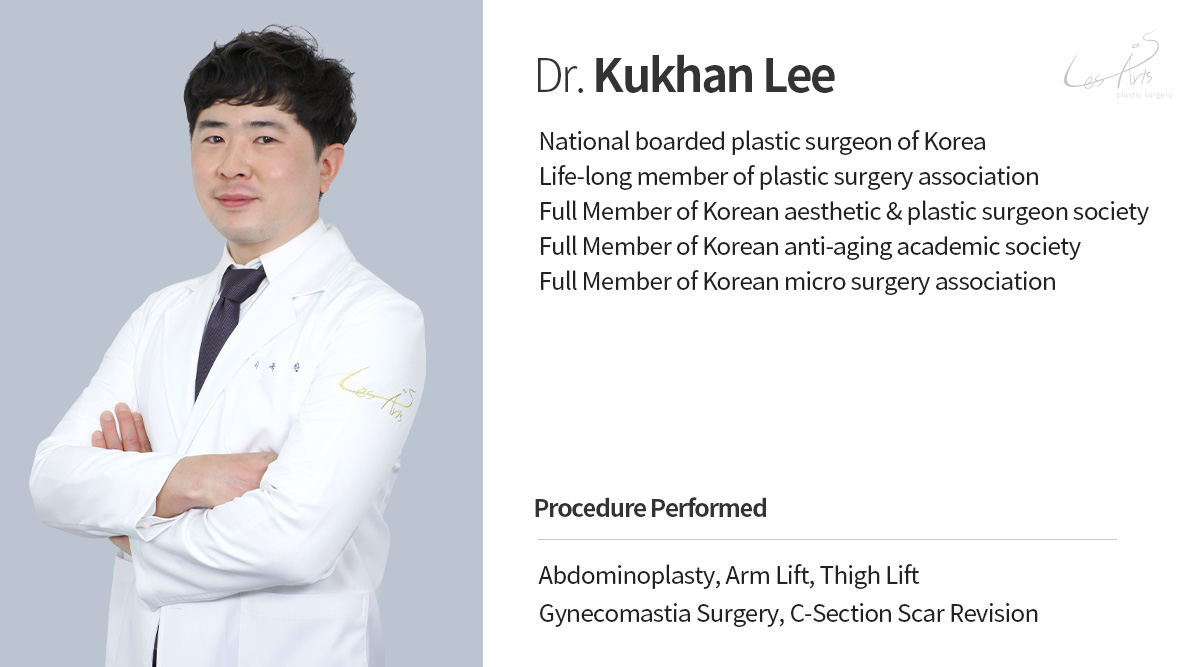
Hello, I am Dr. Kukhan Lee, Board-Certified Plastic Surgeon at Lesarts Plastic Surgery Clinic.
During consultations with patients struggling with abdominal skin laxity,
"Which tummy tuck method is best for me?"
is one of the most common questions asked.
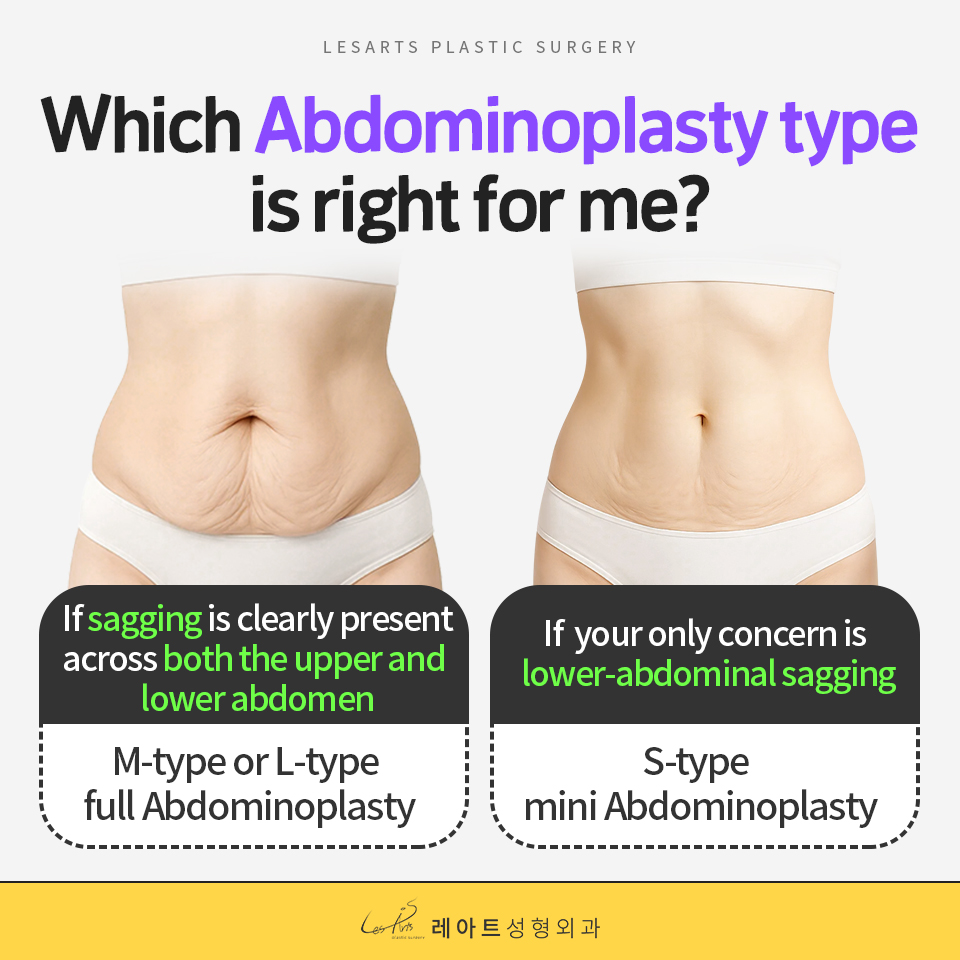
When skin laxity is clearly visible across both the upper and lower abdomen,
opting for a full abdominoplasty such as Type M or Type L
is a relatively straightforward clinical decision.
Conversely, when epigastric laxity is negligible and you only wish
to correct lower abdominal skin sagging,
a Type S mini tummy tuck
serves as an appropriate choice.
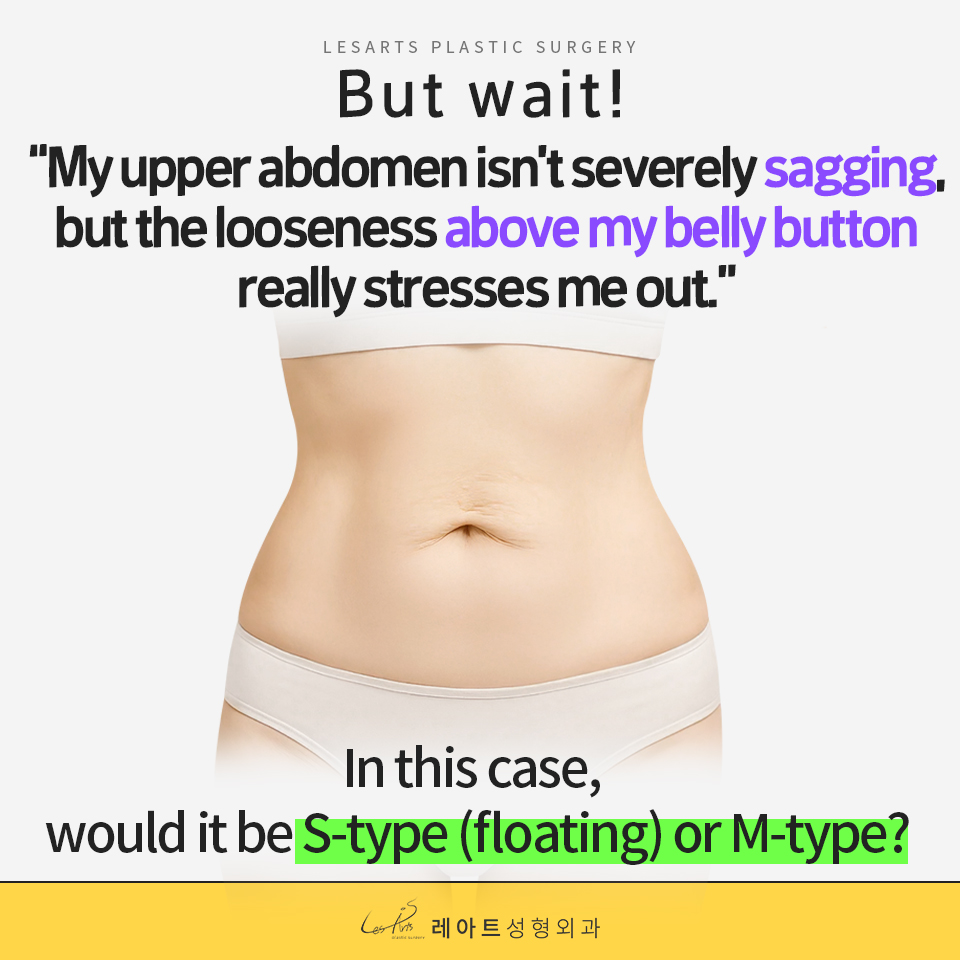
However, the most challenging dilemma arises when
upper abdominal laxity is mild, yet the skin directly above the belly button sags slightly
or forms horizontal creases that cause daily distress.
In such anatomical presentations, recommending a single standardized technique
is neither simple nor ideal.
In this clinical guide,
we examine how to determine whether Type S floating or Type M full abdominoplasty
is the more suitable option
through two actual patient cases.
[Case Overview]
Both patients presented with
infraumbilical laxity as their primary concern.
While overall upper abdominal skin excess was mild,
both voiced dissatisfaction with a horizontally flattened, hooded belly button and supraumbilical skin folds.
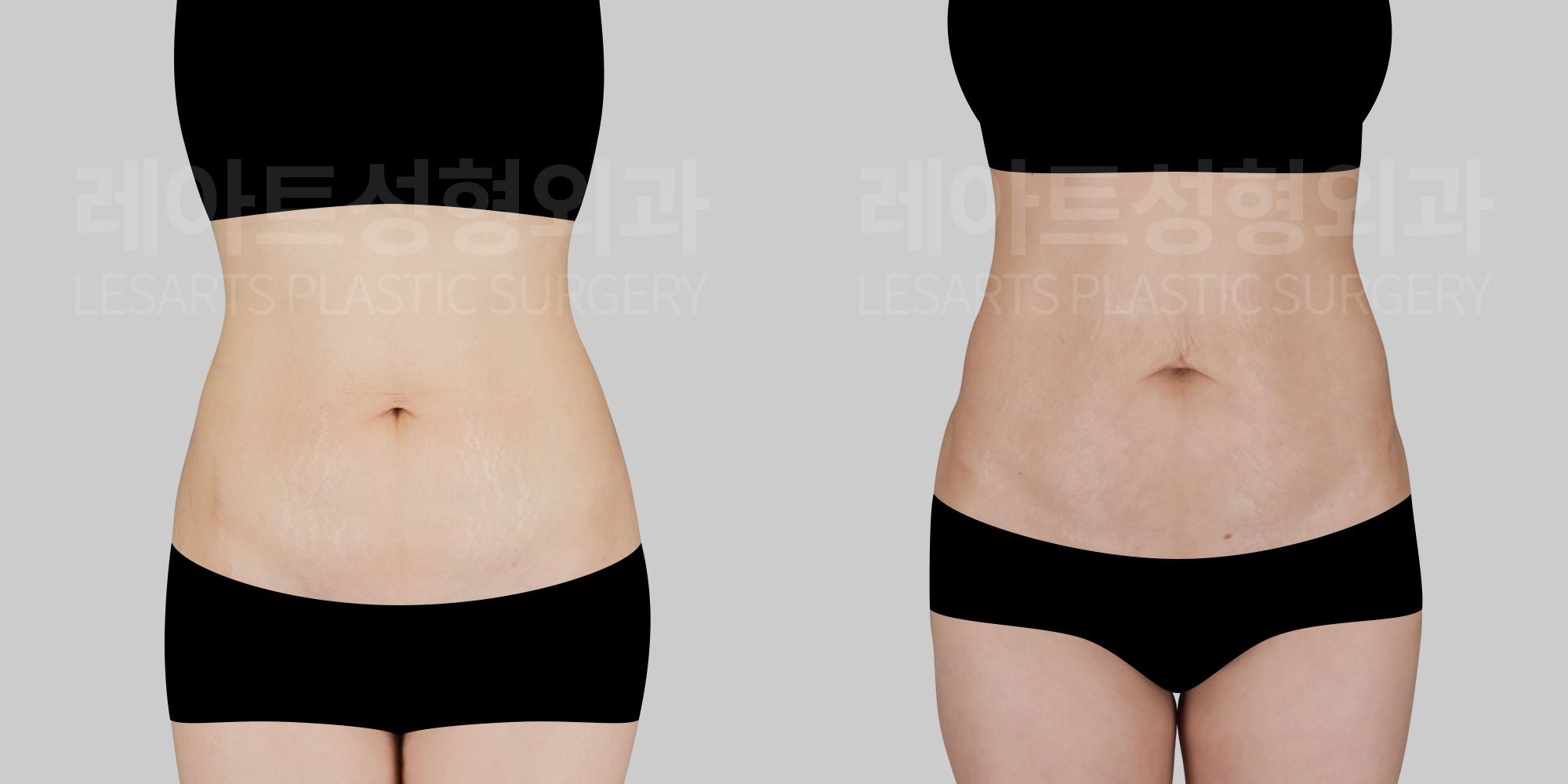 Lesarts Tummy Tuck Pre-Operative Assessment
In these intermediate cases,
we present both Type S floating and Type M options in detail.
Incision length and placement,
alongside daily wardrobe preferences
(underwear waistlines, crop tops, low-rise bottoms, swimwear),
are comprehensively weighed to determine the most customized surgical plan.
Both patients featured in this column
underwent concurrent abdominal liposuction with their abdominoplasty.
[Case 1 — Type S Floating Umbilicus Tummy Tuck]
Lesarts Tummy Tuck Pre-Operative Assessment
The first patient presented with
postpartum lower abdominal bulging
and supraumbilical skin folds as her chief complaints.
Because epigastric skin redundancy was modest,
pulling tissue downward in a full Type M procedure carried anatomical limitations,
and diagnostic assessment confirmed rectus diastasis across both upper and lower midlines.
Available Surgical Options
1) Type S Floating Tummy Tuck
• As the umbilicus shifts slightly downward,
epigastric creasing improves partially,
though the degree of upper correction is less dramatic than Type M
• Post-operative umbilical position
shifts approximately 1.5 to 2 cm lower than original baseline
• Incision scar rests in a low, easily concealable position beneath underwear
• Shorter horizontal scar length than Type M
2) Type M Full Tummy Tuck
• Delivers definitive, maximal tightening of supraumbilical skin folds
• Because upper abdominal laxity is limited,
the horizontal scar position may sit somewhat higher than standard Type M placement
• Longer horizontal incision span than Type S
Following thorough consultation,
the patient selected the Type S Floating Tummy Tuck.
Her decision was based on two priorities:
1. A slight downward shift in belly button position was completely acceptable to her
2. Keeping the scar short and concealed low within underwear lines took precedence over maximal upper tightening
Accordingly, abdominal liposuction was performed concurrently
with a Type S floating umbilicus abdominoplasty.

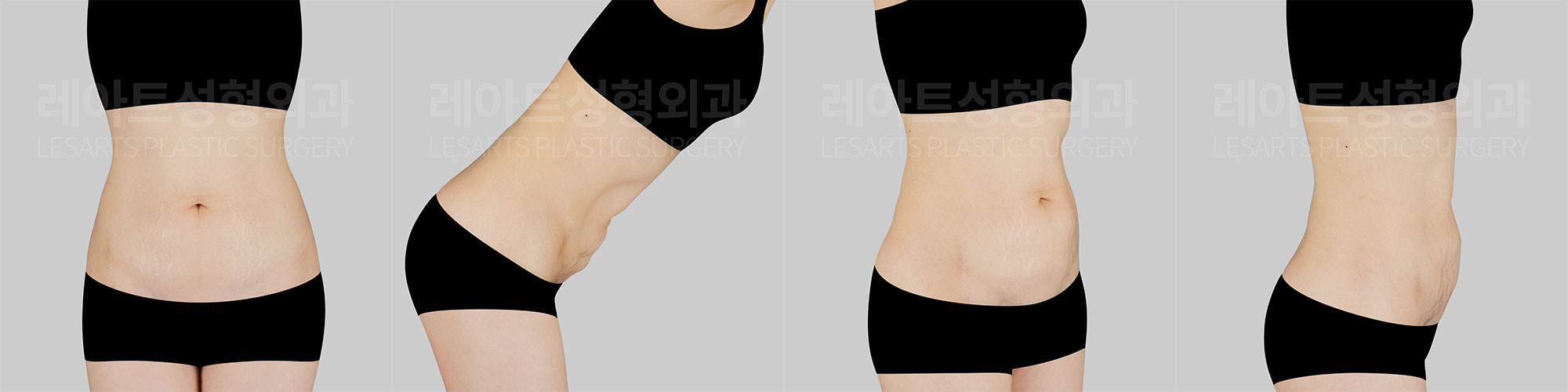
Lesarts Type S Floating Tummy Tuck Before & After (5 Months) - Anterior View
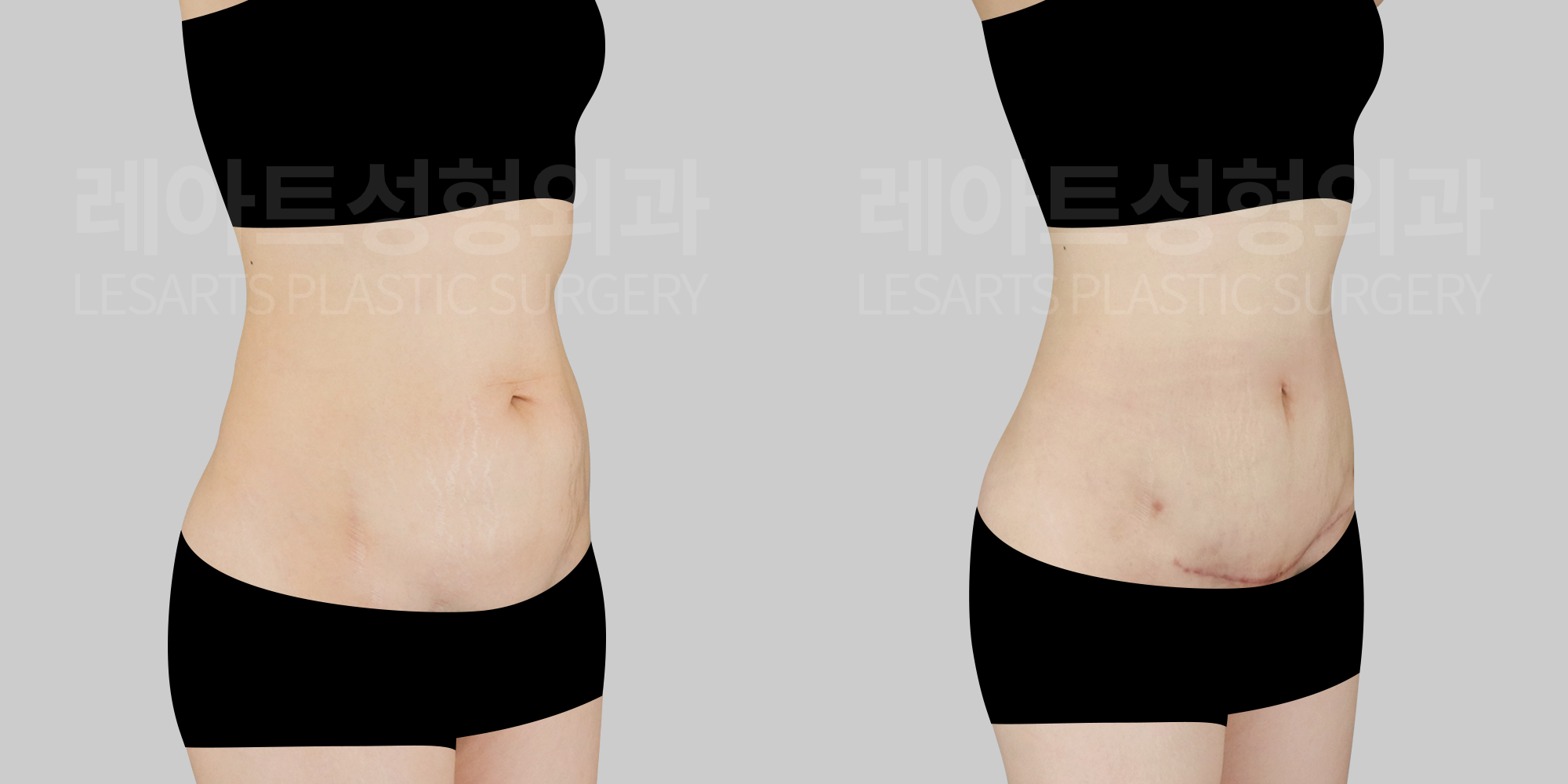
Lesarts Type S Floating Tummy Tuck Before & After (5 Months) - 45° Oblique View
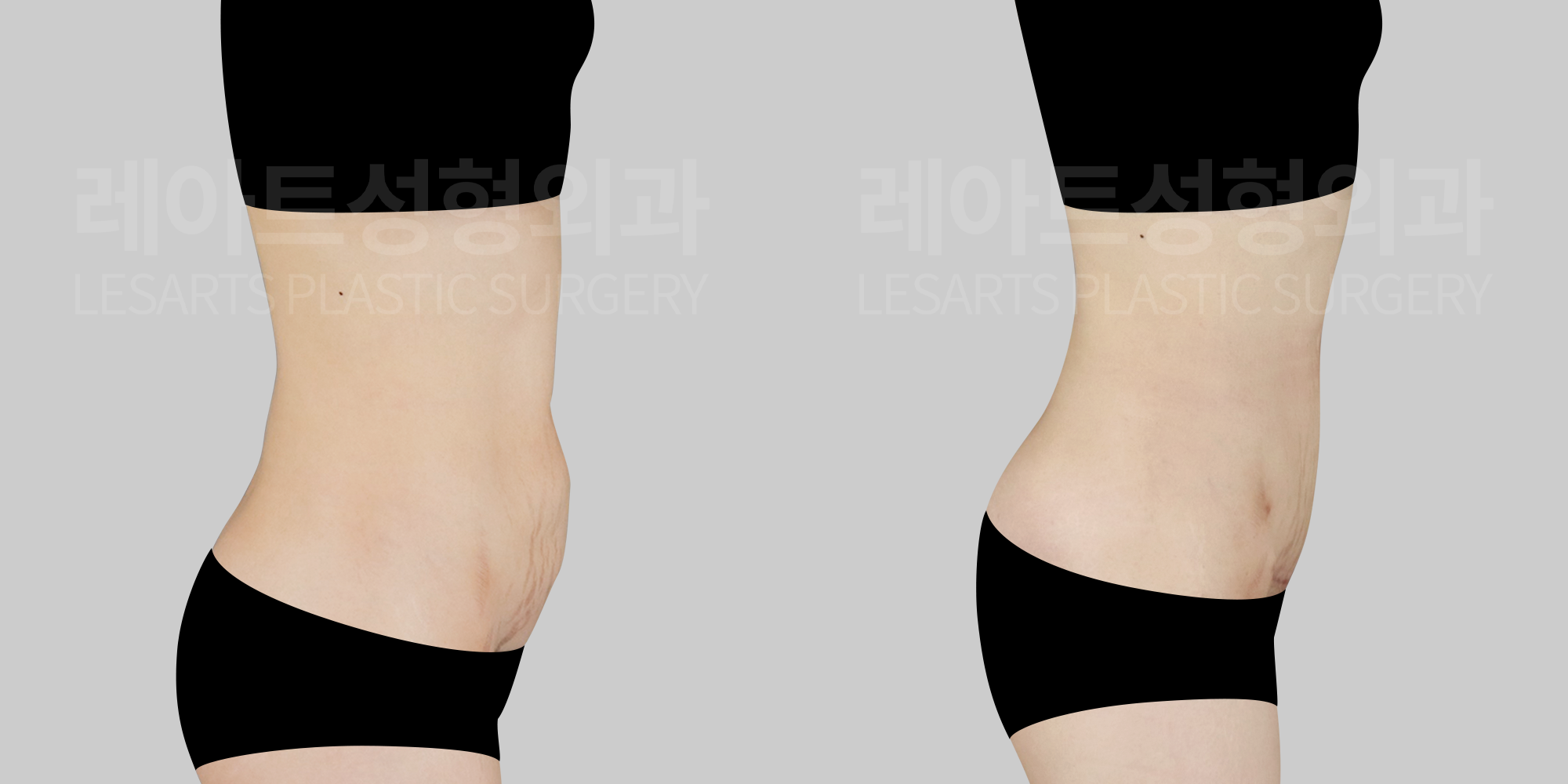
Lesarts Type S Floating Tummy Tuck Before & After (5 Months) - 90° Lateral View
[Post-Operative Results]
Rectus diastasis was stably repaired across both upper and lower segments,
and redundant lower abdominal skin was smoothly excised.
Consequently, even when bending forward at the waist,
the abdominal wall maintained a flat, taut contour without rolling folds.
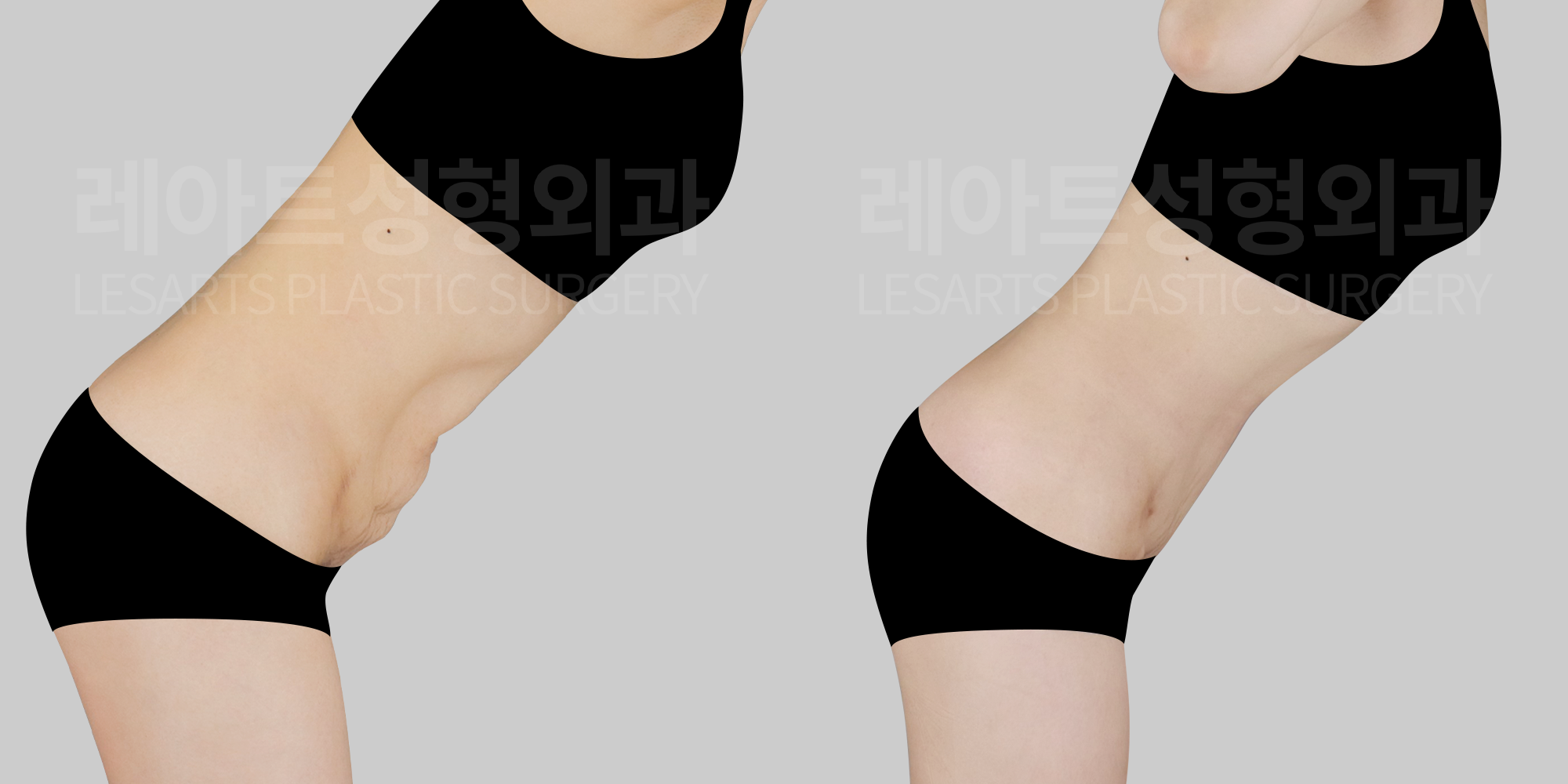
Lesarts Type S Floating Tummy Tuck Before & After (5 Months) - Forward Flexion
As the belly button shifted slightly downward,
supraumbilical skin creasing naturally smoothed out as well.
While a Type S floating abdominoplasty is not primarily designed
to resect massive upper abdominal skin,
re-anchoring the umbilical stalk in a slightly lower position provides
the secondary aesthetic benefit of tensioning
and smoothing epigastric skin.
[Case 2 — Type M Full Tummy Tuck]
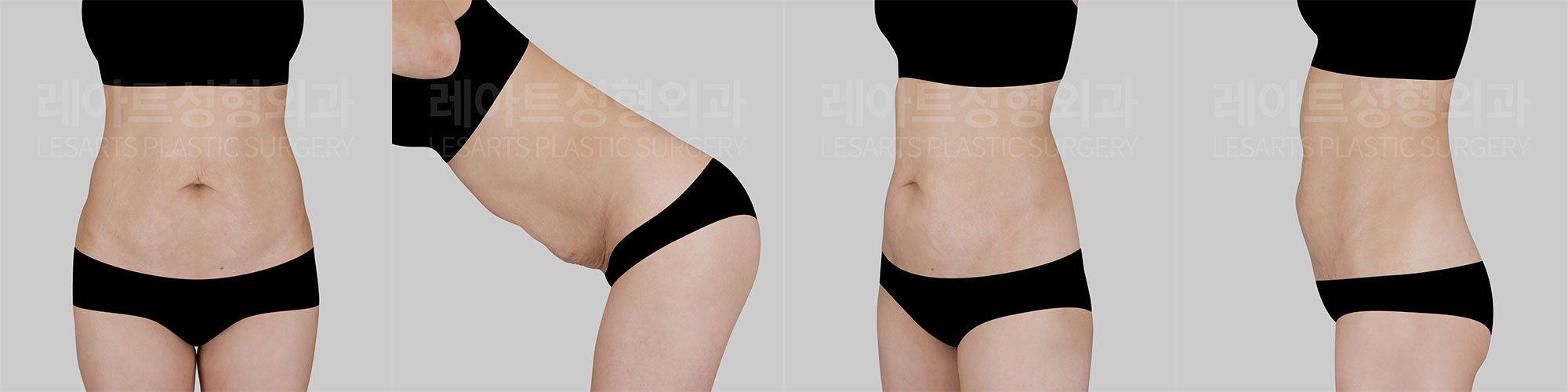 Lesarts Tummy Tuck Pre-Operative Assessment
The second patient presented with
lower abdominal bulging and skin laxity as her primary concerns,
and because she frequently wears midriff-baring clothing,
she strongly desired definitive eradication of supraumbilical creasing.
Subcutaneous fat was modest and abdominal musculature was well developed,
yet postpartum skin laxity and
full-length rectus diastasis were clearly diagnosed.
Her belly button exhibited horizontal stretching;
furthermore, although upper abdominal laxity was mild,
her baseline umbilical height was relatively high,
making surgical technique selection highly nuanced.
Available Surgical Options
1) Type S Floating Tummy Tuck
• As the umbilicus shifts downward, some upper creasing improves
• Umbilical position drops approximately 1.5 to 2 cm lower
• Shorter scar concealed low beneath underwear
• Limited capability in completely smoothing upper abdominal laxity
2) Type M Full Tummy Tuck
• Delivers definitive, complete correction of supraumbilical skin laxity
• When upper laxity is limited, the horizontal scar line may sit somewhat higher
• Longer incision span compared to Type S
Because 'definitively eliminating supraumbilical skin folds'
was her absolute highest priority,
the patient selected the Type M Full Tummy Tuck.
Her decision was guided by two factors:
1. Concern that partial improvement would leave her dissatisfied and with an unnecessary scar
2. Complete resolution of skin sagging outweighed concerns over incision length
In cases like this, performing a Type M full abdominoplasty
carries the surgical challenge that the scar line may sit slightly higher
than in patients with massive skin laxity.
However, forcing an excessively low scar by over-tensioning thinned skin
drastically increases the risk of wound dehiscence, skin necrosis, or hypertrophic scarring.
Accordingly, surgery was completed by advancing tissue to the maximal safe tension limit without vascular compromise.
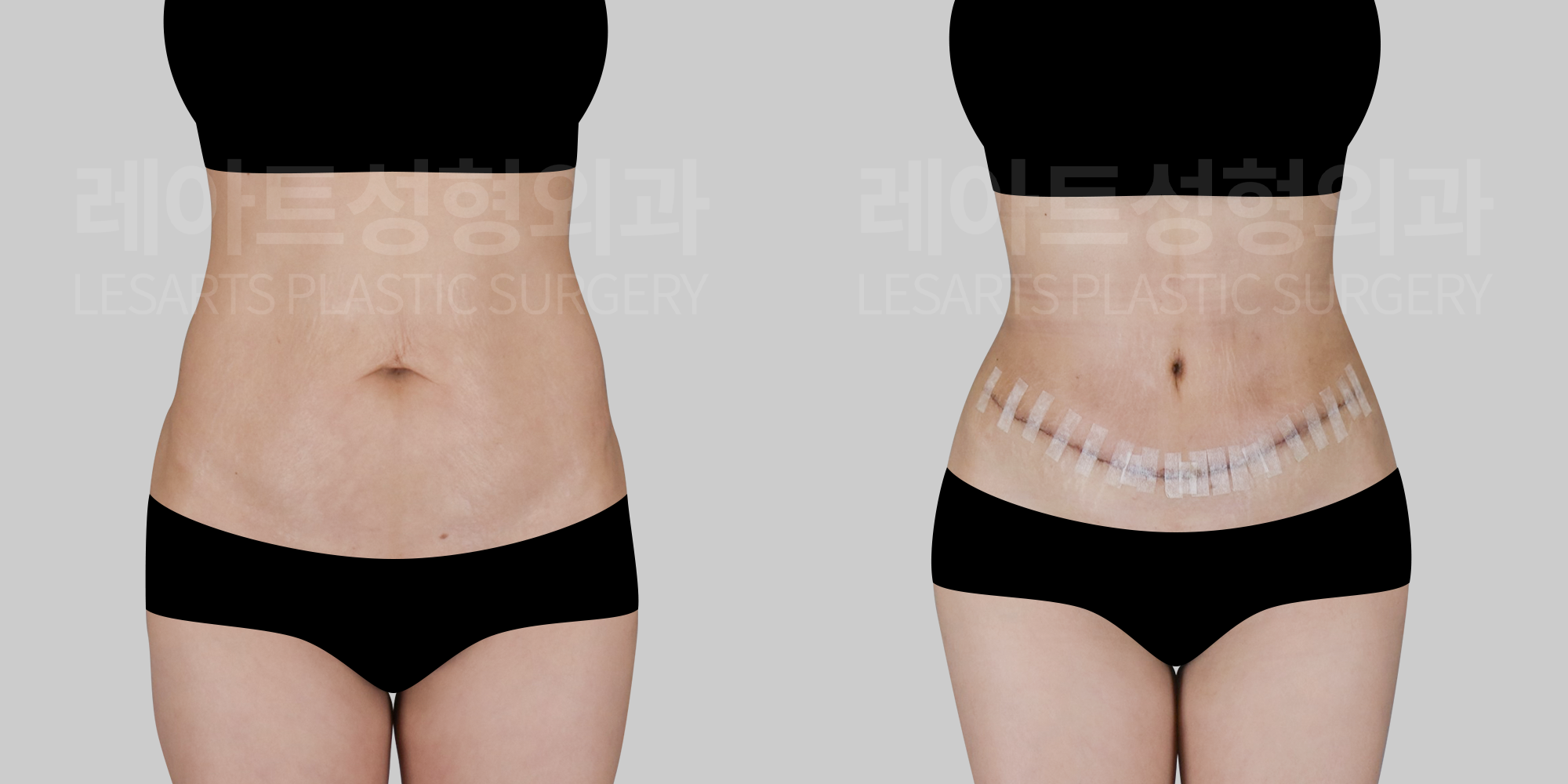
Lesarts Type M Full Tummy Tuck Before & After (2 Weeks)
[Post-Operative Results]
Through Type M abdominoplasty,
redundant skin was completely excised,
and the umbilicus was aesthetically remodeled
into a natural, vertically oriented aperture.
Rectus diastasis was stably reinforced across both upper and lower midlines,
and concurrent abdominal liposuction with hip dip fat grafting
established a seamless, contoured hourglass silhouette.
While the scar placement settled slightly higher
than in conventional high-laxity Type M procedures,
the patient's primary source of distress—supraumbilical creasing—
was completely eliminated,
resulting in exceptional post-operative satisfaction.
[Conclusion]
In abdominoplasty,
the patient must never be forced into a predetermined technique;
the surgical technique must be selected to fit the patient's individual anatomy.
Beyond skin laxity grade, fascial separation, and dermal elasticity,
personal lifestyle, clothing habits, and scar priorities
differ distinctly for each individual.
If you are considering a tummy tuck, rather than deciding alone,
we recommend obtaining an accurate diagnosis of tissue laxity and rectus diastasis
and consulting thoroughly with specialized surgeons
to establish the optimal procedure tailored to your aesthetic goals.
FAQ
Q1. What is the fundamental difference between Type S floating and Type M full abdominoplasty?
Type S floating focuses primarily on lower abdominal laxity with partial upper smoothing,
whereas Type M full abdominoplasty comprehensively corrects laxity across both upper and lower midlines including umbilical transposition.
Q2. When is Type M full abdominoplasty needed even if upper laxity is mild?
Yes. Even when epigastric laxity is modest, if your primary goal
is the definitive and complete eradication of supraumbilical skin folds,
Type M serves as the more effective surgical solution.
Q3. Can a Type S floating tummy tuck improve supraumbilical creasing?
Partial improvement is achievable. As the belly button re-anchors slightly lower,
the upper abdominal skin is redraped downward, naturally softening mild supraumbilical folds.
Q4. Is choosing the method with the shortest scar always the best approach?
No. While scar length is an important factor,
balancing the degree of skin laxity with achievable tightening results
is essential to prevent secondary deformities and select the most appropriate procedure.
Q5. What clinical criteria determine the ideal tummy tuck technique?
The surgical plan is determined by comprehensively evaluating the span of skin laxity, rectus diastasis,
dermal elasticity, and umbilical position, alongside individual clothing styles and scar preferences.
Dr. Kukhan Lee


Cases finding
similar to my profile
Customer Diagnostics


Select the surgery and
area you are interestedto see real
before andafter changes.


we
make you,
the art
Clinic hours
MON - FRI
10 am – 7pm
SAT
10 am – 4pm
Holiday
SUN, HOLIDAY
Location
Lesarts Moon Clinic Tower 4-5F, 40, Nonhyeon-ro 168-gil,
Gangnam-gu, Seoul, Republic of Korea

Medical institution name Lesarts Plastic Surgery
Address Lesarts Moon Clinic Tower 4-5F, 40, Nonhyeon-ro 168-gil, Gangnam-gu, Seoul, Republic of Korea
Representative Moon sung jun
