




Online Consultation
Please accurately enter the information below.
Quick Cost Consultation
Quick Consultation & Reservation
Cases finding
similar to my profile






Doctor's Note
Medical columns by our surgeons
Thigh Liposuction | Is Removing Saddlebags Enough? Easily Overlooked Design Principles in Thigh Contouring
2026-07-20
Thigh Liposuction | Is Removing Saddlebags Enough? Easily Overlooked Design Principles in Thigh Contouring
Why is comprehensive contour design far more critical than merely removing saddlebags during thigh liposuction?
Visual leg length, proportion, and silhouette are determined not by the absolute volume of fat removed,
but by the fluid continuity of anatomical curves extending from the pelvis to the knees.
Aggressively extracting saddlebag fat in isolation can flatten pelvic curves
or exaggerate leg bowing, creating an unnatural outcome.
Therefore, precise line design—calibrating the inner thigh gap, softening saddlebag flare, and refining suprapatellar transitions according to underlying musculoskeletal anatomy—
to determine 'what to preserve and what to sculpt'
is essential to rebalance lower-body proportions and make the legs look substantially longer, sleeker, and more refined.
▶ Learn More About Lesarts Liposuction
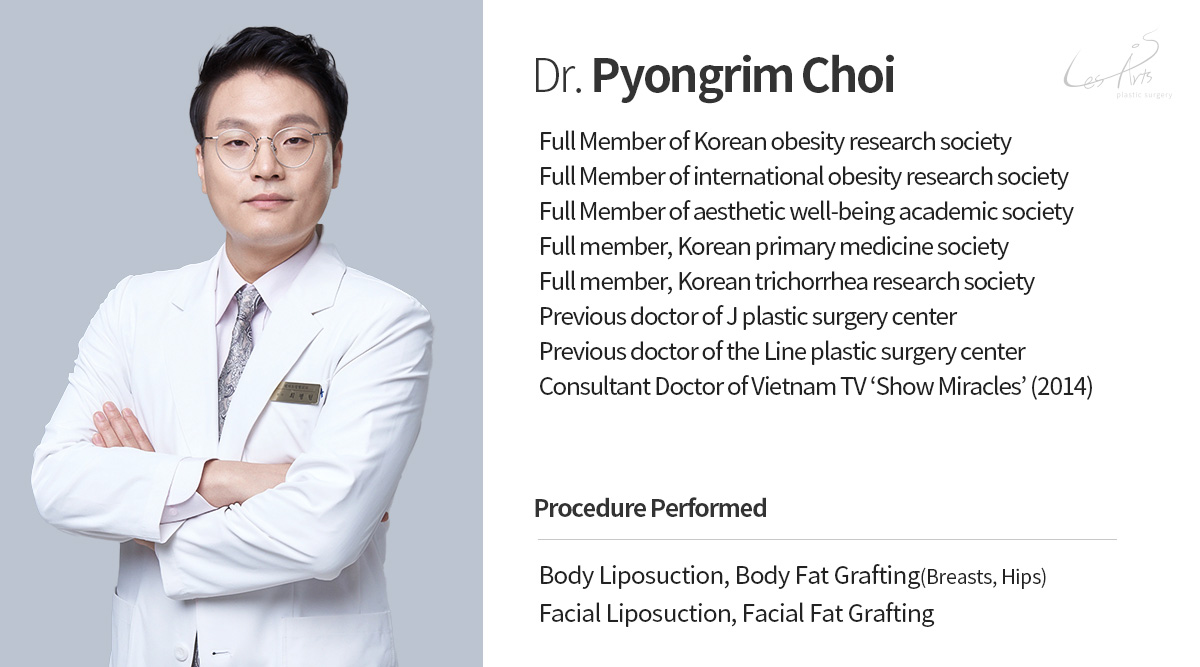
Hello, I am Dr. Pyongrim Choi, Board-Certified Plastic Surgeon at Lesarts Plastic Surgery Clinic.
Even with identical height and body weight metrics,
why do some individuals boast slender leg lines
while others appear notably heavier in the lower extremities?
The aesthetic perfection of the lower body is not determined solely by absolute fat volume.
It is the product of localized adipose distribution, underlying muscular contours,
and the proportional balance of bodily curves
flowing from the pelvis down to the knees.
This explains why successful weight loss alone often fails to deliver
the graceful lower-body silhouette patients desire.
In this clinical article, I will explain the fundamental principles behind sculpting an attractive, feminine thigh line,
and clarify why precise 'contour line design' is essential in surgical liposuction
based on anatomical science and actual clinical cases.
1. Three Core Factors Determining Lower-Body Contour Balance
The aesthetic shape of the female thigh is primarily governed by three foundational elements.
1) Adipose 'Distribution Location' Trumps Simple Volume
Lower-body subcutaneous fat is anatomically partitioned across distinct anatomical zones:
- Medial zone (Inner thigh)
- Anterior zone (Front thigh)
- Lateral zone (Outer thigh, commonly known as 'saddlebags')
- Posterior zone (Back thigh and subgluteal roll)
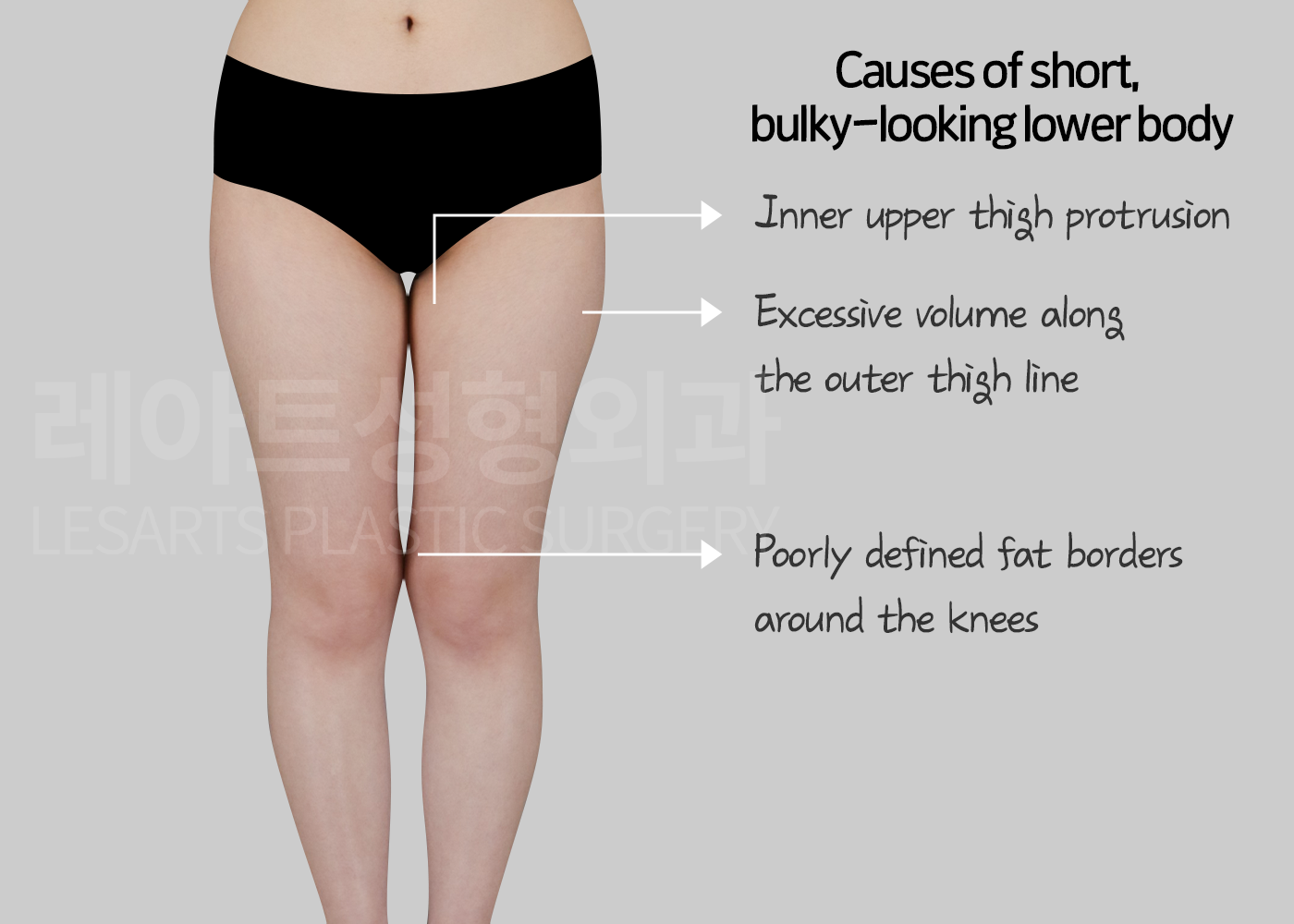
In particular,
when structural irregularities occur across the following three areas,
they create the visual illusion of a shorter, heavier lower body regardless of actual weight:
- Upper inner thigh bulge causing medial friction
- Excessive lateral saddlebag volume widening the upper thigh
- Blunt, undefined fat transitions around the suprapatellar knee area
Ultimately, the core challenge is not how much overall fat exists,
but exactly where that adipose tissue is deposited.
2) Influence of Musculoskeletal Framework and Femoral Alignment
The thigh is not merely an envelope of adipose tissue;
dense muscle architecture forms its structural foundation:
- Anterior: Quadriceps femoris
- Medial: Adductor muscle group
- Posterior: Hamstrings
The subcutaneous fat layer drapes directly over these major muscle compartments.
Furthermore, in female pelvic anatomy,
a wider intertrochanteric pelvic span and
an increased femoral Q-angle
naturally cause the upper inner thighs to touch while the lower segments separate,
forming an apparent curved or bowed silhouette.
Evacuating fat aggressively without respecting these musculoskeletal parameters
risks accentuating anatomical bowing or exposing harsh, unnatural ridges.
3) Seamless Contour Continuity from Pelvis to Knee
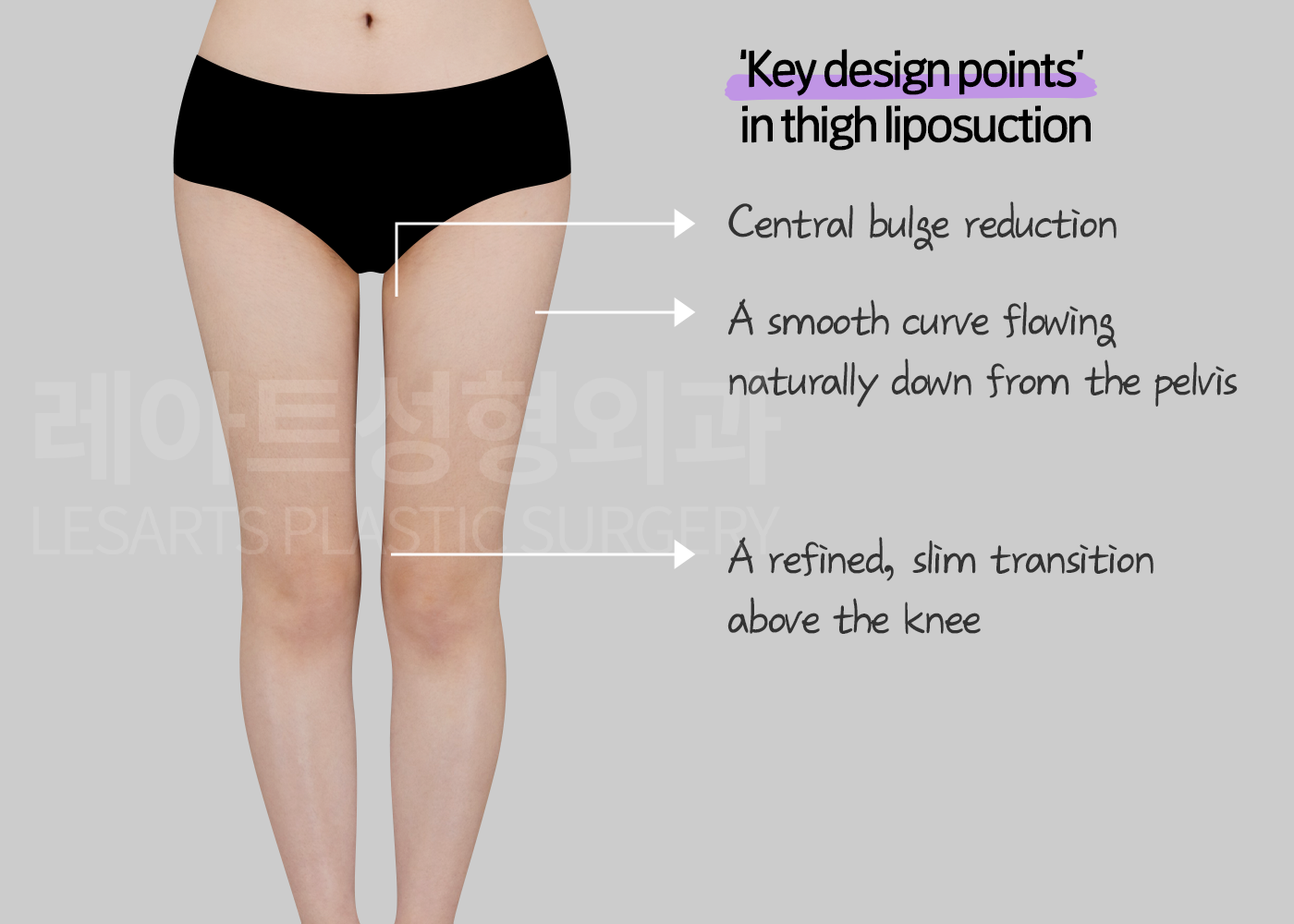
The hallmark of a successful thigh contour lies not in two-dimensional thinning, but in refining the unbroken flow of the silhouette:
- A smooth, unbroken arc extending from the sub-iliac pelvic line
- Softening trochanteric saddlebag protrusions across the mid-thigh
- A clean, slender suprapatellar taper into the medial knee
When these three regions connect without step-off irregularities,
the legs appear significantly longer, straighter, and more statuesque.
2. Essential Design Guidelines for Successful Thigh Liposuction
Thigh liposuction is not a one-dimensional procedure
aimed merely at extracting bulk aspirate volume.
The nuanced clinical judgment of where to preserve adipose buffers and where to contour aggressively
determines the ultimate aesthetic outcome.
1) Medial Thigh (Inner Aspect): Balanced Separation & Fluid Curvature
While the medial thigh demonstrates dramatic visible reduction,
aggressive, excessive suction carries a high risk
of creating an unnatural, hollowed step-off between the legs.
Design Principle: Establish a clean inner thigh gap in neutral standing stance,
while preserving sufficient soft-tissue continuity during ambulation
to respect natural adductor contours and maintain a soft, graceful curve.
2) Lateral Thigh (Saddlebags): Contour Refinement Over Extreme Debulking
Over-resecting trochanteric saddlebag fat can induce subgluteal hollowing
or paradoxically make the pelvic width appear narrow and truncated.
Design Principle: Specialized body contouring feather-sculpts the protruding lateral margins
while carefully preserving an unbroken, flowing transition
from the iliac crest through the lateral thigh.
3) Peripatellar Knee Zone: The Crucial Detail for Proportional Harmony
Targeting localized adipose accumulation around the medial and superior knee,
even in modest quantities, transforms the visual proportions of the entire lower limb.
Design Principle: Defining the peripatellar knee perimeter visually elongates the legs
and delineates a crisp aesthetic transition between the distal thigh and proximal calf.
Circumferential thigh liposuction must always incorporate peripatellar contouring to achieve complete aesthetic refinement.
3. Clinical Case Analysis: Circumferential Thigh Liposuction
Patient Profile: Female in her late 20s
Physical Measurements: Height 155 cm / Weight 46.1 kg (BMI 19.2)
Aesthetic Goals: Desired an airy, natural inner thigh gap
and a feminine silhouette accentuating pelvic curves.
Prioritized overall lower-body contour harmony rather than aggressive, simple fat extraction.
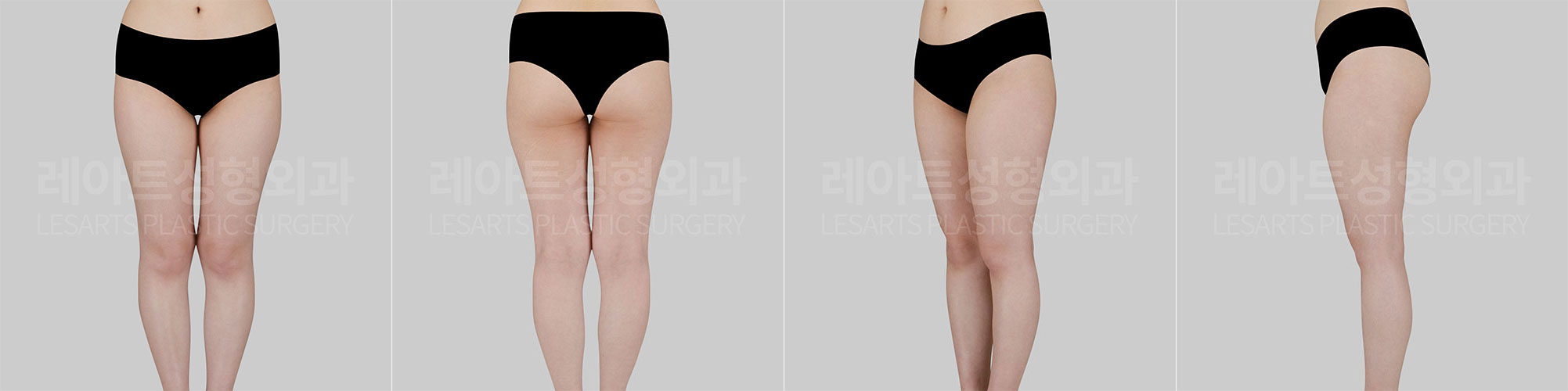
[Pre-Operative Assessment & Surgical Plan]
Pre-Operative Presentation:
Dense medial fat caused complete friction along the upper inner thighs.
Prominent lateral saddlebag bulges truncated the vertical leg line,
making the lower body appear shorter.
Surgical Strategy & Plan:
Perform circumferential 360 thigh liposuction to debulk medial fullness
and smooth lateral saddlebag contours.
Supplement lateral pelvic hollows (hip dips) via autologous fat grafting for seamless curvature.
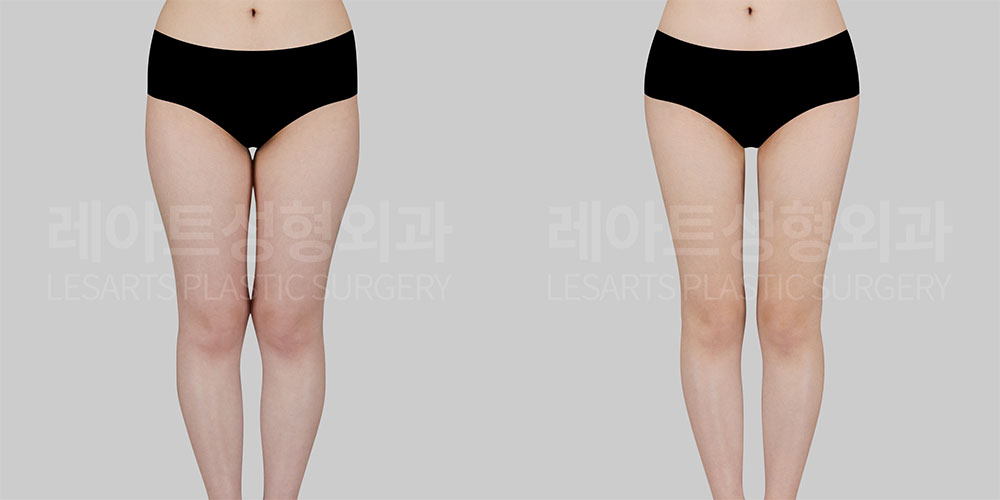
Lesarts Thigh Liposuction: Before & After Comparison
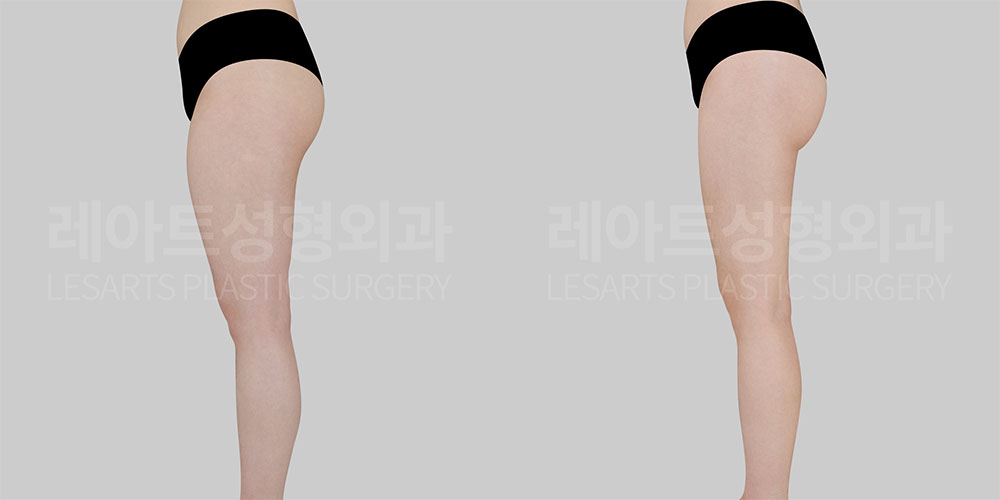
Lesarts Thigh Liposuction: Lateral Profile Comparison by Dr. Pyongrim Choi
[Clinical Progress: Pre-Op vs. 3 Months Post-Op]
Despite virtually no change in total scale weight,
the previously touching upper inner thighs achieved clean, natural separation.
Irregular, bulging lateral saddlebag contours were smoothed into a continuous line.
Concurrently sculpting the peripatellar knee perimeter
visibly elongated lower-body proportions and enhanced vertical leg length.

Dr. Pyongrim Choi


Cases finding
similar to my profile
Customer Diagnostics


Select the surgery and
area you are interestedto see real
before andafter changes.


we
make you,
the art
Clinic hours
MON - FRI
10 am – 7pm
SAT
10 am – 4pm
Holiday
SUN, HOLIDAY
Location
Lesarts Moon Clinic Tower 4-5F, 40, Nonhyeon-ro 168-gil,
Gangnam-gu, Seoul, Republic of Korea

Medical institution name Lesarts Plastic Surgery
Address Lesarts Moon Clinic Tower 4-5F, 40, Nonhyeon-ro 168-gil, Gangnam-gu, Seoul, Republic of Korea
Representative Moon sung jun
