




Online Consultation
Please accurately enter the information below.
Quick Cost Consultation
Quick Consultation & Reservation
Cases finding
similar to my profile






Doctor's Note
Medical columns by our surgeons
Gynecomastia | 2 Months After Male Breast Reduction: What Changes Occur?
2026-07-20
Gynecomastia | 2 Months After Male Breast Reduction: What Changes Occur?
Q. What specific anatomical changes occur in chest contour, scarring, and the areola 2 months after gynecomastia surgery?
A. As major postoperative swelling resolves, previously protruding lower and lateral chest areas settle into a flat,
masculine contour.
With glandular tissue excised, the elevated areolar mound flattens and its diameter contracts naturally
(pigment condensation may make the areola appear slightly darker),
and periareolar incision scars fade significantly by month 2, becoming barely noticeable to the naked eye.
Subsequently, as residual micro-swelling and internal tissue induration (biobond) soften, chest elasticity and sensory innervation normalize completely.
▶ Learn More About Lesarts Gynecomastia Surgery
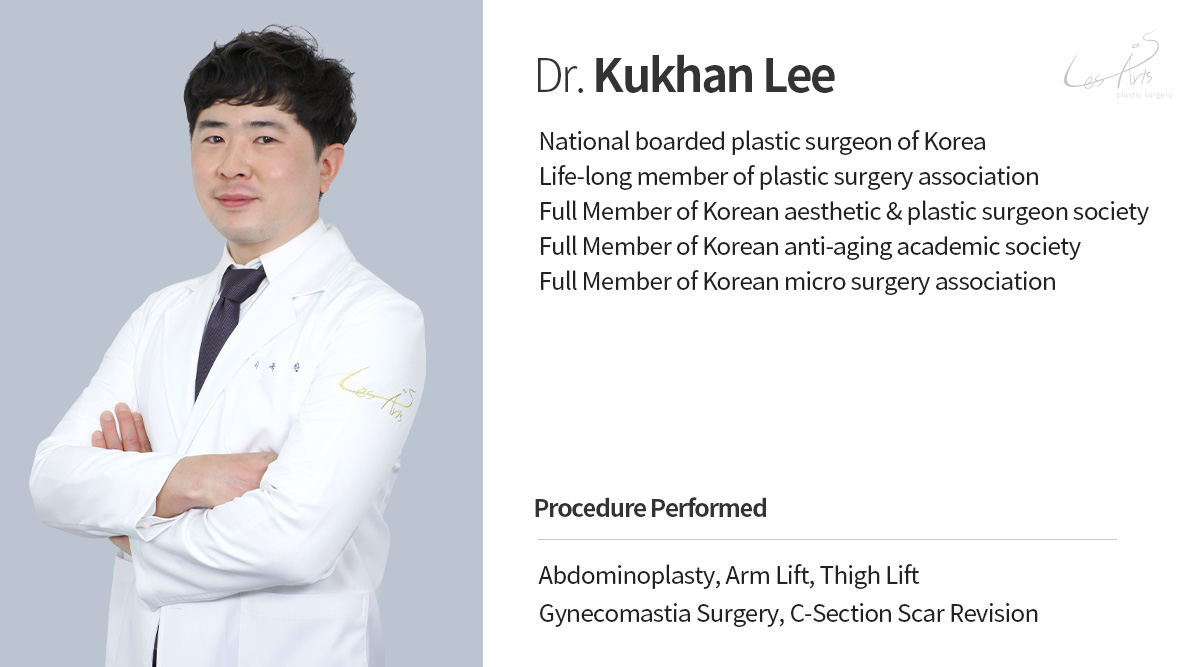
Hello, I am Dr. Kukhan Lee, Board-Certified Plastic Surgeon at Lesarts Plastic Surgery Clinic.
During gynecomastia consultations,
many male patients ask one fundamental question in common:
"Will my chest truly look noticeably different after surgery?"
Having lived with prominent, rounded breast tissue for a prolonged period,
many find it difficult to picture what their chest
will actually look like once corrected.
In clinical reality, however, the overwhelming majority of patients
express immense satisfaction with their immediately flattened chest silhouette
from the earliest postoperative stages.
Nevertheless, the degree of contour transformation varies depending on individual body composition,
with several anatomical parameters directly influencing surgical outcomes:
Pre-operative breast volume and glandular density
Grade of skin laxity and dermal elasticity
Nipple-areola complex positioning and symmetrical balance
In this post, we examine a case of Simon Grade IIa gynecomastia—the grade most frequently encountered in clinical practice—
to review the anatomical progression and healing timeline up to 2 months post-op.
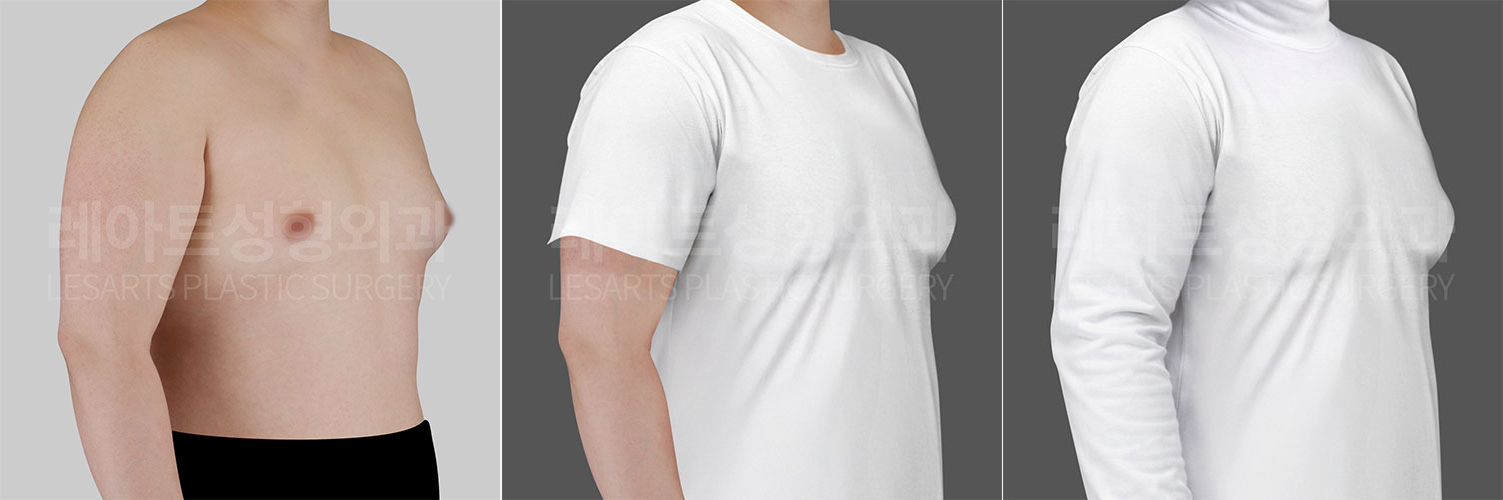
Lesarts Gynecomastia Surgery: Pre-Operative Assessment

Lesarts Gynecomastia Surgery: Pre-Operative Presentation
[Pre-Operative Assessment & Diagnosis]
Diagnostic Grade: Simon Grade IIa
Patient Profile: Height 175 cm / Weight 101 kg
This patient presented seeking definitive correction for chest enlargement
and anterior projection that had persisted since his adolescent teenage years.
He experienced rapid weight gain during elementary school, around which time his chest began projecting outward;
subsequently, even after disciplined dieting reduced his weight down to 66 kg,
his chest volume remained unreduced and persistently prominent.
Recent weight gain further accentuated his chest dimensions, prompting him to seek surgical care.
Pre-operative diagnostic ultrasound and clinical palpation confirmed
mixed gynecomastia (Simon Grade IIa) involving both true fibroglandular proliferation and surrounding subcutaneous adiposity.
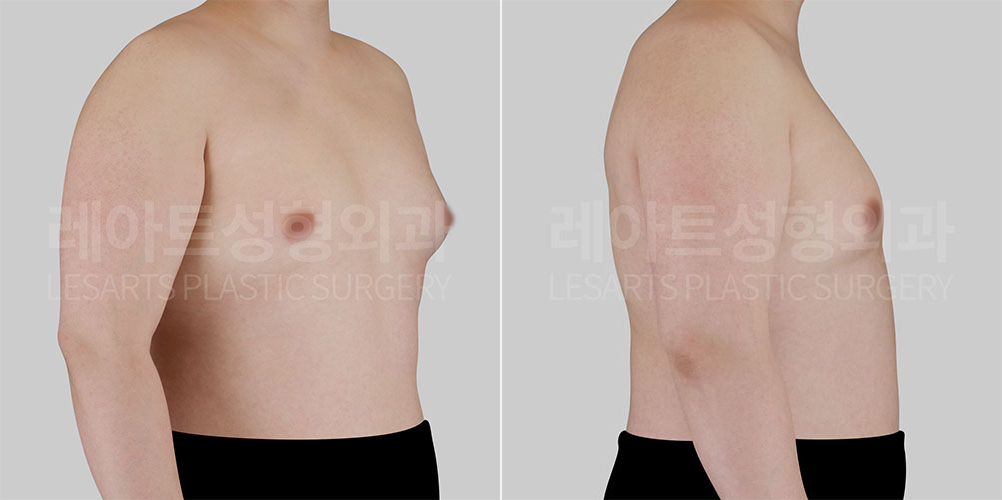
Lesarts Gynecomastia Surgery: Pre-Operative Diagnostic Evaluation by Dr. Kukhan Lee
[Key Pre-Operative Anatomical Findings]
Lower Breast Pole: Pronounced fullness and dependent projection across the inframammary fold
Bilateral Lateral Chest: Substantial subcutaneous adipose accumulation extending toward the axilla
Nipple-Areola Complex: Conical elevation and expanded areolar diameter driven by dense retroareolar glandular hypertrophy
Skin Elasticity: Favorable dermal recoil relative to historical weight fluctuations
Positional Symmetry: Stable vertical areolar position without severe grade ptosis
Addressing these findings, we performed subcutaneous mastectomy to excise retroareolar glandular tissue concurrently with
bilateral chest liposuction to sculpt the lateral contours into an athletic masculine profile.

Lesarts Gynecomastia Surgery: Pre-Op vs. 2 Weeks Post-Op Progress by Dr. Kukhan Lee
[Clinical Progress at 2 Weeks Post-Op]
At 2 weeks following gynecomastia surgery,
residual edema and post-surgical bruising remain visibly present.
Nevertheless, even with early postoperative swelling,
the reduction in lower breast projection is immediately apparent on clinical inspection,
marking the phase where a masculine chest line begins to establish.
Many patients express high satisfaction as early as this 2-week checkpoint.
Over the subsequent weeks, as interstitial fluid resorbs and dermal contraction takes place,
the pectoral contour flattens and firms into its natural anatomical shape.

[Clinical Progress at 2 Months Post-Op]
By 2 months post-operation,
acute edema and ecchymosis have resolved, allowing a sleek,
masculine pectoral silhouette to stabilize.
Key clinical improvements observed at the 2-month mark include:
Flattened Lower Pole: Bulging tissue above the inframammary crease is replaced by an even pectoral line.
Lateral Chest Streamlining: Subcutaneous debulking along the lateral borders harmonizes the transition from chest to torso.
Natural Areolar Elevation: Excising the underlying glandular mound repositions the areola slightly superiorly, producing a natural chest-lifting effect.
Collectively, these refinements confirm that the chest contour has stabilized into a
firmer, flat, and athletic masculine shape.
[Postoperative Changes in Areolar Size and Pigmentation]
Following gynecomastia correction, the areolar circumference naturally decreases.
Because the protruding glandular core is removed, the stretched areolar skin contracts over a flat plane, reducing its total diameter.
Concurrently, the areola may temporarily appear slightly darker in tone.
This is a normal pigment condensation effect occurring as melanin concentrates over a smaller surface area, which resolves naturally over time.
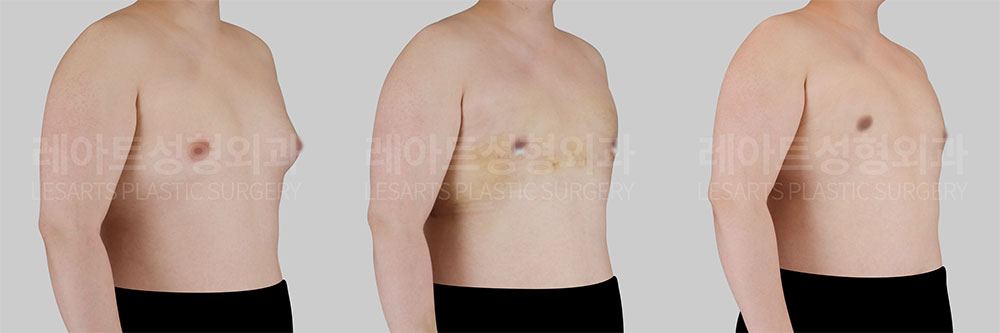
Lesarts Gynecomastia Surgery: Pre-Op vs. 2 Weeks vs. 2 Months Comparison
[Incision Scar Maturation Timeline]
The surgical incision for gynecomastia excision is placed minutely along the lower hemi-circumferential areolar border,
camouflaged within the natural color transition between pigmented areola and normal skin.
Consequently, by 2 months post-op, the fine incision line matures and fades to where it is
practically indiscernible upon casual visual inspection in most patients.
Tissue recovery continues past the 2-month milestone.
Over the ensuing months, residual deep swelling clears, and internal tissue induration
(biobond) completely resorbs and softens.
This allows the pectoral profile to achieve complete pliability,
relieving early feelings of tightness while cutaneous sensation returns to baseline.
Gynecomastia surgery requires precision not only in immediate contouring, but also in managing the full physiological healing cycle.
A dedicated 1:1 consultation is essential to evaluate individual glandular-to-fat ratios, dermal elasticity,
and lifestyle factors to establish an optimal surgical strategy.
In cases where skin elasticity is well preserved without severe ptosis, combining subcutaneous mastectomy with lateral chest liposuction
reliably delivers a refined, athletic masculine chest line.
If enlarged chest tissue has caused persistent self-consciousness in clothing or daily activities,
we recommend consulting a specialist to assess your anatomical status and clarify the postoperative recovery timeline.
A tailored treatment approach addressing the underlying etiology is the most reliable path to achieving a flat, masculine chest with lasting confidence.
FAQ
Q1. Why does enlarged chest tissue persist even after significant weight loss?
A. True gynecomastia involves fibroglandular breast tissue in addition to adiposity.
While fat reduces with diet and exercise, dense glandular tissue does not metabolize with weight loss and requires surgical excision.
Q2. When can the final chest shape be evaluated after gynecomastia surgery?
A. Significant contour flattening is apparent immediately, with defined shaping emerging from week 2.
By 2 months, acute swelling and bruising resolve to reveal a stable, masculine pectoral contour.
Q3. Why does the areola become smaller or appear darker post-surgery?
A. Excising the underlying glandular mound flattens the areolar surface, allowing expanded skin to contract naturally.
As areolar surface area contracts, pigment concentrates, which may temporarily make the tone appear slightly deeper.
Q4. Are scars conspicuous after gynecomastia surgery?
A. Incisions are minimal and discreetly placed along the lower periareolar margin.
By 2 months post-op, the fine incision line typically fades to where it is difficult to detect under normal lighting.
Q5. What healing changes occur beyond 2 months post-op?
A. Residual micro-edema clears and internal tissue induration (biobond) fully softens.
Tissue tightness subsides, cutaneous sensation normalizes, and the chest settles into a pliable, natural contour under fitted clothing.
Dr. Kukhan Lee


Cases finding
similar to my profile
Customer Diagnostics


Select the surgery and
area you are interestedto see real
before andafter changes.


we
make you,
the art
Clinic hours
MON - FRI
10 am – 7pm
SAT
10 am – 4pm
Holiday
SUN, HOLIDAY
Location
Lesarts Moon Clinic Tower 4-5F, 40, Nonhyeon-ro 168-gil,
Gangnam-gu, Seoul, Republic of Korea

Medical institution name Lesarts Plastic Surgery
Address Lesarts Moon Clinic Tower 4-5F, 40, Nonhyeon-ro 168-gil, Gangnam-gu, Seoul, Republic of Korea
Representative Moon sung jun
