




Online Consultation
Please accurately enter the information below.
Quick Cost Consultation
Quick Consultation & Reservation
Cases finding
similar to my profile






Doctor's Note
Medical columns by our surgeons
Arm Liposuction | Can Contouring Only the Arms Make Your Entire Frame Look Smaller?
2026-07-21
Arm Liposuction | Can Contouring Only the Arms Make Your Entire Frame Look Smaller? [Doctor's Notes by Dr. Pyongrim Choi]
Can your body silhouette look noticeably different just by slimming the arms without major weight loss?
The arms heavily dictate the perceived width of the upper torso
and the visual scale of your entire frame.
When lateral and posterior upper arm fullness is debulked along with
adjacent axillary and subscapular fat deposits,
the upper body appears significantly lighter and more compact
even without drastic changes in scale weight.
♥ Lesarts Liposuction Procedure Guide
Hello, I am Dr. Pyongrim Choi, Board-Certified Plastic Surgeon at Lesarts Plastic Surgery Clinic.
Higher-weight female patients frequently ask
one recurring question during consultations:
“Even if I do not lose a massive amount of weight,
can slimming just my arms make my body frame look completely transformed?”
In the upper body, one of the most critical anatomical areas
governing perceived visual frame size is the arm.
Particularly in short-sleeved tops or sleeveless wear,
when the visible upper arm is heavy and sags downward,
the upper torso appears larger, wider, and more cumbersome than actual scale metrics indicate.
When lateral arm width flares outward or posterior triceps fat sags low,
the arms catch the eye before the torso does,
making the entire upper body appear broad.
In patients with higher overall body weight,
the subcutaneous adipose layer of the upper arm is notably thick,
with continuous fat deposits extending broadly from the posterior triceps
through the axillary folds into the subscapular back rolls.
If dermal elasticity is compromised as well,
the issue goes beyond simple arm circumference—
the lower arm sags downward, amplifying the visual heaviness
of the entire upper torso.
Therefore, arm liposuction must not be treated as simple localized fat reduction;
it is crucial to evaluate and plan the continuous anatomical line
flowing from the shoulder to the elbow, axilla, and subscapular back.
♡ Check Arm Liposuction Clinical Cases Similar to Yours
1. Why Do Arms Look Thicker and Saggier in Higher-Weight Women?
To understand arm liposuction, one must first examine
the underlying structural anatomy of the upper extremity.
The upper arm consists of the skin envelope, the subcutaneous adipose compartment,
and the deep muscular frame comprising the biceps and triceps.
In patients with higher body weight, subcutaneous fat is not only thick overall,
but is often distributed disproportionately across specific zones,
substantially exaggerating arm width and irregular curvature.
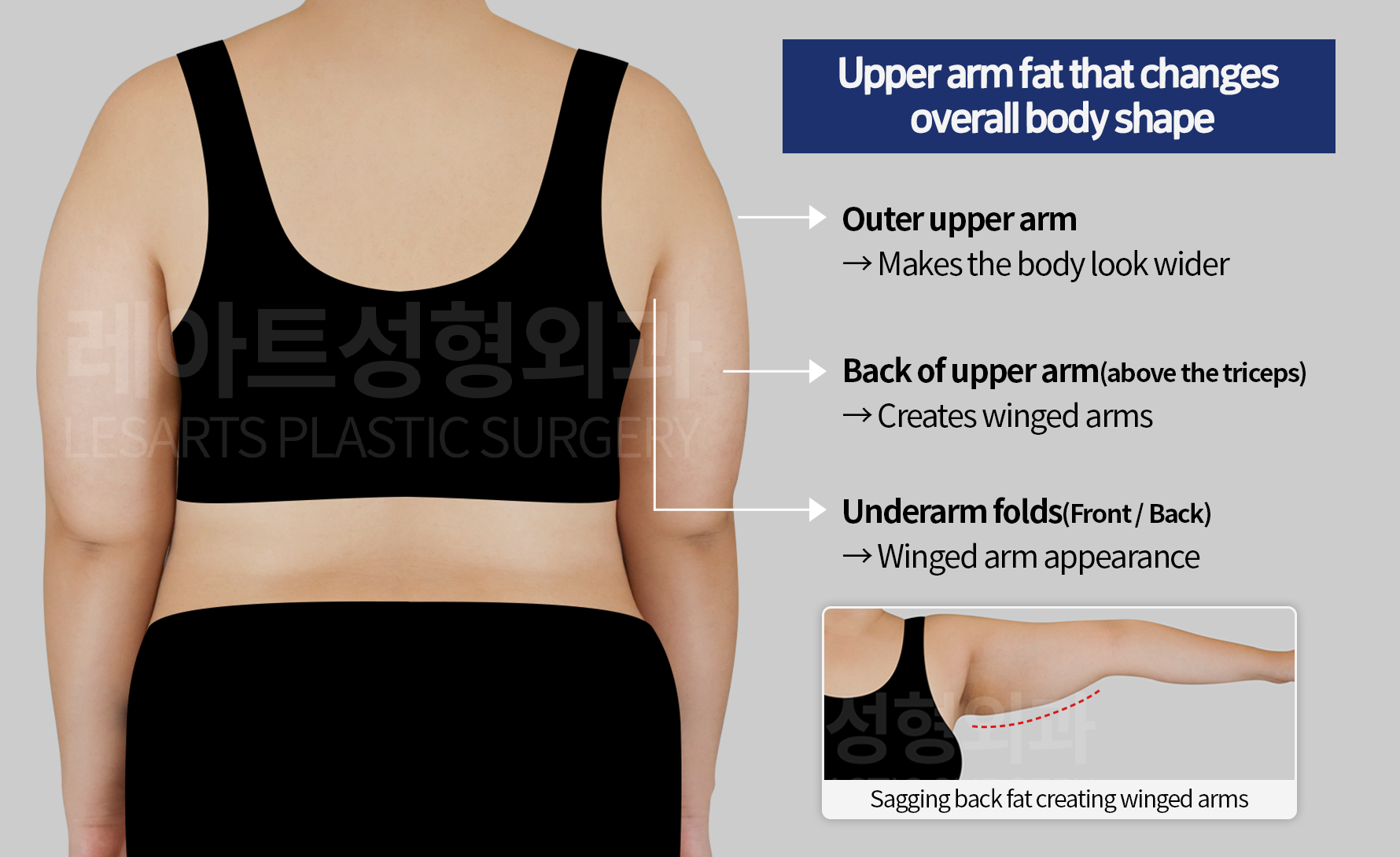
In particular, the posterior brachium is highly susceptible
to the gravitational vector.
When dense adipose tissue overlies the triceps
and skin tone is compromised, extending the arm outward
reveals pronounced, dependent flaccid hanging fat.
Lateral arm fullness causes the arms to appear abducted from the body,
directly broadening the perceived horizontal width
of the upper torso on frontal view.
Fat deposits along the anterior/posterior axillary folds and subscapular area
also heavily impact arm lines.
When volume here blends continuously into the brachium, the demarcation between arm and torso blurs,
giving the entire upper body a heavy, unrefined impression.
Ultimately, assessing arm fat requires evaluating not just how much exists,
but precisely where and along which vectors it is deposited.
2. Why Arm Liposuction Makes Your Entire Frame Look Smaller
Arm liposuction is far more than simply reducing
circumferential centimeters on a measuring tape.
When lateral outward flare and posterior hanging curves are streamlined,
the entire aesthetic impression of the upper torso
undergoes a complete visual transformation.
In a natural relaxed stance, clear space opens between the torso and the arms;
as protruding posterior bulk is debulked,
the line connecting shoulder to elbow straightens visibly.
Consequently, even without massive weight reduction on the scale,
the horizontal torso width appears narrower, creating an overall
streamlined, well-proportioned body frame.
In short sleeves or sleeveless clothing, narrowed upper arm diameter
eliminates fabric pinching, while resolving heavy posterior bulges
makes the upper body feel visibly lighter.
However, pursuing extreme, aggressive thinning does not guarantee
a natural, pleasing transformation.
Shoulder width, deltoid development, skin recoil, and adjacent axillary/subscapular fat
must all be factored in so that the transition from arm to torso flows effortlessly.
3. Critical Principles When Planning High-Volume Arm Liposuction
For patients with higher body weight, arm liposuction cannot be planned
based on extraction volume alone.
Over-resecting simply because fat volume is high can trigger skin waviness,
or make baseline tissue laxity even more conspicuous post-operatively.
In particular, overlying the triceps, a uniform, thin adipose buffer must be preserved
to prevent exposing harsh, masculine muscular demarcations.
Posterior volume must be thoroughly reduced while calibrating cannula depth and scope
so that muscles are not overly skeletonized, sculpting a smooth, natural feminine arm line.
Dermal elasticity must also be rigorously evaluated.
If the arms have carried heavy volume for years or endured cyclic weight fluctuations,
the skin's physiological retraction capacity following fat evacuation may be limited.
Thus, based on baseline skin tone, realistic achievable improvements
and potential residual laxity must be evaluated together.
Continuity between the arm and surrounding aesthetic units is equally essential.
If only the brachium is slimmed while accessory breast (axillary) and
subscapular back fat remain untouched, the anatomical border looks disjointed.
When indicated, contouring the brachium concurrently with the accessory breast,
anterior/posterior axillary folds, and subscapular regions ensures
a seamless, fluid upper body contour.
Clinical Case Analysis
The patient featured here was preparing for her upcoming wedding,
deeply concerned that heavy arm bulk made her entire upper body frame
appear disproportionately large.
Patient Profile
Age: 30s
Height: 163 cm
Weight: 82.2 kg
BMI: 30.9
The patient sought to reduce total arm circumference while making
her upper torso appear smaller, lighter, and more delicate.
Because heavy fat extended continuously through the accessory breast, axilla, and subscapular areas,
a comprehensive plan contouring the arm and adjacent transition zones together was formulated.
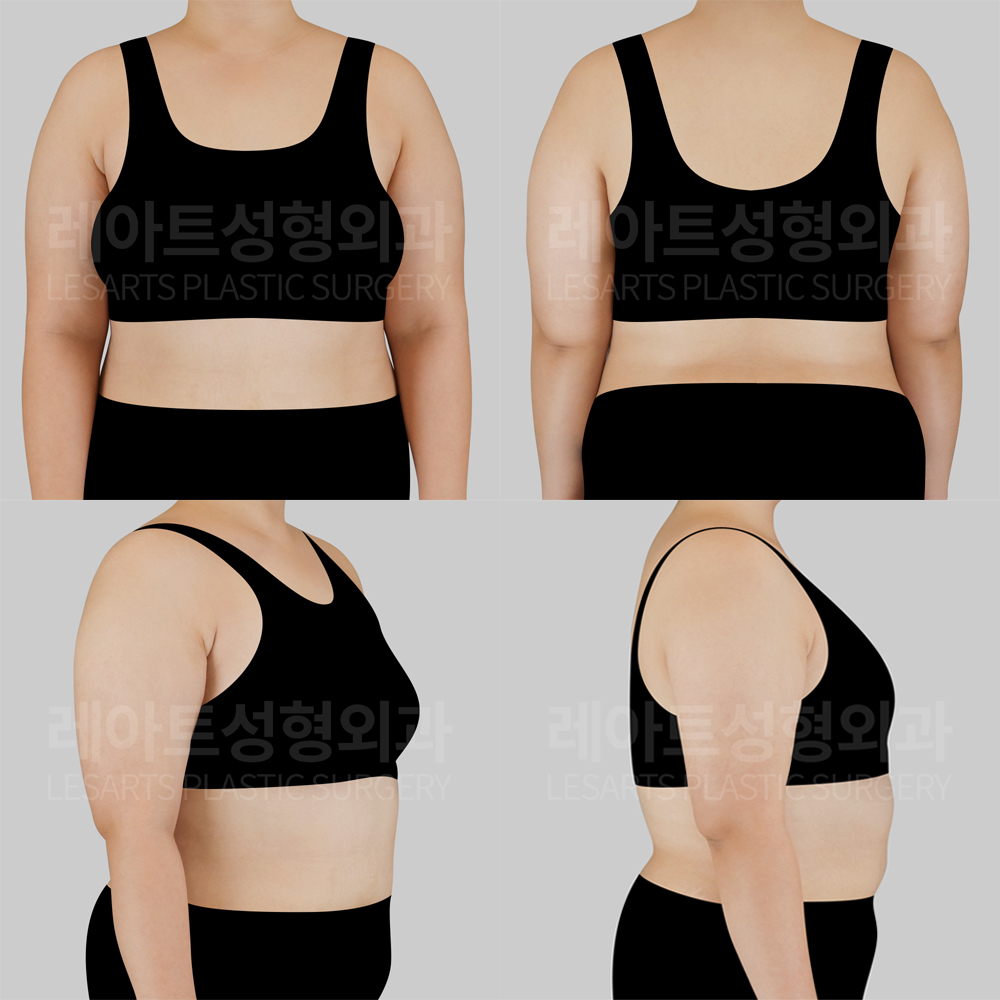
[Lesarts Arm Liposuction: Pre-Operative Assessment]
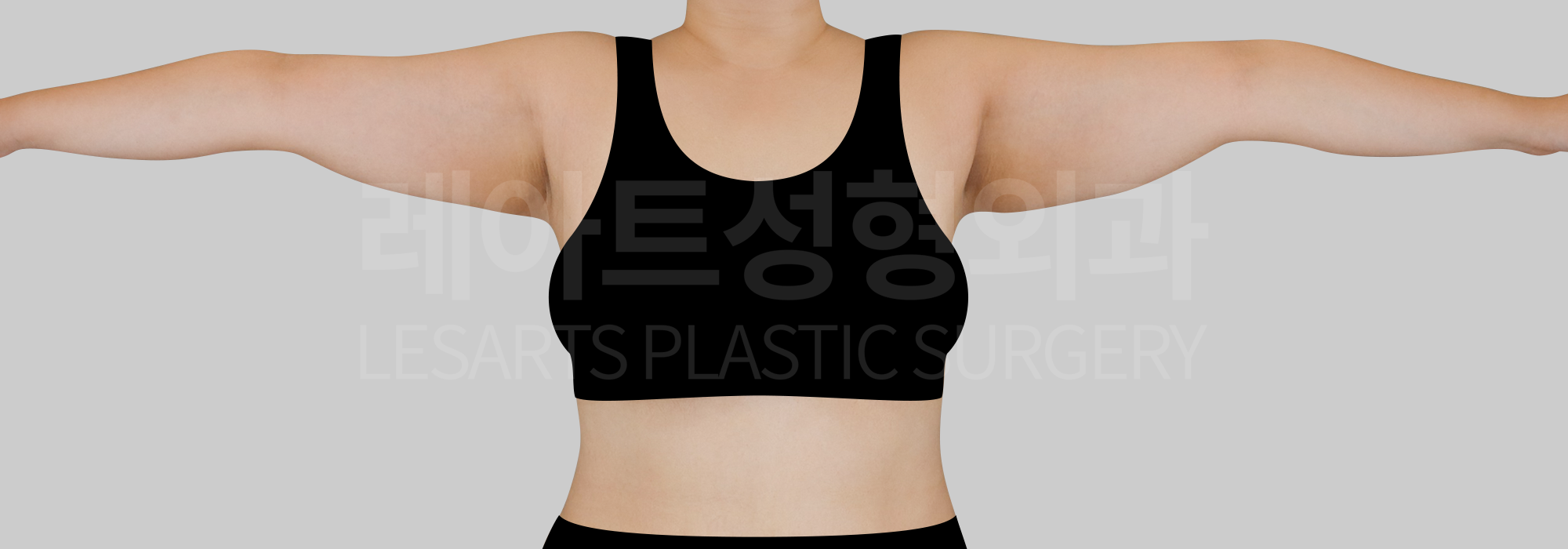
[Lesarts Arm Liposuction: Pre-Op Abduction View]

[Lesarts Arm Liposuction: Pre-Op Posterior View]
[Surgical Scope & Strategy]
Subcutaneous fat of the brachium was thoroughly debulked within safe margins that avoided exposing harsh muscle ridges,
while simultaneously treating adjacent accessory breast, axillary, and subscapular regions.
Beyond thinning posterior and lateral arm depth,
the design prioritized establishing a smooth, continuous transition
from the shoulder to the elbow, and from the axilla into the subscapular back.
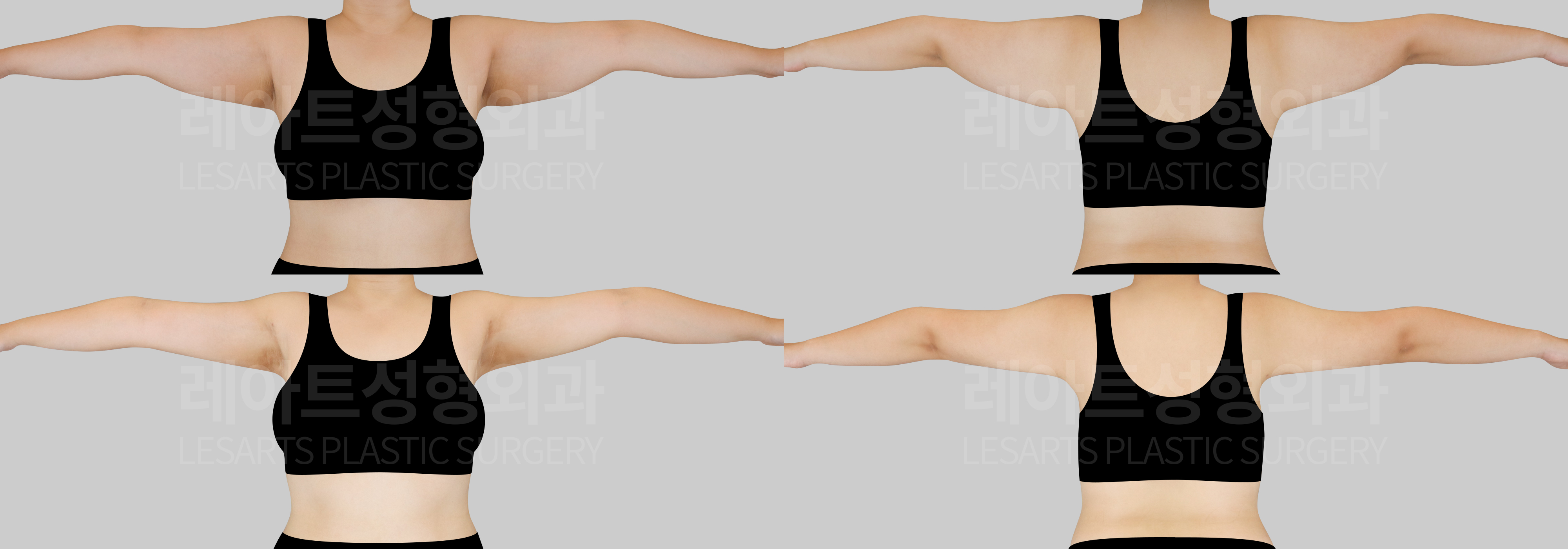
[Lesarts Arm Liposuction Post-Op Abduction View by Dr. Pyongrim Choi]
Arm Liposuction: 3-Month Post-Op Comparison
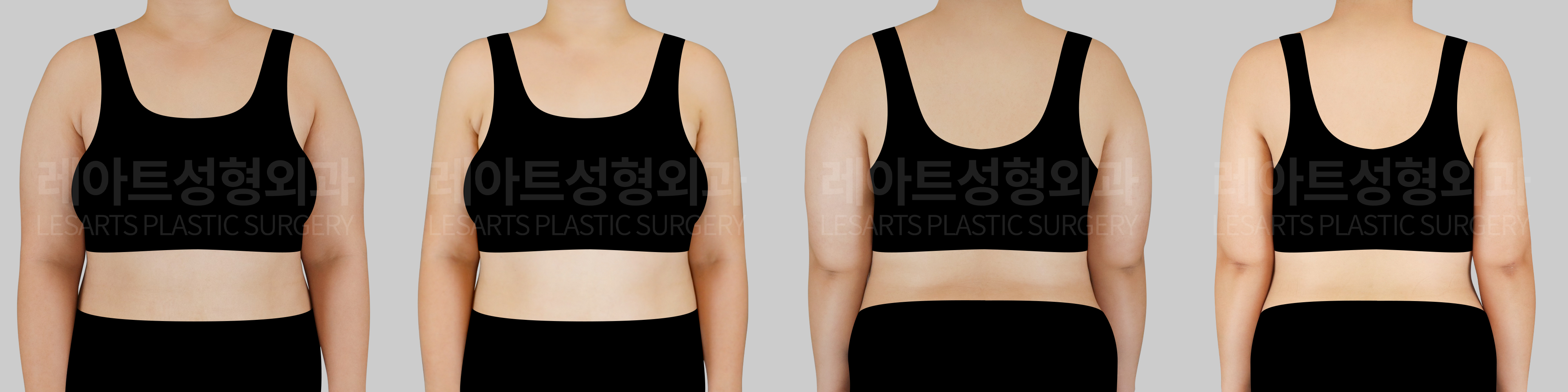
[Lesarts Arm Liposuction: 3-Month Clinical Comparison by Dr. Pyongrim Choi]
Pre-operatively, dependent fat and skin
hung heavily beneath the upper arm;
at 3 months post-op, the line flowing from shoulder to elbow
connects in a visibly straighter, refined contour.
Preserving necessary adipose buffers prevented excessive muscle exposure,
while thoroughly eliminating dependent lower-arm heaviness.
In a natural relaxed stance, reducing posterior outward projection
restored distinct, clear separation between the torso and the arms.
Lateral arm width decreased noticeably, significantly narrowing the perceived horizontal width
of the upper body on frontal inspection.
Rather than treating the arm in isolation, concurrently contouring the accessory breast, axilla,
and subscapular regions established a natural, unbroken flow from the shoulder to the torso.
With adjacent upper body volume streamlined in unison, independent of scale weight fluctuations,
her entire body frame appears substantially smaller, lighter, and more delicate.
Arm Liposuction Creates Transformations Distinct from Weight Loss
Arm liposuction is not a surgery
intended to drastically reduce scale weight.
However, by debulking the lateral and posterior adipose deposits that broaden upper torso width,
your overall silhouette transforms dramatically even without significant weight loss.
Particularly when arm fat volume is high and extends into the axilla and subscapular area,
streamlining the arm alongside its adjacent aesthetic units delivers a remarkably distinct visual change in short-sleeved and sleeveless wear.
What matters most is not simply how many cubic centimeters are aspirated.
One must evaluate current muscular contours, dermal elasticity,
and exact adipose boundaries to plan precisely which areas
to sculpt and at what anatomical depth.
Furthermore, if skin tone is substantially diminished, minor residual laxity may linger after debulking,
making comprehensive pre-operative consultation regarding realistic improvements and anatomical limits essential.
Transforming the arms alone can completely change the visual impression of your upper torso.
To ensure a natural outcome, remember that the upper arm must not be viewed in isolation—
the entire continuous line flowing through the shoulder, axilla, and subscapular back must be harmonized together.
Arm Liposuction FAQ
1. Can arm liposuction alone make your entire body look slimmer?
Reducing lateral arm width and posterior volume narrows the perceived horizontal width of the upper torso,
making your overall frame appear more compact even without major scale weight loss.
2. Can patients with higher body weight safely undergo arm liposuction?
Surgical candidacy is determined after evaluating systemic health, adipose distribution, and dermal elasticity.
Higher volume requires careful planning of treatment scope and assessment of skin retraction capacity.
3. Does removing substantial posterior arm fat completely eliminate sagging?
Debulking fat weight significantly relieves hanging heaviness;
however, if skin tone is poor, minor laxity may remain.
Preserving an adequate, smooth fat buffer is crucial to avoid surface irregularities.
4. Should the axilla and subscapular back always be treated during arm liposuction?
It is not mandatory in every case.
However, when adipose deposits connect continuously across the arm, axilla, and subscapular regions,
treating them concurrently ensures a seamless transition into the torso.
5. Is the final result fully stabilized by 3 months post-op?
Major postoperative swelling subsides by 3 months, revealing clear silhouette changes.
However, minor residual edema and tissue induration (biobond) continue to soften,
allowing the contours to settle into an even smoother, more natural line over 6 months.
Dr. Pyongrim Choi


Cases finding
similar to my profile
Customer Diagnostics


Select the surgery and
area you are interestedto see real
before andafter changes.


we
make you,
the art
Clinic hours
MON - FRI
10 am – 7pm
SAT
10 am – 4pm
Holiday
SUN, HOLIDAY
Location
Lesarts Moon Clinic Tower 4-5F, 40, Nonhyeon-ro 168-gil,
Gangnam-gu, Seoul, Republic of Korea

Medical institution name Lesarts Plastic Surgery
Address Lesarts Moon Clinic Tower 4-5F, 40, Nonhyeon-ro 168-gil, Gangnam-gu, Seoul, Republic of Korea
Representative Moon sung jun
