




Online Consultation
Please accurately enter the information below.
Quick Cost Consultation
Quick Consultation & Reservation
Cases finding
similar to my profile






Doctor's Note
Medical columns by our surgeons
Thigh Liposuction & Hip Dip Fat Grafting | "The Moment Your Confidence Before the Mirror Changes: Designing Your Hidden Silhouette"
2026-08-05
Thigh Liposuction & Hip Dip Fat Grafting | "The Moment Your Confidence Before the Mirror Changes: Designing Your Hidden Silhouette"
Can saddlebags and inner thigh fat that resisted workout regimens be streamlined naturally through liposuction?
Achieving a natural lower-body contour requires evaluating muscle volume, bilateral asymmetry, and hip dip location
rather than simply reducing thigh adipose volume.
Target zones can be debulked via liposuction while depressed hip dips are augmented with fat grafting,
though achievable transformations vary based on tissue tethering and muscular asymmetry.
▶ Learn More About Lesarts Liposuction Techniques
▶ Learn More About Lesarts Fat Grafting Procedures
Hello, I am Dr. Yongseung Seo, Board-Certified Plastic Surgeon at Lesarts Plastic Surgery Clinic.
Many women maintain dedicated fitness routines amidst busy schedules
to manage their body contours.
However, persistent PT, Pilates, or swimming sessions often fail to reduce
stubborn fat deposits across targeted areas.
Particularly when gradual weight gain accentuates saddlebags and inner thigh fullness,
the lower body can feel disproportionately short and heavy.
Patients deciding to undergo liposuction for this concern
frequently request the maximum possible extraction of unwanted fat.
However, liposuction is never decided
by aspiration volume alone.
Surgeons must account for active muscle bulk, tissue dynamics, skeletal architecture, and bilateral asymmetries
to meticulously distinguish zones for reduction from areas requiring fat preservation.
The patient featured today managed a demanding enterprise
amidst a busy daily schedule.
A 10 kg weight gain over the past 2 years deepened her lower-body concerns,
and as someone with prior aesthetic history including arm and abdominal procedures,
she possessed a keen interest in body contouring.
[Patient Profile]
Age: Late 30s
Height: 165 cm
Weight: 63.3 kg
BMI: 23.3
Body Fat Percentage: 29.2%
※ Even with identical height and weight metrics, clinical outcomes vary individually
based on adipose distribution, muscle development, skeletal framework, and dermal elasticity.
Pre-Operative Body Contour Assessment for Thigh Liposuction & Pelvic Fat Grafting
[Pre-Operative Presentation – Lesarts Plastic Surgery Clinic]
Her overall subcutaneous adipose depth was modest
relative to her total body frame.
However, adipose accumulation was concentrated distinctly
along the lateral saddlebags and inner thighs.
Outward saddlebag convexity dropped the perceived origin of the legs downward,
while medial contact caused the lower-body silhouette to feel restricted.
Bilateral symmetry discrepancies were also confirmed across her thighs.
Subcutaneous fat depth measured via ultrasound:
Saddlebags: Right 29 mm / Left 25 mm
Inner Thighs: Right 23 mm / Left 19 mm
Posterior Thighs: Right 11 mm / Left 12 mm
Anterior Thighs: Right 16 mm / Left 18 mm
Medial Knees: Right 9 mm / Left 10 mm
Ultrasound evaluation confirmed that inter-side adipose depth discrepancies
were less pronounced than visual impressions suggested.
Accordingly, we deduced that underlying muscle volume and structural framework
played a substantial role in her apparent asymmetry.
While intrinsic muscular differences cannot be eliminated via liposuction,
calibrating aspirate volume differentially across both limbs optimized visual balance.
Similar clinical presentations can be reviewed in **Thigh Liposuction Before & After Cases**.
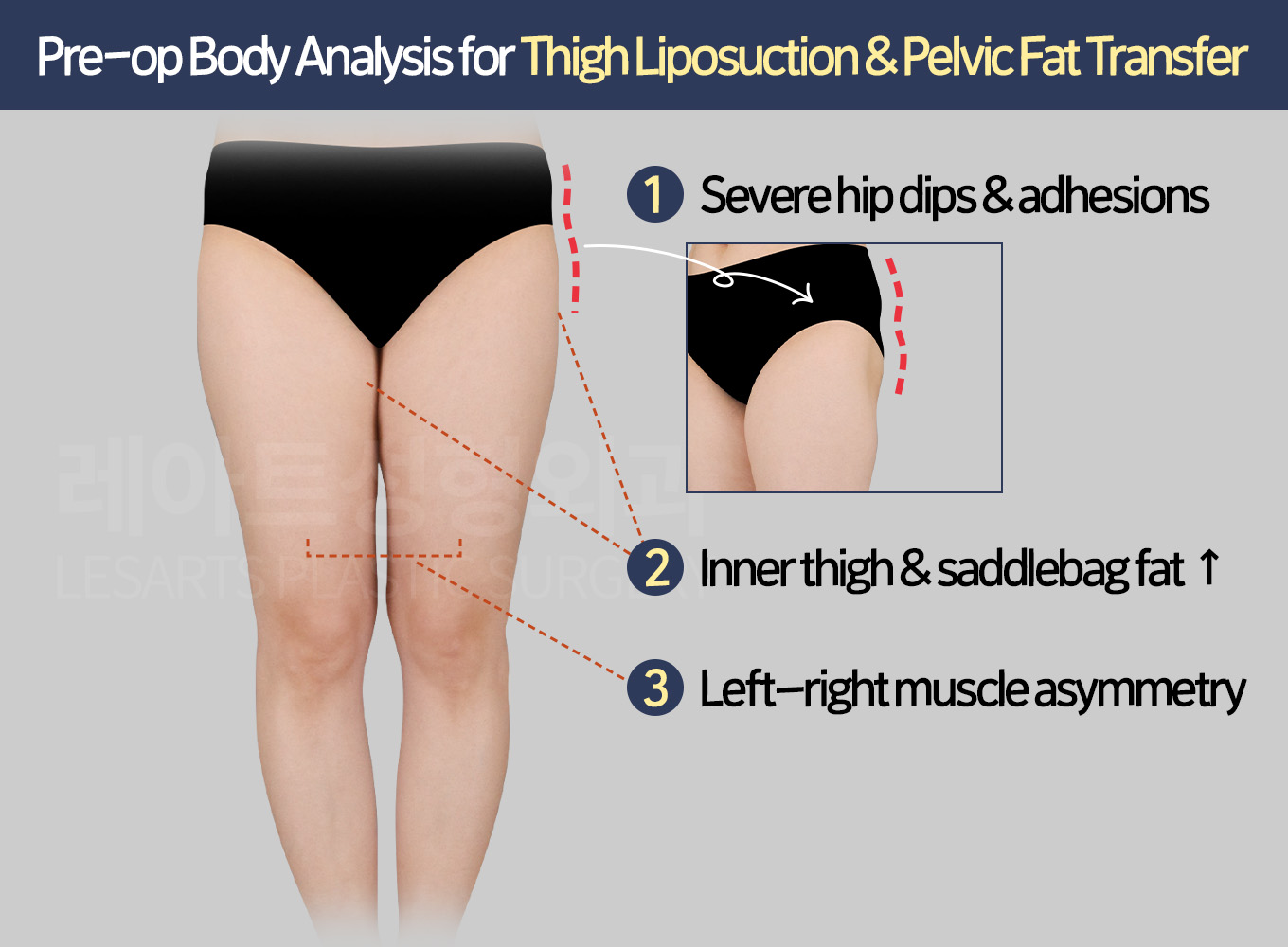
[Pre-Op Saddlebags, Inner Thighs, and Hip Dips Prior to Liposuction & Fat Grafting]
Beyond prominent saddlebags,
she presented with deep trochanteric depressions (hip dips).
Notably, fibrotic tethering accompanied these depressed zones,
requiring thorough release prior to autologous fat grafting.
Dense tethering binds surrounding soft tissues firmly,
meaning graft retention and volumetric gain can remain limited despite fat transfer.
Consequently, we counseled her transparently pre-operatively
that hip dip fat grafting would soften depressions without entirely eliminating them or guaranteeing a flawless curve.
Surgical Design: Thigh Liposuction & Pelvic Fat Grafting
[Contouring Plan Accounting for Saddlebags, Inner Thighs, and Hip Dips]
Saddlebag Liposuction
Outwardly convex saddlebags
were targeted for thorough debulking within safe anatomical limits.
However, because she suffered from deep hip dips,
aggressively stripping fat between the gluteal transition and upper thigh would have exacerbated contour irregularities.
Over-resecting the saddlebag zone alone distorts pelvic-to-thigh lines
and can paradoxically truncate apparent leg length.
Accordingly, while reducing lateral projection,
essential adipose buffers were preserved between the hips and thighs
to maintain a stable, harmonious lower-body proportion.
Medial & Peripatellar Thigh Liposuction
Medial and peripatellar zones were debulked thoroughly.
Beyond simply establishing an interspace, medial mid-thigh curves were refined
to ensure transitions flowing from knee to proximal thigh
appeared straight and sleek.
Anterior Asymmetry Calibration
She presented with conspicuous bilateral anterior quadriceps asymmetry.
Excising identical adipose volumes bilaterally would have magnified underlying muscular differences.
Therefore, evaluating muscular bulk and fat depth jointly,
differential extraction volumes were planned bilaterally
to optimize visual symmetry.
Pelvic Fat Grafting
The patient desired smooth, rounded pelvic and gluteal contours.
However, severe fibrous tethering across hip dips meant aggressive graft placement initially
risked uneven graft take and surface waviness.
Intra-operatively releasing fibrous adhesions completely
allowed us to evaluate receptive tissue capacity
prior to grafting harvested fat into trochanteric zones.
Pelvic and hip dip fat transfer cases can be explored further in **Body Fat Grafting Before & After Cases**.
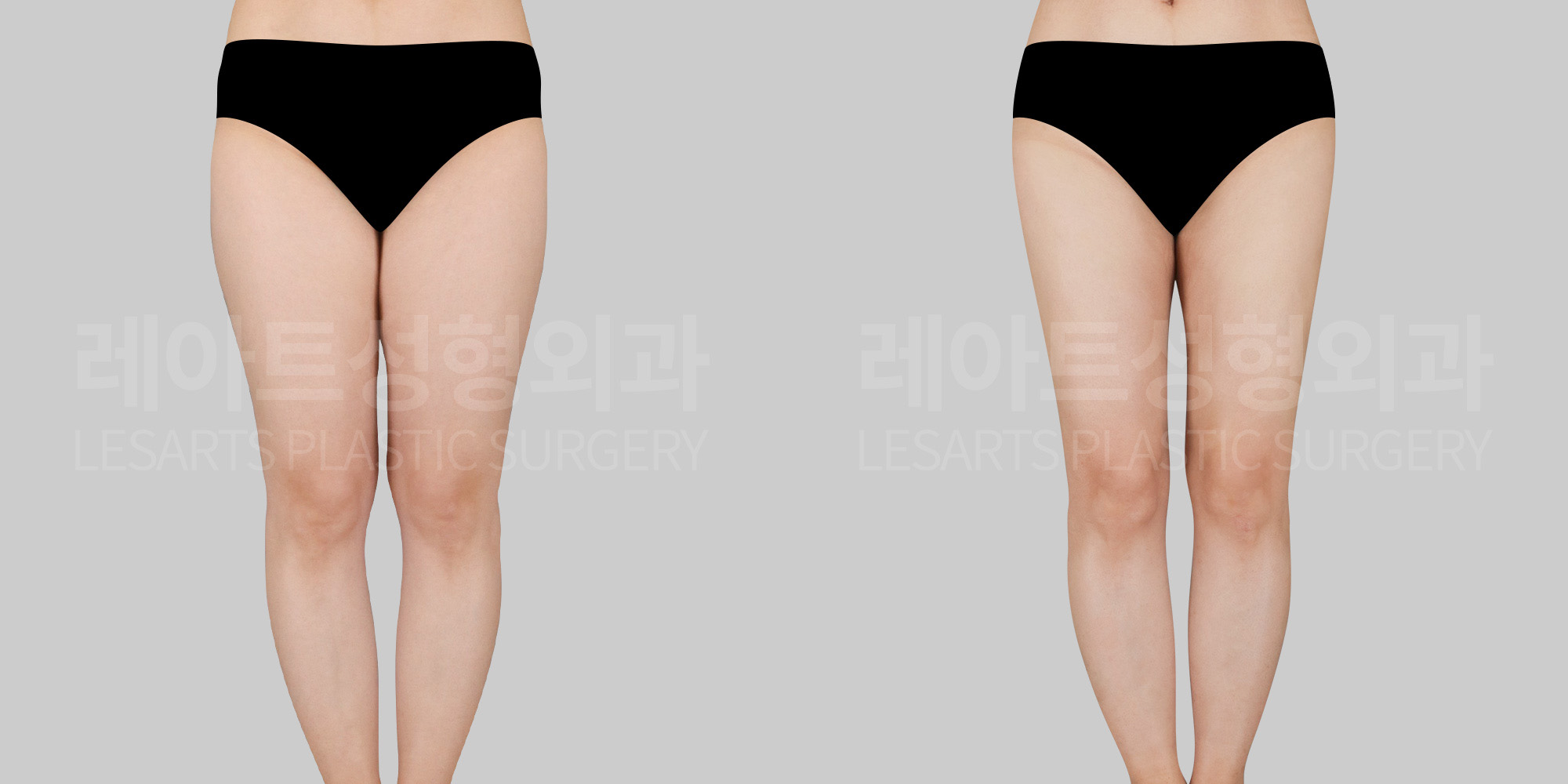
[Thigh Liposuction & Pelvic Fat Grafting Before & After – Dr. Yongseung Seo, Lesarts Plastic Surgery Clinic]
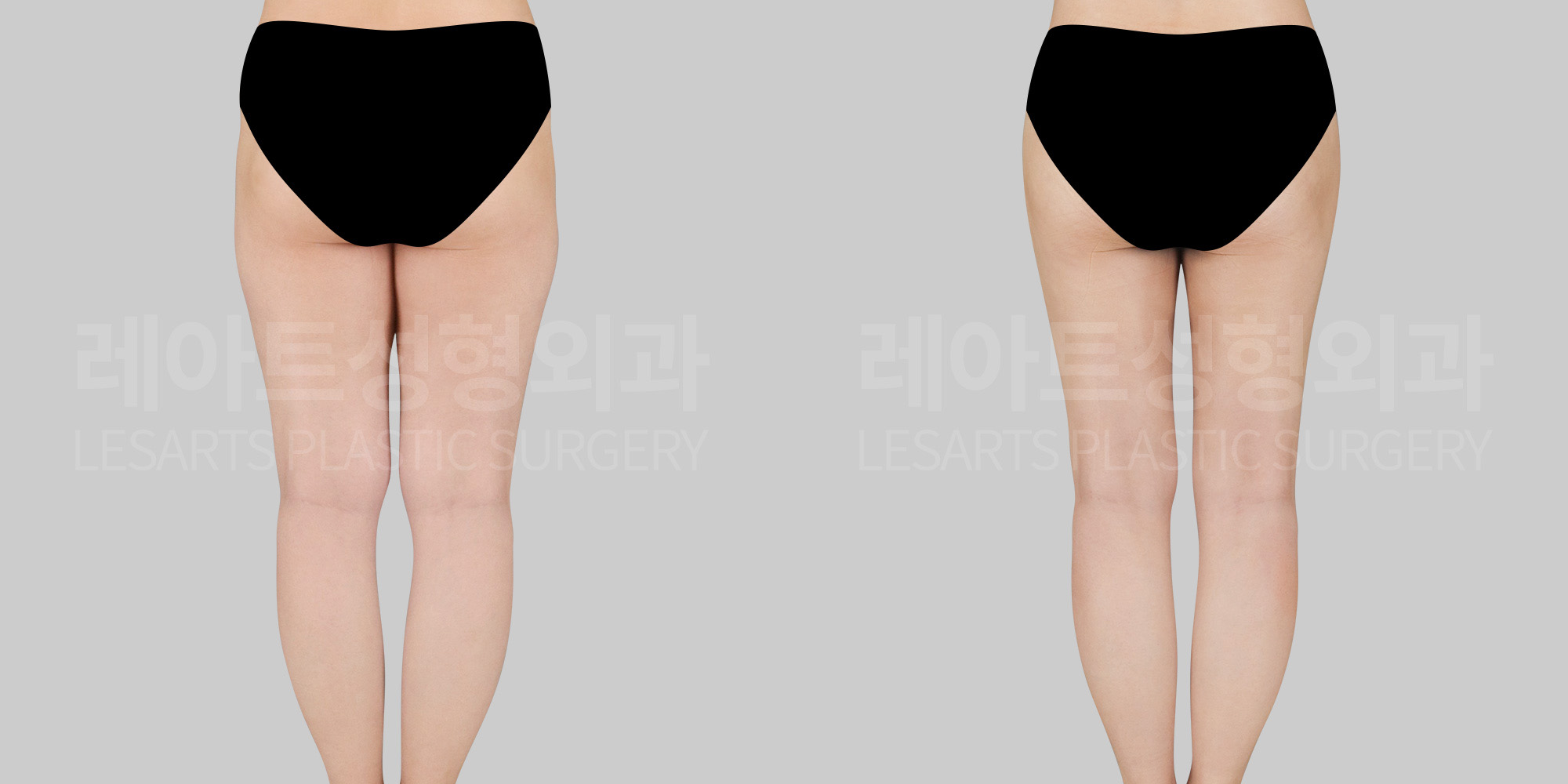
[Thigh Liposuction, Saddlebag Contouring, and Pelvic Fat Grafting Before & After – Dr. Yongseung Seo]
1. Lateral Thigh Transformation
Pre-operatively, prominent saddlebags flared outward,
making thigh width exceed pelvic frame width.
At 3 months post-op, debulking saddlebag volume
created a smooth, continuous line from pelvis down along the outer thigh.
Eliminating lateral convexity narrowed overall limb width
while projecting a straighter axis.
Concurrent pelvic fat grafting filled trochanteric depressions,
preventing saddlebag removal from looking overly hollowed and establishing a natural arc from hip to thigh.
2. Medial Thigh Transformation
Medial fat was extracted thoroughly within safe physiological boundaries.
Because her baseline build featured developed adductor muscles,
an expansive interspace did not manifest across the entire leg.
Nevertheless, medial clearance relieved crowding and friction,
substantially lightening lower-body heaviness.
Surface irregularities smoothed out, refining the transition from knee to upper thigh.
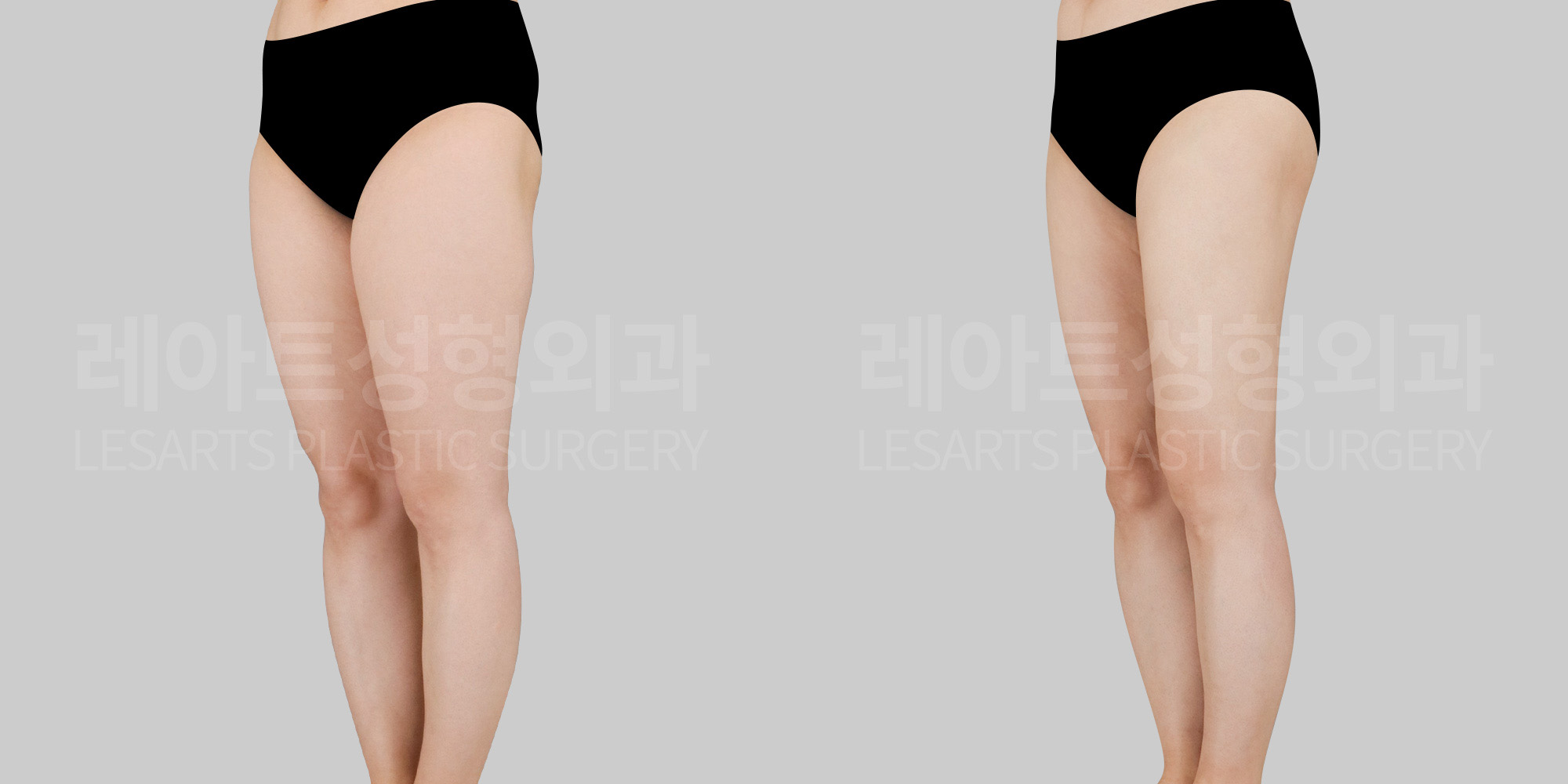
[[Hip Dip Correction] Pelvic Fat Grafting Before & After – Dr. Yongseung Seo, Lesarts Plastic Surgery Clinic]
As anticipated pre-operatively, dense fibrous tethering across the hip dips
meant fat grafting could not deliver massive volumetric elevation.
Following fibrous release and calibrated grafting into available tissue planes,
volumetric retention was modest.
While failing to construct a fully rounded gluteal contour,
deep trochanteric indentations softened significantly.
Combining reduced saddlebag projection with softened hip dips
delivered a much smoother, fluid curve flowing from pelvis to thigh.
Contouring Balanced Lower-Body Lines Accounting for Muscular Asymmetry
This procedure was not designed around maximum fat extraction.
Adipose layers overlying muscles developed through Pilates and swimming
were calibrated specifically against bilateral muscle volume and proportions.
Varying aspiration amounts across anterior, saddlebag, and medial zones
mitigated pre-existing asymmetries successfully.
While 3 months post-op can still feature mild residual edema and firmness,
her primary concern—the connection between saddlebags and hip dips—was smoothed remarkably.
Wearing fitted athletic wear or denim now reveals reduced lateral saddlebag projection
and fluid pelvic lines, delivering a lighter, polished lower-body fit.
Success in liposuction is measured not by aspirated volume in cubic centimeters,
but by harmonizing lines against underlying muscle, skeletal framework, and bilateral symmetry.
Thigh Liposuction & Pelvic Fat Grafting FAQ
1. Can saddlebags remaining after fitness training be resolved via liposuction?
When subcutaneous fat persists along the saddlebag zone despite weight and muscle management,
liposuction effectively reduces volume.
However, contouring must preserve necessary tissue buffers
to maintain seamless continuity with hip dips.
2. Can a muscular thigh build prevent an inner thigh gap post-op?
Medial fat reduction opens interspace, but strong adductor muscle development
or narrow skeletal frames can limit wide gaps.
3. Can muscular asymmetry be corrected via liposuction?
Intrinsic muscular dimensions cannot be altered.
Adjusting differential fat extraction volumes bilaterally
softens visual discrepancies effectively.
4. Can severely tethered hip dips be fully filled via pelvic fat grafting?
Severe fibrous tethering restricts available space for graft take,
limiting volumetric expansion.
Achievable outcomes vary depending on adhesion severity and tissue responsiveness.
5. Is pelvic fat grafting fully stabilized at 3 months post-op?
At 3 months, acute swelling subsides and transferred fat approaches stability.
Residual micro-edema and tissue firmness can persist,
meaning subtle refinements continue to evolve over time.
Dr. Yongseung Seo


Cases finding
similar to my profile
Customer Diagnostics


Select the surgery and
area you are interestedto see real
before andafter changes.


we
make you,
the art
Clinic hours
MON - FRI
10 am – 7pm
SAT
10 am – 4pm
Holiday
SUN, HOLIDAY
Location
Lesarts Moon Clinic Tower 4-5F, 40, Nonhyeon-ro 168-gil,
Gangnam-gu, Seoul, Republic of Korea

Medical institution name Lesarts Plastic Surgery
Address Lesarts Moon Clinic Tower 4-5F, 40, Nonhyeon-ro 168-gil, Gangnam-gu, Seoul, Republic of Korea
Representative Moon sung jun
