




Online Consultation
Please accurately enter the information below.
Quick Cost Consultation
Quick Consultation & Reservation
Cases finding
similar to my profile






Doctor's Note
Medical columns by our surgeons
Tummy Tuck (Abdominoplasty) | Upper Navel Wrinkles & Lower Abdominal Protrusion, 4-Month Changes with M-Type Full Tummy Tuck
2026-08-05
Tummy Tuck (Abdominoplasty) | Upper Navel Wrinkles & Lower Abdominal Protrusion, 4-Month Changes with M-Type Full Tummy Tuck
Can upper belly button wrinkles and lower abdominal protrusion develop without any history of childbirth?
Repeated cycles of significant weight gain and weight loss in the past can stretch the abdominal skin
and loosen the abdominal wall, even without previous pregnancies.
When skin folding above the navel and lower abdominal bulging occur simultaneously,
an M-type full tummy tuck can be considered after a thorough diagnosis of the skin and abdominal wall condition.
▶ Lesarts Plastic Surgery Tummy Tuck Guide
Hello, I am Dr. Kukhan Lee, Director at Lesarts Plastic Surgery.
During consultations with patients considering abdominoplasty,
many are concerned not only about lower belly sagging but also about
persistent horizontal wrinkles and skin creases remaining directly above the belly button.
In particular, when upper abdominal skin loses elasticity after massive weight loss,
regular workouts and
dietary weight management alone often fail to achieve the desired degree of tightening.
In such cases, after carefully examining the location and extent of skin laxity,
we consider surgical methods to pull down and tighten the abdominal skin.
When skin laxity extends continuously from above the navel,
one of the most effective solutions is an M-type full abdominoplasty (tummy tuck).
The M-type tummy tuck involves extensive dissection of the upper abdominal skin,
pulling it downward to excise redundant, loose tissue.
Rather than merely excising skin beneath the belly button,
its primary purpose is to simultaneously restore skin elasticity
and redefine the entire abdominal contour from the epigastric region down to the lower abdomen.
This patient visited our clinic with a physical profile of
160 cm in height and 51.4 kg in weight.
Although she had no history of childbirth, her weight had previously
increased up to approximately 70 kg in the past,
after which she successfully maintained her current body weight
through rigorous exercise and steady lifestyle management.
While her weight had decreased significantly, her abdominal skin
did not completely retract back to its pre-weight-gain state.
Specifically, crepey skin folds and creases remained above the navel,
and the lower belly continued to protrude outward, causing significant aesthetic distress.
Residual skin laxity following massive weight loss cannot be adequately resolved solely by
**Abdominal Liposuction**, which only reduces subcutaneous adipose tissue volume.
Therefore, it is essential to evaluate not only the volume of fat
but also skin elasticity, the rectus abdominis muscles, and the integrity of the abdominal wall.
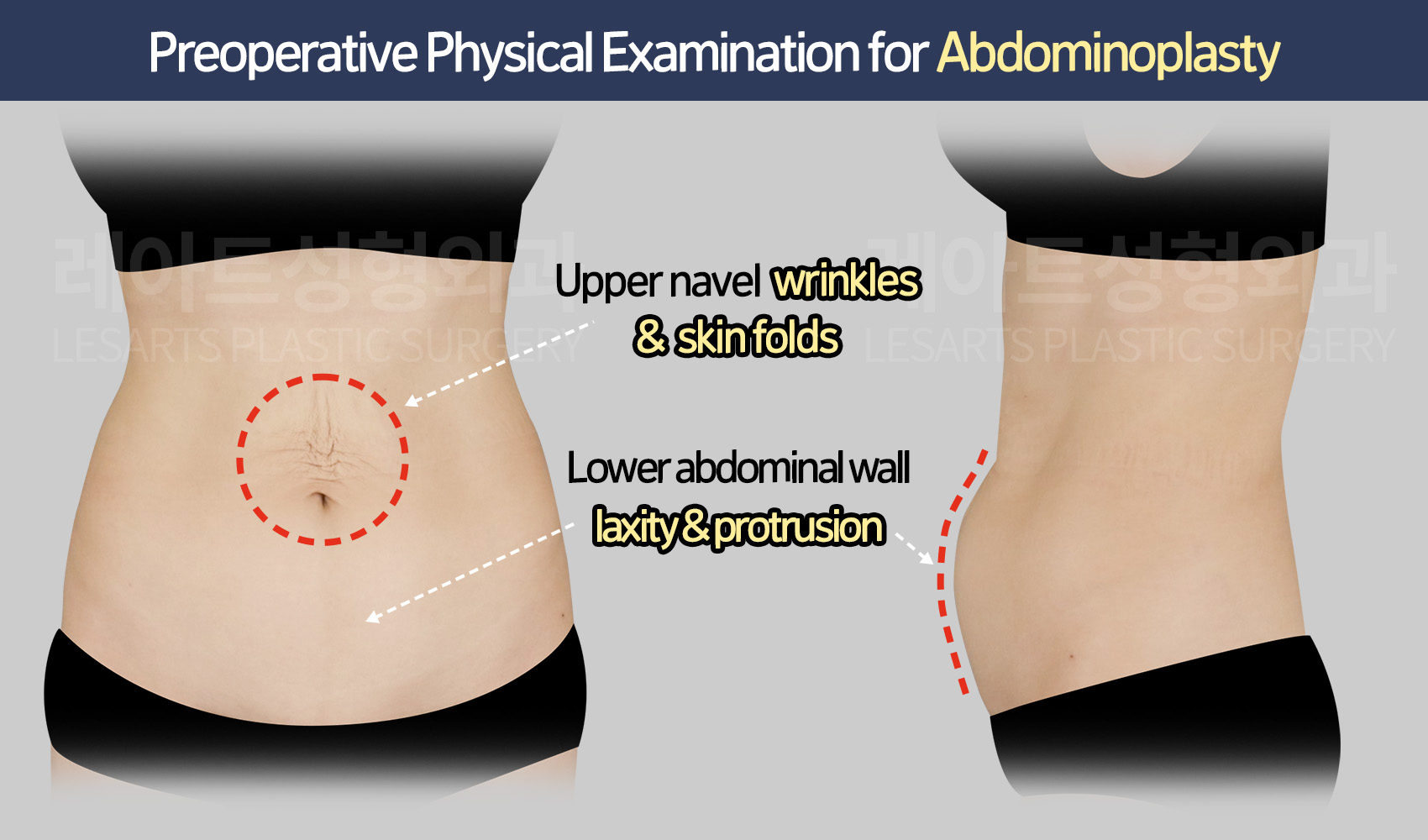 [Pre-Op: Upper Navel Skin Wrinkles & Lower Abdominal Protrusion Before Tummy Tuck]
On physical examination, there was no prior history
of abdominal surgeries or cosmetic body procedures.
Because she was nulliparous (no pregnancy history),
there was no severe muscle diastasis;
however, mild diastasis recti and lower abdominal wall laxity
were confirmed as a consequence of past weight fluctuations.
This structural looseness caused her lower belly to protrude forward
disproportionately relative to her lean body weight.
The patient's greatest aesthetic concern
was the stubborn horizontal wrinkles above the belly button.
As upper abdominal skin folded downward, multiple undulating lines appeared across the midline,
becoming even more pronounced with movement or postural changes.
Although her baseline skin elasticity was relatively good,
laxity extended all the way up into the upper abdomen.
Therefore, we determined that an M-type full abdominoplasty was far more suitable
than a mini tummy tuck that only addresses the lower abdomen.
However, because her overall skin laxity was not extreme,
we explained in advance that even after adequate skin advancement,
there might be limitations in positioning the final scar as low as ideally desired.
[M-Type Tummy Tuck Surgical Plan to Correct Upper Navel Wrinkles]
We planned an M-type abdominoplasty to dissect the upper abdominal skin thoroughly
and advance it downward to flatten and smooth out the folds above the navel.
While excising redundant lower abdominal skin, we also planned to repair
the mildly separated rectus abdominis muscles and tighten the relaxed fascial wall.
This dual approach was designed to eliminate supraumbilical wrinkling
while simultaneously flattening the anterior abdominal bulge seen in profile.
Additionally, adjunctive liposuction was incorporated to sculpt remaining subcutaneous fat,
slimming the torso depth and establishing sleek, natural waist contours.
You can explore more before-and-after cases of similar body types in our
**Tummy Tuck Clinical Case Gallery**.
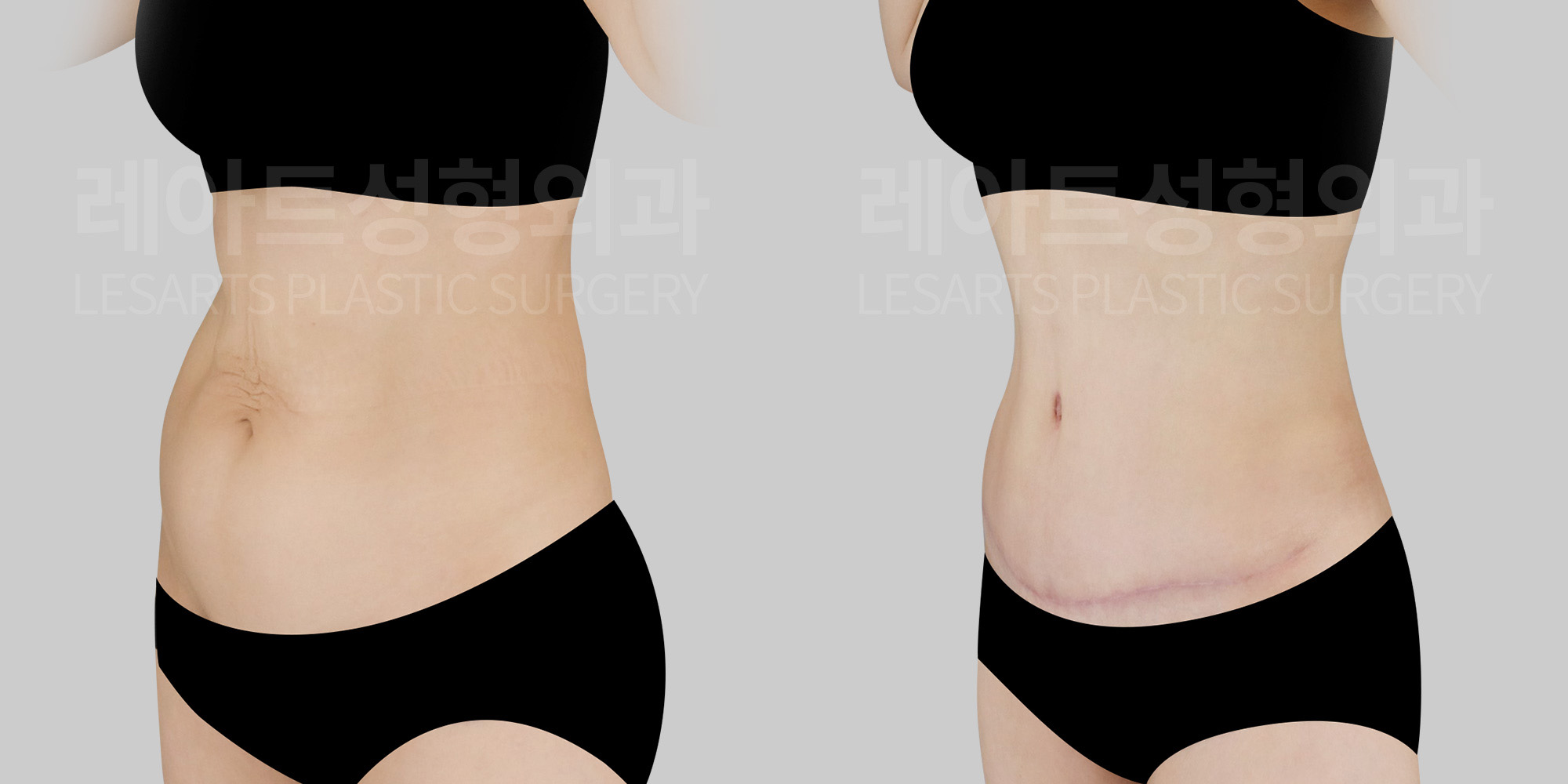
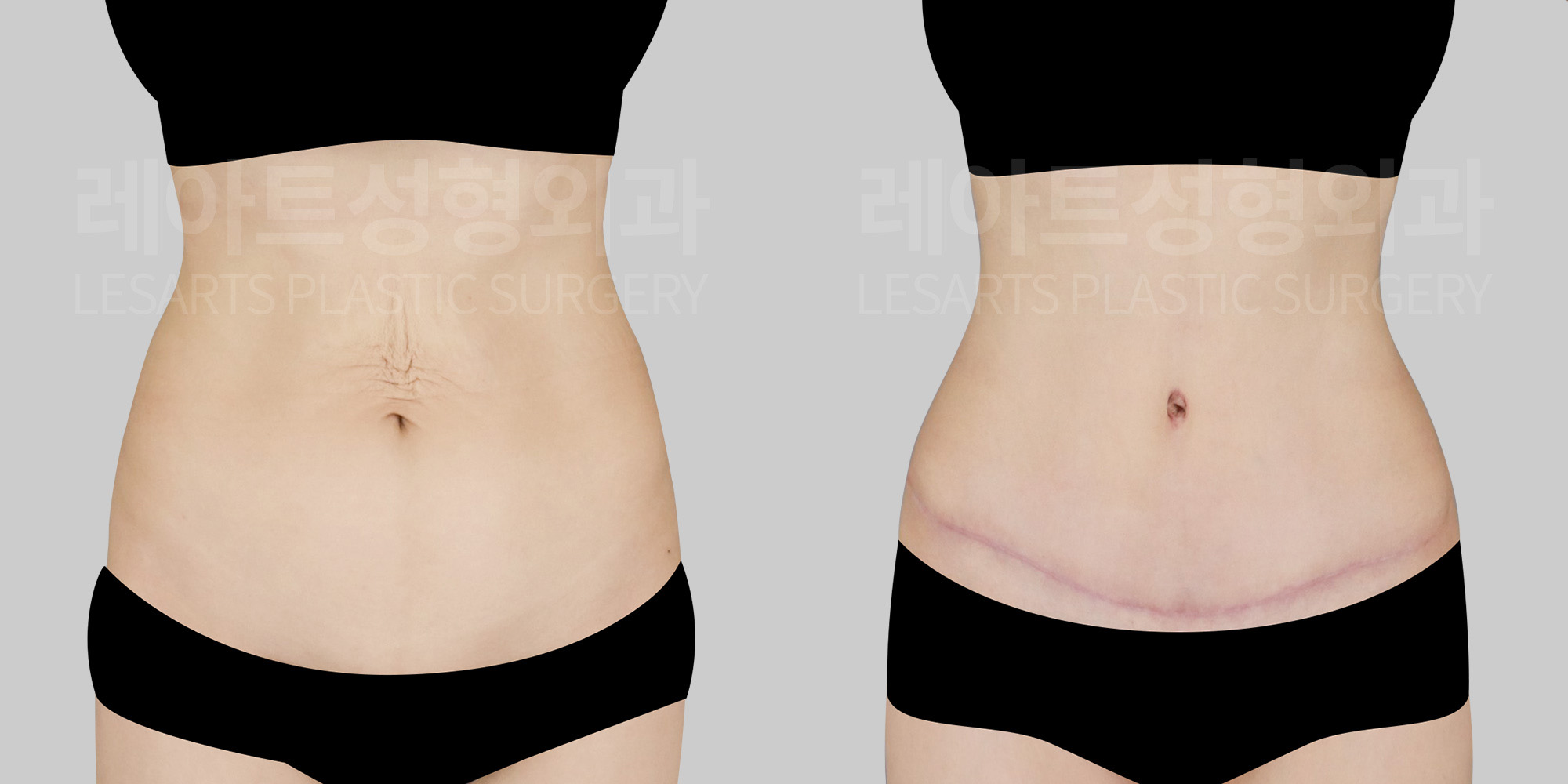 [4 Months Post-Op M-Type Tummy Tuck: Upper Navel Wrinkles & Abdominal Contour Changes]
Let us examine the surgical results at 4 months post-op.
By resecting excess lower abdominal tissue and advancing the upper abdominal skin downward,
the entire abdominal surface now transitions
with taut, firm elasticity compared to before.
The supraumbilical wrinkling that caused the patient the most distress
has been remarkably softened and flattened.
The multi-layered folds present before surgery have been smoothed out,
creating a clean, continuous profile
from the upper abdomen through the belly button down to the lower abdomen.
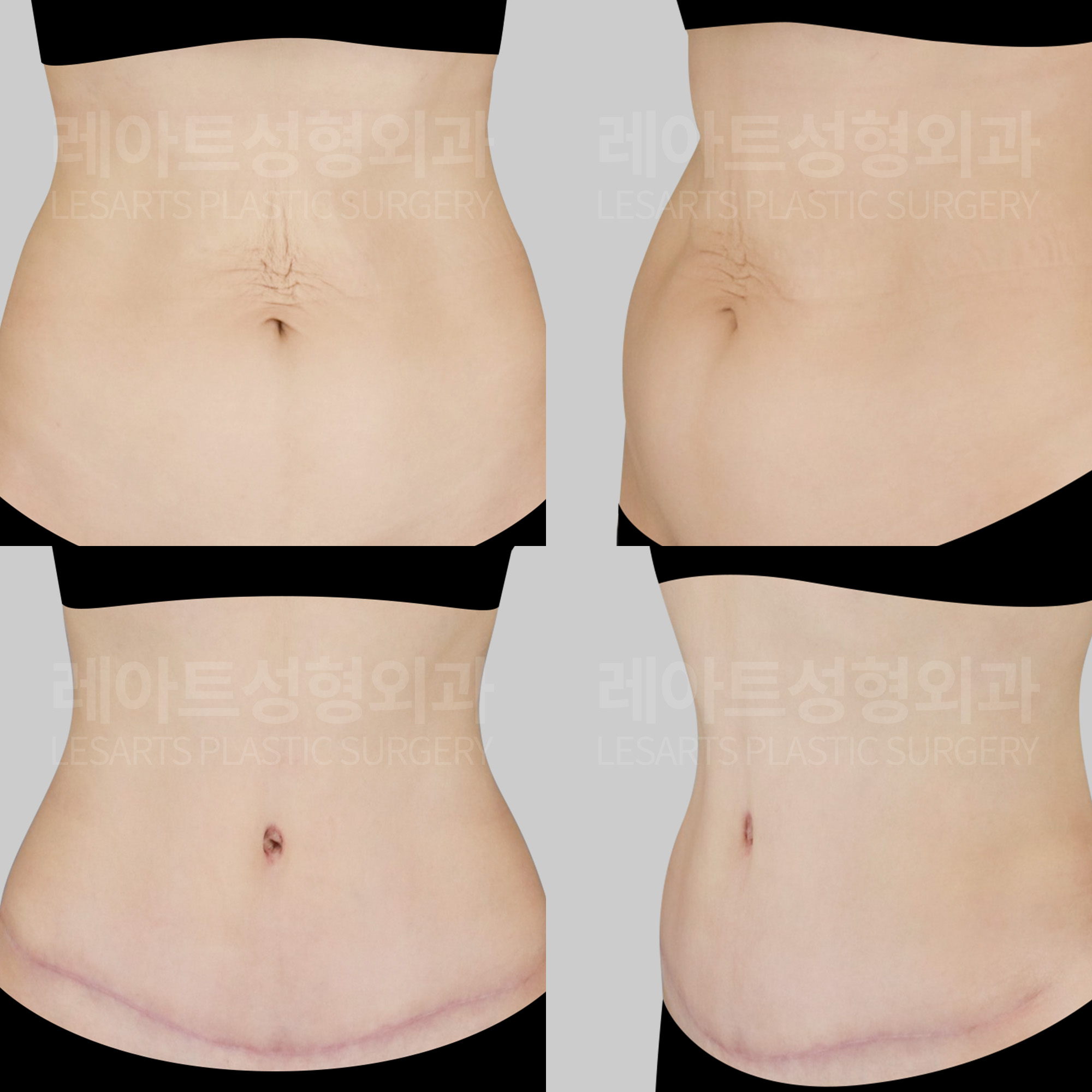 [Before & After 4 Months: Comparison of Upper Navel Skin Wrinkles]
Before surgery, upper abdominal skin sagged downward,
creating distinct horizontal creases above the navel.
Post-surgery, as the upper tissue was pulled inferiorly,
the folded skin naturally smoothed out,
and the midline abdominal contour flows much more seamlessly.
Since the available excess skin was not exceptionally abundant,
rather than pulling excessively, we achieved a refined, natural finish
strictly within the safe limits of her tissue elasticity and resectable margin.
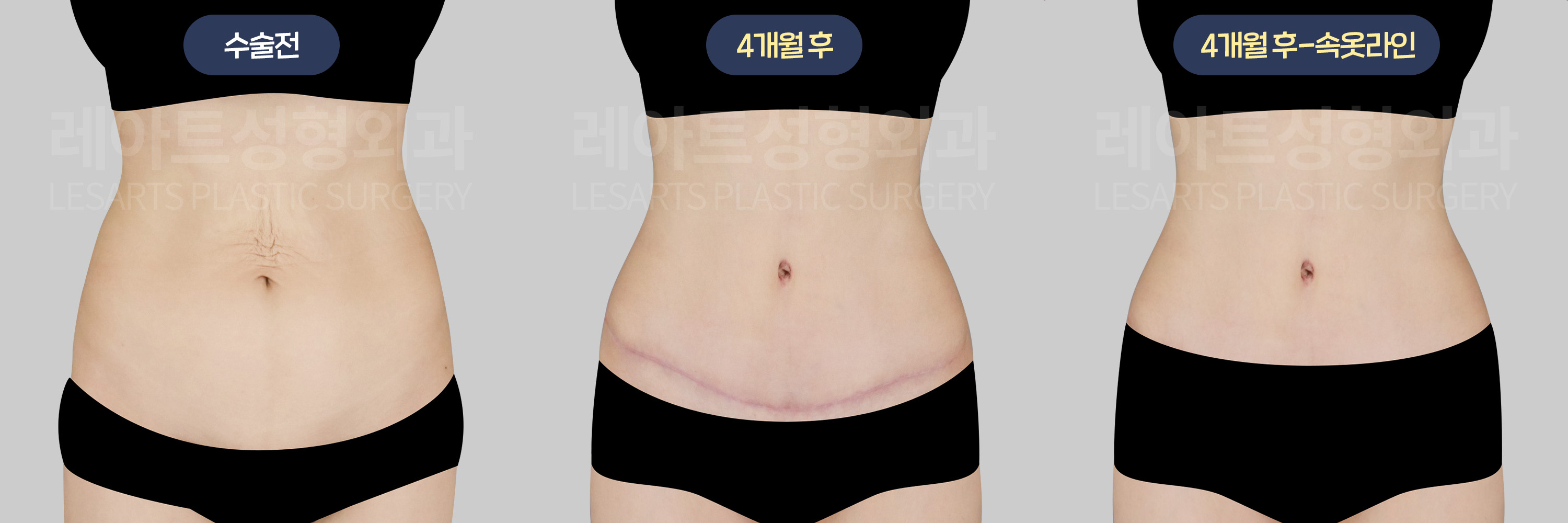 [4 Months Post-Op M-Type Tummy Tuck: Lower Abdominal Incision Line Placement]
The abdominal skin was advanced downward as far as anatomically safe,
allowing the final incision line to settle in a relatively low, well-concealed position.
However, as explained preoperatively, in cases where the amount of resectable tissue is modest,
there are anatomical boundaries to how low the scar line can be brought down.
At 4 months post-op, mild erythema (redness) along the scar is completely normal during the healing phase.
Currently, the incision line is healing stably without hypertrophic scar formation
or scar widening.
Scar redness and tissue induration will continue to soften and fade gradually,
making stage-appropriate postoperative scar therapy essential.
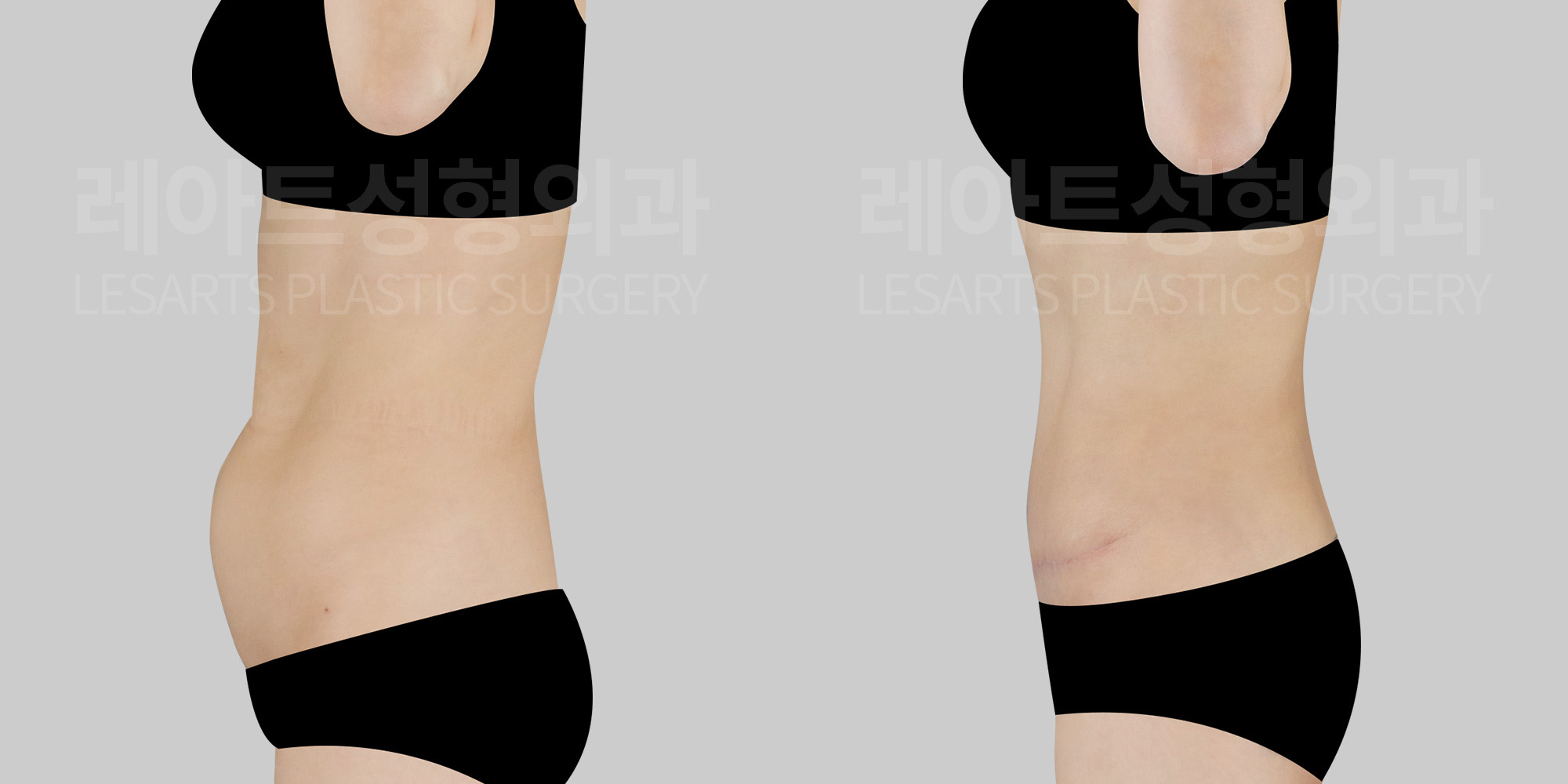 [4 Months Post-Op: Lateral Profile View of Lower Abdominal Wall Improvement]
The lateral profile clearly demonstrates the correction of lower abdominal bulging.
Before surgery, despite no childbirth history, the relaxed abdominal wall
and mild diastasis recti caused the lower belly to push outward.
Post-operatively, tightening the relaxed fascial wall alongside muscle plication
effectively eliminated the protruding lower belly contour.
The anterior profile connecting the upper abdomen, navel, and lower abdomen
now presents a much flatter, stable, and sculpted appearance.
In addition, liposuction performed concurrently debulked excess volume across the entire torso,
resulting in a noticeably slimmer body thickness and refined waistline from the side view.
[4 Months Post-Op: Lateral Profile View of Lower Abdominal Wall Improvement]
Abdominoplasty should never be viewed simply as a procedure
to trim away loose skin.
Rather, it is closer to a comprehensive anatomical reconstruction that reshapes the entire torso by evaluating
the extent of skin laxity, tissue elasticity, abdominal wall looseness, and adipose distribution.
Even without pregnancy or childbirth, individuals with past major weight fluctuations
often retain upper abdominal folds combined with internal wall laxity.
In these cases, surgical methods should not be decided based solely on weight or fat percentage;
the origin point of skin drooping and the status of rectus separation must be verified.
At approximately 4 months post-op, major swelling has largely resolved,
and abdominal silhouettes are becoming well-defined.
Because internal tissue recovery and scar maturation are still ongoing, maintaining healthy weight
and diligently following clinic-guided scar care protocols remain essential.
If upper belly wrinkles or persistent lower belly bulging concern you,
we recommend undergoing an in-depth abdominal evaluation to determine
whether an M-type abdominoplasty is the right solution for you.
Abdominoplasty (Tummy Tuck) FAQ
1. Can I undergo a tummy tuck if I have never given birth?
Yes. If past significant weight changes have left stretched
abdominal skin or a lax abdominal wall,
you can definitely consider a tummy tuck even without a history of childbirth.
Suitability is decided after evaluating skin elasticity, rectus separation,
and internal abdominal wall support.
2. Can upper belly button wrinkles be corrected with abdominal liposuction?
Liposuction is designed to reduce subcutaneous fat volume.
Wrinkles and creases caused by redundant, overstretched skin folds
cannot be adequately smoothed out with liposuction alone.
3. When is an M-type full abdominoplasty required?
It is indicated when skin laxity and wrinkles extend
not only across the lower belly but also above the belly button.
The entire abdomen is tightened by extensively dissecting the upper abdominal skin
and pulling it downward to excise excess tissue.
4. Will the tummy tuck scar always stay hidden inside the underwear line?
The final scar position depends on the volume of skin excised, skin elasticity,
and baseline abdominal anatomy.
If there is limited excess skin redundancy, there may be anatomical limitations
in bringing the scar line as low as desired.
5. Are the results at 4 months post-op final?
At 4 months, significant contour improvements are clearly visible,
but scar erythema and deep tissue induration may still persist.
Scars and contour definitions will continue to soften, fade, and stabilize over the ensuing months.
Dr. Kukhan Lee


Cases finding
similar to my profile
Customer Diagnostics


Select the surgery and
area you are interestedto see real
before andafter changes.


we
make you,
the art
Clinic hours
MON - FRI
10 am – 7pm
SAT
10 am – 4pm
Holiday
SUN, HOLIDAY
Location
Lesarts Moon Clinic Tower 4-5F, 40, Nonhyeon-ro 168-gil,
Gangnam-gu, Seoul, Republic of Korea

Medical institution name Lesarts Plastic Surgery
Address Lesarts Moon Clinic Tower 4-5F, 40, Nonhyeon-ro 168-gil, Gangnam-gu, Seoul, Republic of Korea
Representative Moon sung jun
