




Online Consultation
Please accurately enter the information below.
Quick Cost Consultation
Quick Consultation & Reservation
Cases finding
similar to my profile






Doctor's Note
Medical columns by our surgeons
7 Months Post-Gynecomastia Surgery: The Transformation
2026-07-28
7 Months Post-Gynecomastia Surgery: The Transformation
How much does chest contour change 7 months after gynecomastia surgery?
Yes. At 7 months post-operation, internal tissues have largely stabilized,
transforming previously projecting breast tissue into a flat, natural masculine pectoral contour.
Specifically, periareolar protrusion resolves, allowing shirts and fitted clothing to drape in a balanced, confident silhouette.
[Learn More About Lesarts Male Gynecomastia Surgery]
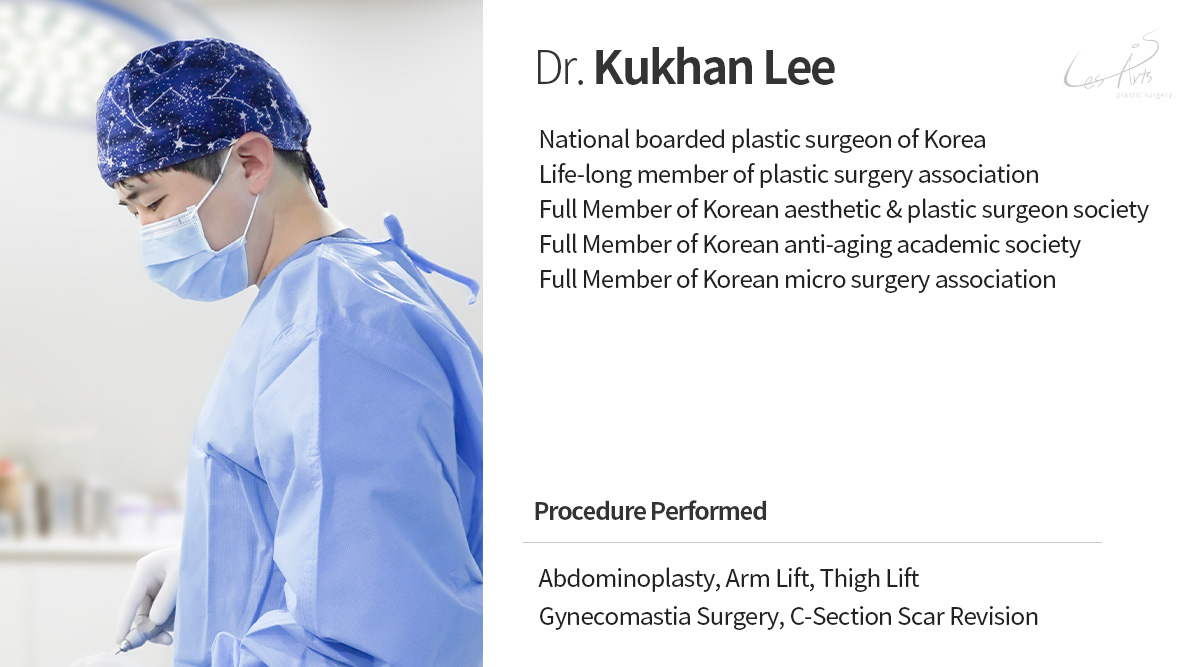
Hello, I am Dr. Kukhan Lee, Board-Certified Plastic Surgeon at Lesarts Plastic Surgery Clinic.
When considering gynecomastia correction, the most common inquiry patients share is:
"How noticeably will my chest truly change after surgery?"
Even when reviewing before-and-after photographs and clinical cases,
many hesitate to proceed because they wonder whether
similar improvements will translate to their unique anatomy.
Particularly for those who have experienced psychological distress from protruding chest tissue for years,
anticipation is naturally accompanied by apprehension regarding the final surgical outcome.
In this clinical article,
we examine an actual clinical case at 7 months post-op
to review key anatomical milestones and the progressive contour refinements
achieved following gynecomastia surgery.

[Pre-Operative Chest Contour: Lesarts Plastic Surgery Clinic]
This patient was a 27-year-old male who had experienced emotional stress
due to persistent chest enlargement since his adolescent teenage years.
Although he maintained consistent physical exercise and dietary discipline,
the rounded protrusion of his lower chest and periareolar area
showed no reduction, prompting him to seek medical evaluation for gynecomastia.
Physical palpation and diagnostic ultrasound examination confirmed
true gynecomastia (Simon Grade IIa),
leading to a surgical plan for subcutaneous mastectomy to excise retroareolar glandular tissue.
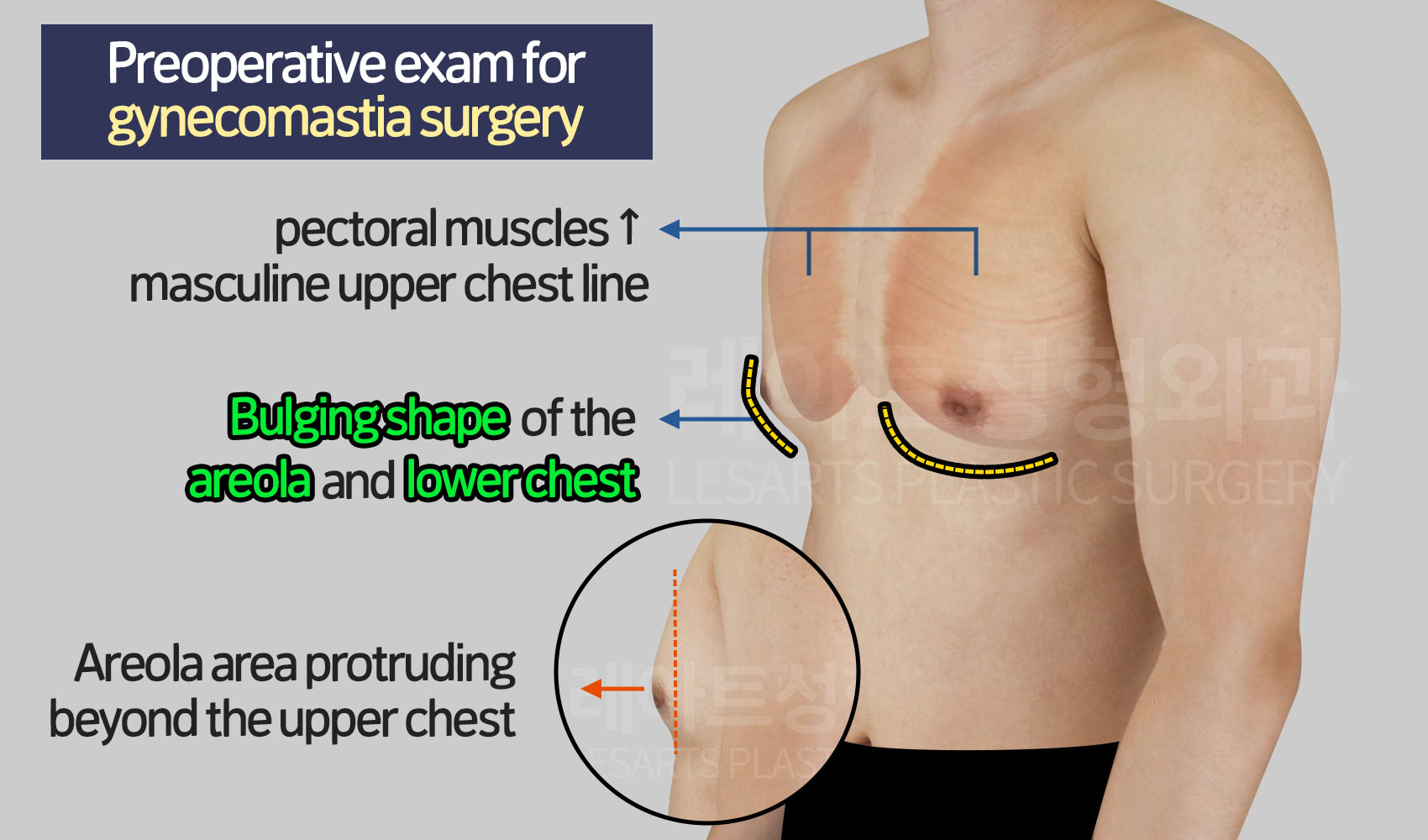
[Gynecomastia Examination & Diagnostic Assessment: Simon Grade IIa – Lesarts Plastic Surgery Clinic]
Pre-operative clinical images show well-developed pectoralis major musculature in the upper chest,
exhibiting a relatively masculine, athletic pectoral foundation.
In contrast, the lower chest including the periareolar complex
projected outward into a rounded, feminine shape,
disrupting the structural balance of the entire chest silhouette.
On lateral profile, the point of maximum anterior projection
was localized around the areola rather than the upper pectoralis;
in clothing, this lower point made contact first,
making the chest appear conspicuously pronounced.

[Pre-Op Areolar and Chest Projection in Lightweight T-Shirts]
The patient described this focal protrusion in lightweight clothing
as his single greatest daily insecurity.
Gynecomastia surgery selectively excises glandular tissue
without disrupting underlying pectoral musculature.
Therefore, patients need not be concerned about
muscular atrophy or loss of upper-body strength post-operatively.

[Gynecomastia Before & After: Dr. Kukhan Lee, Lesarts Plastic Surgery Clinic]
Evaluating clinical progress at 7 months post-gynecomastia correction,
internal tissue induration (biobond) has completely resolved, and the soft-tissue matrix has stabilized.
Compared to baseline,
a distinctly natural and firm masculine pectoral contour has emerged.

[Chest Reduction & Areolar Flattening via Gynecomastia Surgery]
Post-operatively, the rounded glandular projection of the chest
flattened completely,
revealing a natural, athletic masculine contour.
On lateral and oblique profiles,
the apex of anterior chest projection shifted from the areola to the upper pectoralis major,
aligning the entire chest profile with anatomical masculine standards.

[Postoperative Wardrobe Fit: Dr. Kukhan Lee, Lesarts Plastic Surgery Clinic]
By excising the retroareolar glandular core while preserving
upper pectoral volume, the highest anatomical point
naturally relocates superiorly.
Consequently, when wearing lightweight t-shirts or fitted clothing,
the areola no longer pushes against the fabric,
delivering an authentic, clean, and masculine chest silhouette.
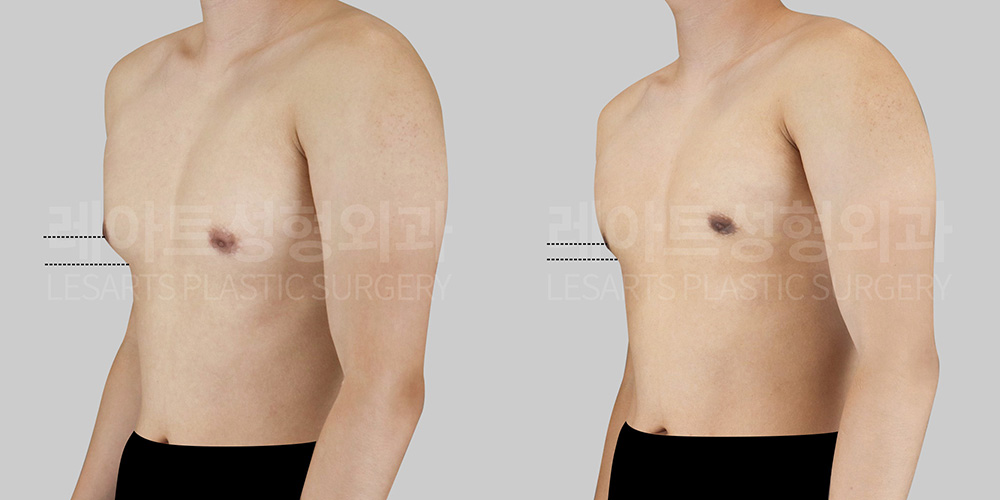
[Shift in Peak Projection Point Post-Gynecomastia Surgery: Dr. Kukhan Lee, Lesarts Plastic Surgery Clinic]
Additionally, as the vertical height of the lower breast from the inframammary fold to the areola reduced,
the vertical dimension of the chest contracted naturally,
establishing a firm, athletic masculine pectoral contour.
While gynecomastia surgery alone accomplishes substantial aesthetic improvement,
once full biological recovery is achieved, developing the pectoralis major through consistent resistance training
further refines chest definition and athletic proportion.
Gynecomastia surgery is not simply about volume reduction;
it is an architectural procedure designed to restore masculine body harmony
and boost personal confidence.
[View More Lesarts Gynecomastia Clinical Cases]
FAQ
Q1. Are surgical results considered fully finalized at 7 months post-gynecomastia correction?
Yes. By 7 months post-op, internal biobond induration has resolved and soft tissues have stabilized,
revealing a natural pectoral line.
While minor individual healing variations exist, this milestone reliably reflects the definitive chest silhouette.
Q2. Does gynecomastia surgery cause loss of chest muscle mass or strength?
No. Gynecomastia correction selectively resects retroareolar glandular tissue without invading the pectoralis major muscle.
It does not cause muscular atrophy or strength reduction, and normal athletic workouts can be resumed once recovered.
Q3. Can postoperative weight training further enhance results after gynecomastia surgery?
Yes. Once tissue recovery is complete, targeted pectoral resistance training builds the underlying muscle plate,
further accentuating a firm, well-proportioned masculine chest line.
Q4. How does clothing fit change after gynecomastia surgery?
Yes. As periareolar projection flattens, the apex of chest projection shifts naturally to the upper pectoralis.
Consequently, the areola no longer pokes through lightweight shirts or t-shirts, delivering a clean, masculine fit.
Q5. Is gynecomastia surgery strictly a volume reduction procedure?
No. Beyond debulking unwanted glandular tissue to eliminate anterior protrusion,
gynecomastia correction sculpts complete pectoral contours to establish a balanced, authentic masculine profile.
Dr. Kukhan Lee


Cases finding
similar to my profile
Customer Diagnostics


Select the surgery and
area you are interestedto see real
before andafter changes.


we
make you,
the art
Clinic hours
MON - FRI
10 am – 7pm
SAT
10 am – 4pm
Holiday
SUN, HOLIDAY
Location
Lesarts Moon Clinic Tower 4-5F, 40, Nonhyeon-ro 168-gil,
Gangnam-gu, Seoul, Republic of Korea

Medical institution name Lesarts Plastic Surgery
Address Lesarts Moon Clinic Tower 4-5F, 40, Nonhyeon-ro 168-gil, Gangnam-gu, Seoul, Republic of Korea
Representative Moon sung jun
