




Online Consultation
Please accurately enter the information below.
Quick Cost Consultation
Quick Consultation & Reservation
Cases finding
similar to my profile






Doctor's Note
Medical columns by our surgeons
Floating Umbilicus Abdominoplasty – 3-Month Postoperative Follow-Up
2026-07-29
Floating Umbilicus Abdominoplasty – 3-Month Postoperative Follow-Up
Q. In successful body contouring surgery (liposuction, abdominoplasty, gynecomastia), why is precision 'design' far more critical than merely removing massive amounts of tissue?
A. Because skeletal framework, muscle anatomy, and skin elasticity vary for each individual; aggressive, uniform debulking disrupts bodily balance, causing surface waviness and step-off deformities.
Body contouring is not about simply reducing numbers—it is an art of sculpting 360-degree anatomical balance by distinguishing areas to debulk from areas to preserve.
Only when subcutaneous adipose volume and tissue laxity are meticulously tailored to the underlying musculoskeletal framework can a natural, elegant contour be achieved.
[ Learn More About Lesarts Abdominoplasty ]
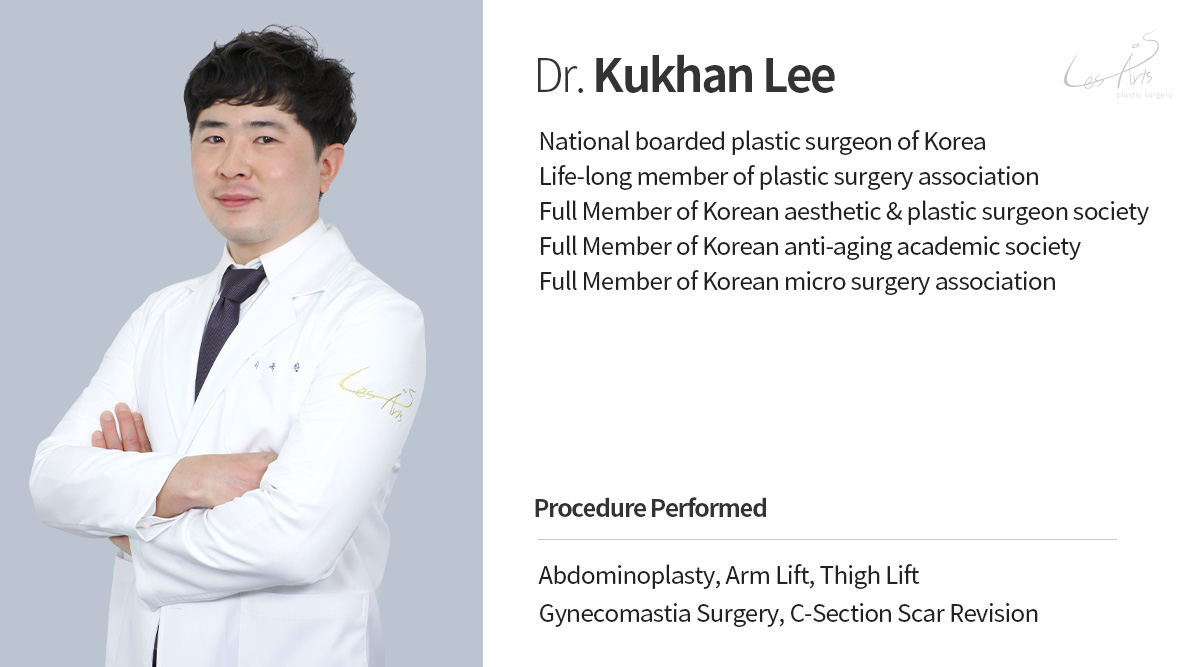
Hello, I am Dr. Kukhan Lee, Board-Certified Plastic Surgeon
specializing in body contouring and abdominoplasty at Lesarts Plastic Surgery Clinic.
During consultations for postpartum abdominal skin laxity,
before proceeding with a detailed physical examination,
I always ask my patients one fundamental question first:
"Relative to your navel, which area bothers you significantly more:
the upper abdomen (epigastrium) or the lower abdomen (hypogastrium)?"
While the specific surgical technique in abdominoplasty is guided by the degree of tissue laxity and anatomical excursion,
the most essential principle is that the patient's body must never be forced to fit a standardized surgical procedure;
rather, the optimal, customized technique must be chosen to match the patient's individual anatomy.
The final surgical plan is established by comprehensively evaluating
the physical extent of skin laxity alongside the exact anatomical areas
causing the patient the greatest aesthetic distress.
In clinical consultations, the most challenging dilemma for both surgeon and patient arises
when skin laxity is observed across both the upper and lower abdomen, yet:
epigastric skin laxity is not severe enough to justify the full operative and scar burden of a Type M full abdominoplasty,
while relying solely on a standard Type S mini abdominoplasty
risks under-correcting the supraumbilical zone.
Standing precisely on the borderline between these two techniques,
selecting a single conventional procedure is never a straightforward decision.
The highly effective customized solution designed for this intermediate scenario
is the floating umbilicus (umbilical float) abdominoplasty.
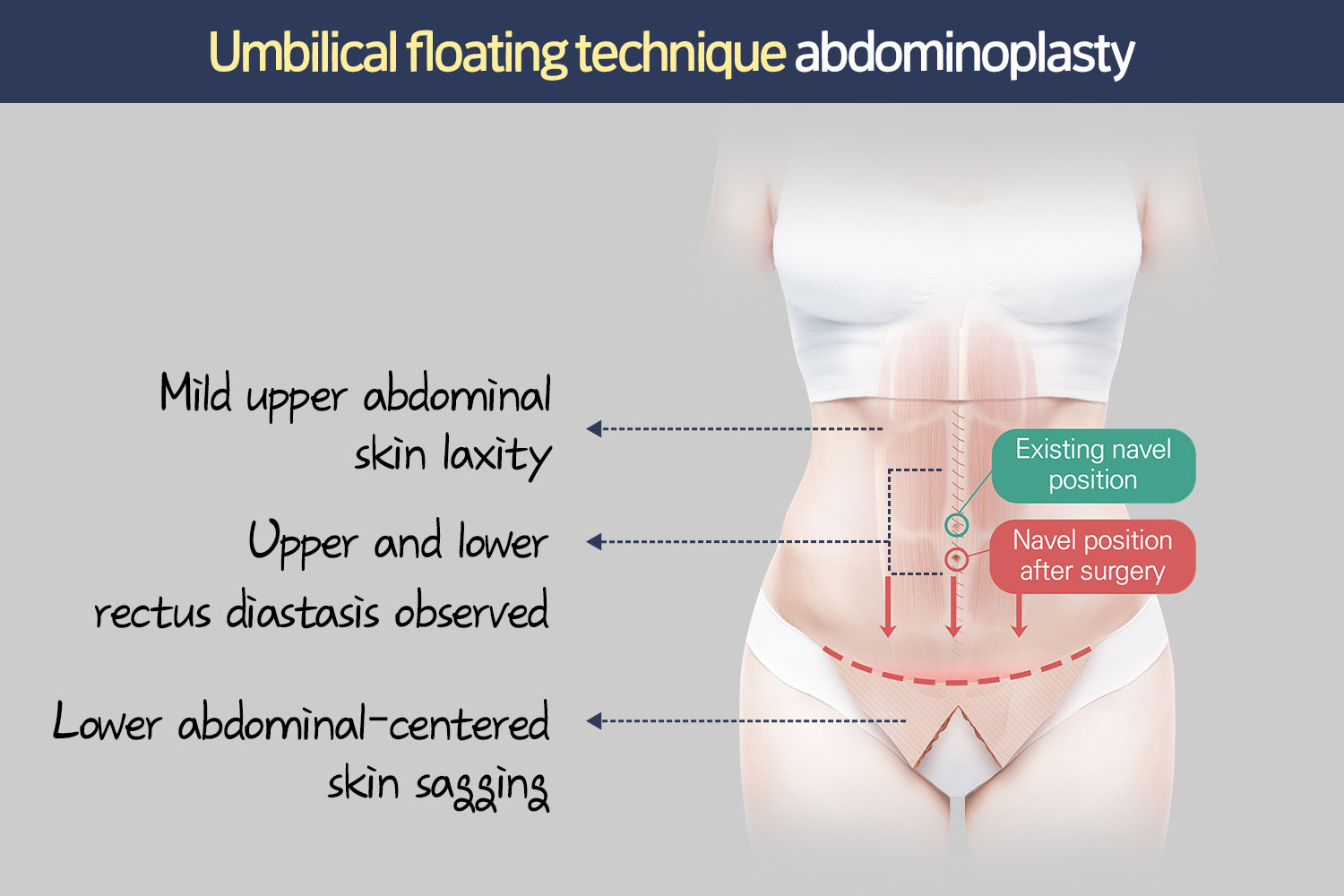
[What is a Floating Umbilicus (Umbilical Float) Abdominoplasty?]
The umbilical float technique is an advanced hybrid procedure that repairs rectus diastasis across both the upper and lower midline
while detaching and re-anchoring the umbilical stalk slightly lower, simultaneously redraping
and smoothing mild-to-moderate supraumbilical skin laxity without creating a separate circular scar around the navel.
It is exceptionally suited for patients presenting with the following anatomical profile:
Rectus diastasis is confirmed across both the upper and lower abdomen,
yet epigastric skin laxity and dermal stretching remain relatively mild.
Let us examine how this approach works through an actual clinical case.
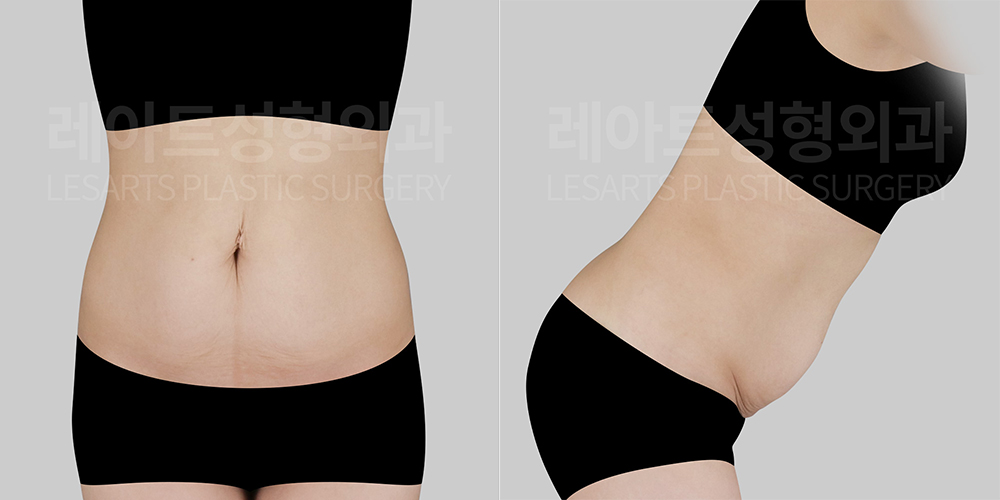
This patient was a mother of two delivered via Cesarean section,
who struggled with widespread lower abdominal skin laxity along with
conspicuous wrinkling and creasing around her navel.
[Key Pre-Operative Anatomical Findings]
- A pre-existing piercing scar situated directly above the navel
- Following childbirth, the periumbilical skin—including the piercing mark—
developed an irregular, puckered, and wrinkled appearance that caused her severe distress.
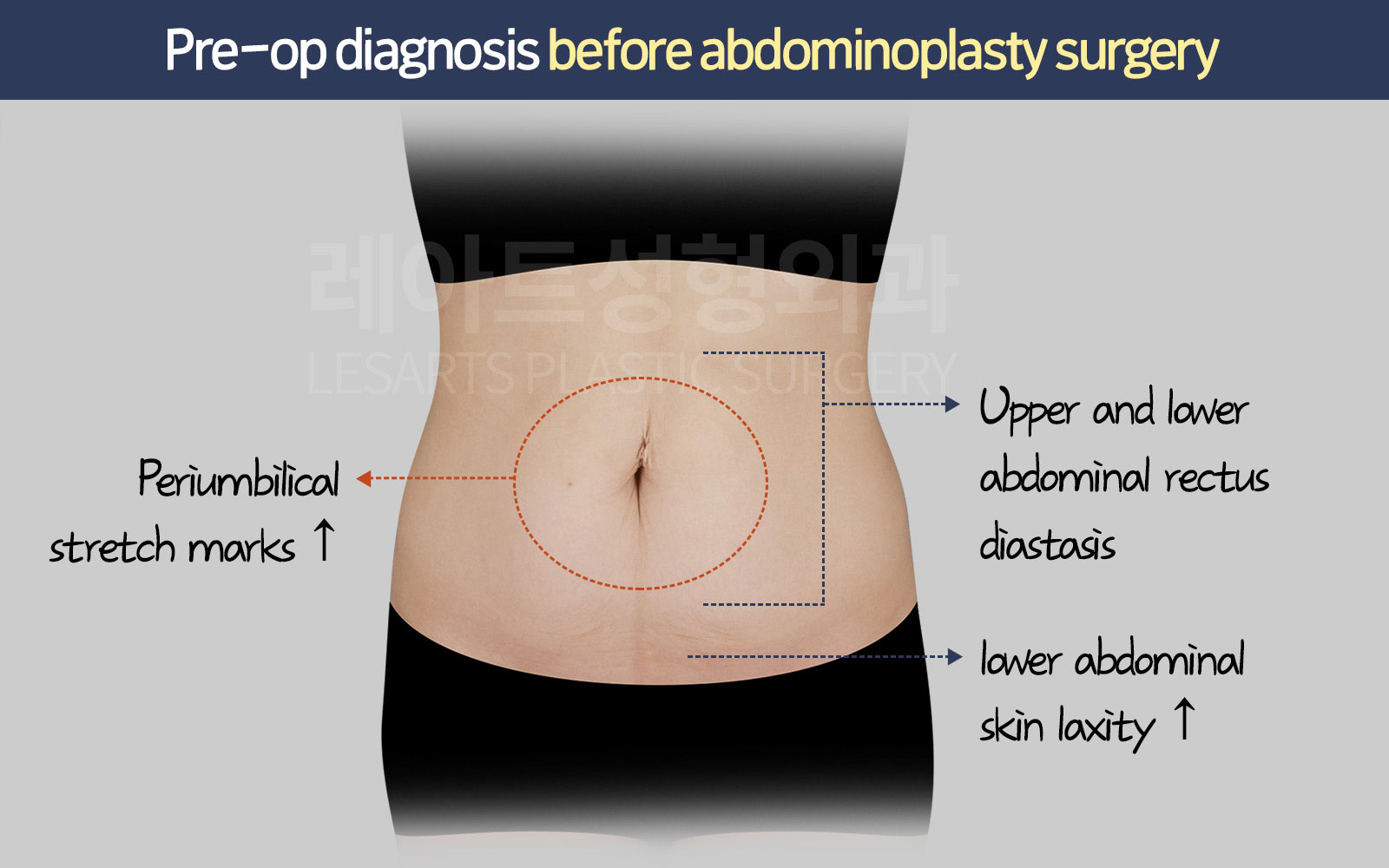
[Clinical Diagnostic Assessment]
- Substantial striae (stretch marks) and thin subcutaneous fat surrounding the navel
- Evident full-length rectus diastasis (abdominal wall separation) spanning from epigastrium to hypogastrium
- While the baseline C-section scar was relatively well healed, severe lower abdominal skin laxity folded over the incision line
[Why Floating Umbilicus Was Selected Over Type M Full Abdominoplasty]
Considering the full-length rectus diastasis and diminished upper skin tone,
a Type M full abdominoplasty was technically an available option;
however, several surgical dilemmas were present in this specific case:
1. Because epigastric laxity was not massive,
pulling skin down in a full abdominoplasty risked failing to reach the low C-section scar,
which could force the new horizontal scar to sit uncomfortably high.
2. Attempting to completely excise the supraumbilical piercing scar in a full abdominoplasty
could inadvertently displace the new navel too high on the abdominal wall.
3. Conversely, keeping the scar line low risked leaving the piercing scar
awkwardly positioned above the incision line.
4. Yet, full-length rectus plication was non-negotiable
to restore structural core stability.
Weighing these anatomical variables in unison,
the floating umbilicus technique was established as the ideal, tailored procedure.
[Advantages and Trade-Offs of the Floating Umbilicus Technique]
[Advantages]
1. Excises the existing C-section scar while placing the final horizontal closure line low beneath standard underwear borders
2. Allows precise, full-length plication of both upper and lower rectus diastasis
3. Avoids a circular periumbilical scar around the navel and can allow a shorter transverse scar span than a full Type M procedure
4. By migrating the navel slightly downward, supraumbilical skin is smoothly tensioned and flattened
[Trade-Offs]
1. Anatomically limited in excising massive, redundant upper abdominal skin folds
2. Relocates the baseline navel position approximately 1.5 to 2 cm lower than its original height
After thoroughly counseling the patient on these structural trade-offs,
the operation was performed combining floating umbilicus abdominoplasty with concurrent abdominal liposuction.

[Clinical Evaluation at 3 Months Post-Op]
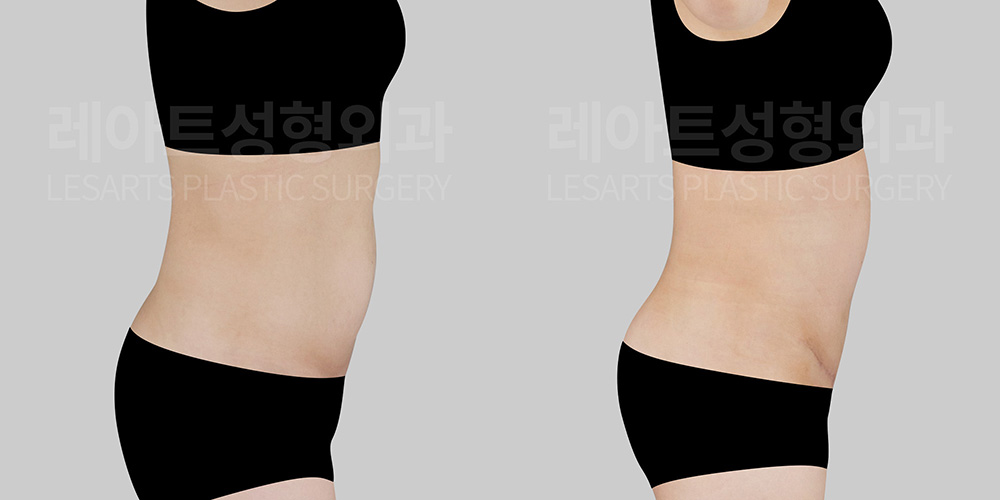
These follow-up photographs document results at 3 months post-operatively.
The hanging lower abdominal skin folds and creases have smoothed out completely,
the prior C-section scar was completely resected, and the fine new closure line
rests discreetly concealed beneath regular underwear borders.
When substantial skin laxity is corrected, the horizontal incision cannot be artificially shortened;
extending the incision proportionately to the excised skin volume is anatomically required,
yet in clinical experience, the lateral extremities of the scar line
mature and fade significantly faster over time.
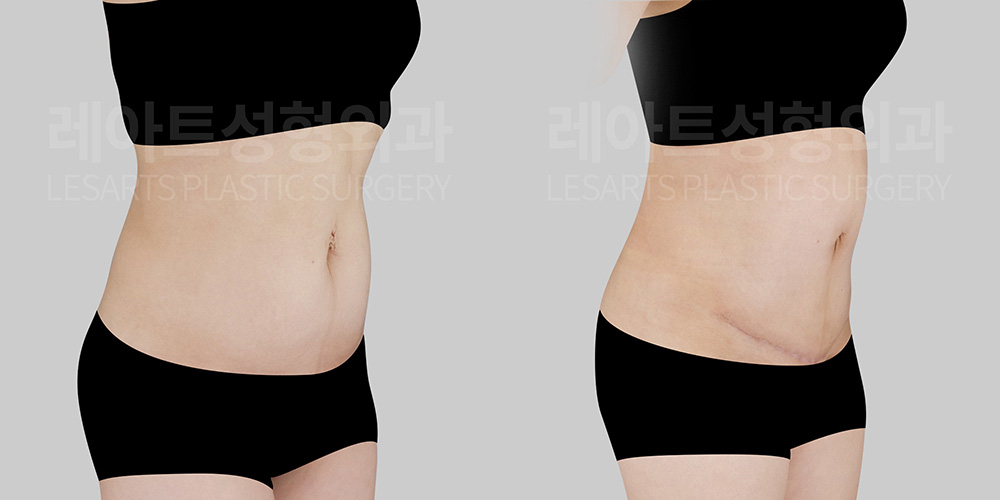
Furthermore, migrating the navel slightly downward
effectively redraped and smoothed periumbilical skin folds,
successfully lifting and tautening the puckered tissue
surrounding the previous piercing scar.
[Recovery Progression & Long-Term Care]
At 3 months post-abdominoplasty, residual micro-edema and internal tissue firmness (biobond)
enter an active softening and stabilization phase.
As tissue remodeling progresses, the abdominal silhouette will settle into an even smoother and more pliable contour.
From this point onward,
progressive abdominal conditioning and core strengthening exercises can be safely resumed;
pairing consistent core workouts with healthy nutrition will ensure that this refined,
toned abdominal contour remains stable for years to come.
Abdominoplasty is an intricate body contouring procedure where no single standardized technique
can serve as the answer for every patient.
Identifying the method precisely tailored to your dermal elasticity, adipose depth, and fascial integrity—
while clearly understanding the trade-offs of each approach—is the most crucial step.
If you are struggling with postpartum skin laxity or tethered scars, schedule an in-depth consultation with Lesarts.
Through precise anatomical evaluation, we will provide an honest, transparent roadmap covering
your optimal surgical options, realistic expectations, and essential precautions.
FAQ
Q1. What is a floating umbilicus (umbilical float) abdominoplasty?
A. It is a specialized abdominoplasty technique that plicates both upper and lower rectus diastasis
while shifting the navel slightly downward to smooth mild supraumbilical skin laxity without creating a circular scar around the belly button.
It provides an ideal alternative when upper laxity is too mild for a full abdominoplasty, yet a standard mini tummy tuck falls short.
Q2. What are the key advantages of the floating umbilicus technique?
A. It removes pre-existing C-section scars while keeping the final closure line low within underwear borders.
Unlike a mini tummy tuck, it reinforces full-length rectus diastasis across both the upper and lower abdomen, and avoids a circular periumbilical incision.
Q3. What are the anatomical trade-offs of the umbilical float approach?
A. Because epigastric skin is not fully resected, it cannot resolve severe upper abdominal dermatochalasis.
Additionally, the belly button settles approximately 1.5 to 2 cm lower than its baseline position.
Q4. Can postpartum periumbilical wrinkling and piercing scar puckering be improved?
A. Yes. By advancing and redraping abdominal skin downward while migrating the navel,
periumbilical stretch marks and irregular puckering around prior piercing scars are smoothed into a taut, flat surface.
Q5. What is the recovery timeline, and when can exercise be resumed after floating umbilicus abdominoplasty?
A. By 3 months post-op, acute edema has cleared, skin folds have flattened, and the incision matures discreetly beneath underwear borders.
From the 3-month milestone onward, core conditioning, abdominal resistance training, and dietary discipline can be safely integrated to preserve long-term results.
Dr. Kukhan Lee


Cases finding
similar to my profile
Customer Diagnostics


Select the surgery and
area you are interestedto see real
before andafter changes.


we
make you,
the art
Clinic hours
MON - FRI
10 am – 7pm
SAT
10 am – 4pm
Holiday
SUN, HOLIDAY
Location
Lesarts Moon Clinic Tower 4-5F, 40, Nonhyeon-ro 168-gil,
Gangnam-gu, Seoul, Republic of Korea

Medical institution name Lesarts Plastic Surgery
Address Lesarts Moon Clinic Tower 4-5F, 40, Nonhyeon-ro 168-gil, Gangnam-gu, Seoul, Republic of Korea
Representative Moon sung jun
