




Online Consultation
Please accurately enter the information below.
Quick Cost Consultation
Quick Consultation & Reservation
Cases finding
similar to my profile






Doctor's Note
Medical columns by our surgeons
Changes in Areolar Size and Pigmentation 2 Months After Gynecomastia Surgery
2026-07-30
Changes in Areolar Size and Pigmentation 2 Months After Gynecomastia Surgery
Do areolar size and pigmentation also change following gynecomastia surgery?
Yes. Once proliferating glandular tissue is surgically excised, tension over the stretched areola subsides, contracting its diameter into a flatter, smaller shape.
Furthermore, while the areola may temporarily appear slightly darker during early postoperative recovery,
pigmentation gradually softens back to a natural tone as biological tissue remodeling stabilizes.
[Learn More About Lesarts Gynecomastia Surgery]
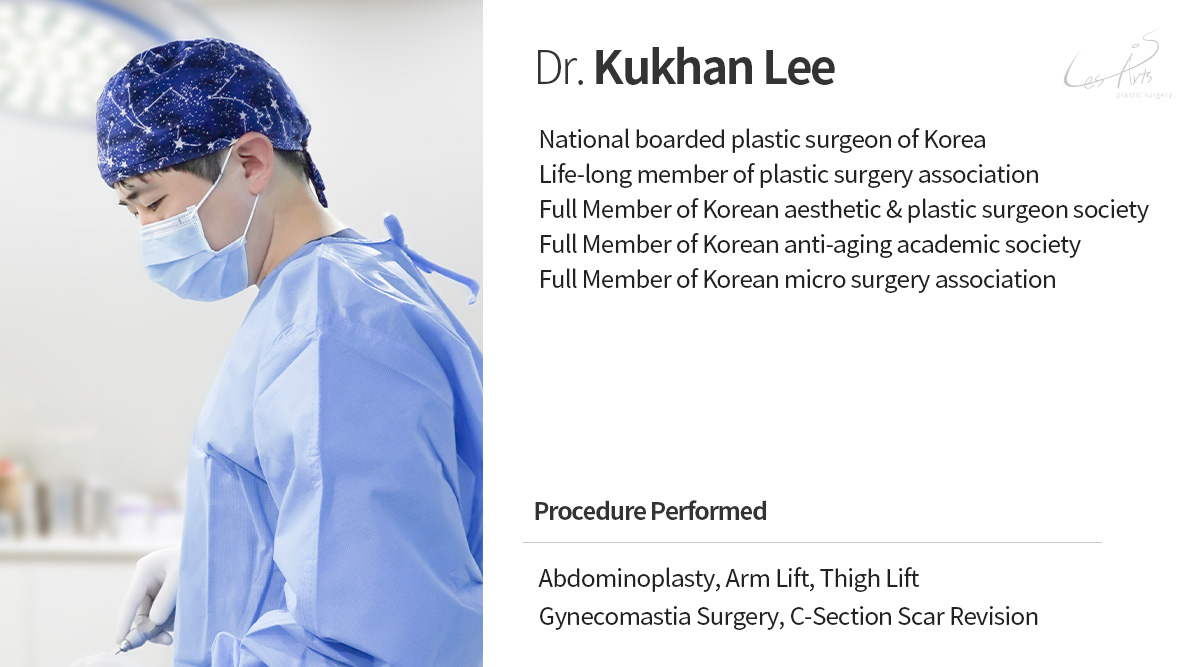
Hello, I am Dr. Kukhan Lee, Board-Certified Plastic Surgeon
specializing in gynecomastia correction and body contouring
at Lesarts Plastic Surgery Clinic.

[Chest Reduction Results 2 Months Post-Gynecomastia Surgery – Dr. Kukhan Lee, Lesarts Plastic Surgery Clinic]
Many men considering gynecomastia surgery hesitate not only because of overall chest size,
but due to curiosity and anxiety regarding
how the shape, size, and pigmentation of the areola will transform post-operatively.
In particular, when the areola is wide or projects outward in a conical mound,
many worry whether this rounded projection will persist even after surgery.
Patients with naturally lighter areolar pigmentation also frequently wonder
whether its color will alter significantly after the procedure.
In clinical reality, the areolar complex is one of the anatomical units
that demonstrates the most distinct and immediate transformations following gynecomastia surgery.
In this clinical article, we compare the baseline pre-operative presentation with outcomes at 2 months post-op,
examining how areolar diameter, surface projection, and pigmentation evolve throughout recovery.

[Pre-Operative Assessment: Gynecomastia – Dr. Kukhan Lee, Lesarts Plastic Surgery Clinic]
This patient was a male in his 20s diagnosed with Simon Grade IIa gynecomastia,
exhibiting moderate glandular breast enlargement without severe dermal ptosis.
Prior to surgery, his areolar diameter was relatively expanded,
and the lower chest—including the periareolar complex—projected outward,
displaying a distinctly feminine breast contour.
Although areolar pigmentation was a normal light brown without pathological findings,
the outward expansion and conical elevation driven by proliferating glandular tissue beneath
served as a source of chronic psychological stress.
Accordingly, we performed subcutaneous mastectomy concurrently with liposuction;
let us now review how the chest contour and areolar architecture
transformed by the 2-month postoperative milestone.

[Gynecomastia Before & After: Areolar Transformation – Dr. Kukhan Lee, Lesarts Plastic Surgery Clinic]
[Postoperative Wardrobe Fit in Fitted T-Shirts – Dr. Kukhan Lee, Lesarts Plastic Surgery Clinic]
Following gynecomastia correction, the chest settled
into a firm, masculine pectoral contour,
with lower breast projection thoroughly eliminated.
The previous rounded appearance was resolved completely,
revealing a flat, naturally balanced masculine chest line.
With glandular tissue excised, tension over the areola subsided,
contracting its diameter and flattening its profile flush against the chest wall.
During this areolar contraction process,
the pigmentation may temporarily appear slightly deeper or darker than before,
which is a standard physiological occurrence.
However, because this assessment is at 2 months post-op,
temporary postoperative reactive hyperpigmentation may still be present,
making it too early to evaluate final areolar color.
As tissue remodeling progresses over subsequent months, pigmentation stabilizes
and naturally brightens back toward baseline tone.

[Areolar Reduction Effect Before & After – Dr. Kukhan Lee, Lesarts Plastic Surgery Clinic]

[Essential Pre-Enlistment Gynecomastia Checklist – Dr. Kukhan Lee, Lesarts Plastic Surgery Clinic]
When areolar surface area contracts,
melanocytes concentrate over a smaller surface area,
which explains why the color can appear slightly darker than pre-operatively—an important
physiological detail to keep in mind.
Because the patient is still in early recovery,
subtle firmness may linger, but as time passes,
the pectoral profile settles into a pliable, natural, and athletic form.
Incorporating chest resistance workouts within safe limits
once recovery advances supports even more satisfying pectoral definition.
Postoperative areolar changes are not merely about dimensional contraction;
they represent natural biological adaptations occurring during
glandular excision and soft-tissue healing.
While early pigmentation and shape may feel unfamiliar at first,
they consistently stabilize over time.
Therefore, rather than evaluating surgical outcomes prematurely during early recovery,
it is essential to understand the biological healing timeline.
If you are considering gynecomastia correction,
understanding these physiological stages in advance
will give you clarity and confidence in your decision.
FAQ
Q1. Does areolar diameter decrease after gynecomastia surgery?
Yes. When underlying glandular tissue is excised, the stretched areolar skin contracts naturally,
typically settling into a smaller, flatter shape.
Q2. Why does the areola look darker following gynecomastia surgery?
As areolar surface area contracts, existing pigment-bearing cells concentrate over a tighter zone,
and early postoperative reactive pigmentation can temporarily make the tone appear deeper than before surgery.
Q3. Does the darkened areolar pigmentation remain permanently?
No. At 2 months post-op, tissues are still in active recovery, making it too early to assess final color.
As internal tissues stabilize over time, pigmentation steadily lightens and returns to a natural tone.
Q4. When can exercise be resumed to enhance chest definition?
Once biological recovery is sufficiently established, gradually integrating chest resistance training
helps build underlying pectoralis major musculature, sculpting a firm, athletic masculine chest line.
Q5. Are postoperative areolar changes considered part of normal healing?
Yes. Changes in areolar size, projection, and color are expected biological responses during glandular excision and tissue remodeling.
Rather than judging the final outcome immediately after surgery, allowing adequate recovery time ensures an accurate evaluation of results.
Dr. Kukhan Lee


Cases finding
similar to my profile
Customer Diagnostics


Select the surgery and
area you are interestedto see real
before andafter changes.


we
make you,
the art
Clinic hours
MON - FRI
10 am – 7pm
SAT
10 am – 4pm
Holiday
SUN, HOLIDAY
Location
Lesarts Moon Clinic Tower 4-5F, 40, Nonhyeon-ro 168-gil,
Gangnam-gu, Seoul, Republic of Korea

Medical institution name Lesarts Plastic Surgery
Address Lesarts Moon Clinic Tower 4-5F, 40, Nonhyeon-ro 168-gil, Gangnam-gu, Seoul, Republic of Korea
Representative Moon sung jun
