




Online Consultation
Please accurately enter the information below.
Quick Cost Consultation
Quick Consultation & Reservation
Cases finding
similar to my profile






Doctor's Note
Medical columns by our surgeons
Thigh Liposuction | Common Trait of Shorter-Looking Frames: Saddlebags and Narrow Pelvic Width
2026-07-29
Thigh Liposuction | Common Trait of Shorter-Looking Frames: Saddlebags and Narrow Pelvic Width
Q. How do thigh liposuction and pelvic fat grafting improve a petite frame with visually shortened legs?
A. Bulging saddlebags are debulked to narrow horizontal leg width, while narrow pelvic hollows are filled with autologous fat to elevate the visual starting point of the legs.
By redistributing adipose volume to rebalance upper-to-lower body proportions, the waistline looks cinched and the legs appear significantly longer and straighter than their physical measurements.
[Learn More About Lesarts Thigh Liposuction]
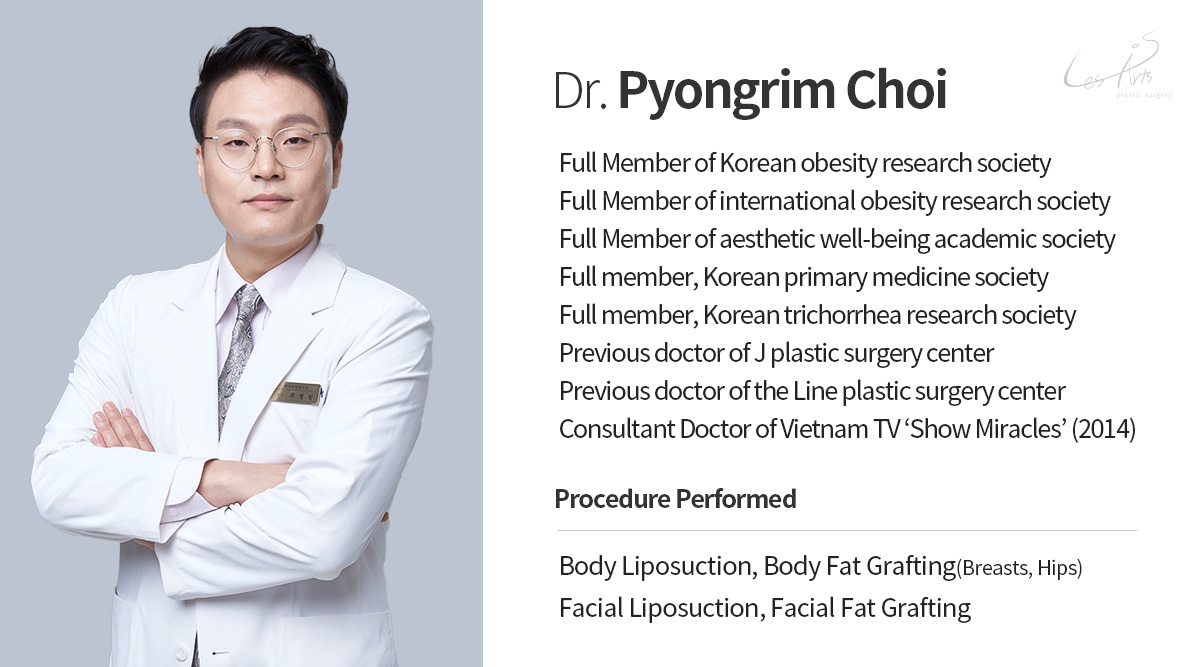
Hello, I am Dr. Pyongrim Choi, Board-Certified Plastic Surgeon at Lesarts Plastic Surgery Clinic.
What anatomical trait do silhouettes that appear shorter than their actual height share in common?
The clinical answer is 'prominent saddlebags combined with narrow pelvic width.'
This means the dilemma is not simply
"excessive weight," but "a structural disproportion in lower-body contours."
Particularly for petite individuals whose lower bodies appear disproportionately developed,
the following concerns are frequently shared during consultations:
"My body weight is modest, yet my legs look disproportionately short."
"My pelvic frame looks narrow, while outer saddlebag bulges flare outward,
making my entire lower body appear heavy and stocky."
These contour concerns cannot be resolved simply
by losing scale weight through dieting or focusing solely on lower-body exercises.
The underlying issue is not the absolute volume of subcutaneous fat,
but its anatomical 'distribution' and
the resulting 'optical proportions' it creates.
In this clinical article,
I will explain from a specialized perspective why legs appear shorter in petite frames with prominent lower-body contours,
and examine the practical transformative impact and line refinement achieved
by combining thigh liposuction with pelvic and hip dip fat grafting.
1. Why Does This Physique Make Legs Appear Shorter?
Petite silhouettes with prominent lower-body development typically present
the following anatomical characteristics simultaneously:
- Narrow horizontal pelvic bone width
- Outward convex bulging along the lateral thighs (saddlebags)
- A low visual starting point of the legs (hip line and pelvic crest), truncating height
- Flattened lateral gluteal lines or deep hip dips causing indented side profiles
When these anatomical factors converge, the optical effect is unmistakable:
the lower body appears significantly wider and heavier than the upper torso,
dragging the perceived starting point of the legs downward.
Rather than physical stature or innate femoral bone length,
the 'pelvic curvature + lateral thigh line' established by fat distribution dictates overall body proportions and aesthetic presence.
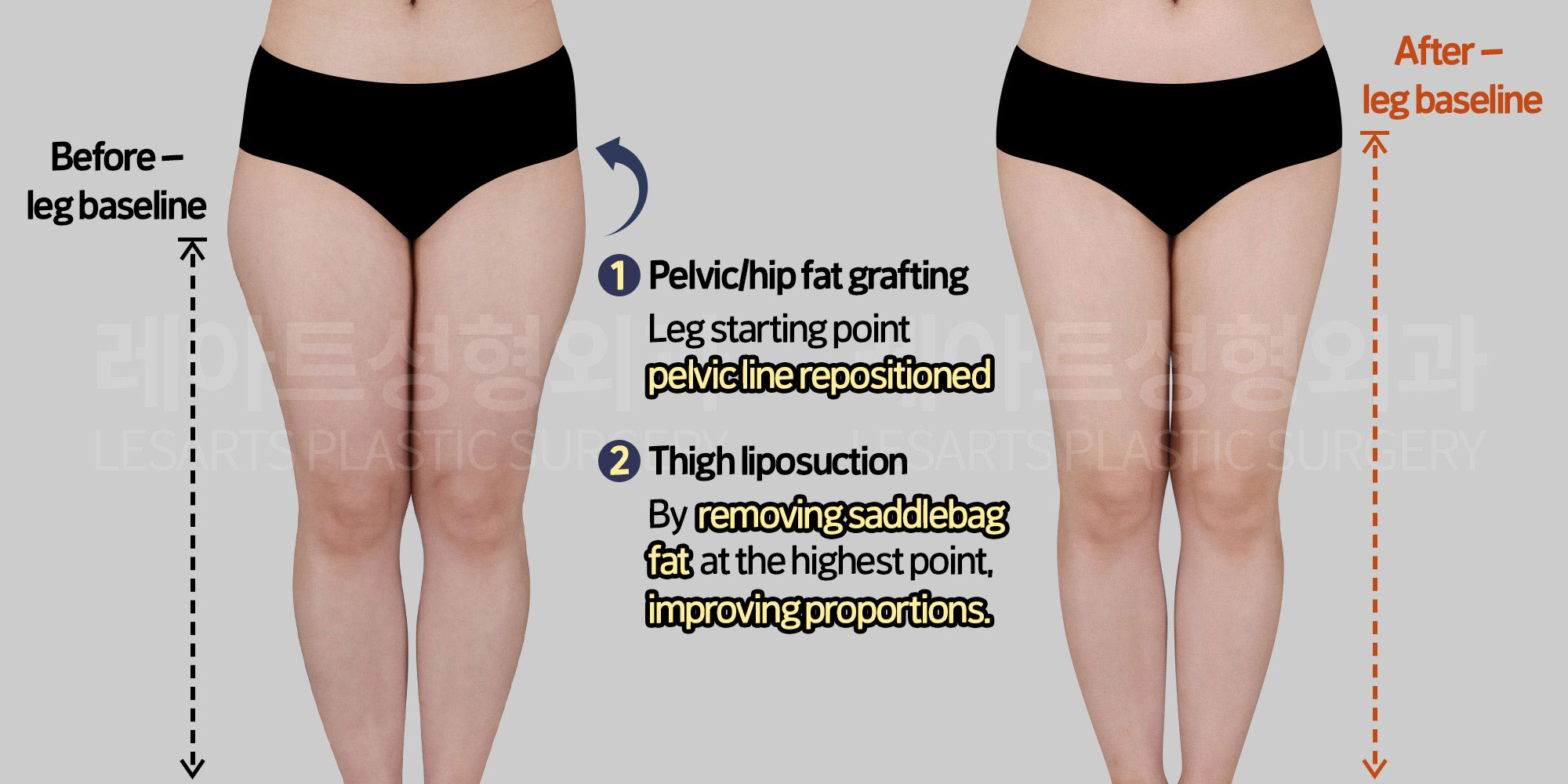
2. Thigh Liposuction – Precision 'Contour Line' Over Bulk 'Volume'
In this body type, the goal of thigh liposuction is not merely
extracting large quantities of aspirate.
The definitive target is the 'saddlebag area.'
Saddlebags make the pelvis appear comparatively narrower,
widen the horizontal span of the lower body,
and act as the primary cause making legs look short and heavy.
Therefore, performing thigh liposuction to sculpt the trochanteric saddlebag flare
narrows the outer lateral span,
establishing a straight leg silhouette
while producing a visual lifting effect
that makes the legs look noticeably longer.
3. Pelvic & Hip Dip Fat Grafting – 'The Final Piece to Complete Body Proportion'
However, standalone thigh liposuction leaves one missing aesthetic dimension:
insufficient lateral pelvic volume and depressed hip dips.
While debulking saddlebags slims the thighs,
if the patient naturally possesses a narrow pelvic framework,
the post-operative silhouette can appear somewhat flat or boxy.
The final key to achieving complete refinement is
pelvic and hip dip autologous fat grafting.
By naturally restoring volume to lateral pelvic hollows and trochanteric depressions,
the waistline appears comparatively more cinched, the curvature from hip to thigh transitions seamlessly,
and the visual origin of the legs is elevated directly to the superior pelvic crest.
[Core Biomechanical Principle]
Narrow the outer lateral thigh span, and fill narrow pelvic depressions with fat grafting
to fundamentally redistribute upper-to-lower body proportions.
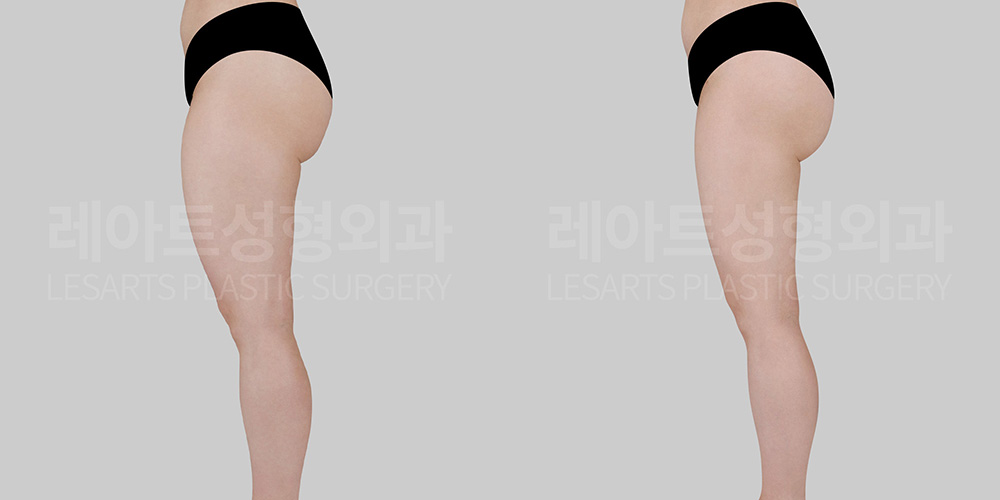
[Clinical Case Analysis]
Patient Profile: Female in her 30s / 145 cm / 42.9 kg / BMI 20.4
Patient Goals: "Bulging saddlebags are my greatest stress, and I want to balance bilateral asymmetry.
I want my thigh lines to connect naturally and smoothly."
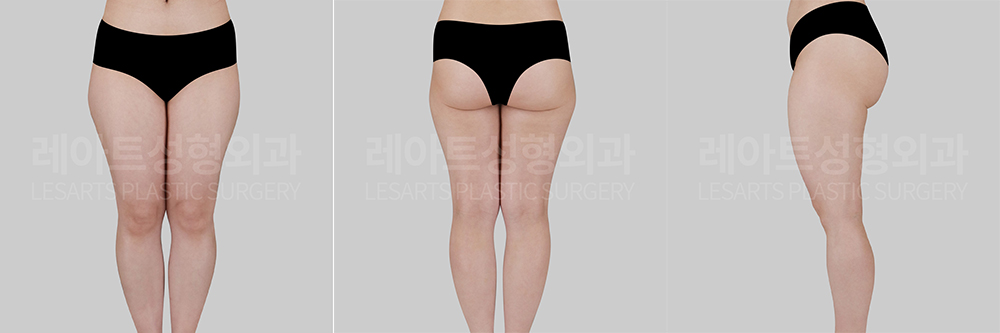
[Pre-Operative Body Contour Assessment]
Bilateral Saddlebag Asymmetry: The right saddlebag projected more abruptly and narrowly compared to the left
Lower-Body Proportion: A narrow pelvic frame and a low visual leg starting point truncated overall height
Adipose Distribution: Subcutaneous fat depth across the inner and anterior thighs was modest
[Customized Surgical Strategy]
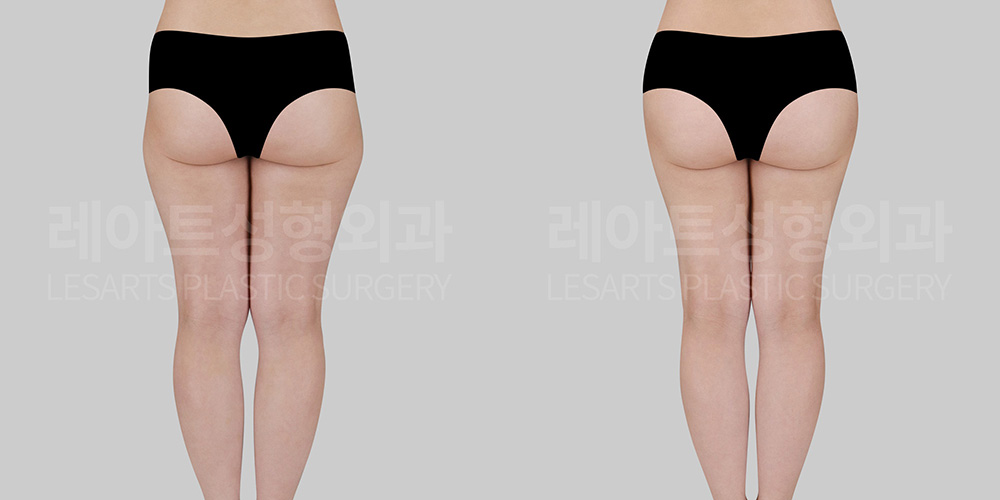
Circumferential Thigh Liposuction:
Because more fat required extraction on the right saddlebag to balance asymmetry,
the patient was informed pre-operatively that subtle skin laxity could temporarily persist on the right side
Pelvic & Hip Dip Fat Grafting:
Because total aspirate from the thighs was modest,
a primary fat grafting session was planned to refine pelvic curvature and maximize bilateral symmetry

Dr. Pyongrim Choi


Cases finding
similar to my profile
Customer Diagnostics


Select the surgery and
area you are interestedto see real
before andafter changes.


we
make you,
the art
Clinic hours
MON - FRI
10 am – 7pm
SAT
10 am – 4pm
Holiday
SUN, HOLIDAY
Location
Lesarts Moon Clinic Tower 4-5F, 40, Nonhyeon-ro 168-gil,
Gangnam-gu, Seoul, Republic of Korea

Medical institution name Lesarts Plastic Surgery
Address Lesarts Moon Clinic Tower 4-5F, 40, Nonhyeon-ro 168-gil, Gangnam-gu, Seoul, Republic of Korea
Representative Moon sung jun
