




Online Consultation
Please accurately enter the information below.
Quick Cost Consultation
Quick Consultation & Reservation
Cases finding
similar to my profile






Doctor's Note
Medical columns by our surgeons
Abdominal Liposuction | When Scale Numbers Drop but Your Silhouette Remains 'Stalled'
2026-07-31
Abdominal Liposuction | When Scale Numbers Drop but Your Silhouette Remains 'Stalled'
Why does the waistline show little change even after losing an additional 5 kg?
While overall scale weight may decrease with weight loss, innate skeletal framework and regional adipose distribution often keep the waistline from transforming visibly.
When stubborn localized contours persist, personalized body contouring that respects individual anatomy and fat distribution
is often far more effective than simply pushing for further weight loss.
[Learn More About Lesarts Liposuction]
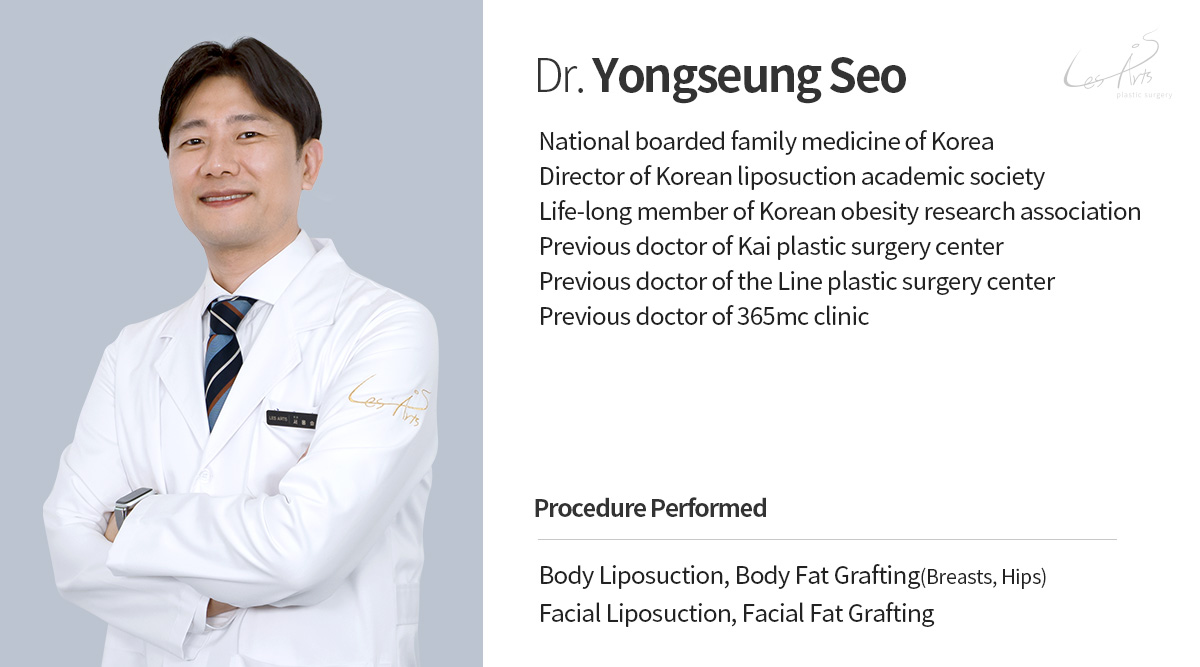
Hello, I am Dr. Yongseung Seo, Plastic Surgeon at Lesarts Plastic Surgery Clinic.
Losing '5 kg' is by no means a minor achievement.
Many individuals invest immense dedication into disciplined nutrition and consistent exercise
to slim down and reclaim their previous body shape.
Yet, when scale weight drops but the reflection in the mirror reveals an unchanged waistline,
or when a straight, boxy midsection appears even more prominent,
it naturally leads to a deep sense of frustration.
It is completely natural to find yourself wondering:
"Do I need to lose even more weight, or is my skeletal framework simply built this way?"
The patient featured in this clinical case
initially consulted us after reducing her weight from a peak of 73 kg down to 63 kg,
and later returned after losing an additional 5 kg down to 58 kg.
Although she successfully achieved significant weight loss,
her greatest remaining frustration was that her 'boxy waist' and 'lower abdominal bulge'
showed virtually no improvement.
Rather than simply extracting bulk fat volume,
cases like this require liposuction focused on architectural body design
to reveal a three-dimensional waistline in everyday life and photographs.
In this clinical review, we examine how unyielding contour concerns that resisted an extra 5 kg of weight loss
were definitively resolved through specialized contouring.
[Patient Profile]
Age: Early 30s
Height: 168 cm
Weight: 58.3 kg
BMI: 20.7 kg/m²
Body Fat Percentage: 31.7%
* Clinical outcomes vary individually based on skeletal anatomy, tissue elasticity, and fat distribution.
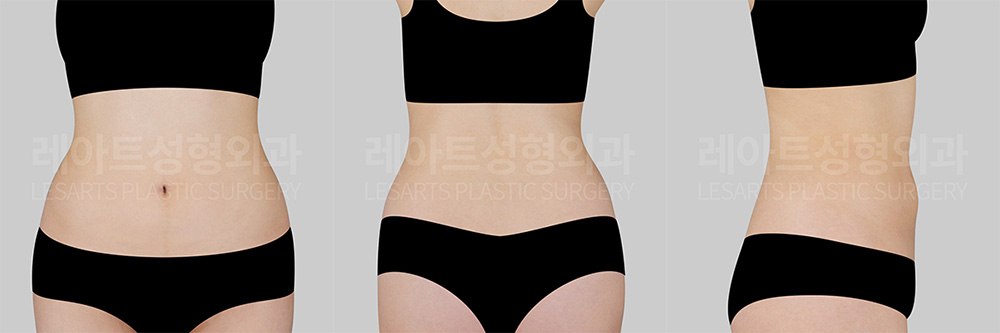
[Pre-Operative Assessment: Abdominal Liposuction]
[Pre-Operative Evaluation & Surgical Design]
Despite substantial weight reduction, the patient shared that
an undefined waistline remained
her single greatest aesthetic dissatisfaction.
On visual inspection,
diffuse subcutaneous fat lingered across the abdominal wall,
innate skeletal alignment gave the flanks a thick, boxy appearance,
and bilateral waist asymmetry was noticeably pronounced.
Additionally, anterior projection was prominent across the lower abdomen.
Diagnostic ultrasound imaging measured subcutaneous fat depth as follows:
Love handles: 17 / 19 mm
Flanks: 12 / 14 mm
Upper abdomen: 17 mm
Lower abdomen: 28 mm
These measurements confirmed ample subcutaneous fat for liposuction,
while the anterior abdominal wall presented a high proportion of fibrous connective tissue.
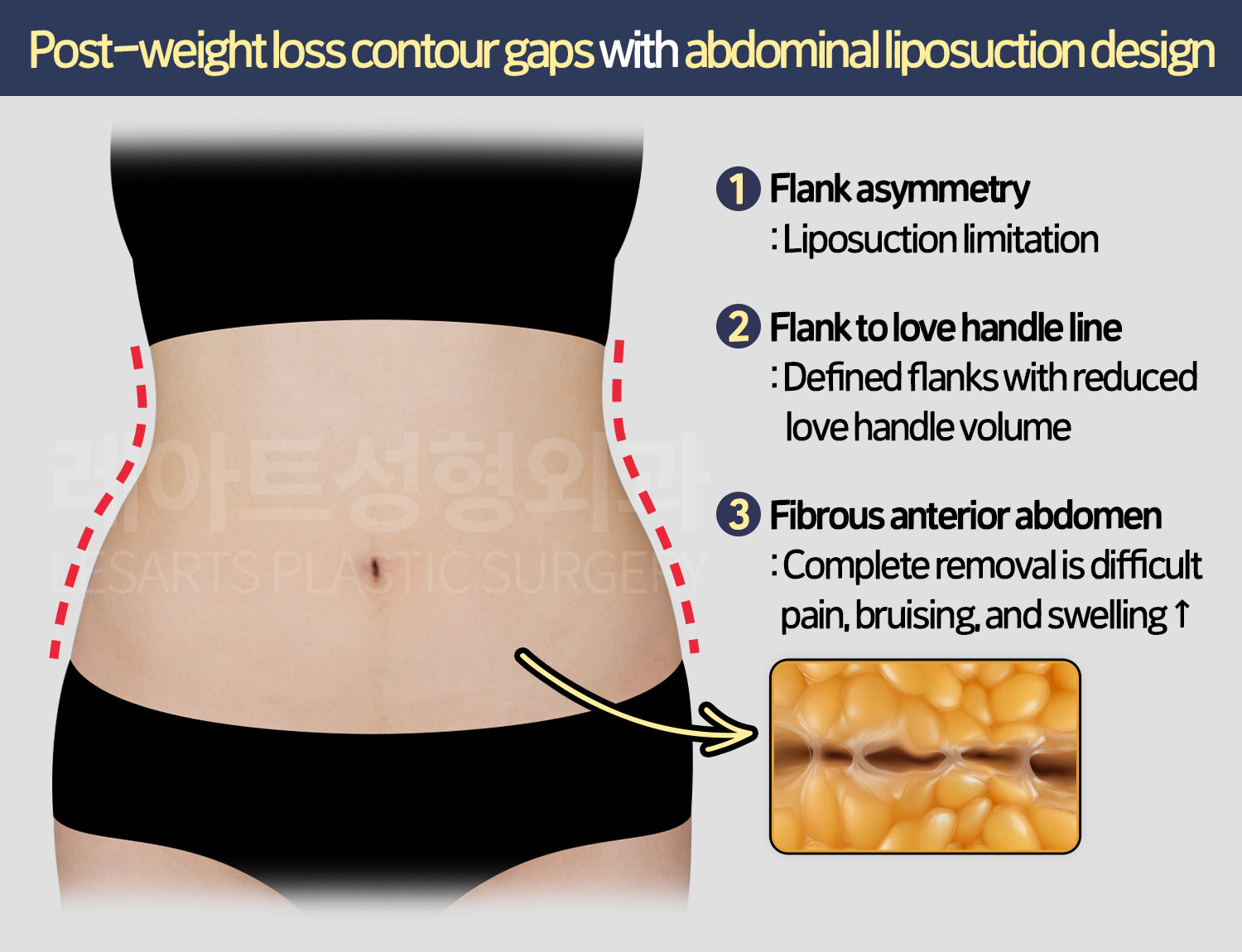
[Surgical Design: Abdominal Liposuction]
Flank Asymmetry:
While subcutaneous fat was ample overall,
bilateral asymmetry along the flanks was readily apparent.
Ultrasound confirmed that this discrepancy was caused by underlying skeletal framework rather than unequal fat depth.
Therefore, the surgical strategy required deciding whether to prioritize bilateral balance by adjusting extraction volume,
or to maximize fat removal for the slimmest possible waist.
Balancing asymmetry through liposuction often involves
leaving strategic fat buffers on one side to visually mask the underlying bone structure.
However, because the asymmetry in this case was intrinsically skeletal,
we clearly explained that even if fat were preserved selectively,
achieving perfect bilateral symmetry would be anatomically limited.
Following comprehensive consultation, the patient prioritized maximum waistline narrowing over strict symmetry,
and the surgical blueprint was finalized to debulk fat thoroughly across both sides.
Anterior Abdominal Fibrous Tissue:
The anterior abdominal wall exhibited dense fibrous tissue content.
High fibrous density increases surgical dissection resistance and procedural complexity,
which can lead to more pronounced postoperative swelling, ecchymosis, and temporary discomfort.
Furthermore, because fibrous septae cannot be suctioned away like adipocytes,
we thoroughly informed the patient in advance that a minor degree of structural thickness might naturally remain
even after maximal fat evacuation.
Love Handle Contouring:
The patient was initially concerned that debulking too much fat from the love handles might flatten her waistline into a boxy shape.
However, this outcome is not universal.
Removing fat indiscriminately without respecting the natural waist curve and pelvic crest can indeed flatten feminine contours;
yet in her case, evaluating adipose distribution alongside her skeletal framework confirmed
that an authentic, cinched waistline could be successfully achieved.
Comparing the discomfort of residual pinchable rolls against the aesthetic benefit of maximizing contour definition,
she opted for thorough debulking to rebalance overall torso proportions.
Accordingly, the love handles were contoured aggressively
to sculpt a tapered transition into the pelvis.
[Abdominal Liposuction: Before & After Comparison]
※ Photographed at 6 months post-operatively under standardized studio lighting and positioning.
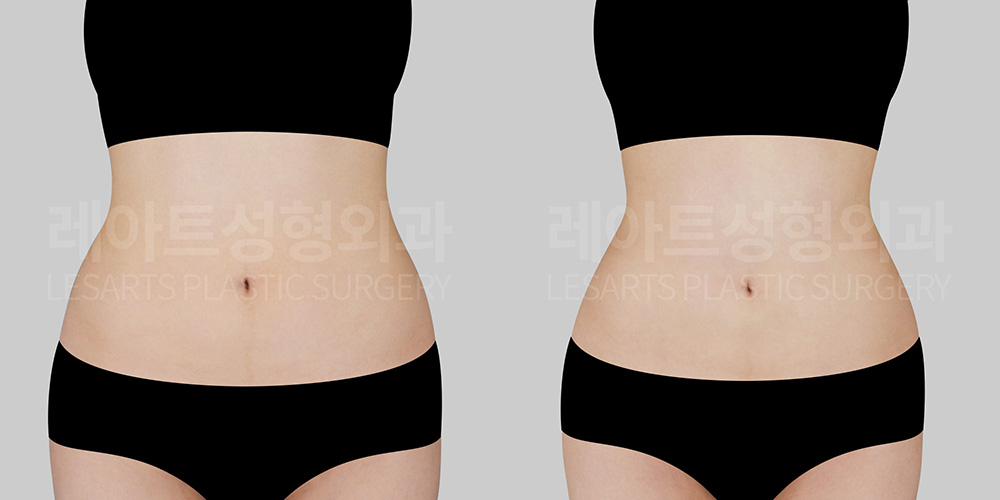
[Sculpting Waist Contours via Liposuction After Weight Loss – Dr. Yongseung Seo, Lesarts Plastic Surgery Clinic]
Despite losing substantial scale weight, an undefined waistline had persisted as her most distressing aesthetic issue.
Through targeted abdominal liposuction,
she achieved the definitive waist taper that dieting alone could not deliver,
transforming her midsection into a sculpted, three-dimensional silhouette.

[Abdominal Liposuction Before & After – Dr. Yongseung Seo, Lesarts Plastic Surgery Clinic]
While innate skeletal asymmetry remained present as predicted,
debulking the love handles maximally did not flatten the flanks;
rather, it preserved and highlighted an elegant, natural waistline curvature.
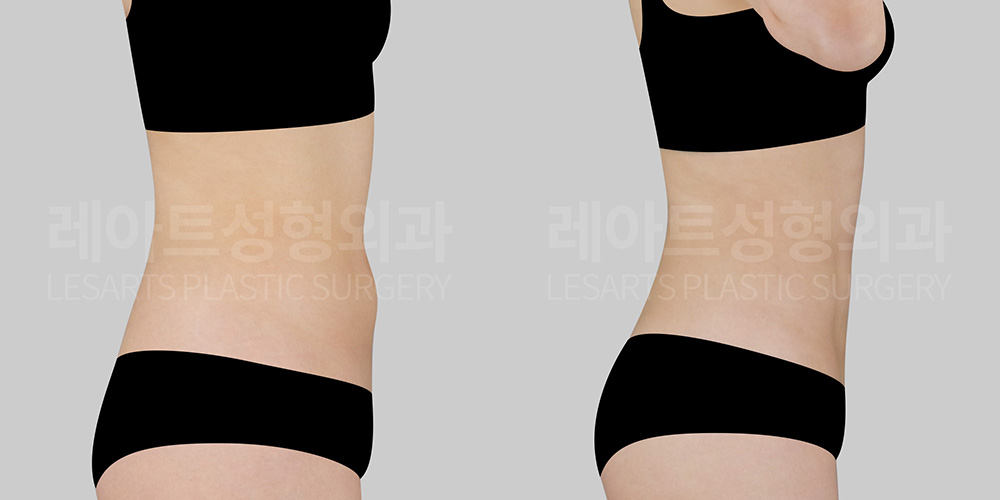
[Lateral Profile Transformation Post-Liposuction – Dr. Yongseung Seo, Lesarts Plastic Surgery Clinic]
Pre-operatively, the anterior abdominal wall displayed a distinct, bulging '3-curve' profile;
post-operatively, this was refined into a flat, smooth plane.
The anterior lower abdominal protrusion was completely streamlined into a continuous, natural contour.
When specific body lines fail to improve despite dedicated weight loss,
the issue is rarely about losing more weight;
it is almost always governed by genetic musculoskeletal framework and localized adipocyte distribution.
Liposuction is not simply about evacuating large volumes of fat.
Through thorough pre-operative consultation and clinical examination,
identifying the patient's exact aesthetic concerns, target goals,
achievable transformation boundaries,
and inherent anatomical limits is essential
to delivering consistently rewarding clinical outcomes.
At Lesarts, we carefully evaluate each patient's unique anatomical framework and fat distribution
to engineer the body contour best suited to their physique.
[View More Lesarts Abdominal Liposuction Cases]
FAQ
Q1. Why does the waistline remain unchanged even after losing significant weight?
Even when scale weight decreases, innate skeletal framework and genetic fat distribution can keep stubborn deposits along the flanks and lower abdomen unchanged.
Q2. Can slender individuals undergo abdominal liposuction?
Yes. Even with a lower body weight, if sufficient localized subcutaneous fat persists across the abdomen and love handles, liposuction can effectively sculpt the waistline.
Q3. Can abdominal liposuction correct skeletal asymmetry?
Asymmetry originating from bone structure and rib cage alignment cannot be entirely corrected through liposuction alone, though fat extraction can be calibrated to soften visual discrepancies.
Q4. How does high fibrous tissue content in the anterior abdomen affect surgery?
High fibrous density increases surgical resistance and can temporarily elevate postoperative swelling, bruising, and discomfort, while some structural thickness naturally remains post-op.
Q5. Does extracting substantial love handle fat flatten the waist?
When surgical design accounts for skeletal boundaries and pelvic curvature, love handles can be debulked thoroughly while preserving and accentuating natural feminine waist taper.
Dr. Yongseung Seo


Cases finding
similar to my profile
Customer Diagnostics


Select the surgery and
area you are interestedto see real
before andafter changes.


we
make you,
the art
Clinic hours
MON - FRI
10 am – 7pm
SAT
10 am – 4pm
Holiday
SUN, HOLIDAY
Location
Lesarts Moon Clinic Tower 4-5F, 40, Nonhyeon-ro 168-gil,
Gangnam-gu, Seoul, Republic of Korea

Medical institution name Lesarts Plastic Surgery
Address Lesarts Moon Clinic Tower 4-5F, 40, Nonhyeon-ro 168-gil, Gangnam-gu, Seoul, Republic of Korea
Representative Moon sung jun
