




Online Consultation
Please accurately enter the information below.
Quick Cost Consultation
Quick Consultation & Reservation
Cases finding
similar to my profile






Doctor's Note
Medical columns by our surgeons
Abdominoplasty | Correcting C-Section Scar Shelf Deformities with Tummy Tuck Surgery: A Clinical Case
2026-07-31
Abdominoplasty | Correcting C-Section Scar Shelf Deformities with Tummy Tuck Surgery: A Clinical Case
Can a skin step-off shelf deformity caused by a C-section scar be improved through abdominoplasty?
Yes, it is possible. Subcutaneous tissue tethering and contour step-offs around a Cesarean section scar can be definitively resolved through abdominoplasty by excising the pathological scar
and redraping the redundant, sagging skin envelope simultaneously.
However, because the optimal surgical technique varies depending on epigastric skin laxity, rectus diastasis, and dermal elasticity, an accurate clinical diagnosis is paramount.
[Learn More About Lesarts Abdominoplasty]
[Learn More About Lesarts C-Section Scar Revision]
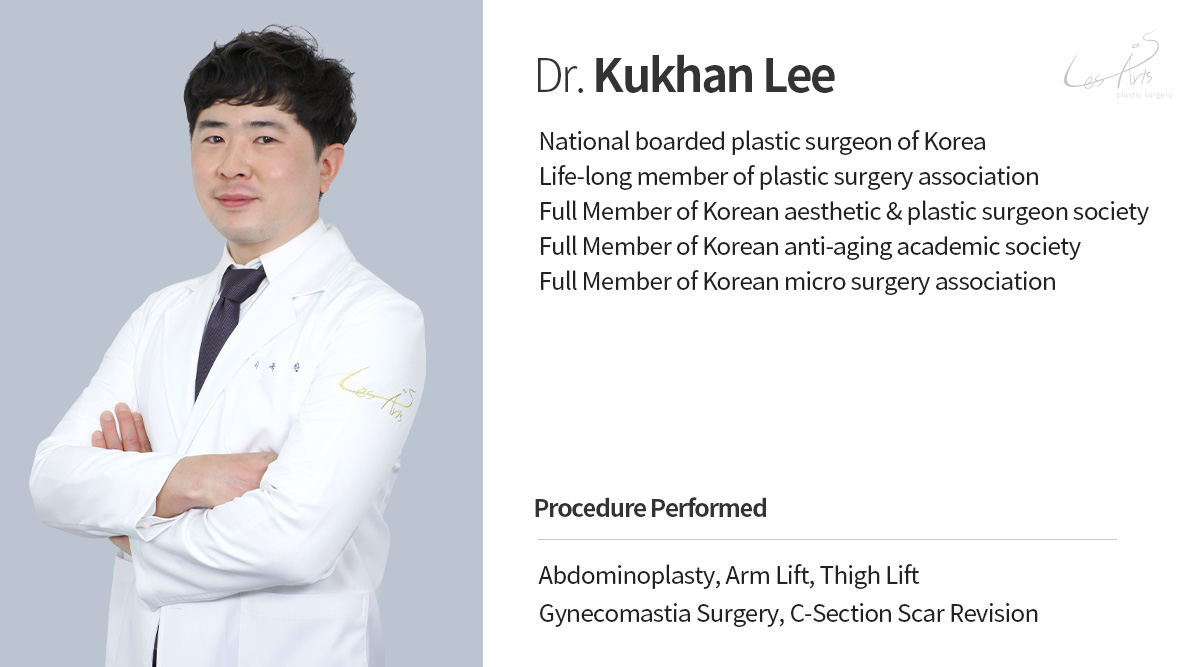
Hello, I am Dr. Kukhan Lee, Board-Certified Plastic Surgeon at Lesarts Plastic Surgery Clinic.
Even when a Cesarean section scar itself is not overtly prominent,
many women experience deep distress when a protruding skin step-off (shelf deformity)
develops around the incision line.
Particularly when the surgical scar sits relatively high on the lower abdomen,
the step-off fold remains visible even when wearing underwear,
causing constant wardrobe and aesthetic frustration.
Today, I will introduce a clinical case of a patient presenting with generalized abdominal skin laxity, rectus diastasis,
and a distinct C-section shelf deformity that were corrected simultaneously.

[Pre-Operative Assessment: Lesarts Abdominoplasty]
Evaluating her pre-operative presentation,
tissue laxity was clearly evident across both the upper and lower abdomen
relative to the umbilicus.
Epigastric skin laxity can often be diagnosed by umbilical morphology:
when the navel stretches horizontally or collapses into a hooded, downward-pointing caret ('^') shape,
it signifies that descending upper abdominal skin is actively pushing downward against the navel.
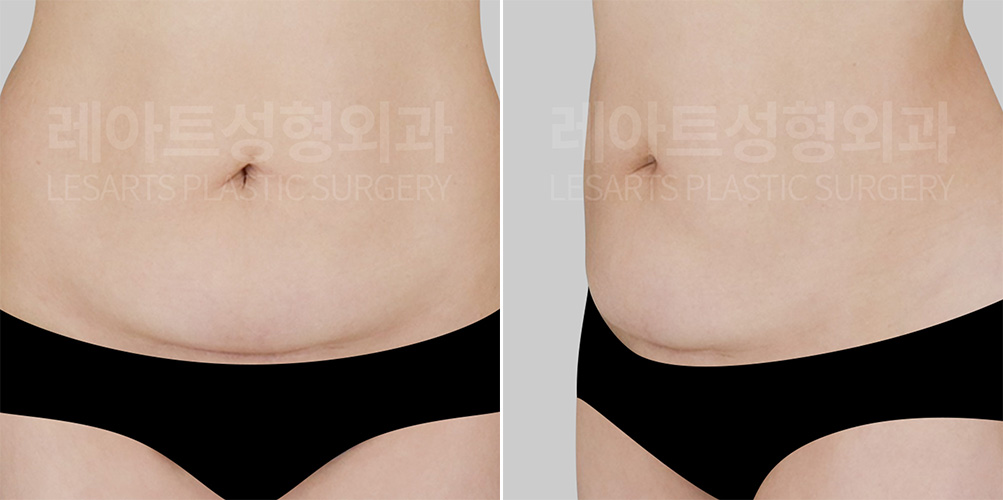
[C-Section Scar Position & Shelf Deformity]
The patient also presented with pronounced infraumbilical skin laxity,
and her prior C-section scar was situated noticeably higher
than the standard suprapubic crease.
Furthermore, deep superior tethering along the scar plane
caused the loose lower abdominal skin to hang over the incision like an apron fold,
forming a stark contour step-off deformity.
Although she had experienced only one pregnancy,
full-length rectus diastasis was present across both the epigastrium and hypogastrium,
accompanied by diminished overall abdominal skin elasticity.
When multiple structural challenges such as skin laxity, rectus diastasis, and scar shelf deformities coexist,
the surgical blueprint must be formulated around
the patient's primary aesthetic priorities.

[Pre-Operative Diagnosis & Surgical Planning]
If upper abdominal laxity and umbilical shape changes are not major concerns,
a Type S mini abdominoplasty can be considered to resect the C-section scar and relocate it lower.
Conversely, when addressing full-thickness skin laxity across the entire abdomen
and remodeling the navel into an aesthetic vertical aperture are prioritized,
a Type M full abdominoplasty is the definitive clinical procedure of choice.
As discussed in prior cases,
a Type M full abdominoplasty requires a relatively wider horizontal incision span.
Therefore, after thoroughly counseling the patient on the achievable outcomes and anatomical trade-offs of each approach,
the surgical plan is finalized to align directly with the patient's core aesthetic goals.
Because this patient desired comprehensive correction of full abdominal skin laxity along with umbilical reshaping,
we performed a Type M full abdominoplasty combined with abdominal liposuction.
Let us now examine the clinical transformation at approximately 5 months post-operatively.
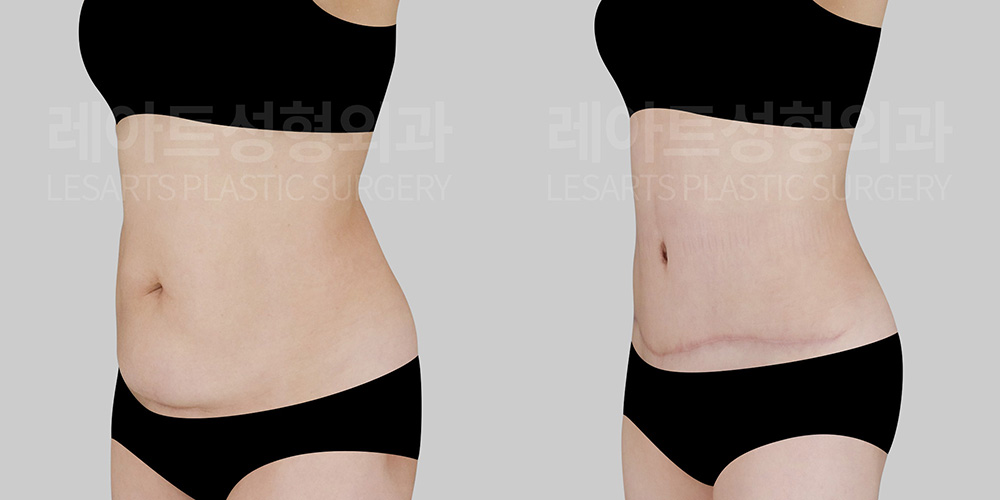
[Abdominoplasty Before & After – Dr. Kukhan Lee, Lesarts Plastic Surgery Clinic]
By combining concurrent liposuction,
the abdominal wall depth was thinned uniformly,
restoring a smooth, balanced, and aesthetically refined body silhouette.
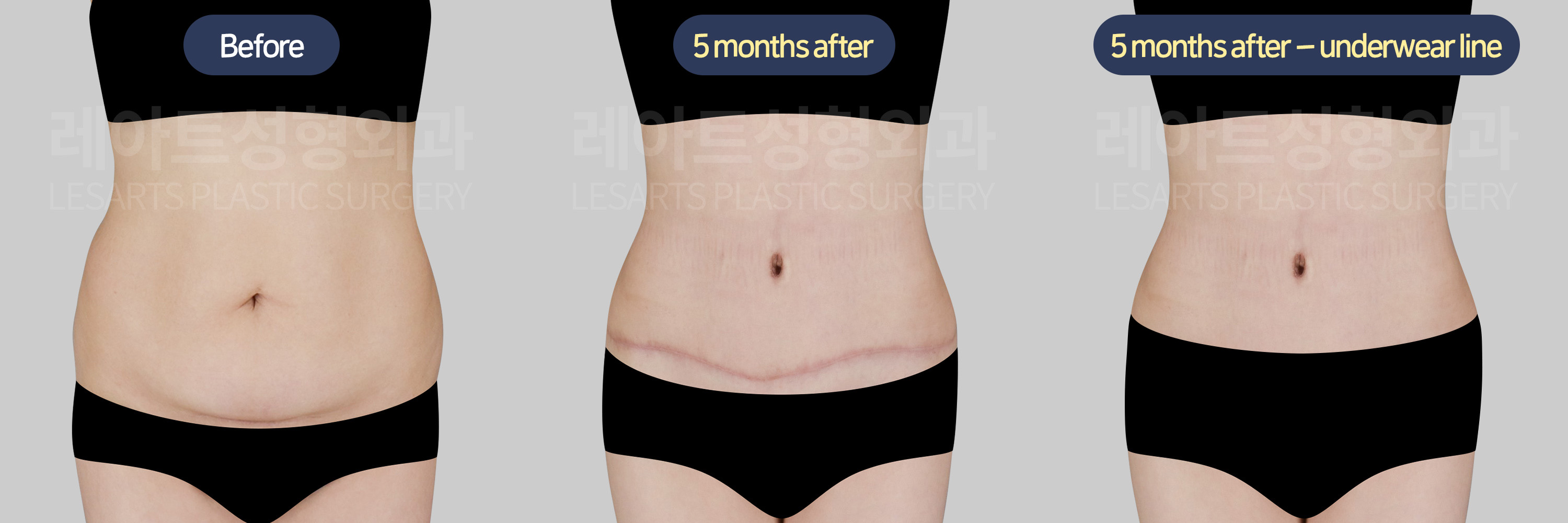
[Abdominoplasty Incision Line Positioning – Dr. Kukhan Lee, Lesarts Plastic Surgery Clinic]
Because a Type M full abdominoplasty was performed,
the transverse incision length was necessarily extended.
However, the new closure was positioned low along the pelvic crease,
allowing the scar to be discreetly concealed beneath standard underwear.
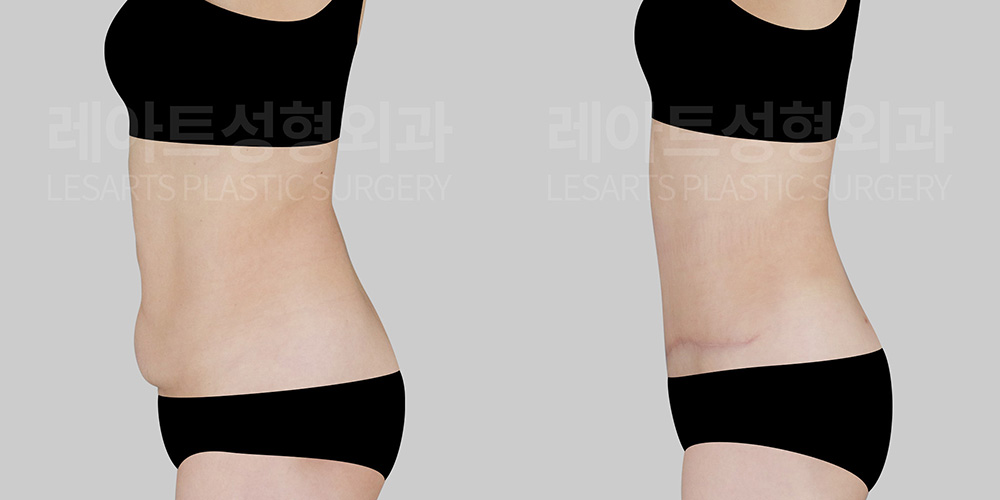
[C-Section Shelf Deformity Corrected via Tummy Tuck – Dr. Kukhan Lee, Lesarts Plastic Surgery Clinic]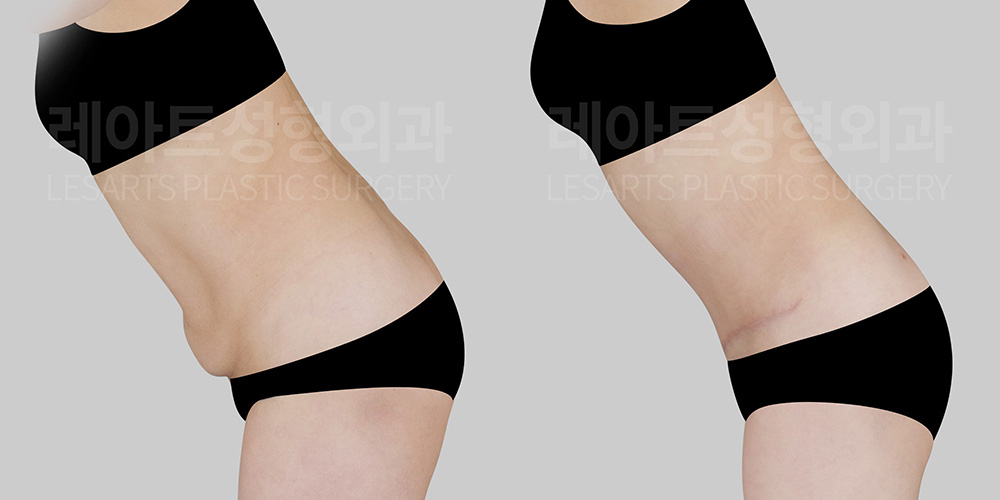
[Full Tummy Tuck & Rectus Plication: Before & After – Dr. Kukhan Lee, Lesarts Plastic Surgery Clinic]
Excising the pre-existing Cesarean scar completely
simultaneously eliminated the tethered step-off shelf deformity.
As a result, the lower abdominal contour settled into a flat, smooth, and natural plane.
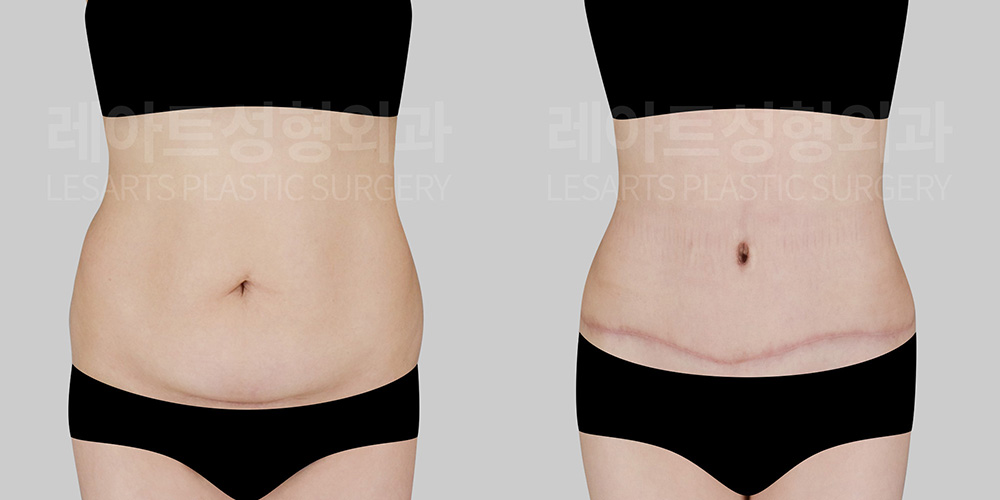
[Clinical Transformation & Profile Refinement – Dr. Kukhan Lee, Lesarts Plastic Surgery Clinic]
The navel was aesthetically remodeled into a vertical aperture.
At 5 months post-operation,
faint periumbilical hyperpigmentation was still visible,
which will continue to fade and soften naturally as tissue remodeling completes.
Abdominoplasty scars generally appear most erythematous and prominent around months 3 to 4 post-op.
With consistent scar aftercare and hydration,
the scar line gradually matures, pales, and stabilizes over time.
If you are experiencing postpartum abdominal skin laxity
accompanied by a stubborn step-off shelf above your C-section scar,
we hope this case provides helpful clinical perspective.
Because dermal tone, tissue laxity,
rectus diastasis, and body proportions differ for every individual,
determining your optimal surgical technique requires an in-person diagnostic evaluation
and detailed consultation with a board-certified specialist.
[View More Lesarts Type M Abdominoplasty Clinical Cases]
FAQ
Q1. Can a step-off shelf deformity caused by a C-section scar be improved through abdominoplasty?
Yes, it is possible.
By excising the fibrotic Cesarean scar, subcutaneous tethering and the hanging apron shelf can be corrected simultaneously.
However, the surgical approach varies depending on the anatomical extent of skin laxity and rectus diastasis.
Q2. What is the difference between a Type S mini tummy tuck and a Type M full abdominoplasty?
A Type S procedure is indicated when upper abdominal laxity is minimal, focusing on excising the C-section scar and placing the closure line lower.
Conversely, a Type M full abdominoplasty is indicated when addressing full abdominal skin laxity—including the epigastrium—and reshaping the navel are required.
Q3. Is the scar conspicuous after an abdominoplasty?
During early recovery, the scar line appears red and prominent.
It typically peaks in erythema around months 3 to 4 post-op,
after which disciplined scar management allows it to pale, flatten, and mature into an inconspicuous line.
Q4. Can the shape of the navel also be remodeled during abdominoplasty?
Yes.
In a Type M full abdominoplasty, the periumbilical tissue is redraped, allowing a horizontally stretched or collapsed navel to be reshaped into an attractive vertical aperture.
Q5. Can surgery be performed if the C-section scar is situated unusually high?
Yes, it is feasible.
Evaluating scar height, subcutaneous tethering, and abdominal laxity allows for a customized surgical plan,
which can relocate the final closure line significantly lower beneath underwear borders.
Dr. Kukhan Lee


Cases finding
similar to my profile
Customer Diagnostics


Select the surgery and
area you are interestedto see real
before andafter changes.


we
make you,
the art
Clinic hours
MON - FRI
10 am – 7pm
SAT
10 am – 4pm
Holiday
SUN, HOLIDAY
Location
Lesarts Moon Clinic Tower 4-5F, 40, Nonhyeon-ro 168-gil,
Gangnam-gu, Seoul, Republic of Korea

Medical institution name Lesarts Plastic Surgery
Address Lesarts Moon Clinic Tower 4-5F, 40, Nonhyeon-ro 168-gil, Gangnam-gu, Seoul, Republic of Korea
Representative Moon sung jun
