




Online Consultation
Please accurately enter the information below.
Quick Cost Consultation
Quick Consultation & Reservation
Cases finding
similar to my profile






Doctor's Note
Medical columns by our surgeons
Abdominoplasty | How Is the Incision Scar Position Determined? [Doctor's Notes by Dr. Kukhan Lee]
2026-08-04
Abdominoplasty | How Is the Incision Scar Position Determined? [Doctor's Notes by Dr. Kukhan Lee]
Can an abdominoplasty scar be placed as low as the patient desires?
An abdominoplasty scar cannot be determined based solely on the patient's desired placement.
The final incision line is established by evaluating multiple factors together,
including the extent of descending upper abdominal skin, skin elasticity,
the safe anatomical range for tissue undermining, and internal adhesions from prior abdominal surgeries.
▶ [View Lesarts Abdominoplasty Cases]
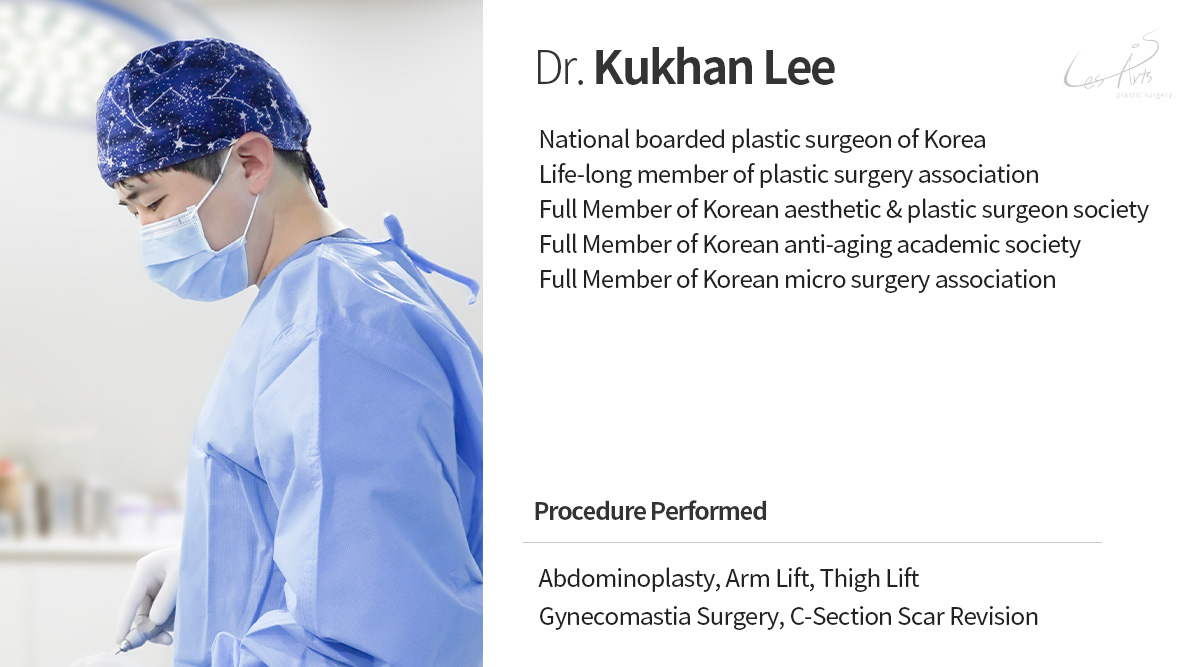
Hello, I am Dr. Kukhan Lee, Board-Certified Plastic Surgeon at Lesarts Plastic Surgery Clinic.
During abdominoplasty consultations,
many patients express deep concern over the final placement of the postoperative scar.
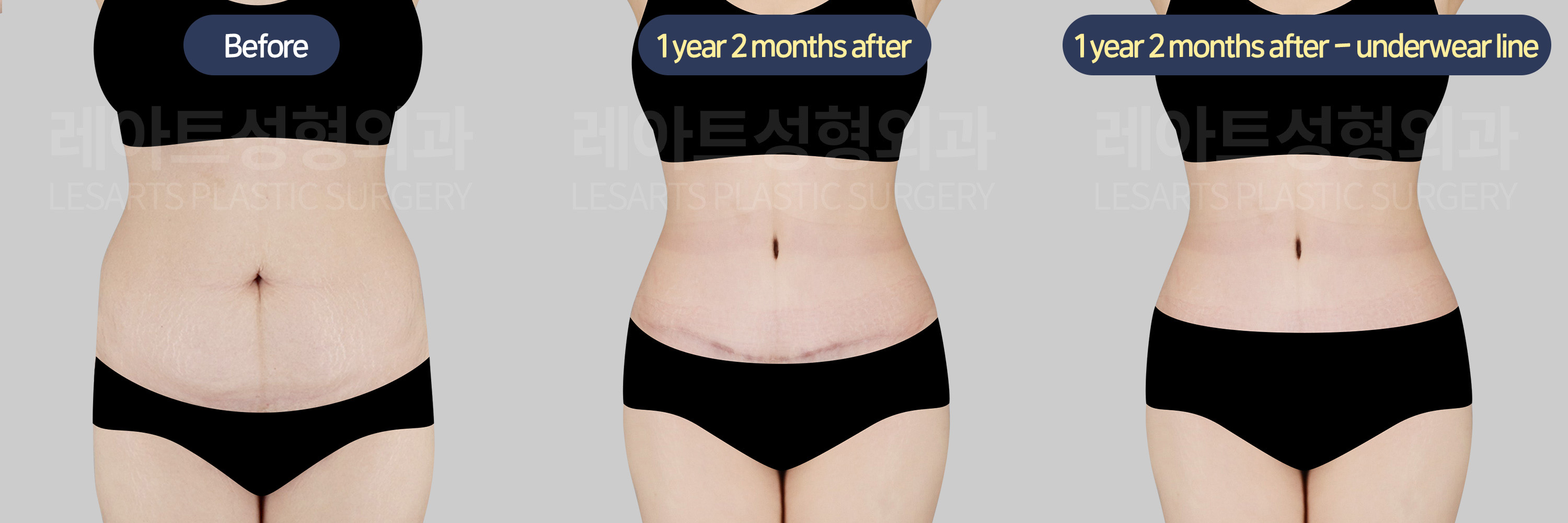
[Abdominoplasty Scar Position – Dr. Kukhan Lee, Lesarts Plastic Surgery Clinic]
Particularly when considering a Type M full abdominoplasty to correct supraumbilical skin laxity and periumbilical wrinkling,
patients frequently worry whether the scar will sit above the waistband of their underwear.
This anxiety stems from the natural desire to thoroughly correct redundant abdominal skin
while keeping the transverse incision line positioned as low as possible.
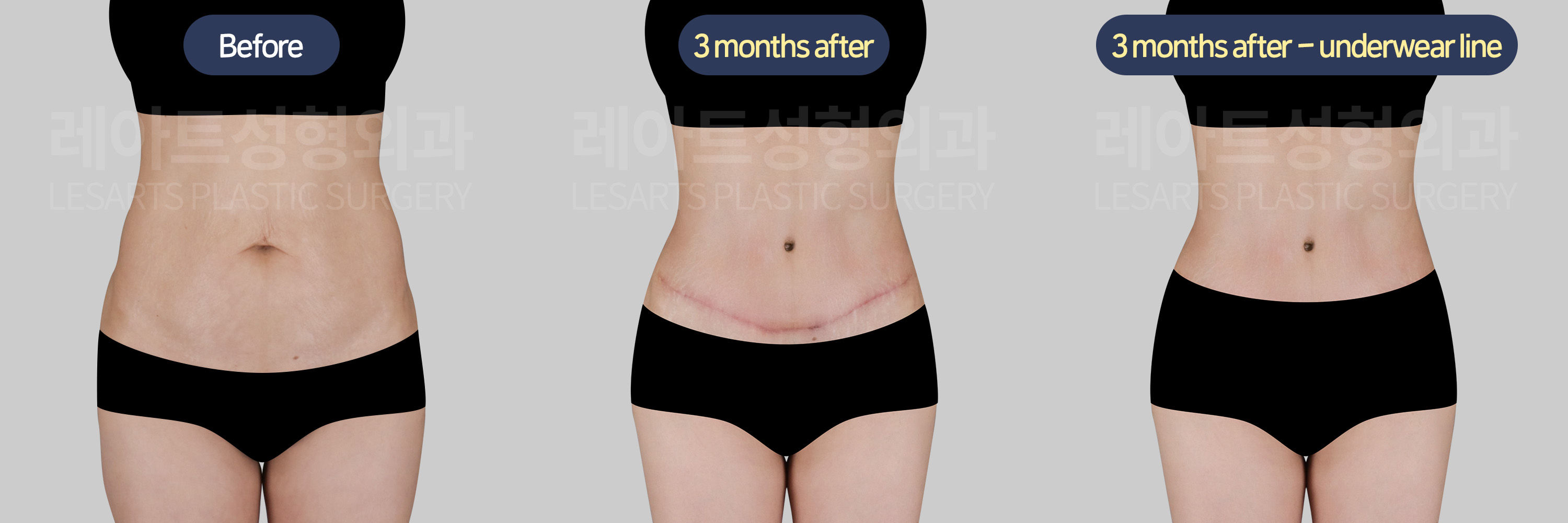
[Abdominoplasty Before & After Comparison, Incision Placement, Underwear Line – Dr. Kukhan Lee]
However, the scar position in an abdominoplasty cannot simply be determined
by accommodating a request to “make it as low as possible.”
Lowering the incision line requires epigastric skin to advance downward sufficiently toward the hypogastrium,
which necessitates that tissue undermining and skin mobilization
can be performed safely within physiological boundaries.
In this article, focusing on the Type M full abdominoplasty,
we will explain the exact clinical process through which scar placement is determined.
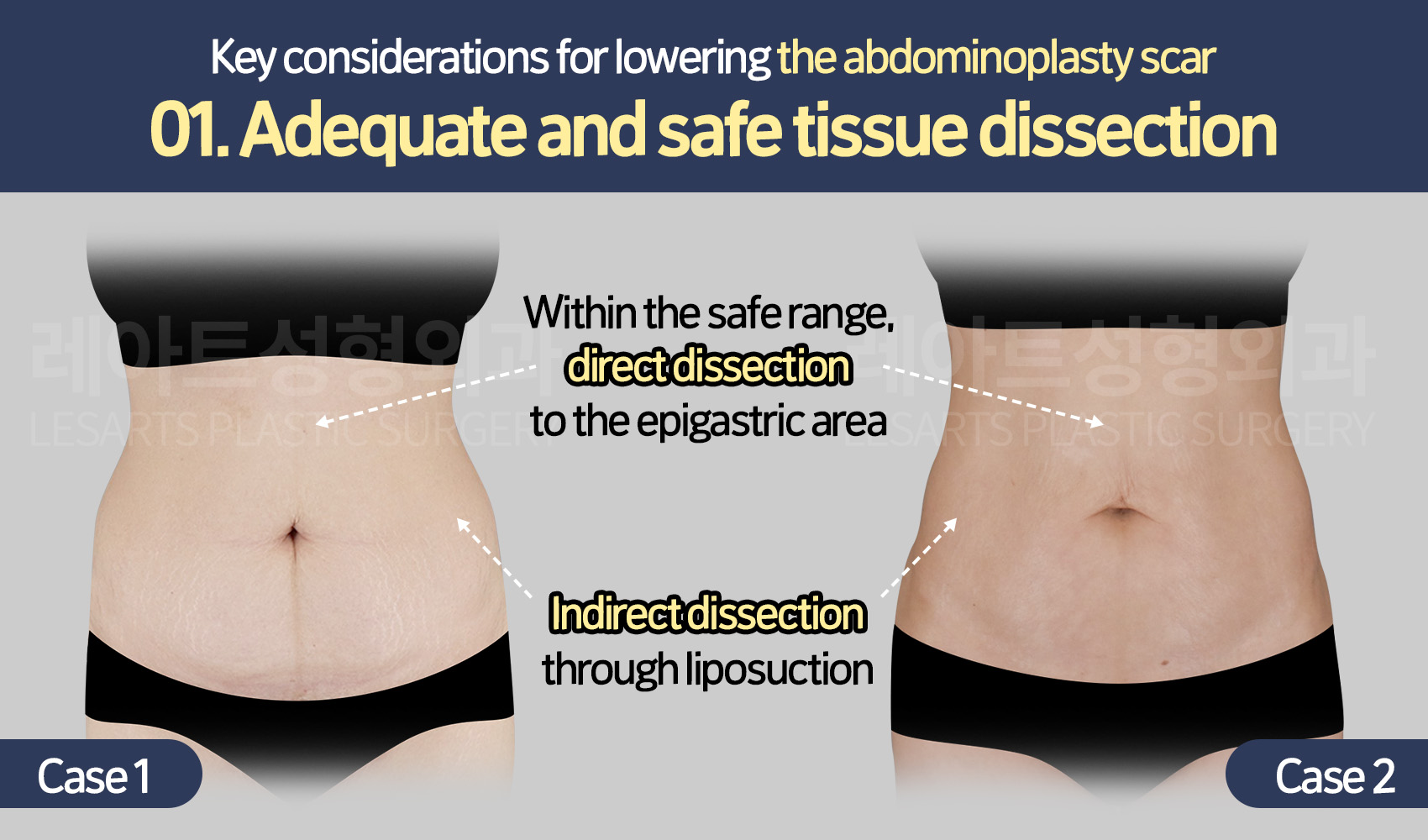
[Clinical Evaluation for Predicting Abdominoplasty Scar Placement]
1. Safe and Sufficient Tissue Undermining
When establishing scar placement during an abdominoplasty,
the primary diagnostic priority is verifying
whether epigastric skin can be mobilized downward with adequate mobility.
Advancing upper abdominal skin inferiorly requires surgical dissection
to separate subcutaneous tissue across the required plane.
However, this does not mean dissecting blindly across all upper zones.
Aggressive, uncalibrated dissection into high epigastric territories containing major perforating vessels
substantially elevates vascular compromise and tissue necrosis risks.
Therefore, direct undermining is executed safely up to the xiphoid region,
while indirect undermining via liposuction is integrated across superior zones.
This combined mobilization must be executed effectively
to allow upper abdominal skin to redrape naturally downward toward the lower abdomen.
If tissue mobility is restricted and skin fails to advance inferiorly,
closing the incision at a low level becomes mechanically unfeasible,
imposing strict anatomical limits on lowering the abdominoplasty scar.
[Abdominoplasty Incision Line Length and Placement]
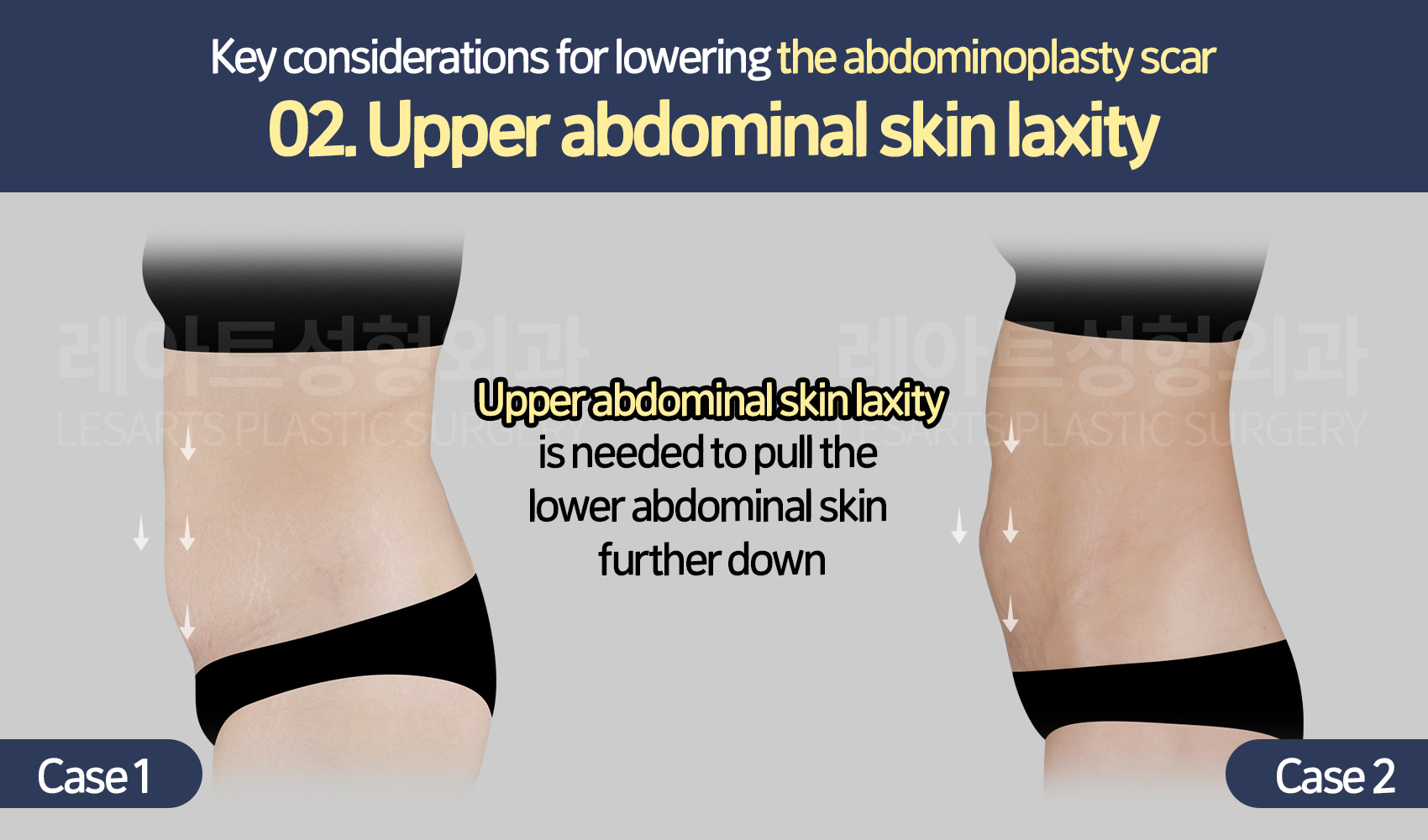
2. Extent of Supraumbilical Skin Laxity
The second critical factor to assess is
the degree of redundancy and laxity present above the umbilicus.
When ample supraumbilical skin redundancy exists,
more tissue can be advanced inferiorly,
allowing a larger volume of sagging lower abdominal skin to be excised.
This anatomical advantage makes it significantly more feasible
to comprehensively correct complete abdominal laxity while positioning the final closure line low.
Conversely, if supraumbilical skin laxity is minimal
yet the patient demands aggressive correction of upper abdominal sagging,
the final scar may settle higher than initially anticipated.
In such clinical scenarios, surgical selection depends entirely
on the patient's core aesthetic priorities:
If correcting epigastric laxity comprehensively is the primary goal,
a Type M full abdominoplasty is selected,
accepting the possibility of a moderately higher scar line.
If keeping the scar strictly low is the absolute priority,
a Type S mini abdominoplasty can be considered;
however, the patient must understand that supraumbilical laxity
will remain largely uncorrected.
Therefore, rather than choosing a procedure based solely on desired scar height,
decisions must be guided by whether correction is needed strictly in the lower abdomen
or across the entire midsection.
[Pre-Operative Assessment to Maximize Abdominoplasty Efficacy]
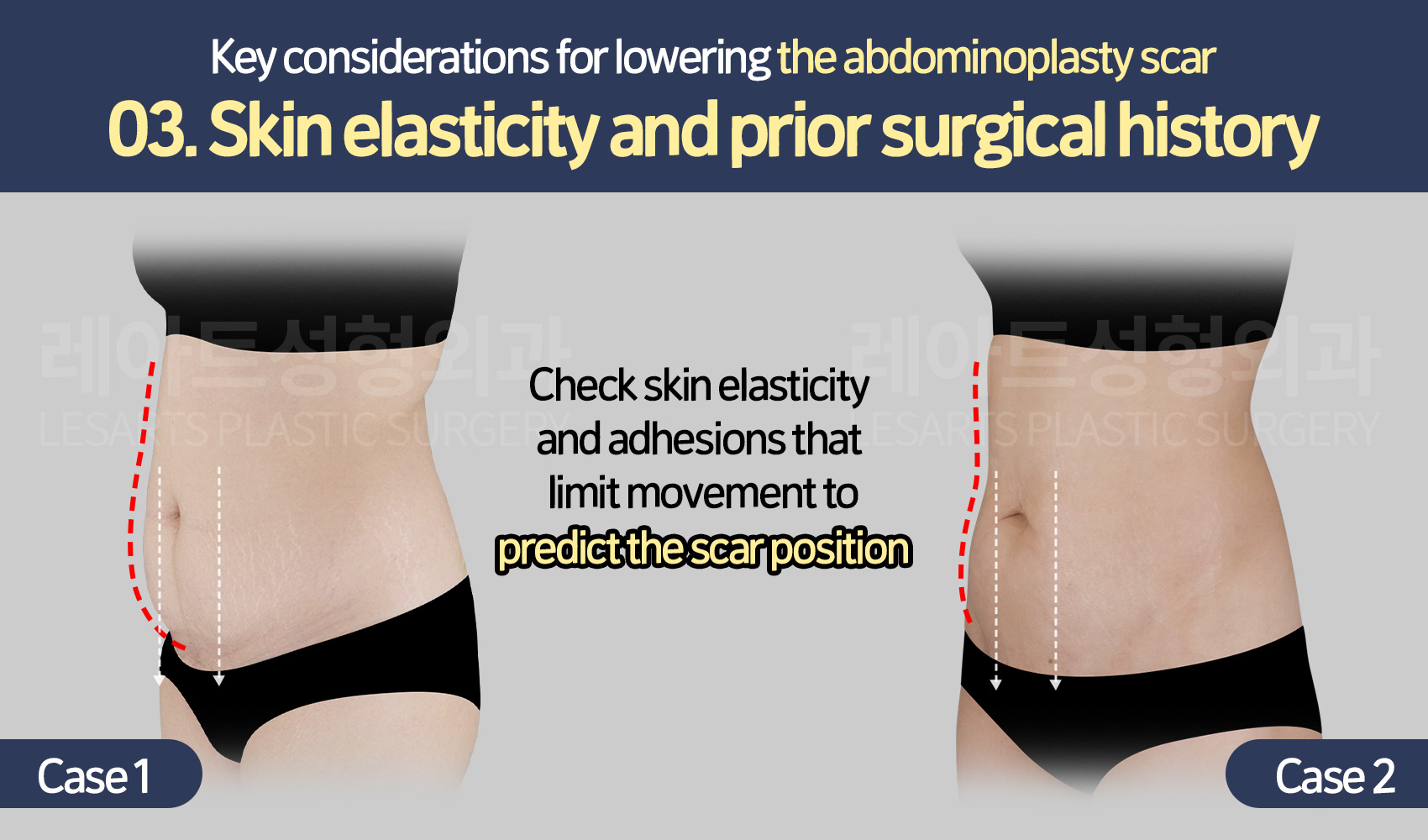
3. Dermal Elasticity and Prior Abdominal Surgery History
Abdominal skin elasticity plays a vital role
in determining final scar positioning.
Even when two patients present with seemingly identical degrees of skin laxity,
actual tissue stretch and mechanical recoil capacity
vary significantly between individuals.
Pre-operative assessments may project generous tissue descent,
yet intra-operative findings can reveal stiffer tissue recoil
or limited inferior gliding.
Consequently, rather than forcing aggressive skin tension pre-operatively to lower the scar,
the primary rule is operating safely within limits
that guarantee tension-free wound closure.
Conversely, if intra-operative tissue laxity permits greater mobilization than expected,
the surgeon can excise redundant margins further
to adjust and position the incision line slightly lower.
A history of prior abdominal surgeries must also be reviewed thoroughly.
Previous procedures such as abdominal liposuction, revision abdominoplasty,
or open visceral surgeries often leave behind dense internal fibrotic adhesions.
Such adhesions restrict tissue glide,
impeding inferior skin advancement during upper abdominal mobilization
and directly impacting anticipated scar height.
Therefore, comprehensive consultation requires cataloging prior surgical history,
evaluating existing scars, and assessing adhesion potential
to accurately predict true skin mobility.
[Abdominoplasty Scars Do Not Sit at an Identical Height for Everyone]
Even when two patients undergo the exact same Type M full abdominoplasty,
the vertical height of the final scar can differ.
An individual with abundant, mobile epigastric skin laxity may achieve a noticeably lower scar than projected;
conversely, a patient with limited skin redundancy, stiff tissue recoil, or internal scarring may rest at a slightly higher elevation.
Accordingly, guaranteeing a fixed scar height pre-operatively
or promising guaranteed concealment beneath underwear for every single patient is clinically unfeasible.
The definitive principle is accurately diagnosing current skin laxity, tissue glide, and surgical history,
and executing the safest possible technique within those parameters.
Whether prioritizing epigastric correction or maintaining a low incision line
will also shape the surgical strategy.
If you are considering an abdominoplasty, ensure you receive a thorough explanation
covering expected incision placement and length, alongside upper and lower abdominal correction ranges,
to determine the precise plan tailored to your anatomical profile.
Abdominoplasty Scar FAQ
1. Can an abdominoplasty scar always be placed entirely beneath underwear?
While incisions are designed low to facilitate concealment, the actual vertical height of the scar
varies based on skin laxity, tissue mobility, and the volume of tissue requiring excision.
2. Does a full abdominoplasty leave a higher scar than a mini tummy tuck?
Not necessarily. When upper abdominal skin mobilizes adequately,
a full abdominoplasty can achieve a remarkably low incision line.
Limited skin elasticity, however, can elevate scar positioning.
3. Does placing the scar lower compromise upper abdominal correction?
Attempting to keep the scar exceptionally low when supraumbilical skin redundancy is scarce
can leave epigastric laxity under-corrected.
Balancing correction scope against scar placement priorities is essential.
4. Does prior abdominal liposuction affect scar placement?
Prior liposuction can create internal fibrotic adhesions that restrict skin mobility.
Evaluating previous extraction boundaries and adhesion status pre-operatively is vital when projecting scar placement.
5. Can I know my exact scar position during consultation?
Pre-operative examination allows for an accurate projected placement,
though true tissue glide is confirmed intra-operatively.
Final incision positioning is determined to ensure safe tissue mobilization and tension-free closure.
Dr. Kukhan Lee


Cases finding
similar to my profile
Customer Diagnostics


Select the surgery and
area you are interestedto see real
before andafter changes.


we
make you,
the art
Clinic hours
MON - FRI
10 am – 7pm
SAT
10 am – 4pm
Holiday
SUN, HOLIDAY
Location
Lesarts Moon Clinic Tower 4-5F, 40, Nonhyeon-ro 168-gil,
Gangnam-gu, Seoul, Republic of Korea

Medical institution name Lesarts Plastic Surgery
Address Lesarts Moon Clinic Tower 4-5F, 40, Nonhyeon-ro 168-gil, Gangnam-gu, Seoul, Republic of Korea
Representative Moon sung jun
