




Online Consultation
Please accurately enter the information below.
Quick Cost Consultation
Quick Consultation & Reservation
Cases finding
similar to my profile






Doctor's Note
Medical columns by our surgeons
Thigh Liposuction & Hip Dip Fat Grafting | Square-Shaped Hips... What Causes Them? Body Contouring Solutions to Transform Boxy Hips into Round Curves
2026-08-06
Thigh Liposuction & Hip Dip Fat Grafting | Square-Shaped Hips... What Causes Them? Body Contouring Solutions to Transform Boxy Hips into Round Curves
Q. What causes hips to appear square or boxy regardless of body weight,
and how can combining thigh/upper panty line liposuction with hip dip fat grafting create a smooth, rounded hip contour?
A. Boxy hips result from a combination of depressed hip dip volume, protruding upper panty line fat,
and lateral saddlebag bulges. Correction is achieved by sculpting away redundant fat and filling
the hollow pelvic hollows to rebalance lower-body proportions.
Learn More About Lesarts Plastic Surgery [ Hip Dip (Pelvic) Fat Grafting & Thigh Liposuction]
Even without carrying high overall body weight,
some individuals present with flat, boxy, or square-shaped buttock contours
resembling a loaf of bread when viewed from behind.
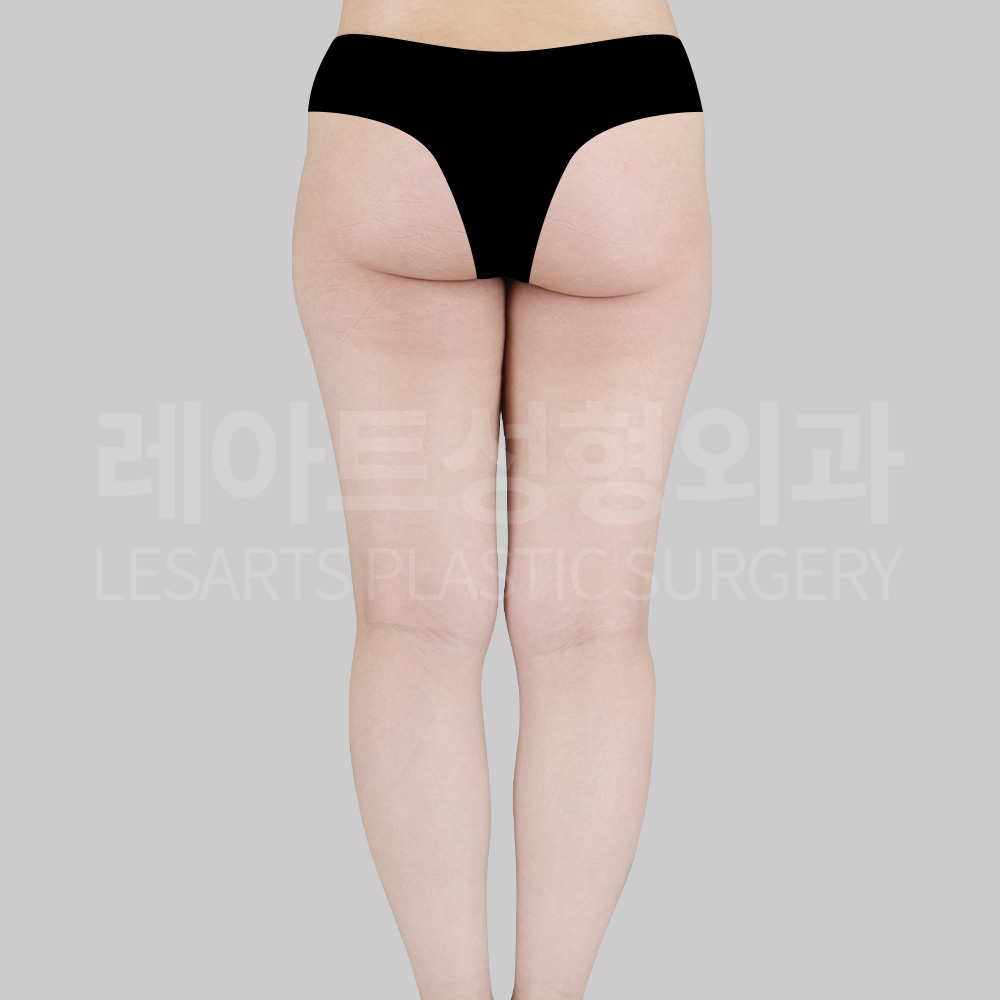
Posterior View of Hip Line Before Thigh Liposuction
In this square-shaped body type in particular:
- Outer thigh saddlebags appear thick and bulging,
- Subcutaneous fat over the upper panty line protrudes outward,
- The upper pole of the buttocks relatively lacks projection,
- And the visual starting point of the legs drops lower, making legs appear shorter than they actually are.
In such structural profiles, simple dietary weight loss or focused glute workouts
have definitive limitations in transforming the underlying silhouette in the vast majority of cases.
Consequently, a customized approach that simultaneously performs outer thigh liposuction and upper panty line liposuction
to slim down lateral thigh contours,
while transferring autologous fat into the hip dip depressions to restore lateral pelvic volume,
is widely utilized to dramatically enhance lower-body balance and proportions.
Rather than merely extracting stubborn fat cells,
this approach is more accurately defined as an anatomical re-sculpting and repositioning of lower-body contours.
1. Why Do Hips Look Square and Boxy?
From the posterior perspective, the ideal aesthetic hip silhouette exhibits
soft, feminine lateral pelvic curves that taper naturally
downward into a smooth, rounded contour.
However, when the following anatomical factors overlap,
the hips take on a flattened, broad, and boxy rectangular appearance:
1). Volume Deficiency Above the Hip Joints & Hip Dips
The lateral pelvic area around the greater trochanter should form a continuous, flowing curve created by muscle and subcutaneous fat.
When soft tissue volume is deficient here, lateral depressions (hip dips) form,
rendering the entire buttock silhouette harsh, hollow, and rectangular.
2). Protrusion of Upper Panty Line Subcutaneous Fat
Between the upper gluteal region and the lower flank sits
the anatomical zone often termed the upper panty line. When excess adipose tissue accumulates here,
the upper buttock pole becomes bulky, blurring the tapered demarcation between waist and hips,
and causing the buttocks to appear horizontally spread out and flattened.
3). Outer Thigh Saddlebag Fat Accumulation
When fat deposits localize along the lateral upper thighs (saddlebags),
the outer thighs bulge outward,
widening the lower horizontal baseline of the hips
and cementing a blocky, square lower silhouette.
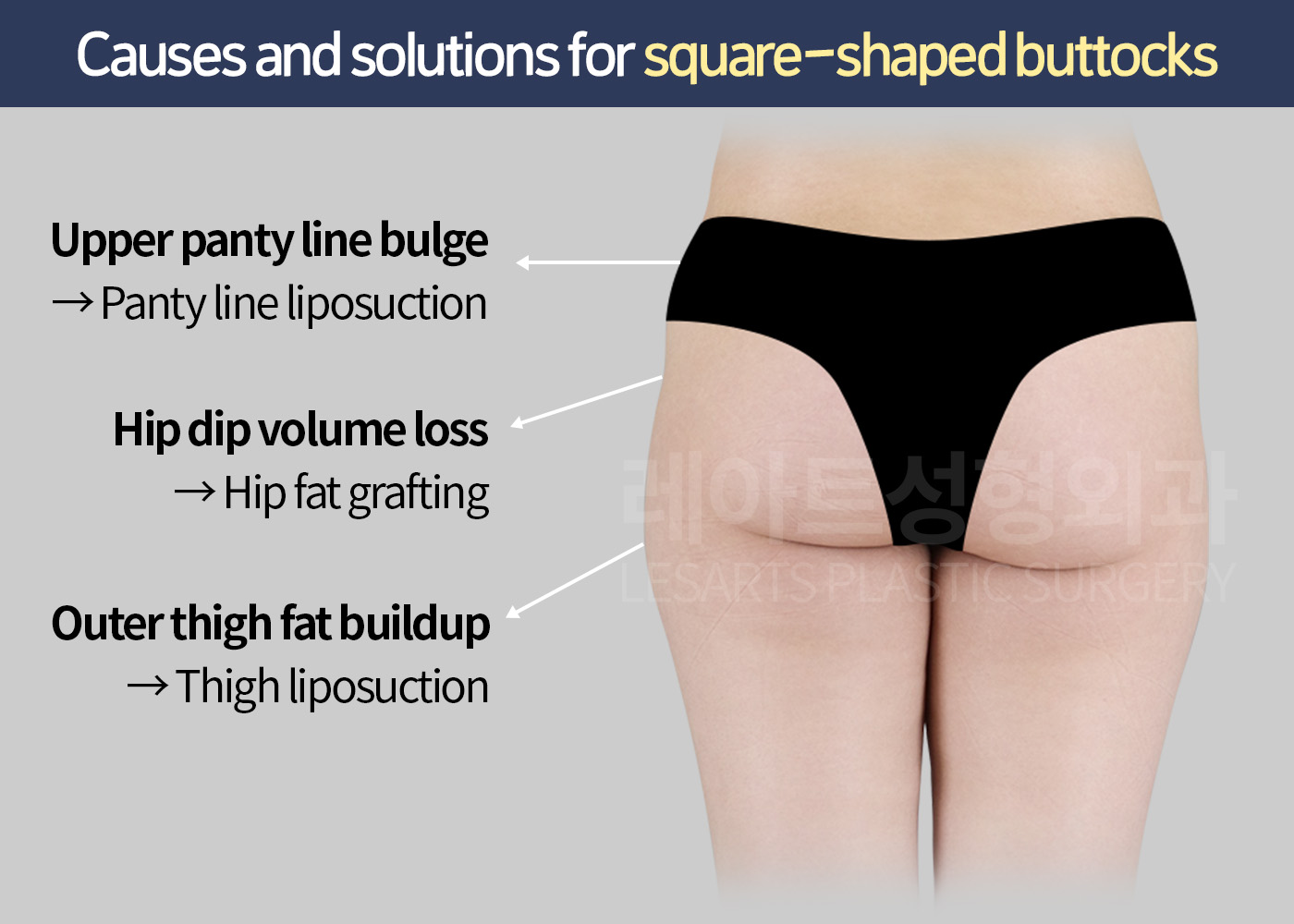
2. Core Surgical Design Plan to Refine Lower-Body Silhouettes
In this boxy hip profile, rather than simply projecting volume into the central gluteal region,
a comprehensive 3-dimensional approach that reconstructs the entire lower-body frame is vital.
1). Thigh Liposuction
Smoothly sculpting the lateral saddlebags and posterior upper thighs
narrows the horizontal width of the outer thighs and creates a seamless transition below the buttocks.
Refining the lateral thighs creates an optical illusion that makes the pelvis appear comparatively wider and more hourglass-shaped.
2). Upper Panty Line Liposuction
Precisely resecting the redundant fat that adds bulk to the upper gluteal zone
clarifies the pinched waist-to-hip transition line,
lightening the upper pole
and allowing the overall gluteal profile to appear lifted, round, and three-dimensional.
3). Hip Dip Fat Grafting
Autologous fat grafting is not focused on inflating the central gluteal bulk, but rather on
precisely filling the lateral hollows along the hip dips
to establish a smooth, continuous pelvic contour,
supporting the upper buttock pole
to complete an ideal, rounded feminine curve.
3. Why Legs Appear Visually Longer
Combining thigh liposuction with hip dip fat grafting
yields remarkable visual proportion improvements that extend far beyond numerical fat reduction.
Narrowing outer thigh width, accentuating lateral pelvic curves, and elevating upper hip volume
work synergistically to create a powerful effect:
the visual origin of the buttocks is shifted superiorly,
making the legs appear dramatically longer, straighter, and more athletic.
4. Why Moderate Weight Loss Enhances Post-Op Results
During body contouring consultations, patients frequently ask:
“If I lose weight after hip dip fat grafting,
won't all the transferred fat volume melt away?”
To answer directly:
aside from the initial 2-month post-op recovery period when transplanted fat cells establish vascularity,
moderate weight loss thereafter does not adversely affect retained fat volume.
Establishing clear, balanced body contours through surgery
and subsequently refining them through systematic weight management and exercise
is the most effective way to preserve long-term, sculpted hip aesthetics.
[Clinical Case Study: Sculpting Rounded Hips]
Patient Profile: 164 cm / 63.7 kg
Goals: Desired circumferential thigh reduction,
specifically citing heavy saddlebags and a blocky, square hip line as primary concerns.
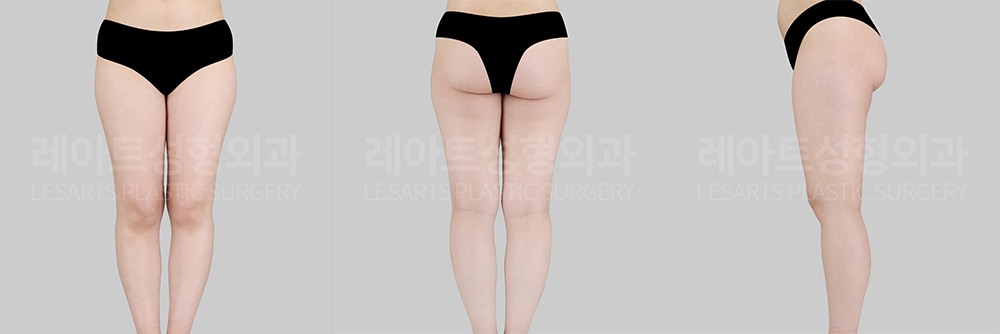
[Pre-Op Body Contour Assessment]
Substantial subcutaneous fat accumulation throughout the thighs,
accompanied by pronounced lateral hip dip hollows and upper panty line bulging,
indicated a clear need for structural correction of the square gluteal profile.
Tailored Surgical Plan: Full thigh liposuction, upper panty line liposuction, and concurrent hip dip autologous fat grafting.
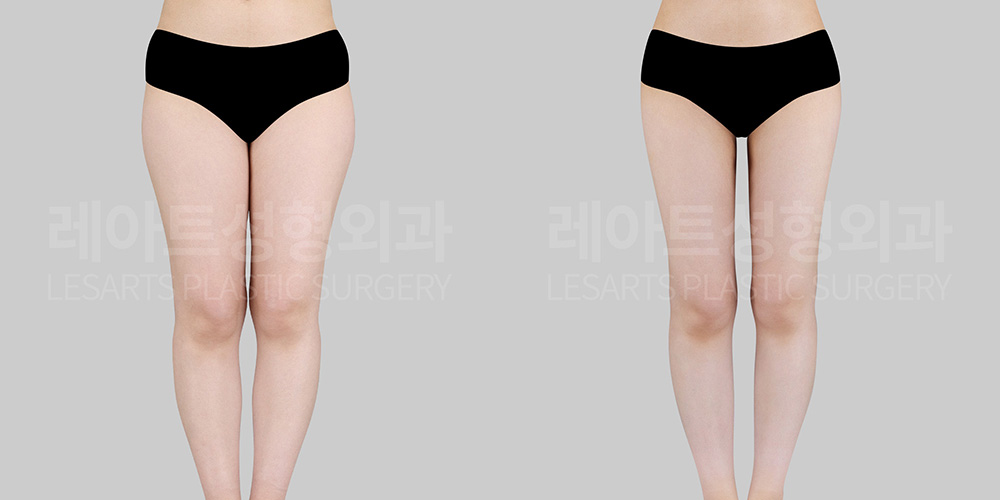
[5 Months Post-Op: Liposuction & Hip Dip Fat Grafting Results]
An aesthetically pleasing buttock contour is not determined by gluteal volume in isolation;
it is a 3-dimensional harmony between the pelvic frame, thigh contours, and subcutaneous fat distribution.
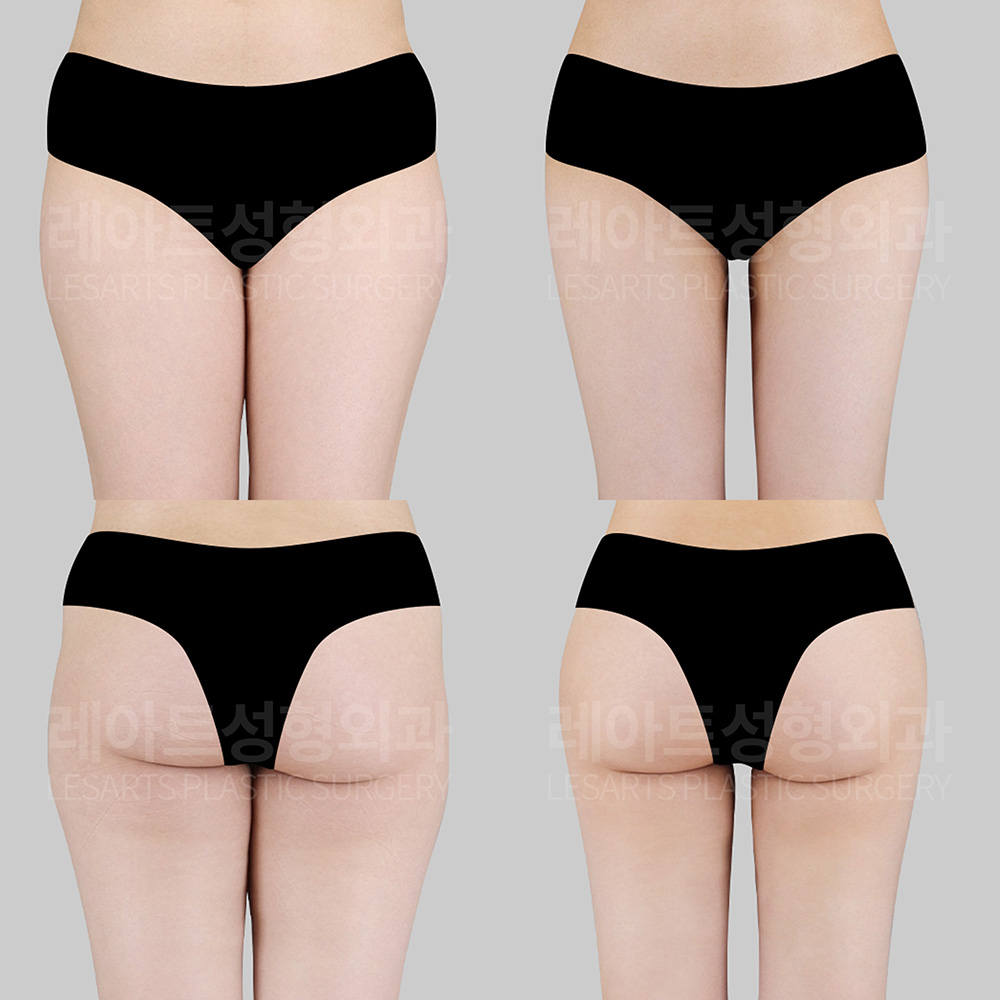
Therefore, correcting a horizontally flattened, boxy hip contour into a round profile requires:
- Slimming both the lateral and medial thigh contours,
- Flattening and debulking the upper panty line fat deposit,
- And filling the lateral hip dip hollows with autologous fat.
A comprehensive, tailor-made surgical design addressing the entire lower extremity is indispensable.

Before & After Thigh Liposuction - Lesarts Plastic Surgery
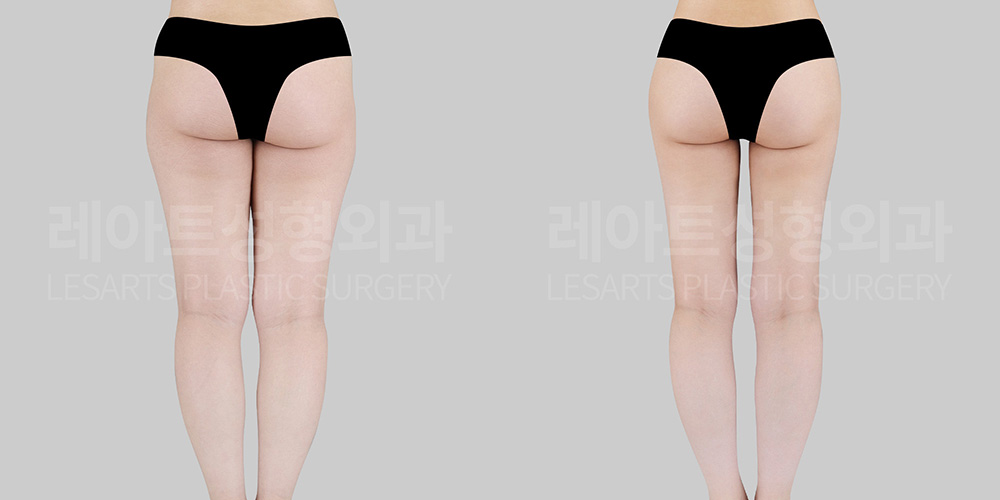
Correcting Buttock Shape with Liposuction & Fat Grafting - Dr. Pyongrim Choi
Through this meticulous restructuring,
the previously flat and horizontally spread-out posterior silhouette
transforms into a rounded, balanced, and sculpted hourglass contour,
achieving an ideal lower-body proportion where legs appear significantly leaner and longer.
Maintaining personalized weight management and exercise after surgery
ensures that these refined body lines remain defined and enduring over the long term.
FAQ
Q1. What anatomical factors make hips appear square and wide even at normal body weights?
A. A lack of soft tissue volume over the lateral hip dips, protruding subcutaneous fat along the upper panty line,
and lateral saddlebag accumulation on the thighs together blur waist-to-hip definition, giving the buttocks a wide, boxy appearance.
Q2. Why is upper panty line liposuction essential when correcting a boxy hip silhouette?
A. Fat accumulating between the upper glutes and lower waist makes the top of the hips look thick and heavy.
Removing this deposit restores a clear distinction between waist and hips, creating a lighter, lifted, and rounded gluteal profile.
Q3. Why does combining thigh liposuction with hip dip fat grafting make legs appear longer?
A. Narrowing the horizontal width of the outer thighs while filling the lateral hip hollows and upper hip pole
elevates the visual starting point of the buttocks, creating an optical lengthening effect throughout the entire leg.
Q4. Will losing weight or dieting after hip dip fat grafting cause all the transferred volume to disappear?
A. No. After the initial 2-month engraftment window, moderate weight loss
does not significantly diminish surviving fat cells. In fact, healthy weight management
helps accentuate the sculpted lines created during surgery.
Q5. How does comprehensive lower-body line repositioning differ from merely injecting volume into the center of the buttocks?
A. Rather than simply enlarging gluteal projection, it combines thigh narrowing, upper panty line debulking,
and lateral hip contouring to naturally harmonize the entire 3D silhouette from waist to pelvis and thighs.
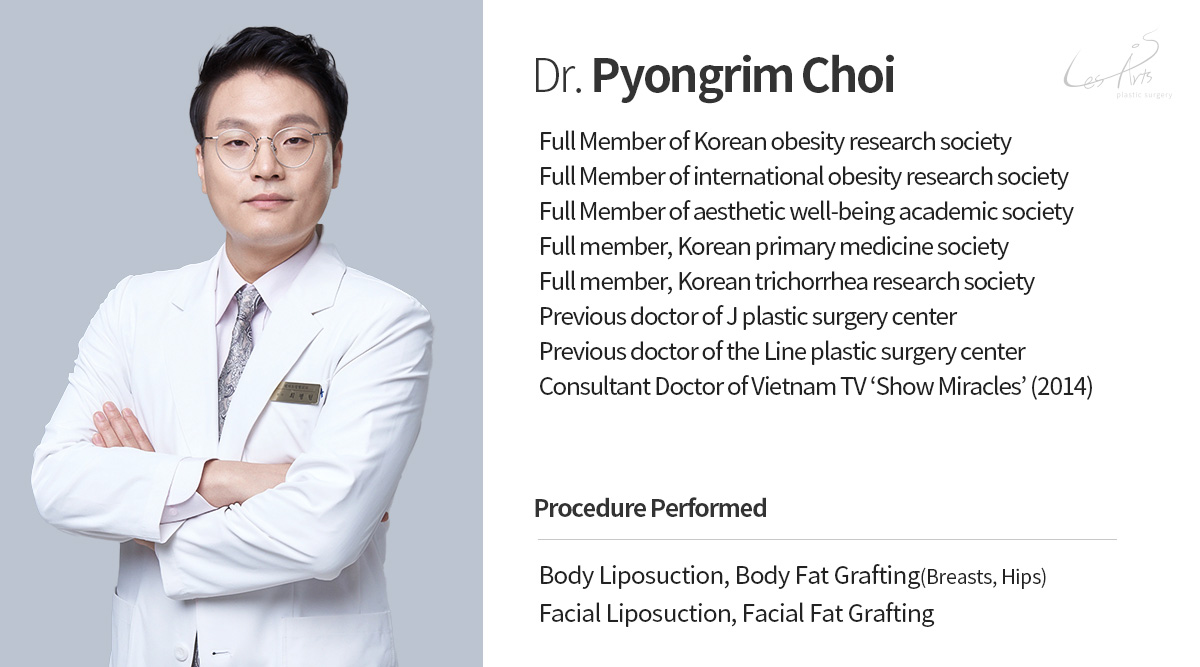
Dr. Pyongrim Choi


Cases finding
similar to my profile
Customer Diagnostics


Select the surgery and
area you are interestedto see real
before andafter changes.


we
make you,
the art
Clinic hours
MON - FRI
10 am – 7pm
SAT
10 am – 4pm
Holiday
SUN, HOLIDAY
Location
Lesarts Moon Clinic Tower 4-5F, 40, Nonhyeon-ro 168-gil,
Gangnam-gu, Seoul, Republic of Korea

Medical institution name Lesarts Plastic Surgery
Address Lesarts Moon Clinic Tower 4-5F, 40, Nonhyeon-ro 168-gil, Gangnam-gu, Seoul, Republic of Korea
Representative Moon sung jun
