




Online Consultation
Please accurately enter the information below.
Quick Cost Consultation
Quick Consultation & Reservation
Cases finding
similar to my profile






Doctor's Note
Medical columns by our surgeons
Arm Liposuction | Straight Arm Lines & Right-Angle Shoulders, 3-Month Changes Accounting for Muscle Anatomy [Doctor's Note by Dr. Pyongrim Choi]
2026-08-07
Arm Liposuction | Straight Arm Lines & Right-Angle Shoulders, 3-Month Changes Accounting for Muscle Anatomy [Doctor's Note by Dr. Pyongrim Choi]
Does removing more fat during arm liposuction always result in slimmer arms?
Arm liposuction is not simply a procedure to remove the maximum volume of fat.
A natural, sleek straight arm line can only be achieved
by reducing bulk while preserving necessary fat layers,
taking into account shoulder and posterior arm muscle contours, skin elasticity, and dynamic movement.
▶ Learn More About Lesarts Arm Liposuction
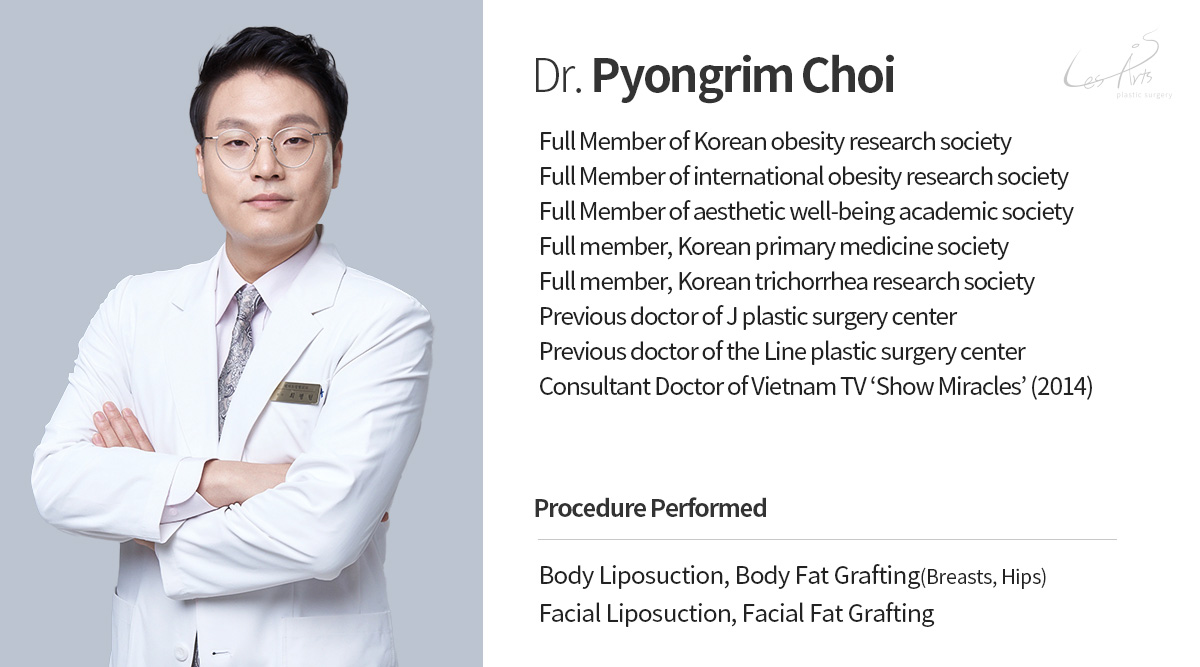
Hello, I am Dr. Pyongrim Choi, Board-Certified Plastic Surgeon at Lesarts Plastic Surgery.
During arm liposuction consultations,
many patients request,
“Please extract as much fat as possible.”
When concerned about upper arm thickness,
it is easy to believe that aggressive fat removal alone will make the arms look slimmer.
However, indiscriminately extracting maximum fat does not guarantee
an elongated, smooth, and aesthetically pleasing arm contour.
Arm contours are shaped not only by subcutaneous fat thickness,
but also by the underlying contours of the shoulder and arm musculature.
Excessive fat extraction can overly expose muscle boundaries
or create unnatural angular indentations, moving further away from the desired straight arm line.
Therefore, when planning arm liposuction,
it is essential to evaluate both the position of underlying muscles and the distribution of adipose tissue.
In this article, I will explain the anatomical criteria for selectively removing and preserving fat,
as well as the arm contour changes confirmed at 3 months post-op.
▶ View More Arm Liposuction Before & After Cases
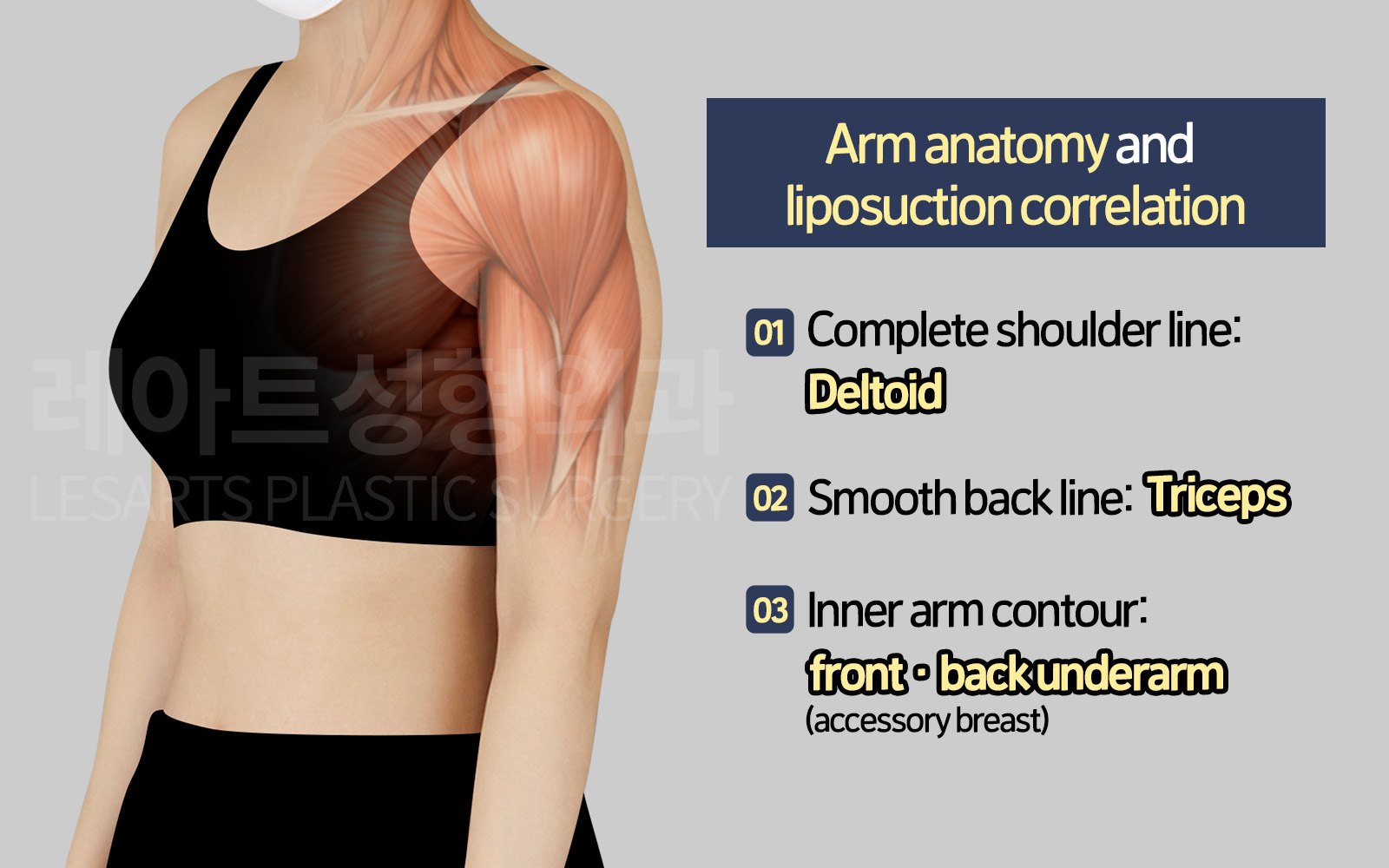
[Anatomical Factors to Consider for a Natural Arm Silhouette]
1. Correlation Between Arm Anatomy and Liposuction
Not all causes of thick-looking arms are the same.
Even with comparable volumes of subcutaneous fat,
the post-op outcome can differ significantly between someone with well-developed shoulder muscles
and someone with prominent posterior arm musculature.
Therefore, before arm liposuction, it is crucial not just to assess fat volume,
but to examine how the deltoid, triceps, and surrounding axillary muscles
transition into one another.
1) The Deltoid Muscle: Defining the Origin of the Arm
The deltoid muscle wraps around the shoulder, determining the starting point of the arm
and the overall shape of the shoulder.
If thick fat remains around the deltoid,
the shoulders can appear rounded and broad.
However, excessively stripping away the fat in this area
is not recommended.
Exposing the muscular borders too starkly
or creating a steep step-off between the shoulder and arm
can leave the arm looking flat, gaunt, and lacking vitality.
Thus, smoothly blending the transition from the lower deltoid
into the upper arm is essential to ensure that the arm drops
naturally and cleanly from below the shoulder.
Keep in mind that right-angle shoulders are influenced not only by fat thickness,
but also by clavicular/scapular skeletal structure and muscle size.
The degree of achievable change can vary
depending on your individual framework.
2) The Triceps Muscle: Shaping the Posterior Arm Line
The sagging flab that hangs downward when extending the arm laterally
is closely tied to posterior arm fat deposits.
Skin in this zone is relatively thin and prone to losing elasticity,
requiring precise calibration of both extraction depth and volume.
Blindly resecting all posterior fat can overly pronounce the triceps shape,
making the arm look bowed, curved,
or excessively muscular.
Conversely, leaving behind too much fat will fail to sufficiently reduce
the posterior bulging thickness when arms rest naturally at the sides.
Therefore, the surgical plan must trim away the bulky adipose tissue while
preserving a delicate, continuous fat layer along the triceps border
to create a straight, seamless flow from shoulder to elbow.
3) Why Axillary and Accessory Breast Areas Must Be Evaluated Together
Anatomical areas just as critical as the arm itself in arm liposuction
are the axilla (armpit) and accessory breast areas.
If excess fat remains where the arm connects to the torso,
fat can bulge outward beside the armpit when resting the arms,
making the arm root appear wide and bulky.
Thinning only the arm while neglecting the accessory breast and axillary folds
can result in an awkward, disconnected transition between treated and untreated areas.
Thus, based on fat distribution, the full arm, accessory breast,
and axillary zone should be viewed as one unified contour line
when designing the surgical scope.
When these surrounding areas are smoothly contoured,
the demarcation between the arm and torso becomes well-defined when arms are lowered,
making the upper body width appear distinctly lighter and more slender.
2. Key Principles for Natural Arm Liposuction Results
Arm liposuction success cannot be judged solely by
the total volume of aspirated fat.
The procedure must retain an optimal layer of fat tailored to muscle and skin conditions,
ensuring natural appearance even through dynamic arm motions.
The following three factors must be accounted for:
1) Uniform Fat Layer Sculpting
Arm fat is not composed of a single, simple layer.
Because deep fat near the muscle and superficial fat under the dermis coexist,
irregular or uneven extraction can lead to surface depressions and skin dimpling.
To reveal muscle lines softly and naturally,
the subdermal fat directly under the skin must also be evenly leveled.
The surgeon must evaluate continuous balance throughout the entire arm,
avoiding localized over-resection or uneven residual thickness.
2) Skin Elasticity and Post-Op Retraction
Arm skin is comparatively thin relative to other body areas.
If there is significant fat volume with diminished skin elasticity,
one must anticipate the risk of residual skin laxity or wrinkling after fat removal.
During surgery, delicate mechanical stimulation is applied during suctioning
to encourage optimal skin retraction along the newly contoured arm framework.
3) Dynamic Contour Changes with Arm Movement
Arms are in constant motion—bending, extending, and lifting—
rather than remaining static at the sides.
Even if the arm looks natural in an anatomical resting stance, patient satisfaction will drop
if muscle boundaries look excessively harsh or skin folds awkwardly when abducted.
Therefore, preoperative planning must assess fat and muscle dynamics
both with arms resting down and when abducted and flexed.
Only by anticipating muscle contraction and relaxation can we produce an arm line
that looks effortless and natural throughout everyday movements.
Actual skin retraction varies depending on age, baseline elasticity, and weight history,
making realistic preoperative assessment of potential outcomes and limitations vital.
[Clinical Case Study: Arm Liposuction]
Age: 30
Height: 160 cm
Weight: 51 kg
The patient's greatest aesthetic concern was the posterior arm bulge,
and she desired maximum safe fat reduction within anatomical limits.
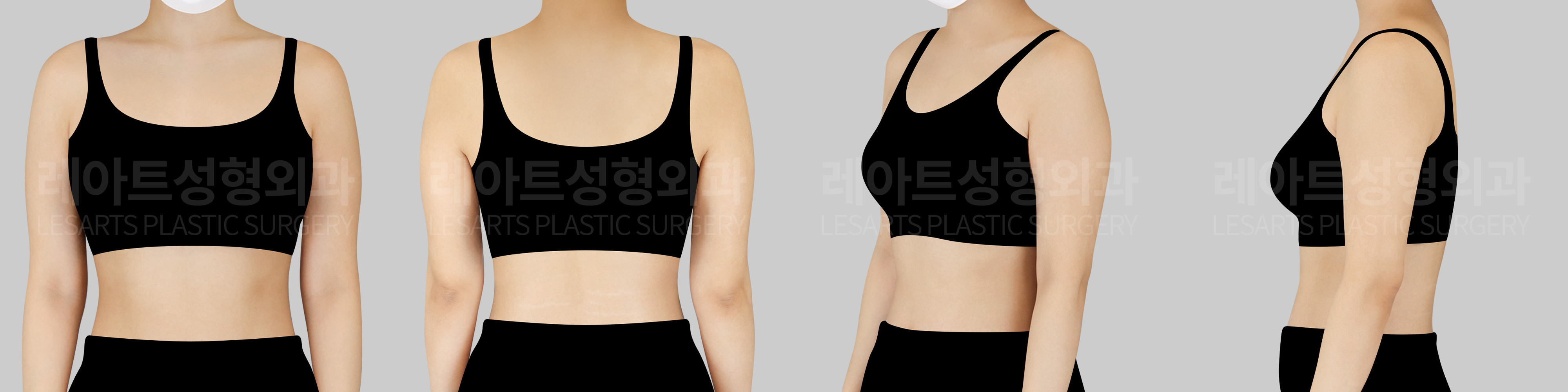
[Pre-Op Assessment: Posterior Arm, Accessory Breast, and Axillary Area]
In the preoperative photos, the area directly beneath the shoulder line
bulged outward with a rounded contour.
Posterior arm fat made the anteroposterior thickness appear heavy,
with additional fat deposits noted along the accessory breast and axillary folds.
Resting arms against the body pushed axillary fat outward,
giving the arms and upper torso an overall bulky silhouette.
The patient sought to reduce posterior arm thickness significantly
while creating a clean straight arm line flowing effortlessly from shoulder to elbow.
Surgical Plan Accounting for Muscular Contours
To achieve the desired thickness reduction,
substantial fat extraction from the posterior and lateral arm zones was required.
However, focusing solely on aggressive removal risked overexposing the triceps borders,
which could cause the arm to look curved or bowed.
Thus, we planned to debulk the fat responsible for thickness while preserving an optimal layer
over the muscle margins to maintain a smooth, straight contour.
Simultaneously contouring the accessory breast and axillary areas ensured
a seamless transition from the arm root into the torso.
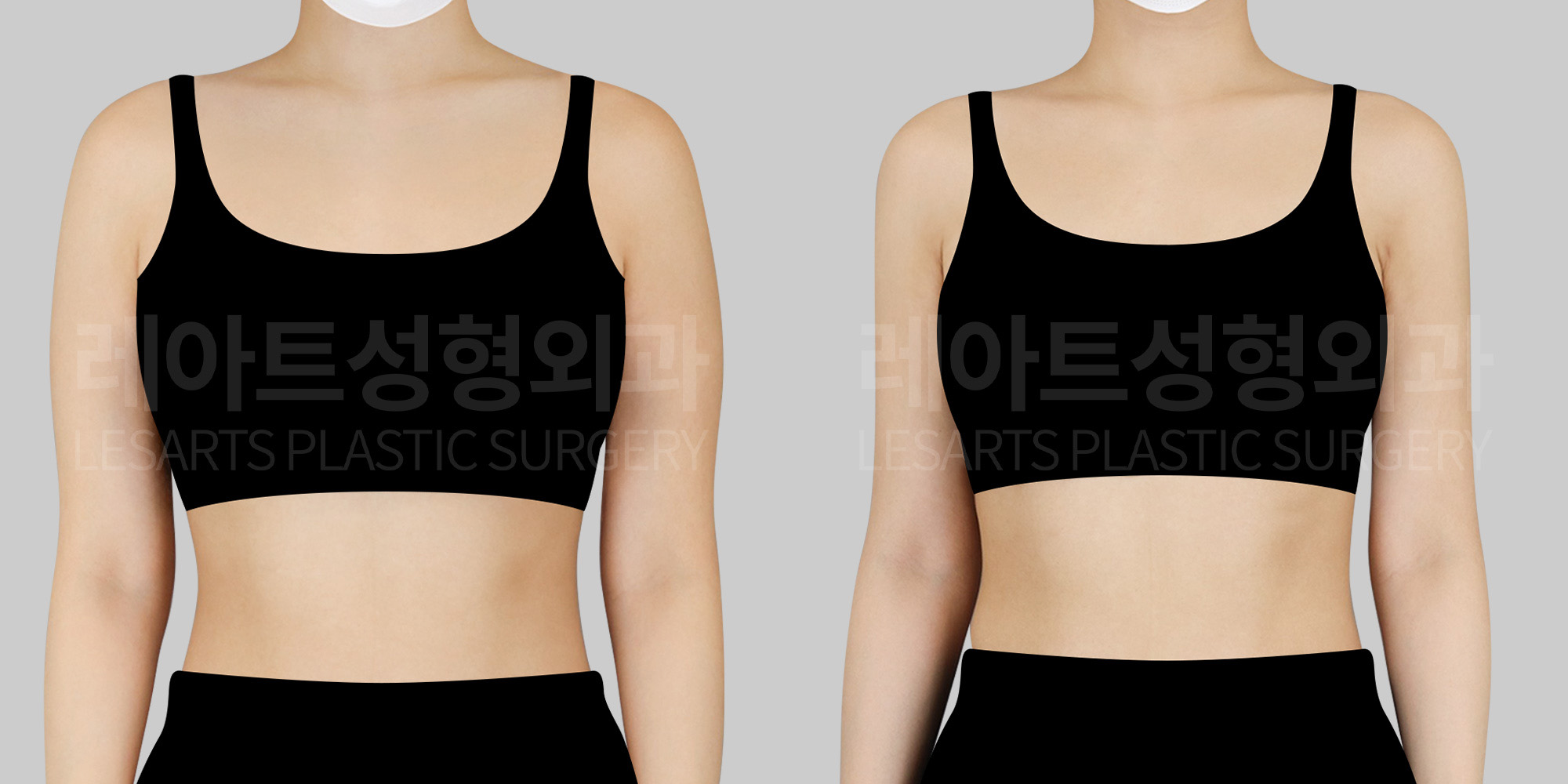
[Before & After Comparison: Frontal View of Arm & Shoulder Line]
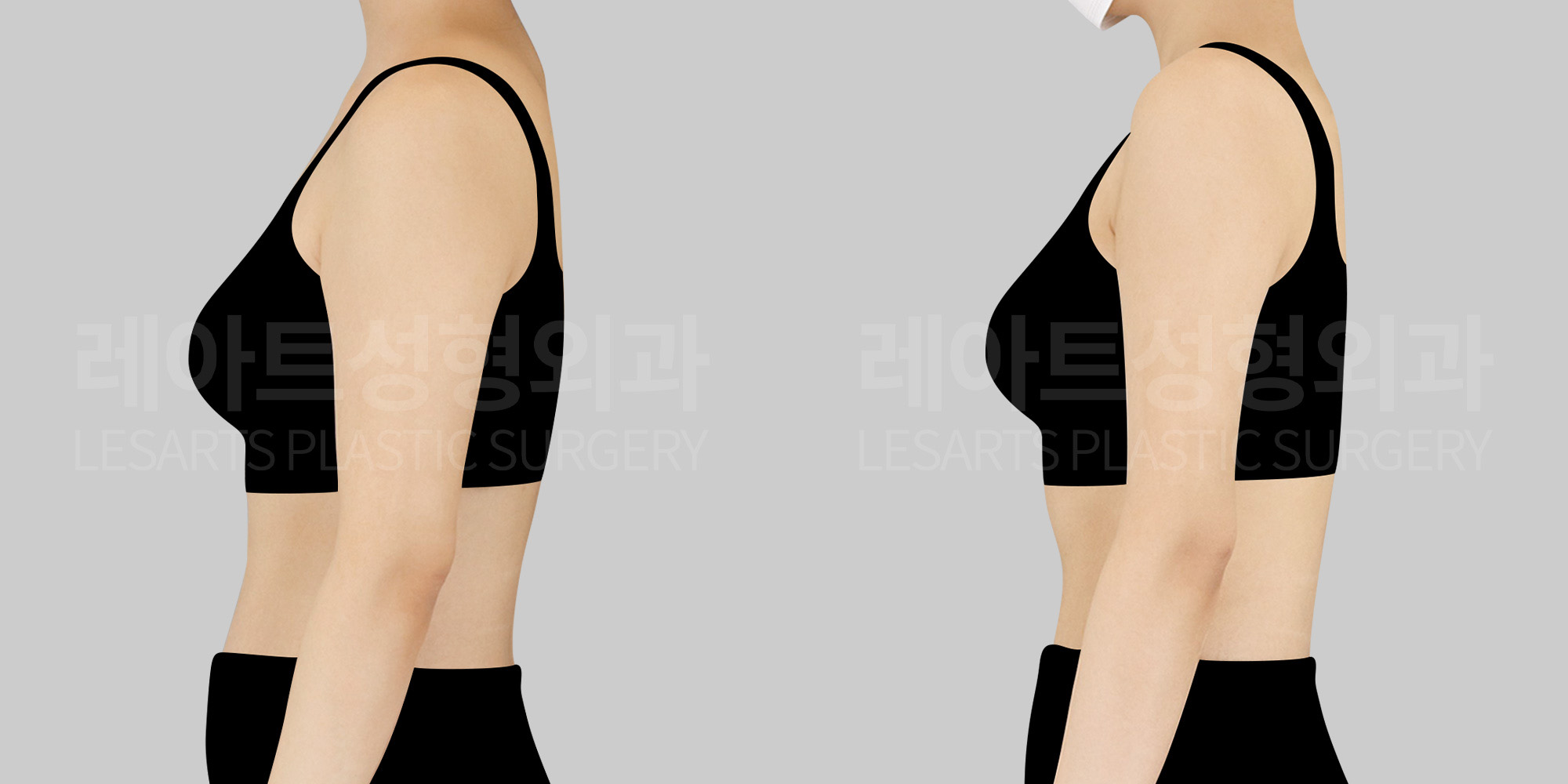
[Sculpting a Straight Arm Line]
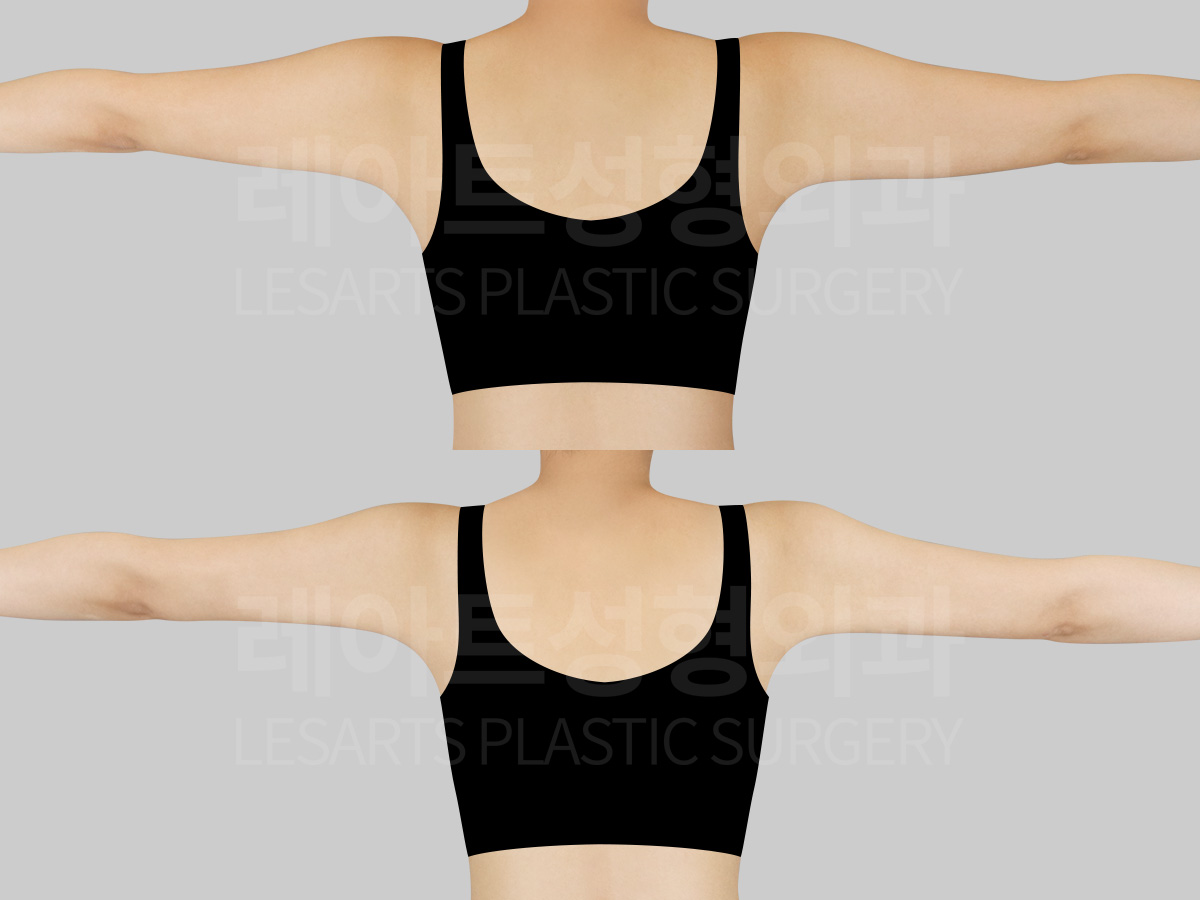
[Post-Op Muscle Contour Comparison with Arms Abducted]
At 3 months post-op, the lateral fullness that previously bulged below the shoulder has been eliminated,
revealing a clean, straight line extending from shoulder to elbow.
When resting arms naturally, the outward flaring width along the flanks
has significantly narrowed.
With arm thickness, accessory breast, and axillary fullness treated concurrently,
the entire upper body silhouette appears far lighter and sleeker than before.
With arms abducted, the benefits of anatomically balanced suctioning become clear.
Before surgery, drooping posterior fat accentuated lower arm laxity.
Post-op, as dependent volume was excised,
the posterior arm line tightened into a firm, cohesive profile.
Triceps definitions emerge naturally
without harsh, over-skeletonized borders,
preventing any bowed or overly muscular appearance.

[Arm Liposuction Before & After Differences]
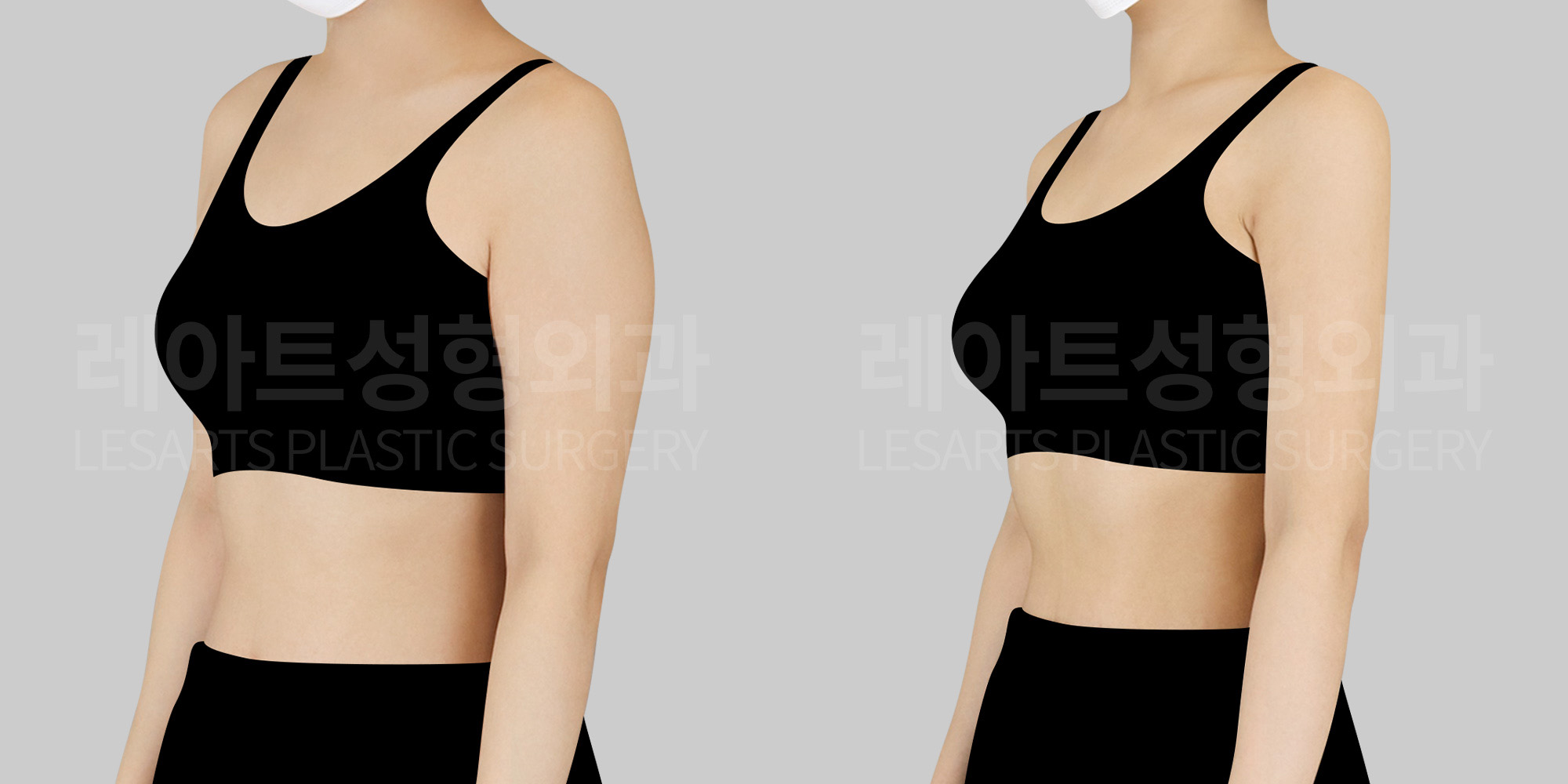
[Reduction of Posterior Arm Bulging with Liposuction]
From the lateral profile, debulking the posterior bulge
dramatically streamlined anteroposterior arm thickness.
The contour from the lower shoulder down to the elbow
now transitions far more smoothly.
In the posterior view, reduced arm volume and axillary contouring
allow the arms and torso to separate cleanly and naturally.
Many patients desire ultra-slender arms with near-zero residual fat after liposuction.
However, aggressive extraction of all fat does not necessarily
yield the most flattering result for every body frame.
In this case, the focus was placed on significantly reducing posterior thickness while
preserving essential fat over the triceps to create a clean straight arm line
without harsh muscular prominence.
At 3 months post-op, the bulging arm width below the shoulder narrowed,
and natural muscular curves were maintained even when abducting the arms.
With accessory breast and axillary folds treated concurrently,
the connection between arm and torso now transitions effortlessly.
In arm liposuction, what matters more than the volume removed
is knowing where to reduce and where to preserve fat,
tailored to your individual muscles, skeleton, and skin elasticity.
Excessive suctioning without regard for anatomical structures
can cause irregular skin adhesions or noticeable bilateral asymmetries.
If you desire a straight arm line and right-angle shoulders, first evaluate
the shape of your shoulder and posterior arm muscles,
as well as where your fat deposits are concentrated.
We encourage you to plan arm liposuction after thorough consultation regarding
the ideal arm line and realistic range of improvement for your body type.
▶ Check Lesarts Arm Liposuction Surgical Methods
Straight Arm & Right-Angle Shoulder Liposuction FAQ
1. Does removing more fat during arm liposuction guarantee a straight arm line?
Excessive fat extraction can overexpose muscular boundaries
or make the arm appear bent, curved, or indented.
Extraction volume must be balanced according to muscle and fat distribution.
2. Can arm liposuction create right-angle shoulders?
Contouring shoulder fat helps soften rounded, wide shoulder impressions.
However, achievable changes depend on clavicular/scapular bone structure
and deltoid muscle dimensions.
3. If I have well-developed arm muscles, should less fat be removed?
It depends on muscle size and your desired aesthetic outcome.
For a soft, feminine straight line, an optimal protective layer of fat
should be preserved over the muscular borders.
4. Should accessory breast and axillary areas be treated alongside arm liposuction?
If fat in these areas disrupts the natural transition between the arm and torso,
treating them together yields superior contour harmony.
The surgical scope is determined by your individual fat distribution.
5. Can skin become bumpy or uneven after arm liposuction?
Uneven fat extraction or irregular tissue adhesion can create surface contour irregularities.
Evenly feathering the fat layers while accounting for skin elasticity is critical.
Dr. Pyongrim Choi


Cases finding
similar to my profile
Customer Diagnostics


Select the surgery and
area you are interestedto see real
before andafter changes.


we
make you,
the art
Clinic hours
MON - FRI
10 am – 7pm
SAT
10 am – 4pm
Holiday
SUN, HOLIDAY
Location
Lesarts Moon Clinic Tower 4-5F, 40, Nonhyeon-ro 168-gil,
Gangnam-gu, Seoul, Republic of Korea

Medical institution name Lesarts Plastic Surgery
Address Lesarts Moon Clinic Tower 4-5F, 40, Nonhyeon-ro 168-gil, Gangnam-gu, Seoul, Republic of Korea
Representative Moon sung jun
