




Online Consultation
Please accurately enter the information below.
Quick Cost Consultation
Quick Consultation & Reservation
Cases finding
similar to my profile






Doctor's Note
Medical columns by our surgeons
Male Gynecomastia Surgery | Advantages and Considerations of Periareolar Incision [Doctor's Note by Dr. Kukhan Lee] - Lesarts Plastic Surgery
2026-08-07
Male Gynecomastia Surgery | Advantages and Considerations of Periareolar Incision [Doctor's Note by Dr. Kukhan Lee] - Lesarts Plastic Surgery
Why is the periareolar incision so widely utilized in gynecomastia surgery?
The periareolar incision provides optimal direct surgical access to mammary glandular tissue,
and because the incision line is placed along the natural border between the areola and surrounding skin,
the post-op scar can be naturally concealed.
However, it is critical to tailor the incision length strictly to the necessary extent,
taking into account both the areolar diameter and the scope of glandular tissue proliferation.
▶ View Clinical Cases of Male Gynecomastia Surgery
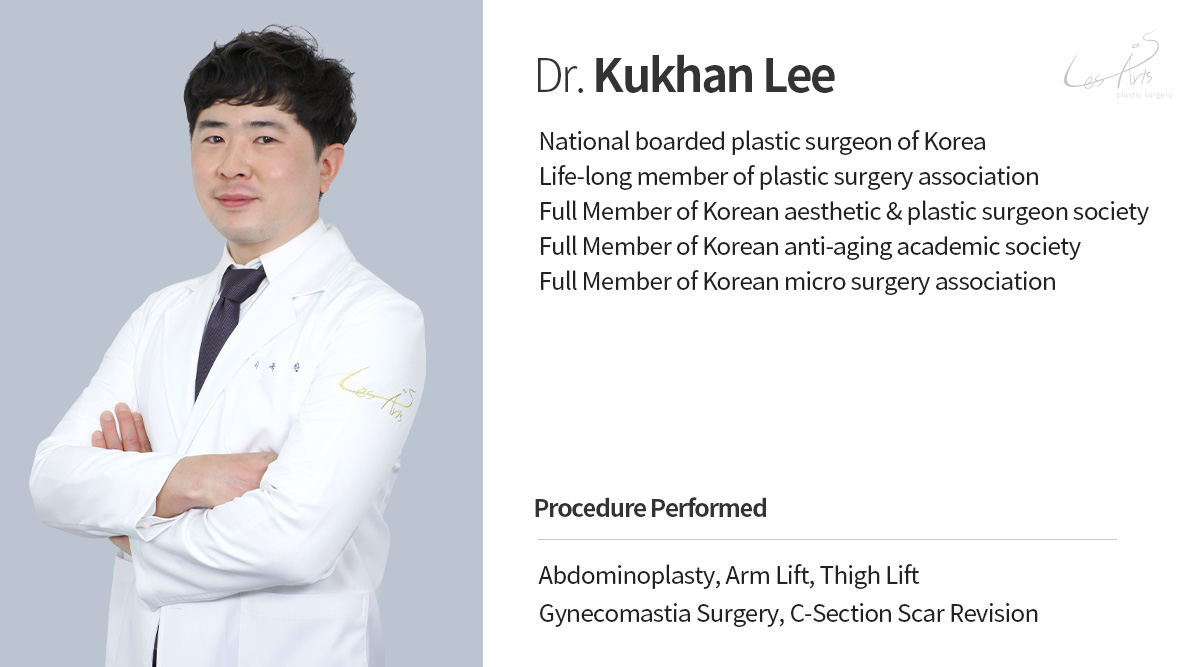
Hello, I am Dr. Kukhan Lee, Board-Certified Plastic Surgeon at Lesarts Plastic Surgery.
When preparing for gynecomastia surgery, a subject patients inquire about
just as much as chest reduction volume or contour transformation
is the incision placement.
While gynecomastia is often perceived simply as excess chest fat accumulation,
in reality, a significant number of patients present with **true gynecomastia driven by hypertrophied glandular tissue**.
When glandular breast tissue has proliferated, liposuction alone
cannot adequately resolve the focal projection of the central anterior chest.
In these cases, surgical excision of the glandular tissue
must be performed in conjunction with targeted liposuction.

[Gynecomastia Surgery Considerations]
To resect mammary glandular tissue, an additional access incision
is necessary beyond the tiny puncture points
used for cannula liposuction.
In male chest reduction surgery, a periareolar incision is the standard approach,
though transaxillary incisions may be evaluated depending on
individual chest anatomy and surgical scope.
The selection of incision placement is never based solely
on choosing the spot where scars are least visible.
The surgeon must comprehensively verify the location and extent of glandular tissue,
the volume of surrounding adipose tissue to be aspirated, and the degree of tissue redraping required.
Because glandular tissue primarily develops directly beneath the areola
and within the central anterior chest,
the **periareolar incision**, which provides direct anatomical visualization,
remains the gold-standard approach worldwide.
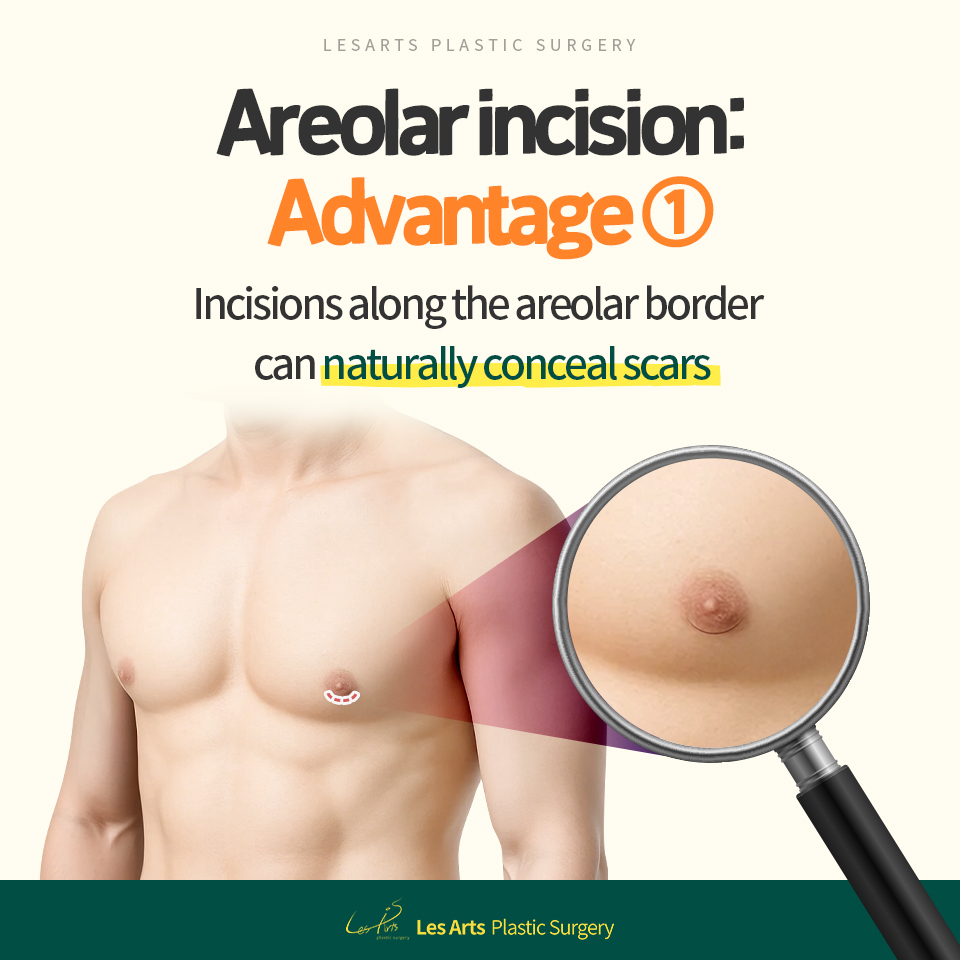
[Advantages of Periareolar Incision in Gynecomastia Surgery – Lesarts Plastic Surgery]
[Advantage of Periareolar Incision ①]
The most prominent advantage of the periareolar incision is that
the resulting scar sits in an anatomically discreet, low-visibility location.
When establishing incision lines in plastic surgery, surgeons prioritize
adequate surgical access to internal structures, while placing equal importance
on how naturally and inconspicuously the scar will blend into surrounding tissue post-recovery.
The areola exhibits a distinct transition in pigmentation and texture compared to adjacent chest skin.
Consequently, when the incision is traced along the natural border where the areola meets normal skin,
it sits directly at the junction of these two different tissue surfaces, allowing the surgical mark
to remain comparatively well-concealed.
During early recovery, the incision line may show temporary redness
or mild pigmentary settling over time;
however, the innate coloration and surface texture of the areola naturally minimize
the visibility of the scar.
In aesthetic plastic surgery, this principle is referred to as the camouflage effect.
[Selection Criteria for Gynecomastia Incision Sites – Lesarts Plastic Surgery]
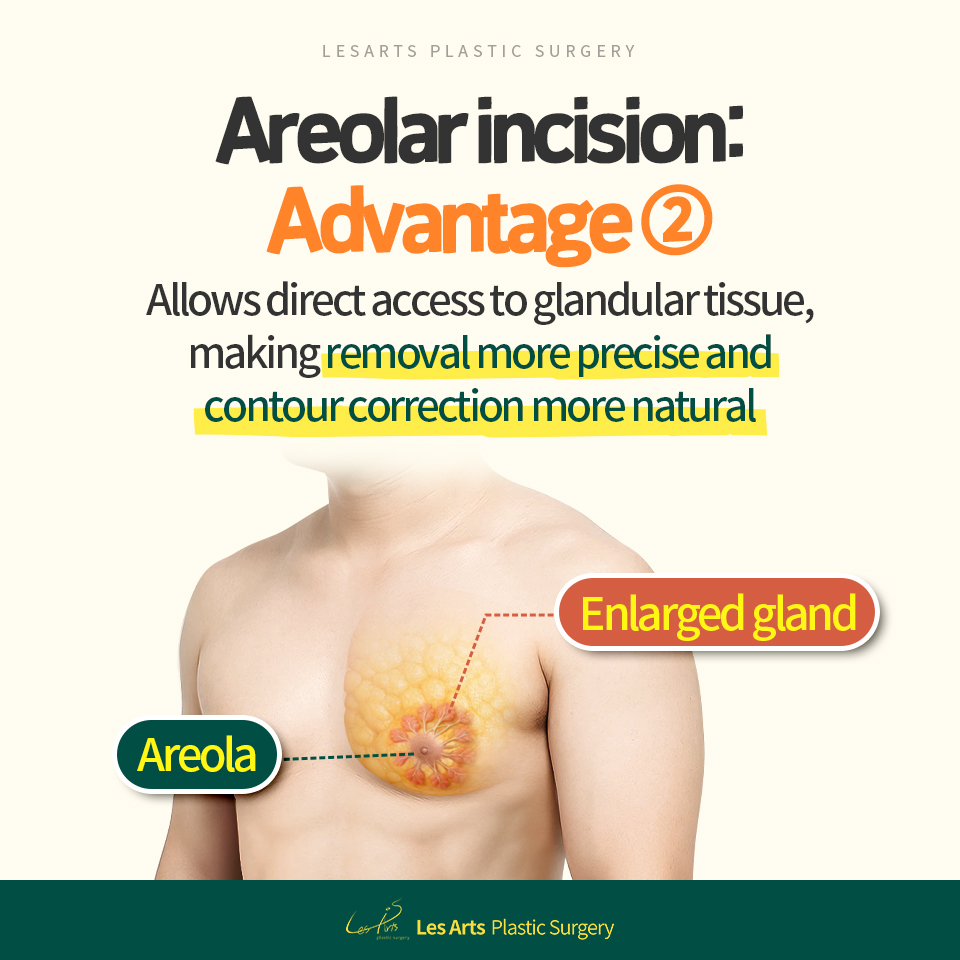
[Advantage of Periareolar Incision ②]
Another significant benefit of the periareolar incision is that
it provides direct, unhindered access to the glandular breast tissue
causing the gynecomastia deformity.
Hypertrophic glandular tissue is predominantly situated directly beneath the areolar complex.
Approaching directly through the areolar margin allows the surgeon to visualize
the precise dimensions and margins of the gland during excision,
making it exceptionally effective for eliminating central chest projection
and establishing a masculine, athletic chest contour.
Following gland excision, the residual tissue must be evenly feathered and redraped
to prevent localized saucer deformities, depression hollows, or unnatural step-offs.
Therefore, the incision site is selected not merely for gland extraction,
but to safely facilitate comprehensive liposuction and smooth subcutaneous redraping as well.
For these reasons, the periareolar incision remains the most widely endorsed approach
in male gynecomastia correction to this day.
▶ Explore More Gynecomastia Before & After Cases

[Critical Surgical Considerations for Periareolar Incisions in Gynecomastia]
[Key Considerations for Periareolar Incision Design]
While the periareolar incision offers numerous advantages,
properly determining the exact length of the incision is critical.
Because areolar diameter varies from patient to patient,
a uniform incision length cannot be applied universally.
Executing an unnecessarily long incision on a small areola
increases the likelihood that the scar will stand out or distort the natural circular areolar contour post-op.
Historically, incisions extending across half the areolar circumference (semi-circular) were frequently utilized.
However, wider incisions risk visible scarring or areolar margin distortion;
hence, contemporary surgical techniques carefully calibrate the incision length
to the minimum size necessary to clearly visualize and excise the glandular tissue.
Conversely, creating an excessively minimal incision is equally problematic.
If the incision is too short, surgical visualization of the gland is compromised,
and forceful traction through a tight aperture can traumatize wound edges, worsening scar healing.
Therefore, the optimal incision length must be carefully calibrated by evaluating
areolar diameter, glandular volume, and the required operative maneuvers.
[Post-Operative Considerations for Periareolar Incisions]
Because the periareolar approach involves surgical skin incision,
certain physiological healing phases will occur during recovery.
Most notably, the scar may appear temporarily conspicuous,
or transient color variations along the areolar border may be observed.
During the early post-op period, erythema (redness) and tissue induration (firmness) are normal,
and mild post-inflammatory hyperpigmentation may develop as healing progresses.
These concerns can be effectively minimized by tailoring the incision placement and length to the areolar size
and balancing complete glandular resection with seamless surrounding liposuction.
Consistently monitoring incision healing during follow-up visits
and maintaining stage-appropriate scar management protocols are vital.
If a scar remains erythematous or hypertrophic,
targeted scar therapies can be implemented according to the recovery timeline.
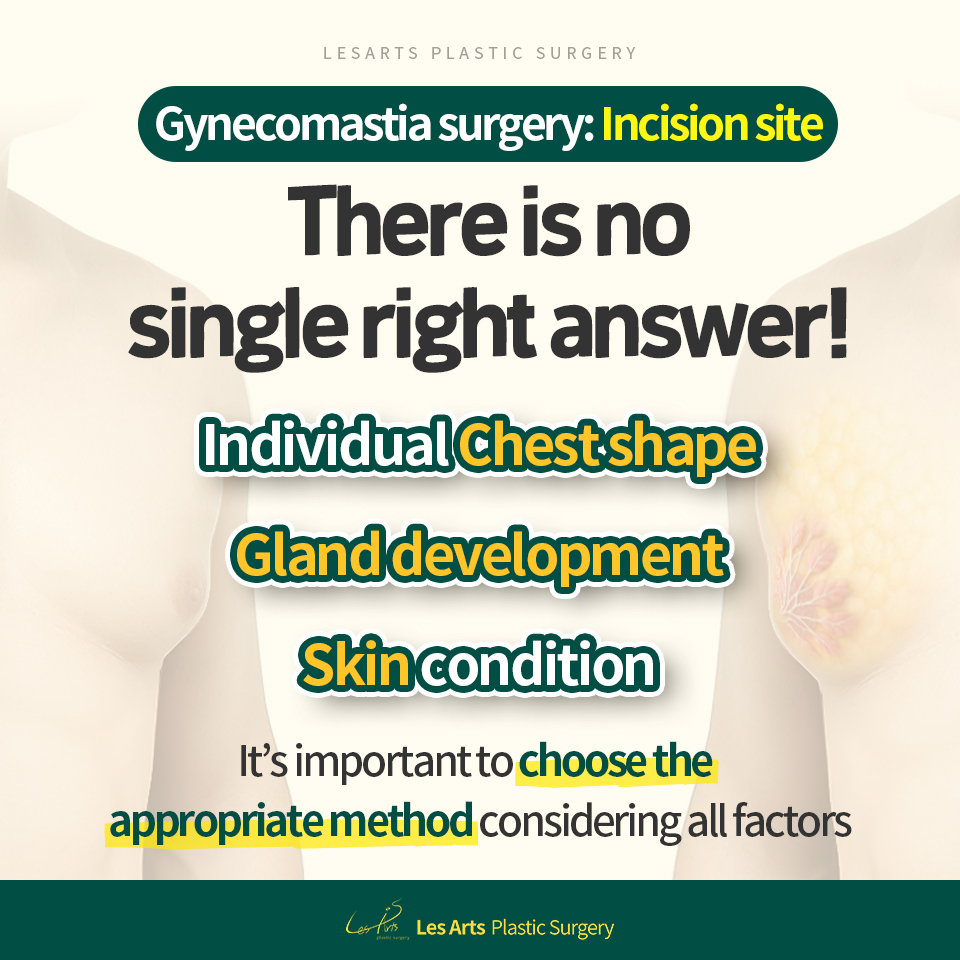
[Is Periareolar Incision Always Superior to Transaxillary Incision?]
It cannot be generalized that one approach—periareolar or transaxillary—is
universally superior for every patient.
Some patients prefer periareolar incisions to avoid scars in the axilla (armpit),
while others express reservations about marks around the nipple-areolar complex
and explore alternate access points.
However, scar location is not the sole deciding parameter.
The definitive incision plan must be formulated by accounting for
the distribution and volume of glandular hypertrophy, regional fat deposits,
the scope of liposuction, and the required tissue redraping techniques.
Moreover, incision strategies used in female aesthetic breast surgery
cannot be applied interchangeably to male gynecomastia surgery.
This is because the primary objectives, targeted tissue components,
and underlying male chest anatomy differ fundamentally.
Rather than choosing an incision method based solely on other individuals' experiences,
it is essential to receive a professional anatomical diagnosis tailored to your own chest structure.
If you are concerned about incision placement or scarring in gynecomastia surgery,
we recommend reviewing clinical recovery cases and consulting in detail
regarding the optimal surgical technique and minimal incision scope for your unique anatomy.
Gynecomastia Periareolar Incision FAQ
1. Is a periareolar incision mandatory for gynecomastia surgery?
When true glandular tissue requires excision, direct surgical access is necessary.
While periareolar incision is the standard approach, alternative access points may be considered
depending on the extent of the gland and the comprehensive surgical plan.
2. How noticeable is the periareolar incision scar?
Placing the incision along the border between the pigmented areola and normal skin
allows it to blend naturally with surrounding tones through the camouflage effect.
However, scar maturation rate, thickness, and pigment recovery vary by individual.
3. Does a smaller periareolar incision always leave less scarring?
A smaller incision shortens scar length, but if it is excessively restricted,
adequate glandular visualization is compromised, and excessive edge tension during gland extraction
can traumatize tissue margins. The incision must balance visibility with safe resection.
4. Can areolar shape change after a periareolar incision?
If the incision is disproportionately long relative to areolar diameter,
or if scar contracture exerts uneven tension during healing,
areolar distortion can occur. Preoperative calibration of incision length and placement prevents this complication.
5. Can periareolar scars receive supplementary post-operative treatments?
Yes. If a scar remains erythematous or hypertrophic during recovery,
supplementary treatments such as scar lasers, silicone sheeting, or topical therapies can be initiated.
The appropriate timing and modality are determined following clinical evaluation of the incision site.
Dr. Kukhan Lee


Cases finding
similar to my profile
Customer Diagnostics


Select the surgery and
area you are interestedto see real
before andafter changes.


we
make you,
the art
Clinic hours
MON - FRI
10 am – 7pm
SAT
10 am – 4pm
Holiday
SUN, HOLIDAY
Location
Lesarts Moon Clinic Tower 4-5F, 40, Nonhyeon-ro 168-gil,
Gangnam-gu, Seoul, Republic of Korea

Medical institution name Lesarts Plastic Surgery
Address Lesarts Moon Clinic Tower 4-5F, 40, Nonhyeon-ro 168-gil, Gangnam-gu, Seoul, Republic of Korea
Representative Moon sung jun
